

🌸 ikigai 生き甲斐 is a reason for being, your purpose in life - from the Japanese iki 生き meaning life and gai 甲斐 meaning worth 🌸
I’ve been re-reading my old essays this week. Having a proper ‘please tell me I wasn’t being a complete wanker’ wobble.
When I started all this over two years ago, I think I thought I’d find a universal process that worked, and deliver you an ikigai map. Purpose solved, everyone happier.
Lovely plan.
Except now I’m scrolling through things I wrote with such conviction, and worrying... did I ever accidentally make someone feel small? Did I slip into “do it this way” when what I meant was “here’s an experiment that worked for me in my specific weird life”?
When you find something that helps you feel more alive, more aligned, that gives you an amazing reason to get up in the morning... it’s almost impossible not to want other people to try it.
I love you. I want good things for you. I want you to be happier and to wake up with purpose instead of dread.
It’s so bloody hard not to slip into giving advice when what I really want is to offer companionship. Solidarity even.
So yes, I apologise if I ever stray into preachy.
It’s because I care, and caring makes you want to fix things… wanting to fix things for people is it’s own kind of trap.
Advice is not authority.
No-one else can realistically hand you perfect answers to a life that only you lives.
Not me, even with carefully curated ikigai frameworks and essays full of desire for you to feel less stuck… but when *any* of us are overwhelmed, when tired or scared we feel like we do want someone to just tell us what to do.
The certainty trap
The wanting is real. Your nervous system is literally screaming for certainty.
Certainty feels like being held. Like relief, that you can finally exhale because someone else is driving.
Scripts can be soothing until you realise they encourage performing a life that doesn’t exactly fit.
You still have to live in your body, with your specific constellation of fears and resources and histories and capacities. You still have to wake up tomorrow in your actual life.
It’s understandable given the chaotic nature of our world right now to want an easier life, for an adultier adult to come along and sort it all out for us… but I’ve learned that the slightly more difficult sounding thing ends up being better for us in the long run most of the time.
Certainty calms you. Agency changes you.
You can borrow language.
You can borrow perspective.
You can borrow frameworks and prompts and the occasional life-saving “oh thank god it’s not just me”.
But you can’t borrow the part where you choose.
That part is yours.
Which is annoying, and also liberating, because if advice is not authority... then you’re allowed to stop treating it like it is.
When help becomes another bruise
Here’s where I lose the cynics… because I could write a hot take about predatory self-help and grift and manipulation. I could stir up righteous anger about people selling certainty to the desperate.
And yeah, some of that exists. Because, capitalism baby.
Call me hopelessly optimistic but I genuinely believe that most people offering advice are trying to be useful… or at the very least started out with that intention.
Those that have been through something tough learned something and want their hard thing to mean something for someone else. They’re trying to offer a hand up rather than exploit.
The trouble is that sincerity doesn’t automatically prevent harm.
Sometimes the harm comes from certainty, not malice.
A genuinely kind person can still take what worked for them, turn it into a universal rule… forget that their nervous system, finances, support network, health, timing and capacity are not yours and package it all up in a tone that implies “if you don’t do this, you’re choosing suffering”.
If you’ve felt small enough times, cynicism starts to look like wisdom.
A lot of people who could genuinely use support are also the people most wary of it.
Because they’ve been through the loop of > “This will change everything” (tries the thing) > “It didn’t work? Maybe you didn’t want it enough”
At some point, cynicism becomes self-protection. A way of saying I will not be disappointed again. I will not hand over my power to someone who doesn’t have to live my consequences.
So yes, there are predators. But there are also bruised people on both sides… givers and seekers, helpers and helped, all trying to make sense of pain, all trying to find a way through without getting played.
We need a better culture of help.
One where guidance strengthens agency rather than replacing it… where the goal is to help you become someone who can choose, not someone who follows.
What good help sounds like
I’ve been thinking about this a lot (and look, therapists and psychologists have been saying versions of this forever… Rogers built his entire approach on the idea that people are their own best authorities. Self-determination theory shows us that autonomy is a basic psychological need, not a luxury… so I’m not claiming to have invented anything here).
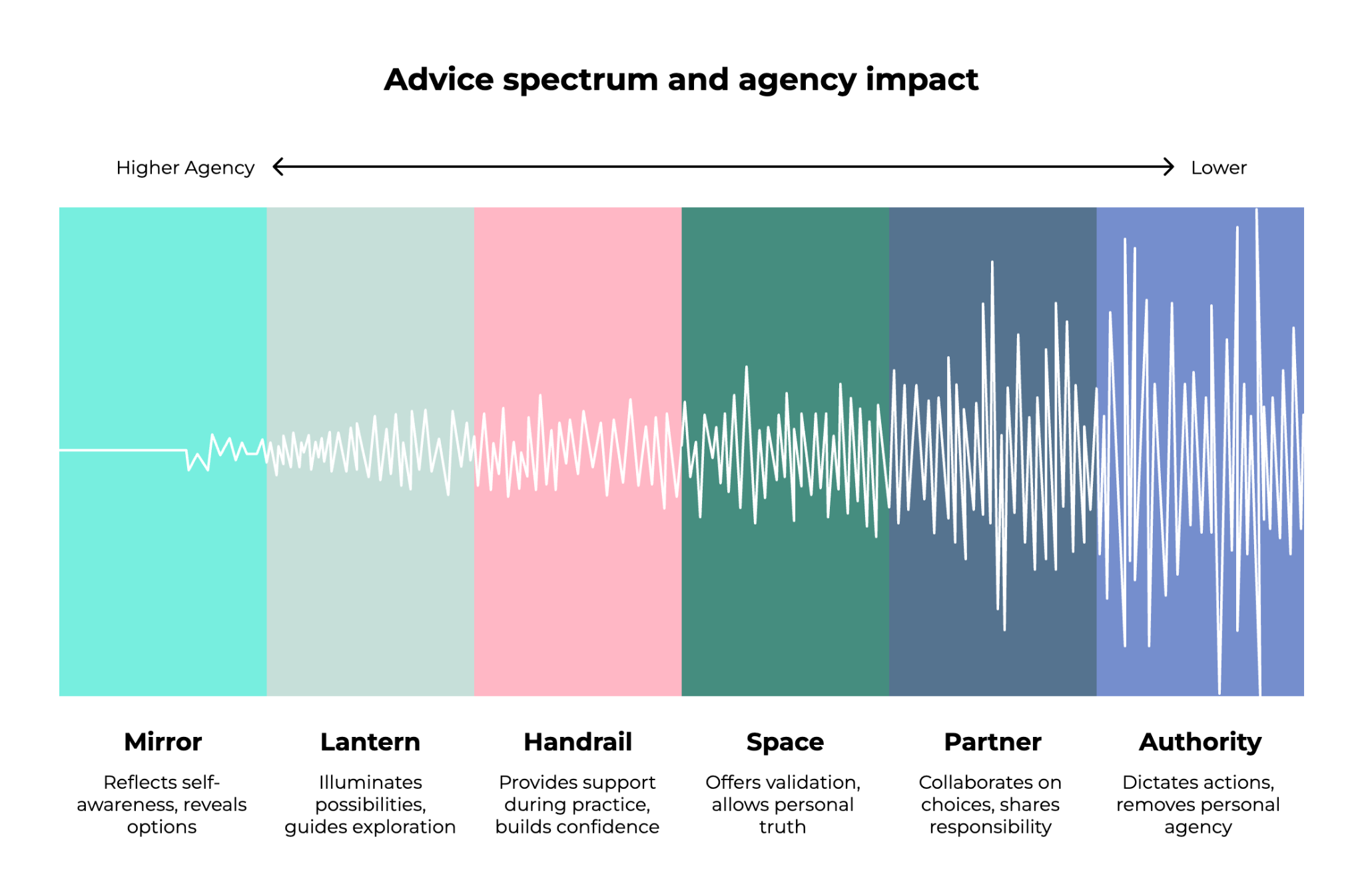
At its best, help is;
🌸 a mirror that helps you see yourself more clearly
🌸 a lantern that lights up options you didn’t notice
🌸 a handrail while you practise walking your own path
🌸 a space where your truth doesn’t get argued with
Good help sounds like;
“Here are a few options I can see”
“Here’s what each one might cost you”
“Here are questions that will reveal what matters to you”
“Try a small experiment rather than a forever choice”
“I can’t choose for you, but I can stand with you while you choose”
Bad help sounds like;
“This always works”
“If it didn’t work, it’s your fault”
“Act now or you’ll miss your chance”
“Only I understand you”
“Do exactly what I did”
The key difference is power, you want help that returns power to you rather than the bad kind which you know deep down takes it away from you.
How I cut down on outsourcing my life to gurus
When I catch myself researching (ahem, scrolling for answers) for too long, I try to pause and ask myself what do I actually want here? What’s really in the way of me doing something?
If it keeps happening then I write about that in my journal and think about what a tiny experiment could look like. Not “change my life” scale, or even a commitment. Just something that could lead to some evidence. Evidence is kinder than pressure and lets you learn what’s true for you without demanding you get it right first time.
I track how it feels in my body. Energy. Alignment. Resentment. Ease. What got easier and what got harder.
That’s how you become the authority again, by learning what’s true for you!
I talk about journalling a lot, but AI can also be brilliant at expanding the space of options for you. Clearly it could be even worse than the worst human guru, as it can never live the consequences. So I use it like a thinking partner, not a decision-maker. I want AI to help me see more clearly, ask better questions, hold complexity... but I don’t want it to choose for me.
Choosing (and doing) is the thing that changes you.
Then I usually take the output back to paper. Because paper is where my nervous system can catch up to my brain, where the choosing becomes embodied rather than just conceptual.
The point is I treat self help content like a library, not a parent. To take what’s useful and leave the rest without guilt or pressure.
The journey is the way
Ikigai often gets talked about like a treasure hunt in the Western world. Like there’s one perfect answer hidden somewhere and if you just search hard enough, hire the right coach, read the right book... it will appear.
I’m increasingly convinced it works differently.
Purpose is chosen, then practised into truth.
Not found.
Not bestowed.
Not confirmed by someone on a moodily lit podcast.
Chosen.
Then proved through small acts repeated until they feel like you.
And if that sounds scary... it’s because it is at times, but it’s also the point.
When we stop treating advice as authority, we can find in it the real help we need along the way… support, not orders. Companionship while we choose and a mirror that helps us see our own answers.
For the part of you, me and all of us, that wants someone to just tell us what to do;
- It’s ok to want guidance.
- You’re allowed to need reassurance.
- It’s sensible to watch someone else go first and tell you what happens.
And you’re also allowed to be the chooser.
Even if you choose imperfectly, slowly or in a way that makes no sense to people who aren’t living inside your life.
Even if you have to keep choosing the same thing over and over because you keep forgetting and falling back into old patterns (just me? probably not just me).
Advice is not authority.
But you are.
And I’m here seeking alongside you. Sharing ideas and experiments, not certainty. Offering companionship in the choosing.
The choosing is where the living happens.
What decision are you currently trying to outsource to “more research”? I’d genuinely love to hear in the comments, or just click the heart if you’re feeling shy. Connection matters so very much.
Sarah, seeking ikigai xxx
PS – ✍️ Bullet journal prompts and spread ideas
The Wish / Obstacle / Choice page
When I’m overwhelmed by advice, this is what I try in my journal:
Wish: What do I actually want? (not what I should want)
Obstacle: What’s genuinely in the way? (be honest, be specific, no performing)
Choice: What’s the smallest action that would generate evidence?
Evidence: What will I track for 14 days?
Tracking spread: Reality, not performance, track just one or two of these;
Energy (1–5)
Sense of alignment (1–5)
Resentment (1–5)
Ease (1–5)
One sentence: “Today I learned...”
At the end, ask: What did reality teach me?
The Advice Audit
“What advice have I collected but not practised?”
“What am I hoping it will save me from?”
“What would ‘good enough’ look like for the next two weeks?”
The Authority Return Ritual
“What do I already know but keep ignoring?”
“What would I choose if nobody got an opinion?”
“What would future me thank me for trying?”
PPS – 🤖 AI prompt to try
“Here’s my situation: [describe it]. Give me 5 options. For each option, list: what it would actually require from me, what I’d be giving up, what the trade-offs are, and one small 14-day experiment to test whether this option is right for me. End with questions that help me decide based on my values, not my fear.”
PPPS – 🎶 Song choice
Everybody’s Free (To Wear Sunscreen) — Baz Luhrmann
“Be careful whose advice you buy, but be patient with those who supply it”... advice given with love and humour and the acknowledgment that you’ll ignore most of it anyway *grin*
Thank you Sarah for this lovely post. It has really help me reflect on my current dilemma, which I have perhaps been over-researching and unwilling to take further action on: to what extent is my substack 'just' a side project...