


🌸 ikigai 生き甲斐 is a reason for being, your purpose in life - from the Japanese iki 生き meaning life and gai 甲斐 meaning worth 🌸
My new 2026 bullet journal has a blank space where my word of the year should be.
Last year I chose “easy”, thinking if I declared it the universe would comply. It did not. Life delivered a whole heap of things that were decidedly not easy. Which left me wondering if I’d accidentally manifested the opposite, or if I hadn’t taken the process seriously enough.
So this year I’m approaching it differently. Taking my time. Listening to other voices. Paying attention to feelings rather than just word meanings.
I love Florence Given talking about audacity and giving permission to be too much, to piss off insecure people by simply existing unapologetically. I felt a visceral recognition but something about claiming “audacity” as my word felt incomplete, like I’d be performing boldness rather than living it.
I do want that feeling of pushing through discomfort to move towards audacity though. Not avoiding the discomfort or pretending it’s not there but recognising it as directional, as information about where growth lives.
I want to take up space unapologetically and spread positivity whilst doing so. Given that I fully agree with Rutger Bregman that we need a moral revolution, as a minimum I need to always push through fear to SPEAK UP. I want to acknowledge that it’s bloody uncomfortable sometimes. That my body still wants to do the nervous laugh and disappear. That courage isn’t the absence of that feeling, it’s what you do alongside it.
“Audacity” alone felt like it skipped over all of that. Like I was supposed to arrive fully formed, confident and bold, without acknowledging the reality of me and my wobbles.
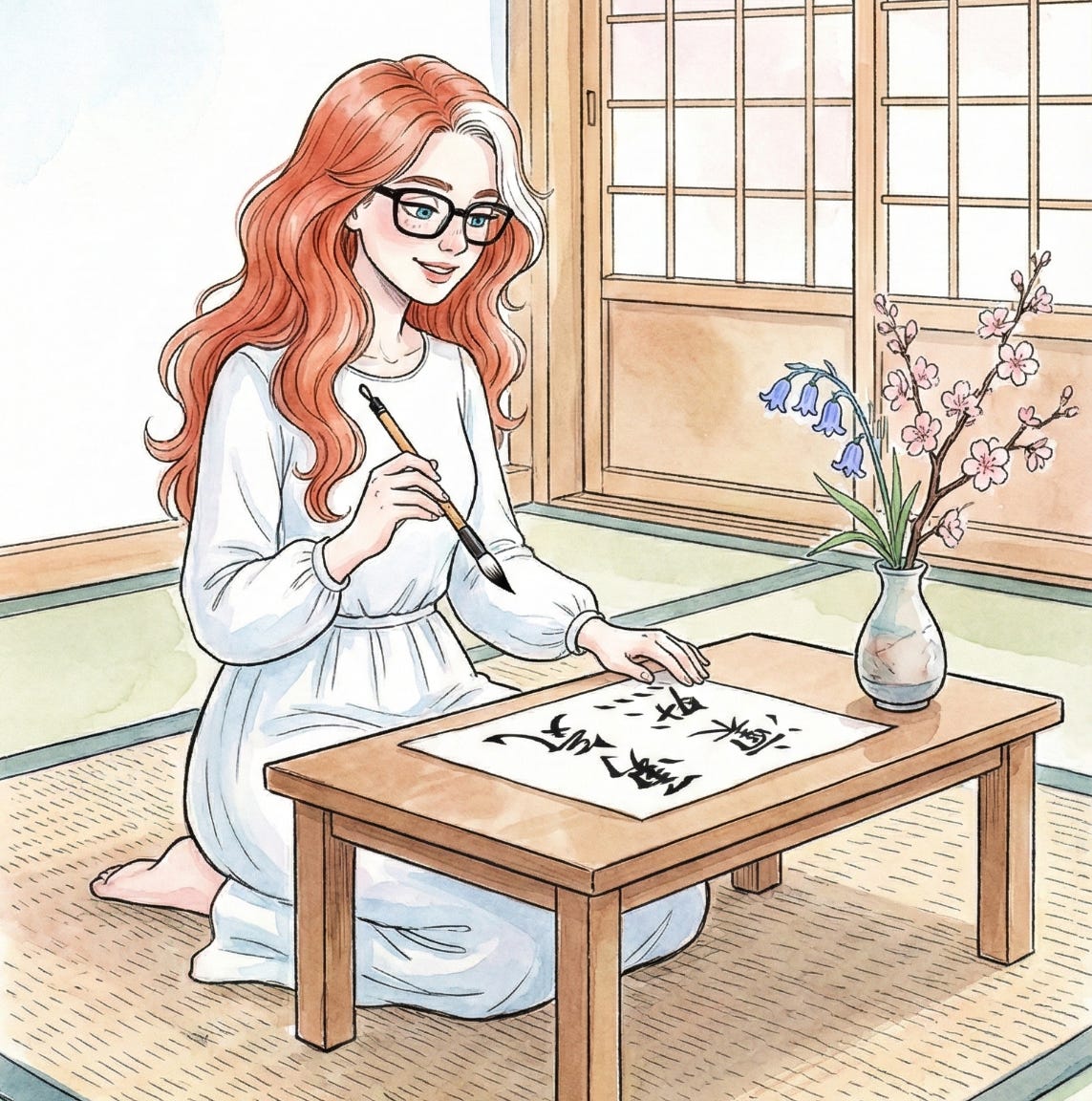
Then I read a gorgeous post by Dr Miki from Japan on kakizome, the Japanese ritual of writing your first calligraphy of the year, words that represent your aspirations. When I shared what I was circling around, pushing through discomfort to take up more space unapologetically, speaking up whilst spreading positivity, she said to me “I think it’s a wonderful and powerful theme! For that feeling, I would recommend 勇気凛然. It describes standing with courage and a calm, dignified strength. It’s close to the idea of having the courage to speak up and carrying yourself with a strong, grounded presence.”
Google Gemini expanded on this for me;
勇気凛然 (yūki rinzen) is a Japanese four-character idiom (yojijukugo) that describes a specific type of attitude. It generally translates to “overflowing with courage and dignity” or “dauntless and awe-inspiring.”
勇気 (Yūki): This is the word for courage or bravery.
凛然 (Rinzen): This describes an atmosphere that is awe-inspiring, commanding, or dignified. The character Rin (凛) implies a sharpness or coldness (like a bracing cold wind) that creates a sense of tension and respect.
When you put them together, it doesn’t just mean someone is not afraid. It means they face adversity with a commanding presence.
Not perfect, but definitely something spoke to me in ‘dauntless’ and ‘commanding’... in coupling courage with dignity… and it made me reflect on the different dimensions of definition and why some words feel so close to right… that perhaps we ask too much of single words alone, certainly English ones.
So yes, I’m visualising and feeling a sense of pushing through a discomfort barrier, of not shrinking back when something matters, of taking up space without apologising for existing. I’ve spent too much of my life unconsciously adhering to societal rules that don’t really serve me.
When something feels uncomfortable in a clean way, not danger, but growth, that’s information about where I need to go.
So when I sit with “audacity,” it does feel uncomfortable. But is it the right kind of uncomfortable?
Audacity alone feels like it could tip into performance. Like I’d be proving something. Taking up space to show I can, rather than because there’s something there worth expressing. It has an edge of reaction to it, a response to all the times I’ve been told to be quieter, smaller, less.
勇気凛然 holds something else. It has the pushing-through-discomfort piece I need. The not-shrinking and the speaking-up piece. But it also has groundedness. Composure. A kind of strength that doesn’t need to shout.
I’m learning to trust the feeling underneath the word. To let language follow sensation, not force sensation into language.
Word-of-the-year practices can leave us choosing words that fracture us instead of ones that integrate us if we aren’t careful, this new to me Japanese ritual gave a sense of coherence I didn’t know I was looking for.
Your word or phrase could help you be more coherent
We choose aspirational words like confident, bold, authentic, present… and then we try to perform them, but perhaps we only needed to be more “confident” in a work context and striving to make changes in your home life exhausts you. Different versions of ourselves trying to live up to a slightly different interpretation of the same word.
The theme didn’t integrate us, it fractured us further.
Treating it like a resolution, something to become… rather than what it could be, a return to coherence.
Reintegration might be the most important thing I’ve learned about ikigai.
You don’t need to wear different masks. Work-you doesn’t have to be substantially different from home-you or friend-you or creative-you. You’re not code-switching your personality based on context, not putting on ill-fitting clothes depending on which room you’re entering.
When survival needs are met, becoming the youest you possible becomes the top priority. The energy you waste maintaining multiple versions of yourself is energy you could be using to actually live.
To feel joy. To help others. To be a positive force in this world.
If you follow this process then it should help with that integration, not hinder it.
Choose by feeling and test before you commit
When you’re considering words, don’t think about how impressive it sounds. Think about how your body responds to the idea of it. Does it feel like permission? Like coming home?
There’s this particular sensation when something is right. Not excitement exactly, though there might be some of that. It’s more like recognition. Oh yes, that.
Look out for discomfort that feels directional. The good kind of scary, that’s how you know it’s yours and not just borrowed confidence.
The words that almost fit for me sparked recognition but also performance anxiety. They made me think about how I’d look embodying them, which could be a fragmentation trap.
The words that I am trying on for size feel different. When I imagine practising them, I can also feel the discomfort of the growth asked of me… but looking for those that underneath discomfort have something solid. Something that doesn’t require an audience to validate it.
That’s the feeling to follow.
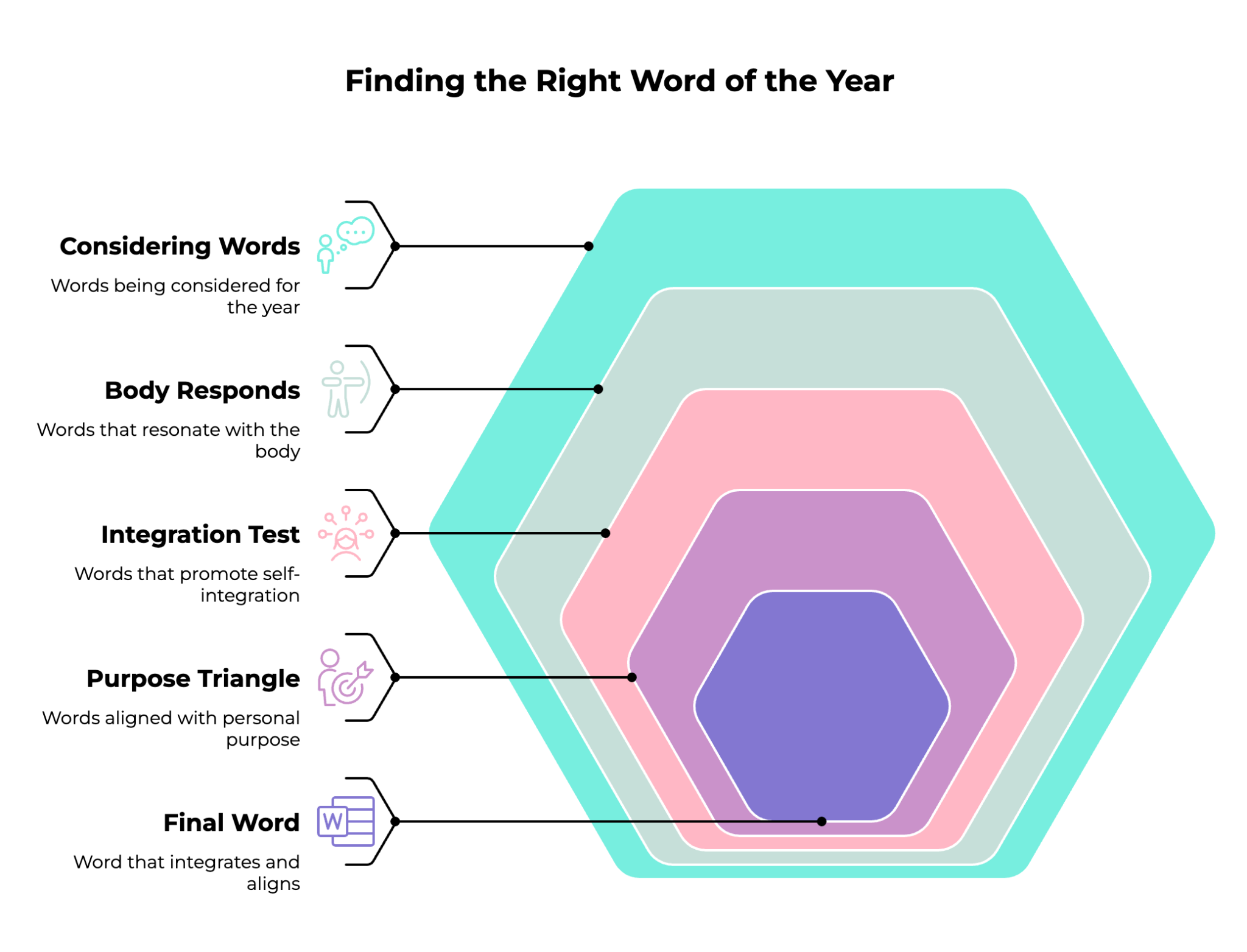
Once you have words that feel right, run them through these filters;
The Integration Test: Does this word ask me to become someone new, or does it invite me to stop fragmenting who I already am?
If your word means different things depending on your audience, it’s fractured. If it could show up the same way in the supermarket, in a difficult meeting, putting your child to bed, writing an essay, having a hard conversation, then you might be onto something.
Your word should feel uncomfortable in a directional way. If your word makes you anxious about performance, that’s fragmentation. If it makes you nervous because it matters and you’ll need to be brave, that’s integration. Learn to tell the difference.
The Purpose Triangle: Is this actually my word?
I wrote about this framework recently and three questions:
AGENCY - What can I actually influence? If your word requires other people to change first, it’s not yours.
ACCEPTANCE - What can I not change? If your word fights your actual reality… your energy, personality, circumstances… you’re choosing from where you wish you were, not where you are.
ALIGNMENT - What do I choose because it’s me? Borrowed words feel like relief when you’re done. Chosen words feel like energy that returns. After you practise this quality, do you feel more like yourself, or less?
If your word passes both tests, you’re probably onto something.
How to live it, not just declare it
The Japanese kakizome practice offers wisdom. You may write it once, at the beginning of the year, with intention. Deliberate. Grounded. Focused. But then that calligraphy should travel with you through the year, which is where regular reflective practice in a bullet journal can help *grin*
1. Leave space for not-knowing
The blank page in my journal? That’s the most honest thing I could do right now. Your word might emerge in February after you’ve lived into the year a bit. Maybe March. Not-yet-knowing is honest and braver than forcing it.
2. Choose for integration, not aspiration
Does this word ask me to perform or to cohere? Split me or unify me? Can I practise this the same way in every role I have?
3. Install it as infrastructure, not inspiration
A word fails when it’s just a vibe. It needs to become your operating system, defaults that protect meaning when you’re busy.
Create Integration Defaults. Simple if-then statements: If I feel the urge to do a nervous “hehe” and disappear, then I notice it, breathe, and say the true thing kindly instead.
4. Track fragmentation, not progress
Don’t track whether you’re “being more X.” Track where you catch yourself code-switching, performing different versions of yourself. Those moments are data about where integration is still needed.
5. Course-correct toward coherence
If your word starts feeling like costume, return to the integration question. Not “am I doing this enough?” but “am I doing this the same way everywhere?”
The blank space is actually fine
I still don’t have my final word.
I’m circling 勇気凛然, drawn to its strength and the serendipity of how it came to me. I’m playing with simpler English translations. I’m sitting with the feeling underneath all the words.
I know I’m looking for something that brings me back to myself rather than splitting me further apart. Something with both roots (infrastructure) and direction (purpose).
And maybe that’s what your theme of the year should be too, beautiful soul.
Not another aspirational mask to wear. Not another version of yourself to perform.
But a return to coherence. A practice of integration and calm, dignified strength that doesn’t change based on who’s watching.
After decades of fragmenting ourselves to fit different contexts, perhaps the most radical thing we could do in 2026 is just... be the same person everywhere. Become the YOUEST you, you can be.
Not perfect or without wobbles.
But coherent, honest and integrated.
I’d so love to hear your thoughts, what’s your theme or word of the year for 2026? Or if you’re still circling like me, what are the contenders?
Sarah, seeking ikigai xxx
PS - ✍️ Bullet Journal Spread: The Integration Audit
If you want to test whether a word-of-the-year practice would actually help you, try this:
Create a page titled “Where I Fragment” and draw a simple grid of your main life contexts (work, home, creative practice, friendships, public/social, etc).
Then honestly reflect;
Where do I perform confidence vs actually feel it?
Where do I code-switch my opinions, energy or personality?
Where am I still wearing masks even with people I trust?
What would it feel like to show up the same way everywhere?
Don’t judge what emerges. Just notice. The gaps between your different selves are where a good word-of-the-year could actually help.
PPS - 🤖 AI Exercise: Is This Actually Your Word?
If you have words in mind, test them with Claude or ChatGPT;
“I’m testing potential words for my year ahead. I need you to help me figure out if these are truly integrating words or if I’m accidentally choosing something that will fragment me.
The words I’m considering are: [list 2-5 words]
Here’s my context;
These are the main areas of my life where I sometimes show up differently: [work, home, creative practice, relationships etc & describe specific ways you fragment]
Here’s what I genuinely value: [core values]
Here’s what I’m actually good at that helps others: [your strengths]
For each word, I need you to:
1. Play devil’s advocate - where might this word ask me to perform rather than integrate? Where could it fracture me?
2. Test it against reality - does this work with who I am or does it require me to be someone I’m not? Where would this quality land in the real world? What would it actually do beyond making me feel differently about myself?
3. Make it practical - what’s one simple if-then default that would help me install this as infrastructure?
After each analysis, tell me honestly: does this word integrate or fragment me?”
PPPS - 🎶 Soundtrack for Finding Your Word
“This Year’s Love” by David Gray, that opening line “This year’s love had better last, heaven knows it’s high time” captures exactly what we’re after here. Tired of words that don’t stick, resolutions that fade by February, themes that fragment rather than integrate. This time, we want something that actually lasts. And when he sings “when you hold me like you do, it feels so right” that’s the recognition feeling. When your word fits, when it asks you to cohere rather than perform, when it feels like coming home instead of trying on someone else’s costume. That’s how you know you’ve got it.
Beautiful post. This practice is new to me, and sounds like it could offer new insights. I'll be thinking about my word!
Love this practice Sarah. I also wonder if we could pick words from outside of English as well. I often find that my mother tongue lacks the nuance of grace of other languages...