


🌸 ikigai 生き甲斐 is a reason for being, your purpose in life - from the Japanese iki 生き meaning life and gai 甲斐 meaning worth 🌸
Last week I fluffed the Konami code at our fabulous monthly Geeks Quiz, to my shame.
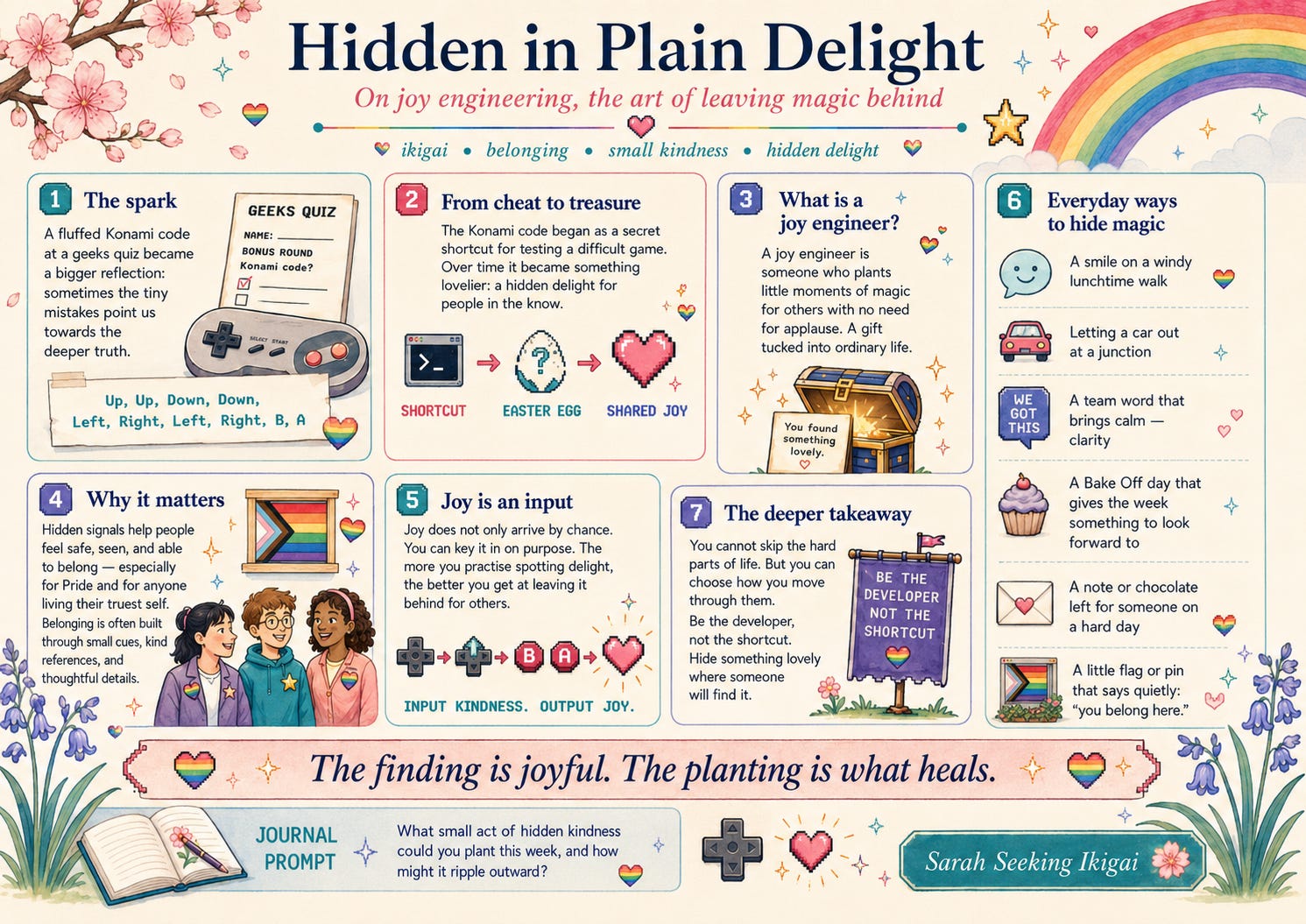
It’s a proper pen-and-paper old school quiz, you scribble your answers down and when the round is over you swap sheets with the next table to mark each other’s. The question came up and a little firework went off in my chest, because this one was mine. Up, up, down, down, left, right, left, right... and then when our lovely quiz master Chris read out the answers over the mic I realised I’d only gone and got B and A the wrong way round.
I was *so* gutted and more than a tad cross with myself for messing up… I am a self-certified gamer geek and that code should live in my bones, and there I was getting it backwards in a room full of fellow nerds. Which goes to show, that anyone can trip up even over the things they know best, when under pressure. You have to laugh or else you might spiral… and losing it over a quiz result would perhaps not be the best use of our one short and precious life. None of us get out of here alive, so I’d rather be able to laugh at my own daft mistakes than take it all too terribly seriously (though I do run a huge risk of my uber competitive husband disowning me over sharing this publicly *grin*).
My rambly thought train this week has been about what the code reminded me of though, and how much I bloody love an easter egg.
From cheat to treasure
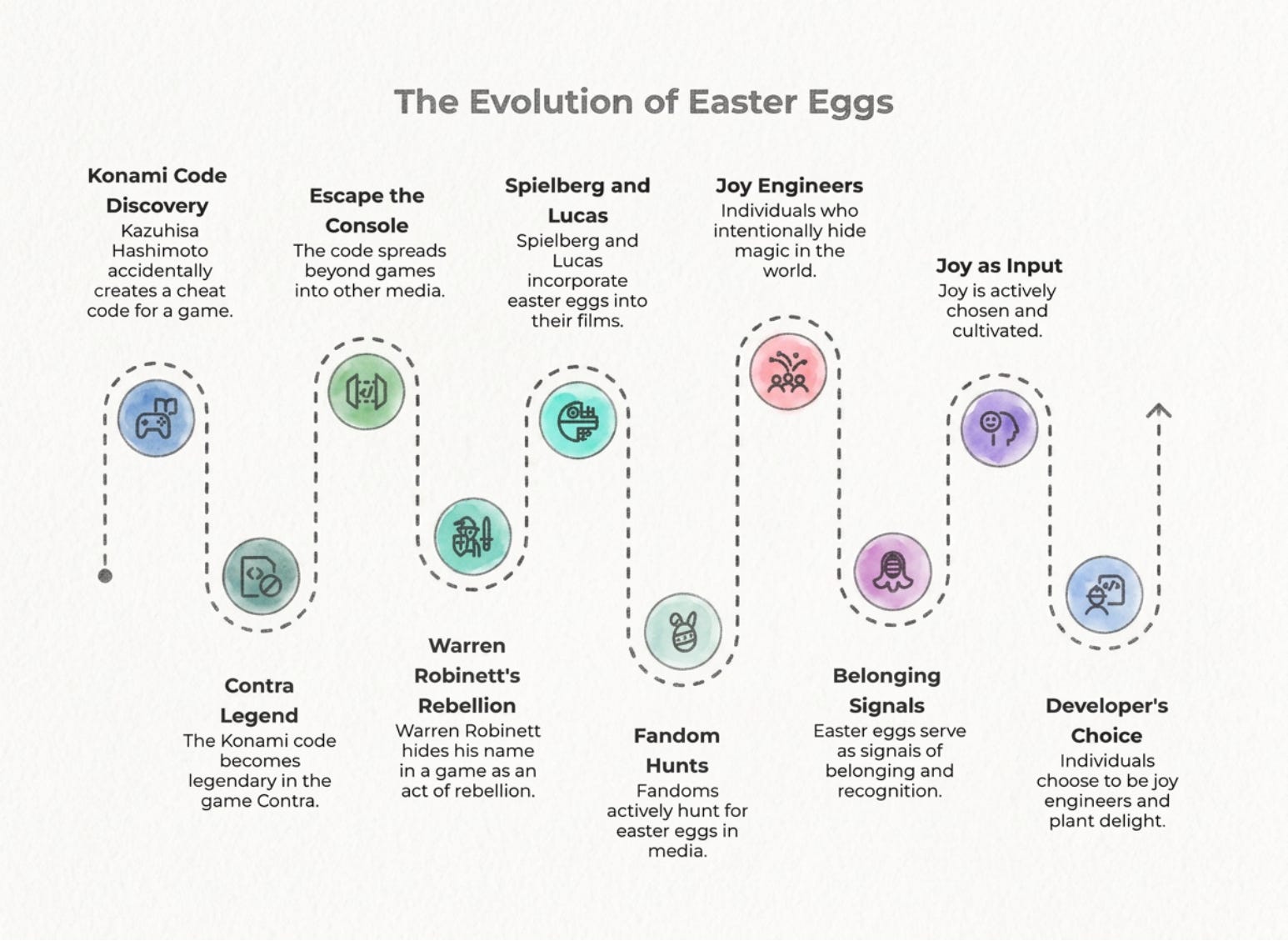
If you’ve never met it, the Konami code is ten button presses. Up, up, down, down, left, right, left, right, B, A. It was born as a cheat. A developer called Kazuhisa Hashimoto was porting an arcade shoot-em-up to the NES home console back in the eighties, found the wretched thing far too hard to test over and over, and built himself a secret shortcut to hand him all the power-ups at once. He left it in by accident. Players found it and it spread from there. An early example in a game called Contra became the stuff of legend, thirty extra lives for anyone who entered the sequence.
It began as a way to skip the hard part. Once you know of a shortcut it’s hard to resist that same reflex, the pull to let the machine play the level for us the second things get tricky… which does make me think about what we lose when we stop struggling through to the other side, and what risks there are for our young ones if nobody helps them sit with hard stuff for long enough… but I’ll save that thread for another day, this one is about the magic.
Because the code didn’t stay a cheat. It escaped the console and multiplied. It also turned up in films and TV shows and websites and far flung corners of the internet, and it for sure stopped being a shortcut and became something very lovely indeed… a secret handshake, a little hidden delight, tucked away for whoever knows where to look. Same ten button presses with a completely different purpose.
The joy engineers
That hidden delight concept is now called an easter egg, and the first famous one was an act of rebellion. Around 1980 a programmer called Warren Robinett was building a game for Atari, a company that flatly refused to print its developers’ names on anything they made. So he smuggled himself in. He buried a secret room inside the game, reachable only by carrying a single pixel to exactly the right spot, and there he signed his name in glowing letters. A signature stowed away inside the cartridge, waiting years for anyone curious enough to find it.
The idea caught on and has never stopped. Steven Spielberg let E.T. recognise a child out trick-or-treating in a Yoda costume, and years later George Lucas returned the wink by sliding E.T.’s own species into the Star Wars senate. A TARDIS turned up in Star Trek Strange New Worlds recently, there just long enough for the sharp-eyed to gasp (though I’m not ready to talk about the recent Doctor Who news as I’m more than a little gutted)… All of it hidden in plain sight waiting for those who are looking closely enough. Whole fandoms now hunt for these things for sport, cataloguing every blink-and-you’ll-miss-it nod, and I love that about my people.
Nobody is paid extra to do this. Somebody decided that a stranger’s jolt of joy was worth the additional hours, and built a little gift into the work for a person they would never meet. That is a joy engineer. Someone who looks at an ordinary thing and thinks, I’ll hide a bit of magic in here, just so a few people get the thrill of finding it.
Finding your people
Every easter egg since carries a version of that same message. It says I was here and I was thinking of you. It says if you get this, you’re one of us. The in-joke that makes you grin because it was so clearly left for your eyes. The reference only your people catch. That little jolt of recognition is how we find one another, and finding one another is how we work out where it’s safe to take the mask off.
Long before developers were burying pixels in code, these kinds of hidden signals were a matter of real-world survival. History is full of these real-life easter eggs… a green carnation, a specific turn of phrase, secret languages built entirely to ask without asking Are you like me? Is it safe here? I’m writing this in Pride month, and it would be remiss of me not to nod to that. For anyone who has to hide parts of themselves away just to get through the day, the coded signal is everything. The flag in the window. The pin on the lapel. The little tell that says you can breathe out here, you belong, you can bring the whole of yourself. Belonging gets built in exactly these small hidden signals, and belonging means safe environments that let people be themselves, to get to feel magic and joy.
Joy is an input
You key joy in on purpose, the same deliberate way you would punch in the code. Joy rarely arrives gift-wrapped while you wait around for the world to improve of its own accord. You choose it, you enter it, up up down down and a wonderful thought is that it’s a skill. Press it often enough and your eye gets trained to spot the hidden delights everywhere, and your hands get quicker at planting them for other people. Nobody is born knowing where the easter eggs are. You learn. You practise and you get better. Joy engineering, you could call it.
Let me show you the ones I’m addicted to being the daft optimist I am.
There’s my lunchtime stomp. Whether it’s a calm day or there’s a proper gale blowing in off the Irish Sea, I get out and I walk rain or shine, grinning like an absolute loon the whole way. The magic in that is as you approach someone coming the other way who looks a little weighed down, off somewhere sad in their own head, and you catch their eye and smile with your whole face, and most of the time they simply cannot help smiling back. For half a second something might lift in them. I get to walk on hoping I topped their tank up just enough that they pass it to the next person, and they to the next. You never see where it ends and that is rather the point.
You’ll know the same thing from the road. You let a car out at a junction, the smallest thing, and ten minutes later you watch that same driver wave somebody else out further down the way. One little input, a ripple you never get to follow to its edge.
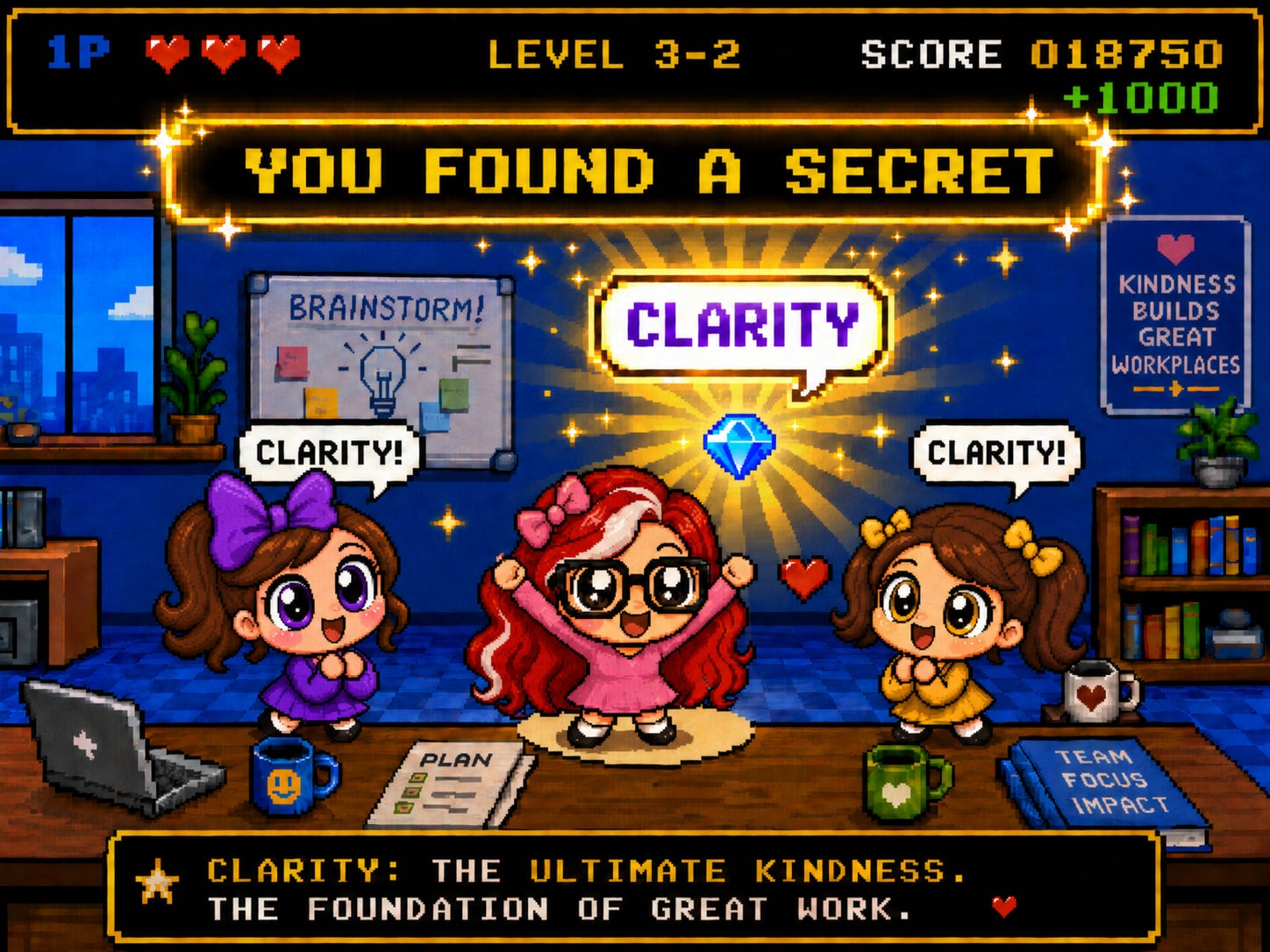
Some easter eggs you can build into a team. We have a word in our corner of the office now that makes us smile and has become a beacon, clarity. When one of us says it, it feels like a hand on the shoulder, because behind it sits a pledge we made each other to try and strip away the noise and the panic and get back to whatever actually matters. One word, and you can watch shoulders drop around the table. An easter egg you can say out loud.
Some you bake into the calendar. A Bake Off day at work, where the spreadsheet can wait a few minutes because someone’s brought a showstopper and we’re all going to grab a coffee and savour it. Things that can give the week a little hook to hang your hope on, things you get to look forward to.
And some you simply hide for one particular person. A note slipped into a bag where they’ll find it on a hard afternoon. A chocolate bar left on a stressed desk. The good games always slip something lovely onto the loading screen, a small reward for the waiting, and you can do the very same with a kettle coming to the boil or a queue that won’t move or a meeting that hasn’t kicked off yet. A little game built to lift the mundane or tedious.
Be the developer
You can’t skip the hard parts of being alive. The grief and the bad news and the grey weeks still come, and joy is no cheat code for getting past them. As I get older I realise that the hard parts are needed really to ever learn something or appreciate when you have it good.
What you do get to choose is how you interact with the glorious game of life. You can grab for a shortcut with the risk it leaves you a touch hollower for it. Or you can be a developer. The joy engineer who buries a little delight in the world, for no reward at all, knowing some stranger will trip over it on a day they badly needed it and feel, for one second, that somebody out there had them in mind.
And that planting is an antidote to pain. The finding is a joy all of its own of course... but the planting is the part that really can heal. Because the surest way I know to feel less alone in a hard world is to spend my day trying to help others, and hiding small proof that the world can still be kind, then trusting it to ripple out somewhere I’ll never get to see, is *such* a joyous thing to be a part of.
So. Up, up, down, down. Get the B and the A the right way round if you can, and have a proper belly laugh when you don’t. Then go and hide something lovely where someone will find it.
Player One, you’re up.
Who is the best “joy engineer” in your life or workplace? What little magic do they do that makes everyone’s day better? Shout them out in the comments!
Sarah, seeking ikigai xxx
PS - A prompt to explore in your journal. Cast your mind back, what easter egg did someone once hide for you, a kindness or a small magic you only clocked later, after they’d gone? Sit a while with how it felt to be thought of like that. Then write down one you could hide this week, and describe how you think the person will react in detail.
PPS - An experiment for your favourite image AI, built to be shared - paste it in and fill in the blanks;
Create a retro 8-bit video game screen in the style of a 1980s console, the moment a player discovers a hidden easter egg. Player 1 name is [NAME]. The scene celebrates [a small kindness or moment of joy from my week, in a few words], drawn in cheerful pixel art with a glowing banner that reads YOU FOUND A SECRET, a sparkle of light, a tiny pixel heart and a retro score counter ticking up in the corner. Use [platform / URL] to understand their public voice, visual brand, colours, themes and personality to inform a scene and style that belongs in their universe.
PPPS - This week’s soundtrack choice is The Rainbow Connection, the Tori Kelly version with Kermit the Frog, from The Wonderful World of Disney at Disneyland. Yes, a felt amphibian on banjo, a song for the dreamers and the believers, who insist there’s some wonder waiting just up ahead. You decide the rainbow means something, you keep your eyes peeled for it on the wet walk home, and the others who believe it too find their way to you.
"Nobody is paid extra to do this. Somebody decided that a stranger's jolt of joy was worth the additional hours."
Sarah this is beaut - one of the warmest pieces of writing I've come across in ages!
“Joy engineer” is such a lovely phrase.
It makes kindness feel less like a vague virtue and more like something you can actually build into the day — a smile, a word, a tiny hidden lever that makes the whole machine less grim.
Also, getting B and A the wrong way round is painfully human. Possibly the most authentic gamer confession available.