


🌸 ikigai 生き甲斐 is a reason for being, your purpose in life - from the Japanese iki 生き meaning life and gai 甲斐 meaning worth 🌸
I’ve apologised for being sick. For needing the loo during meetings. For having a question. For going to a medical appointment. For not replying to an email immediately. For declining an invitation without a “good enough” reason. For having feelings about things.
GenX women excel at apologies. Pre-emptive contrition for the basic crime of being a human existing in systems that weren’t designed with us in mind.
We’re brilliant at it. We can smile whilst grinding our teeth. We can “circle back” when we mean “absolutely not.” We can be “happy to help” when we’re drowning. We’ve turned the performance of fine into an art form.
Showing up fully human shouldn’t have to be brave… what if it was baseline?

The training we didn’t sign up for
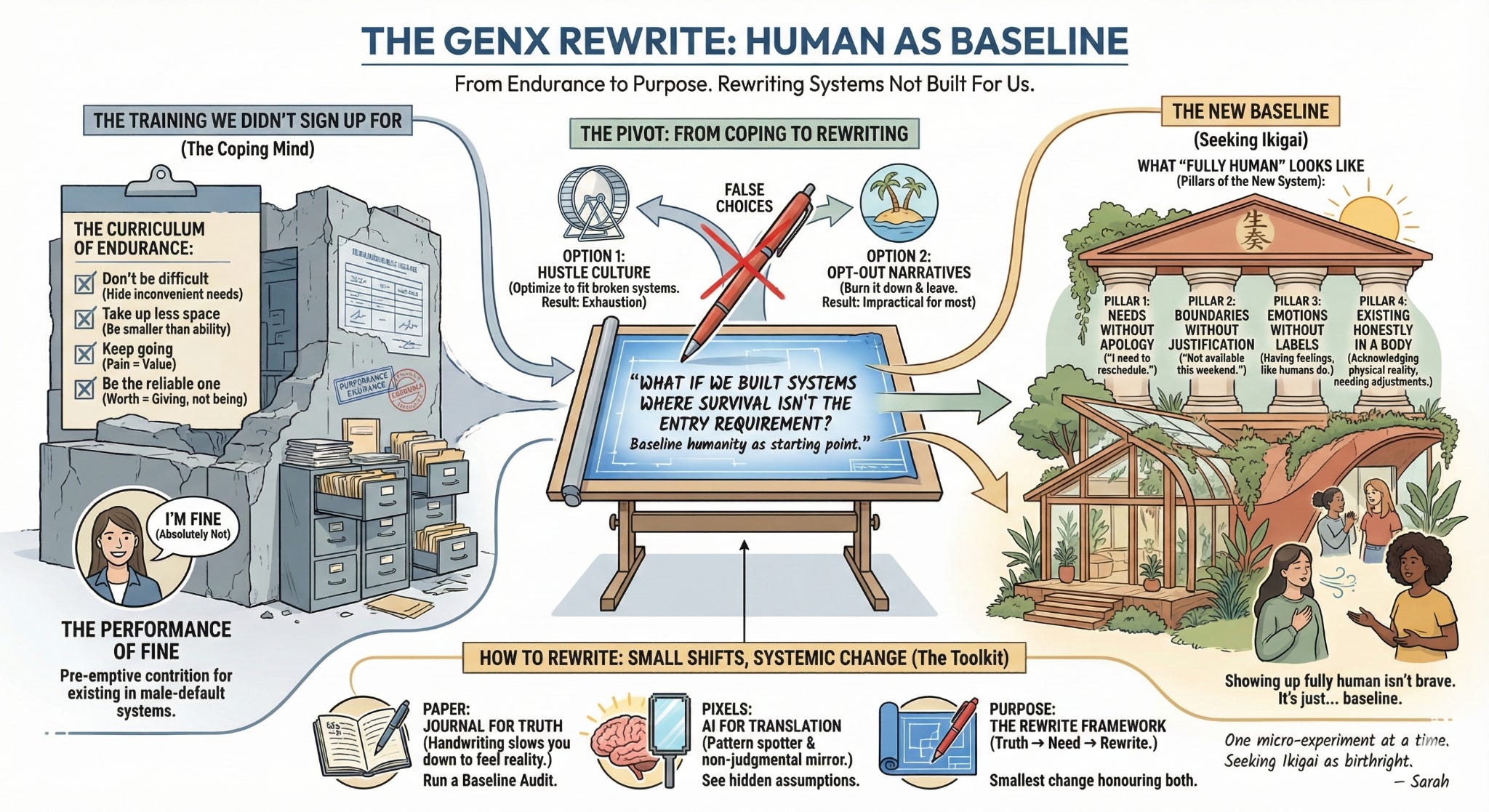
GenX women didn’t grow up learning the language of purpose… we got fluent in the language of coping mind… the curriculum was clear, even if nobody wrote it down;
Don’t be difficult. (Translation: Don’t have needs that inconvenience others)
Don’t take up space. (Translation: Make yourself smaller than your abilities)
Be grateful. (Translation: Whatever you have is more than you deserve)
Keep going. (Translation: Your resilience and pain threshold is your value)
Be the reliable one. (Translation: Your worth is measured in what you give, not what you are)
I learned these lessons watching mothers juggle work and home management. I learned them in school corridors where being clever meant being quiet about it. I learned them in GP surgeries where my pain was dismissed as anxiety. I learned them in workplaces where taking a lunch break was somehow... soft. I learned them every time I was told I was “lucky” to have a voice, a seat, an opportunity… ignoring the tiny voice in my head asking ‘shouldn’t it have been mine by right?’
And to be fair, that training got many of us through. It got us jobs, families, reputations. It got us labelled “strong” and “capable” and “the person we can count on.”
But survival is a terrible long-term strategy for living a joyful life.
By becoming excellent at endurance, you forget what it feels like to not be enduring. You start to think that grinding through is the same as thriving. That powering through is the same as purpose. That being needed is the same as being seen.
It’s not.
The two paths that both feel wrong
When you start to wake up to this, there seem to be two main options being shouted at us;
Option 1: Hustle Culture - “If I just optimise myself hard enough, I’ll earn peace”
This is the one that says you need better morning routines, more productivity hacks, smarter time management, stronger boundaries (but make them empowering, obviously). It promises that if you just work on yourself enough, you’ll finally be worthy.
Except... we’ve been working on ourselves for decades. We’ve read the books, done the courses, implemented the systems. And we’re exhausted. Because optimising yourself to fit broken systems is still just... fitting broken systems.
Option 2: Opt-Out Narratives - “If you don’t like it leave/if I leave, I’ll be free.”
This is the one that says burn it all down, quit your job, move, start your own business, reject everything, live off-grid. It promises that if you just extract yourself from the machinery, you’ll finally breathe.
Except... most of us can’t actually do that. We have mortgages, dependents, responsibilities, communities we care about. And honestly? Some of us still believe systems can be better. We don’t want to abandon them, we want to fix them.
There’s a third way and it starts with a simple premise, rewrite.
Not just personally. Relationally, organisationally, culturally, systemically.
What if instead of optimising ourselves to survive hostile systems or leaving those systems entirely, we started building systems where survival isn’t the entry requirement? Where baseline humanity is the starting point, not the brave exception?
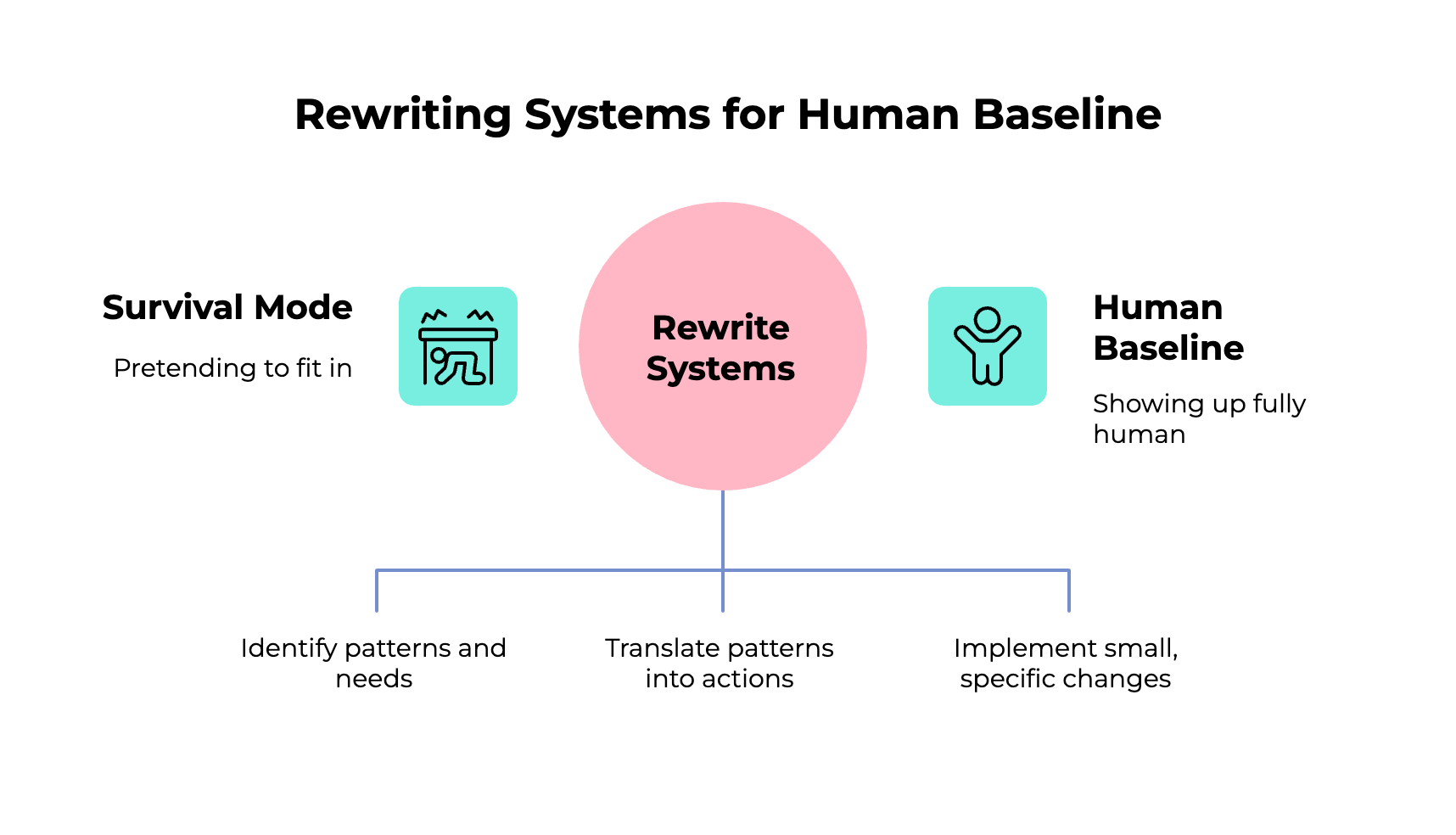
What does a human baseline look like?
I’ve been journaling about this for a while, trying to articulate what “baseline human” means in practice.
Having needs without apologising. Not “I’m so sorry but I need to reschedule because my child is sick” but “I need to reschedule.”
Having boundaries without a TED talk. Not a three-paragraph email explaining why you can’t work this weekend, complete with justifications and promises to make up for it. Merely “I’m not available this weekend.”
Having emotions without being labelled ‘too much’. Not performing calm whilst your insides are screaming. Not prefacing every strong feeling with “I might be being silly but...” Just... having feelings, like humans do.
Existing in a body honestly. Not pretending you don’t menstruate, or need glasses, or have a chronic condition, or get migraines, or need to eat at regular intervals, or need to get up and move more often, or require adjustments. Simply having a body.
When I write it out like that, it seems almost insultingly obvious.
And yet how many of us are doing any of this consistently? How many of us can say we’re showing up as full humans rather than carefully curated, needs-minimised, feelings-compressed versions of ourselves?
(Quick note: I’ve just joined a lovely new team at work who are genuinely supportive humans, so this isn’t about any one specific workplace or relationship. It’s about the water we’re all swimming in. The systems that shape us before we even notice they’re doing it.)
Why this matters more for some than others
Most of our systems aren’t neutral, they’re male by default.
Caroline Criado Perez nails it in Invisible Women “The default human being is a man.” From how cities are designed to how medical research is conducted to how workplace norms were written, the baseline assumption is male bodies, male life patterns, male needs.
Which means when systems claim to be “neutral” or “universal,” what they actually mean is “designed for men and everyone else can adapt or apologise for not fitting.”
Women spend enormous energy pretending to fit defaults that were never designed for us. Pretending we don’t need more frequent toilet breaks…Pretending temperature settings and meeting schedules and career progression timelines work for our bodies and lives.
Add any other marginalised identity on top of being a woman… being disabled, being neurodivergent, being a person of colour, being working class, being queer… and the energy cost can multiply exponentially.
This is why “just be yourself” is such hollow advice. The systems weren’t built for your self. They were built for a very specific self, and you’re not it.
So when I talk about making baseline human actually baseline? I’m not talking about everyone needing to work harder at being authentic. I’m talking about redesigning systems so that a wider range of humans can exist in them without performance, pretence or apology.
Small rewrites, system shifts
So how do we actually do this? How do we move from noticing we’re pretending to showing up human?
I’m a systems thinker, so I needed a framework to make this actionable. Something simple to remember but robust enough to help;
Truth → What’s actually happening (not what you’re pretending is fine)
Need → What a human requires (not what you think you’re allowed to require)
Rewrite → The smallest change that honours both
For example: Truth - I’m reading emails at 10pm and resenting it. Need - I need evenings work-free so I can rest. Rewrite - I turn off notifications after leaving the office. Not “I’ll try to check less” I just turn them off.
Small. Specific. Doable. Not “become a completely different person” who’s magically confident and boundaried but incrementally rewriting the scripts you’re running.
I also recommend a Baseline Audit, four questions you answer in your journal to surface where you’re performing and what needs to change. Then you can use AI as a pattern spotter, because you’re too close to see them clearly. AI can also help translate patterns into words you can use, how to set a boundary without apologising or being aggressive. (Questions and AI prompts in the PS sections below.)
The practice isn’t complicated… journal the truth, let AI show you the patterns, pick a tiny experiment to try this week. Notice what happens. Keep a log. Your bullet journal holds the truth. AI helps you see it. You decide what to do about it. Purpose + Paper + Pixels working together.
The world doesn’t end when you show up as human. Often people respect you more. Often they’re relieved because now they have permission to be human too.
Rewriting our systems
You can’t find your purpose whilst pretending to be someone else, or contorting to fit into systems that don’t serve humanity well.
Your ikigai doesn’t live in a version of you that’s optimised all the humanity out of herself. It lives in the actual you. The one with needs and boundaries and feelings and a body that does body things.
Growing our sense of meaning requires tools that help us stop performing;
Journal for truth - paper doesn’t judge, and handwriting slows you down enough to feel what you’re thinking
AI for translation - a mirror to help you see patterns
Regular practice for rewrites - because one conversation with yourself won’t undo decades of conditioning
This is the work. Not hustling harder or opting out. Rewriting. One baseline audit, one boundary script, one micro-experiment at a time.
When enough of us do this, we don’t just change our own lives. We change what’s normal and expected. We change what’s baseline.
We build systems where showing up fully human isn’t brave. It’s just... what we do.
GenX women were trained to survive systems not built for us and now we’re rewriting them.
We seek ikigai not as luxury. As birthright.
I’d love to hear your thoughts beautiful souls, what costs you the most energy to pretend? Drop a comment or just sit with the question yourself. Sometimes naming it is the first step to stopping it, knowing we’re not alone makes it easier.
Sarah, seeking ikigai xxx
PS: Here’s your Baseline Audit journal prompts to try;
What costs me energy to pretend?
Where am I performing apology or gratitude instead of expressing needs?
What do I keep ‘powering through’ that should be redesigned?
What would ‘fully human’ look like here?
Take a photo. Have a conversation with AI about what you notice and see what patterns emerge.
PPS: If you want to use AI to help here are some prompt ideas (copy and paste, adjust to your situation);
Pattern Finder: Here are my journal notes from a Baseline Audit. Identify the repeating pressures, the hidden assumptions I’m living under and the need underneath them. Then summarise in 5 bullet points in plain English.
Boundary Script: Write 5 versions of a message that sets this boundary: [insert your specific situation]. Constraints: kind, direct, no over-explaining, British English and it must sound human.
Micro-Experiment Designer: Suggest 5 tiny experiments I can run this week to move from ‘surviving’ to ‘baseline human, feeling able to bring my whole self’. Keep each experiment under 15 minutes and applicable to my life context: [describe your situation].
PPPS: The song that’s been playing on repeat whilst I write this is Alanis Morissette’s Hand In My Pocket. “I’m brave but I’m chickenshit, I’m sick but I’m pretty baby”, she captures the whole messy contradiction of being human. Of containing multitudes. Of not having to choose between strong and vulnerable, capable and needing support. We can be both. We ARE both. And that’s baseline human.
Love “the human baseline” We can all heed these lessons