


🌸 ikigai 生き甲斐 is a reason for being, your purpose in life, from the Japanese iki 生き meaning life and gai 甲斐 meaning worth 🌸
I took a couple of days leave this week and said it was because I needed to recharge. As though I am a laptop that needs to be plugged in for a day or so, to be at full availability by Monday.
I borrow the word bandwidth too, and capacity, and running on empty… I’ve said all of them many times without stopping to wonder why I use machine language more than I use natural language for such an important, underrated and misrepresented thing.
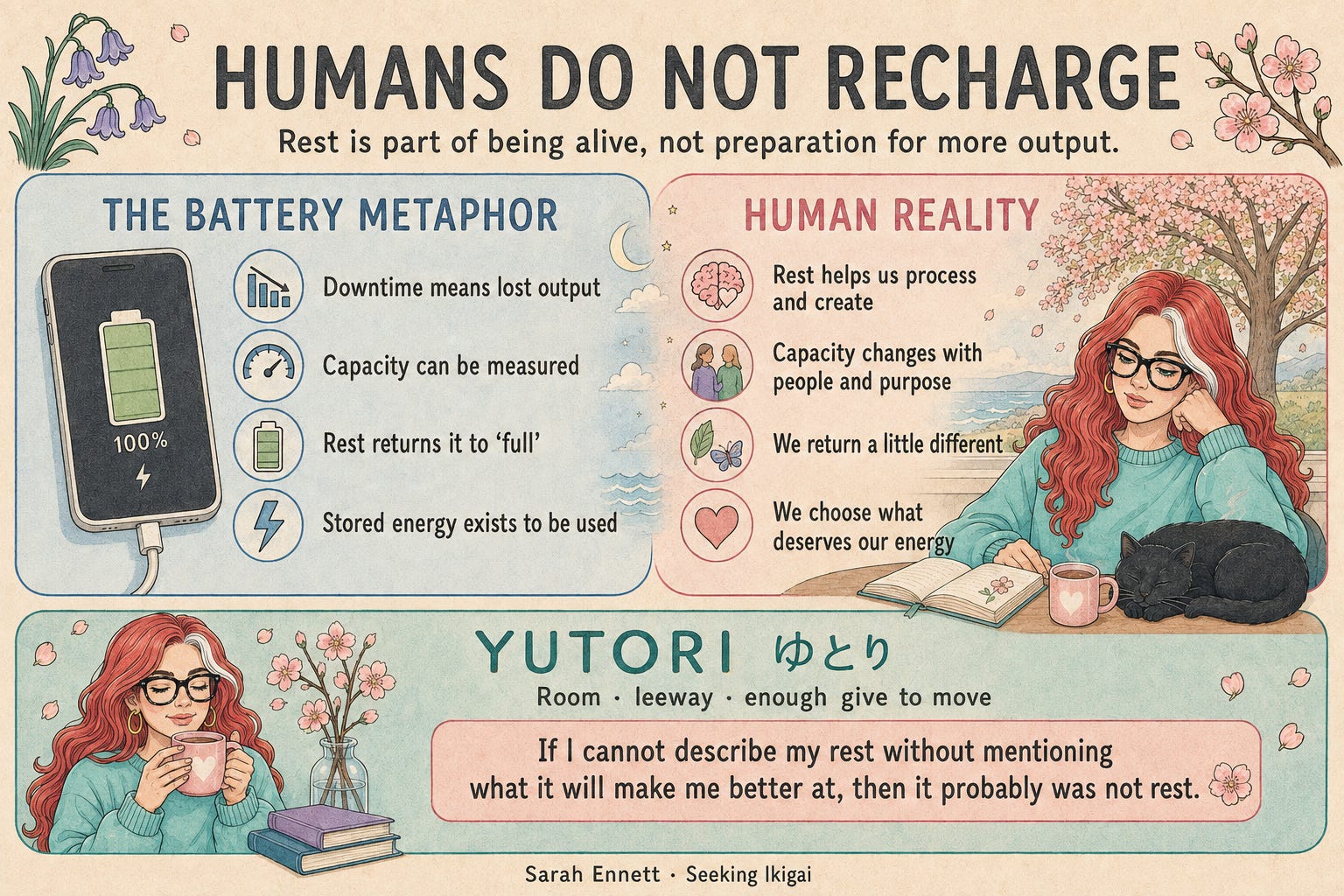
The trouble with borrowing a machine’s word is what comes along with it, the assumptions and unhelpful norms we are perpetuating. Four things are true of a battery metaphor and not one of them is true of me.
Downtime unproductive for a machine. A phone on charge is doing nothing. When I stop, my day gets unpacked and sorted and put somewhere I can reach it later, and my mind goes wandering off and comes back with creative ideas I wouldn’t otherwise have had.
A battery holds a measurable amount. Its charge counts down, the same drain for the same use. Mine makes no such sense. I can be too tired to answer a question at four, then a friend rings at six and I find an hour or two to answer several. Nothing charged in between, whatever I am running on is not quantifiable in that way.
A battery can be returned to what it was. Full is full, and full is the same as yesterday’s full. Nothing alive gets put back to a former state. I come back a little different every time.
A battery has no say over what it powers. It cannot ask whether the work is worth doing, and it cannot decline.
None of that describes an animal, and an animal is what I actually am.

The words we borrow
We have often described ourselves in the language of whatever we had just invented. When clocks were the cleverest things, we talked about doing things like clockwork or being wound up too tightly. In the age of steam we ran on pressure, so we blew gaskets and let off steam and broke down like an engine seizing. When telephone exchanges arrived we talked about wires being crossed. Then came computers, and we began processing things and needing more headspace. Every one of those an interesting analogy but not precise, I also think this is part of what has shaped what people believe they are allowed to need.
Now we are batteries and digital devices. Recharge. Reset. Drained. Out of bandwidth. Running at reduced capacity. A battery has one purpose, storing charge in order to give it away. Charging is not for the battery’s benefit, but for whatever the battery is plugged into. So when I tell you I am recharging, I am telling you my rest is a service performed for something else. That lying on the sofa is an investment with an expected return, and if I do not come back sharper then the time off was somehow spent badly.
English has natural words for the state we are in or the need we have; hibernation, nest, fallow, dormant, moulting, bask, burrow, roost, go to seed, slack water… these assume a cycle. Something has been, something will be again and the bit in between is part of the thing itself. Katherine May described this beautifully in Wintering. Nobody has ever accused a tree in January of being in low power mode, we say dormant and we do not tell it to try harder.
We forget that we are animals attuned to feelings, cycles, seasons, the weather and our environment. Sleep moves in cycles through the night. Attention arrives in waves rather than a smooth line from nine until six. Grief ebbs and flows. Curiosity has a spring and an autumn.
A machine runs at its rated output until the charge is gone.
Who is machine mode modelled on?
Machine thinking assumes steady daily output. A dependable eight hours, roughly the same today as yesterday, topped up overnight. Consistency is the virtue and variation a fault to be managed.
That describes one kind of body, in one tiny slice of a whole life. Lots of bodies vary over different phases of the month or seasons in life. There are weeks where you are sharper than others and we need to stop acting like this is personal failing. Then of course for some there comes a time when the whole system reorganises itself, and the advice available is thin because the research is still worryingly thin for issues that predominantly impact women.
A vocabulary built around constant availability was never going to describe a cyclical animal kindly. Listen to how the worst of productivity culture talks. Crush it. Beast mode. Grind. Sprint. Always on. No days off. 10x. It is locker room language and it suits a certain kind of swagger that isn’t the best role model for our young people if they want to learn how to build healthier societal norms.
Now of course there is the perceived threat of an actual machine to do your work, never needing a weekend, doesn’t get bored, or grieve, or need talking into trying something. Once you work alongside something available at three in the morning it starts to look like the standard, and that standard travels downwards into how much recovery a working life is permitted to require.
That is part of the ikigai-risk (i-risk of AI) I keep contemplating. Purpose can leak out of life when work goes. It also leaks out when the loose hours go, because meaning gets made in the pottering and the reading and the conversations nobody planned.
Room in the sleeve
There is a Japanese word for the thing I really need. Yutori ゆとり. Room. Slack. Latitude. It gets used for the ease built into a garment, the extra fabric in a sleeve that lets your arm move freely and without the seam complaining. It is the give in a thing.
Japan once tried to build it into schools. Yutori kyōiku, education that gives children room to grow, arrived formally in 2002. The week dropped from six days to five and a third of the required curriculum went. Then test scores wobbled and by 2012 the hours were back, and the children who grew up inside the experiment got named the yutori sedai, an insult for anyone who seemed a bit soft. Slack was granted, then it was measured perhaps imperfectly through a certain lens, so that it was deemed to be a failure.
It is hard to install room to breathe inside a system still keeping a tight rein purely on scores as the worth, which is more or less what happens to your annual leave. The 2026 figures are heartbreaking. Twenty one per cent of UK workers do not take their full entitlement. More than a quarter finished the year with fifteen days or more still in the pot. Eighty nine per cent said their mental health was better after they took a break.
Some of that is workload and perhaps a sense of underlying fear in the job market. Most of it, I suspect, is much older. I can explain my thinking in this essay and still feel a sense of shame when somebody rings the doorbell and finds me on the sofa at two on a workday afternoon. Idle hands and the devil’s workshop. Sloth sitting in with the deadly sins. A work ethic that arrived with the Reformation and never quite left. Centuries of moral instruction lodged in us which is why stillness doesn’t feel neutral, it feels like getting away with something.
What rest turns out to be
So here is a welcome piece of research, because it makes the case for downtime without appealing to virtue at all. In 2012 a team led by Benjamin Baird gave people creativity problems and then a break. Some worked hard, some rested, some had no break at all and some did a simple task that let their minds wander. The wanderers came back substantially better at the problems they had already seen. Working hard didn’t cut it, mind you pure rest didn’t either, mild pottering did the trick, I always knew I loved a mooch *grin*.
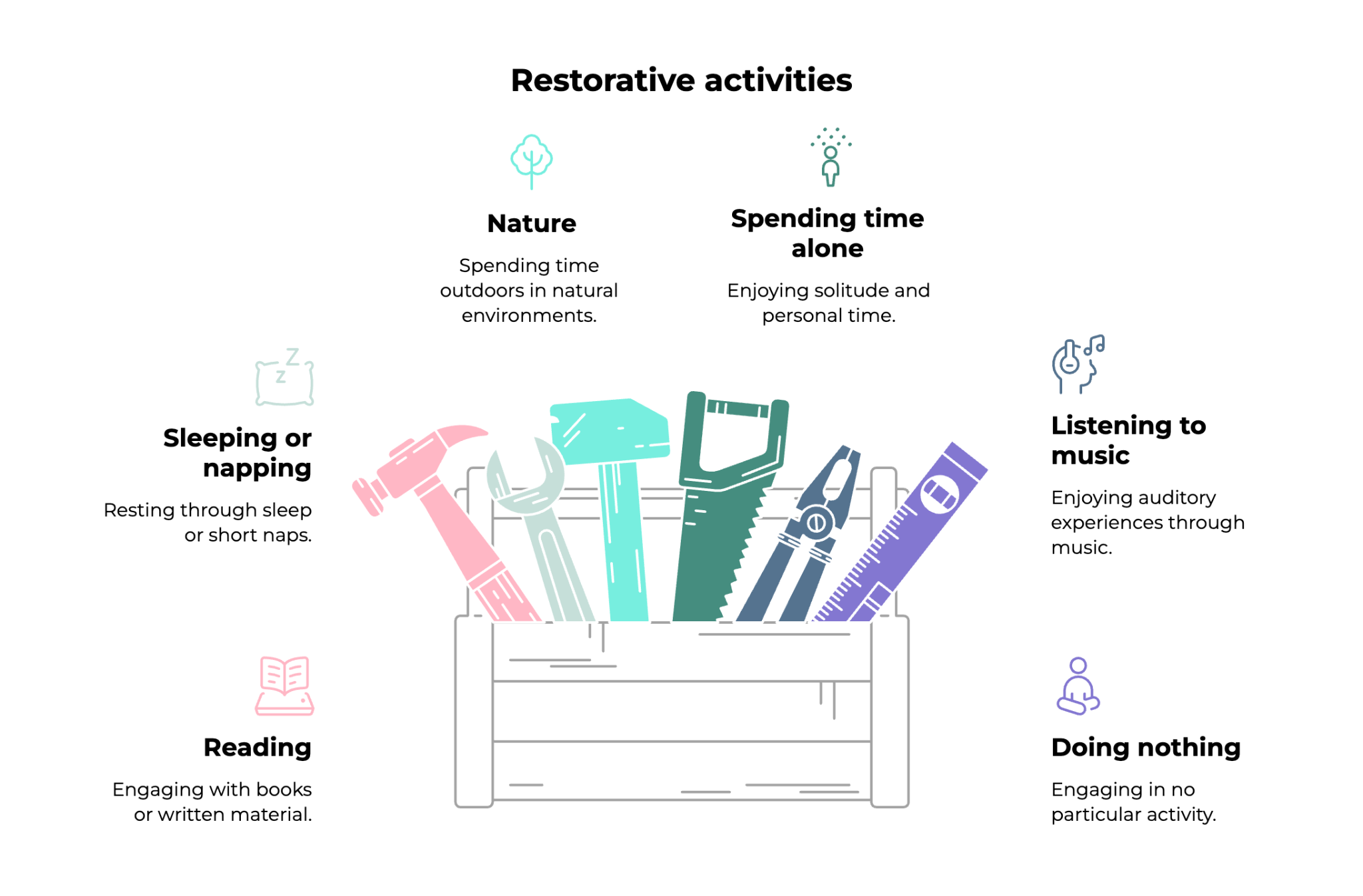
Ask people what rest feels like and they don’t describe recharging either. In 2016 BBC Radio 4 ran the Rest Test with Hubbub, Durham University and Wellcome Collection. More than eighteen thousand people in a hundred and thirty four countries answered, and sixty eight per cent said they would like more rest. Asked what genuinely restored them, the top of the list went like this;
Reading
Sleeping or napping
Nature
Spending time alone
Listening to music
Doing nothing in particular
I love that solitude and nature scored so highly (though makes me wonder if they analysed the respondents would they find a lot of INFJs? *grin*) Doing nothing in particular made the top six and I couldn’t love that more.
Somebody has to go first
I think we need to get better at using the right language. I am fallow this week. I am wintering and doing nothing in particular. I’m trying this out loud and I hope it sounds like a person doing something on purpose, with dignity. It definitely doesn’t promise anyone a return. Every woman I know who rests without apologising has made it a little easier for whoever was watching.
Here is a small test I am keeping. If I cannot describe my rest without mentioning what it will make me better at, then it probably was not rest.
Which brings me back to today, Henry cat soundly asleep next to me with the confidence of someone who has never once justified his afternoon. I am not going to return from this rest improved. There is no charge level and nobody can translate the percentage level anyway. I am making some room, introducing a little yutori.
So the questions I am carrying, and passing to you;
What would my rest look like if it did not have to be useful?
What word am I going to use instead of recharging?
Sarah, seeking ikigai xxx
PS - A bullet journal spread for lying fallow
Give a double page the title Fallow, and if you fancy it draw a field with a gate in it, or a tree in four seasons.
Borrowed words - Collect every machine word you catch yourself using about yourself this week. Recharge, bandwidth, capacity, drained, reset. Just gather them, no telling off allowed.
My own weather - Sketch your last month or so as a season or a tide rather than a line and mindmap the words needed to paint that picture fully, again without judgement.
The pottering list - Five things you would like to do that will not further any goals, jigsaws or photographing flowers or, or, or…
One swap - Choose your replacement rest word and practice it out loud.
Then do one thing from the pottering list for no reason at all.
PPS - An AI prompt for telling rest from maintenance
Try this with your AI of choice, extended thinking on, speak for a few minutes about what you have been up to recently and how you have been feeling, especially in your own time, then use this prompt with your dump;
“Here is how I have spent my last week or two. Help me tell the difference between rest and maintenance. Look for the moments that existed for their own sake and the moments that existed to make me more useful afterwards, and show me the pattern. Point out any language I use about myself that actually belongs to a machine rather than an animal with cycles and seasons. Then suggest three small things I could do this week that will not improve me in any measurable way but might help me feel a sense of renewal and creativity in the way that pottering while resting often can. Ask me questions where you need more information rather than inventing or assuming anything in your answer for me.”
PPPS - The soundtrack
I’m Only Sleeping by The Beatles
In March 1966 Maureen Cleave wrote in the Evening Standard that John Lennon “can sleep almost indefinitely, is probably the laziest person in England”. He answered with a song. That drowsy backwards guitar took George Harrison hours of exacting work, all of it to make something sound like falling asleep.
Love this, Sarah - I especially enjoyed the historical perspective of how we talk about ourselves using the language of the technology of the day!
So clear!! I need to un-machine my language! 🤖