


🌸 ikigai 生き甲斐 is a reason for being, your purpose in life, from the Japanese iki 生き meaning life and gai 甲斐 meaning worth 🌸
I didn’t know what to write today.
Usually, by the time Saturday morning arrives, something has been rattling around in my brain for long enough that writing is mostly an exercise in finding out what I think about it. A conversation. A book. Something about AI. Something about work. An irritation or observation about being human that lodged itself in my head.
Today, not so much.
I had coffee, a blank page and a frustration with myself that after thinking about purpose for this long, I really ought to have something profound to say.
Part of me wondered whether I should skip this one, while another started rummaging around in my notes and brainstorms for Something Important ™.
Then I wondered when I had decided that everything worth writing about had to be some big production. Perhaps there was something interesting in that. The longer I’ve spent seeking ikigai, the less convinced I am that purpose is some huge thing we discover, and the more I see it as something we tend, cultivated over time and returned to season after season.

Most of life happens between the big moments
We tend to put an awful lot of pressure on purpose.
Find your passion. Know your why. Discover your calling. Identify your mission. Seek out your ikigai.
It can sound like there is one shiny answer somewhere, and our job is to keep looking until we uncover it. But lots of life does not feel like a search for buried treasure.
Of course we remember the huge moments. The person we fell in love with. The thing we started. The thing we finally stopped. The day everything changed.
Most days are not like that. Most contain work and dirty clothes and messages and making dinner and walking the dog and moving something that has been sat in a pile on the stairs for considerably longer than it needed to.
Purpose has to be able to live there too.
Psychologists Laura King and Joshua Hicks describe meaning in life as having three broad components. We want our lives to make some kind of sense, we want direction or purpose and we want to feel that our existence has significance or matters. Perhaps most reassuringly, they also found that experiencing life as meaningful is remarkably commonplace. Meaning is available to most of us, most of the time.
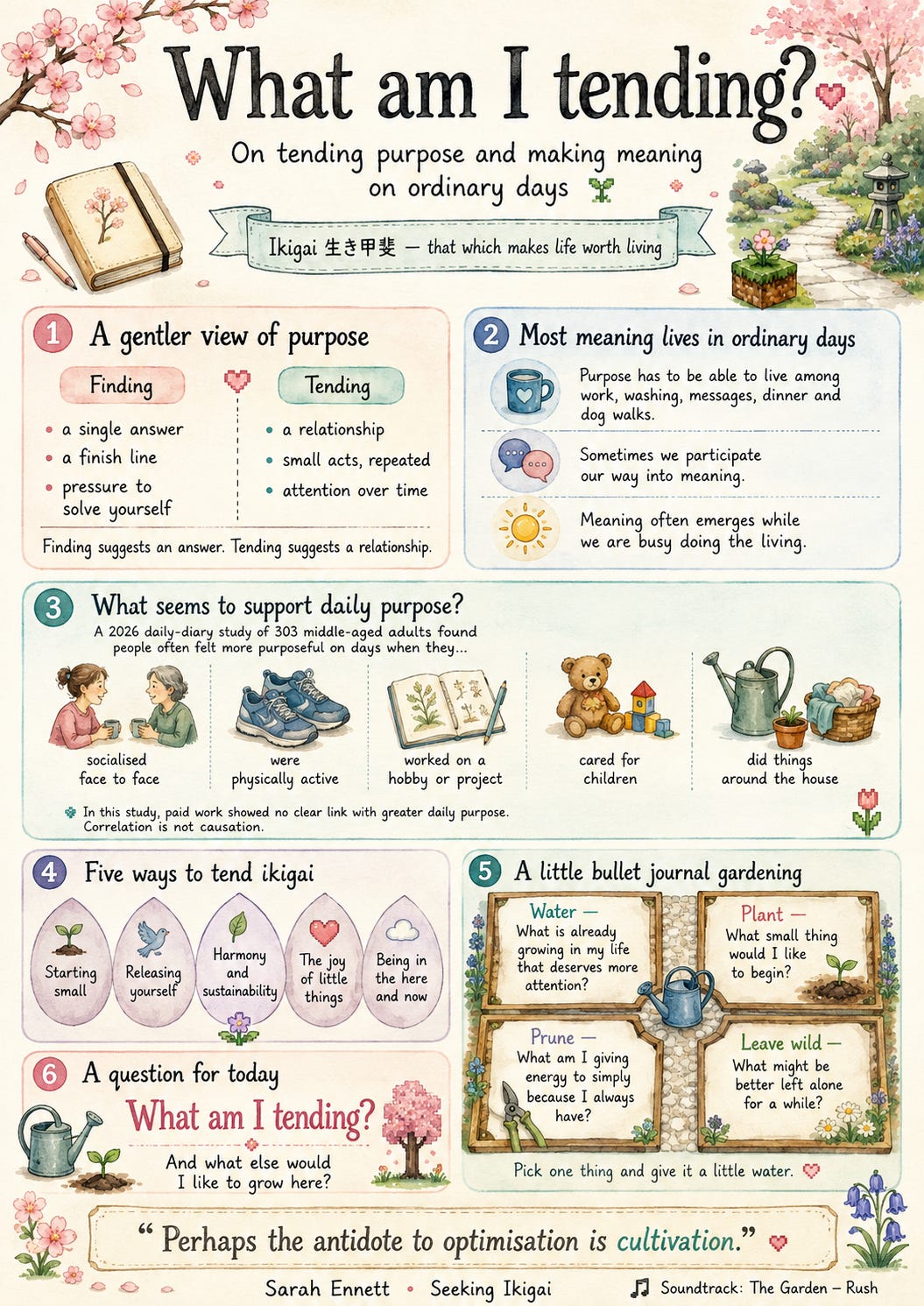
A 2026 study followed 303 middle-aged adults for eight days, asking them what they had done and how purposeful their lives had felt that day.
Their sense of purpose moved.
People tended to feel more purposeful on days when they had socialised face to face, been physically active, worked on a hobby or project, cared for children or done things around the house. Days without social activity were associated with feeling less purposeful. Interestingly, having done paid work showed no link with greater daily purpose.
It is only one study, and correlation is not causation. Perhaps feeling purposeful encourages us to participate more in life just as much as participating helps us feel purposeful.
But I love the possibility hidden inside it.
Sometimes we participate our way into meaning much more than think our way there.
Meaning might emerge while we are busy doing the living.
One block at a time
I think this might be one of the reasons I find Minecraft so soothing.
I can spend an unreasonable amount of time terraforming a patch of virtual land. Moving a few blocks. Softening an ugly hillside. Adding a path that curves towards my house. Planting some trees. Making a little pond. Growing flowers around the edges until it starts to feel like somewhere I would really like to be.
None of it necessary to win the game, I am simply tending my tiny corner of the world… and the change happens gradually, almost invisibly.
One block. One tree. One path. One flower.
Perhaps we can shape our lives like that too. Less through demanding constant reinvention from ourselves, more through noticing what would make this patch feel like somewhere we are really happy to inhabit.
What we choose to cultivate
A garden is a helpful way of thinking about purpose because gardening requires attention without offering complete control. You can water something, feed it, move it into the sunlight and give it good soil. You cannot shout at it until it grows.
Some things flourish with surprisingly little intervention. Some need constant tending. Something you were convinced would thrive dies almost immediately. Something you had completely given up on suddenly pushes a green shoot through the soil months later.
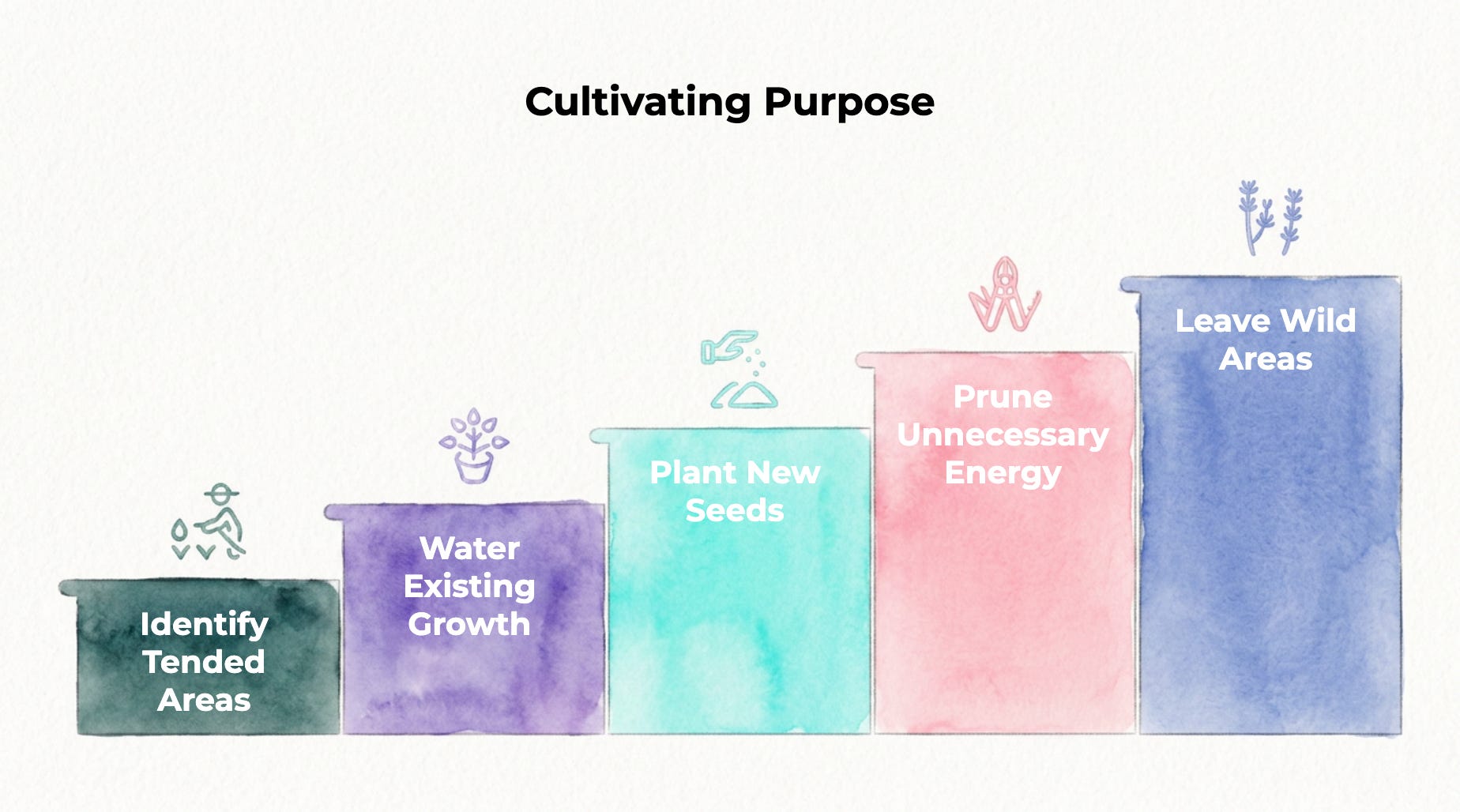
Sometimes you need to plant.
Sometimes you need to prune.
Sometimes the kindest thing you can do is stop interfering and leave a patch wild.
This feels increasingly like the version of purpose I want. Something I create the conditions for, rather than another thing to control, achieve or complete.
It also makes me look again at Ken Mogi’s five pillars of ikigai, which I return to again and again.
Starting small
Releasing yourself
Harmony and sustainability
The joy of little things
Being in the here and now
There is no pillar called develop an impressive five year personal purpose strategy by the end of Q4.
They are surprisingly ordinary practices. Ways of paying attention and participating. Ways of staying connected to the life that is happening while we are making plans for the life that we might like to happen next.
I wonder whether I have spent all this time reading them as five ways to find ikigai when perhaps they are also five ways to tend it.
That feels like an important distinction. Finding suggests an answer. Tending suggests a relationship.
Not everything needs optimising
I keep coming back to this as I think about our relationship with AI too. I love technology that removes friction from things where friction adds no value for me. I am perfectly happy for AI to help me organise information, summarise something enormous, suggest connections I have missed or help me get started when a blank page is being bothersome (though not until I’ve done a rambly human braindump mini essay about how being stuck actually feels for me today and some of the things that have been going on in my life *grin*).
I am also interested in the things I have no wish to make efficient. Grief probably doesn’t need accelerating. Curiosity is allowed to wander somewhere apparently useless. Learning something slowly over a long time period is a perfectly valid way to learn it. A walk does not have to count towards anything. Making something nobody asked for can still be time wonderfully spent. Becoming someone you like being might be one of the least measurable projects you ever undertake.
There are some things where the time spent doing them is part of their value. If my Minecraft garden appeared fully landscaped at the press of a button, I would have saved myself hours. I am not sure I would have gained anything.
Perhaps the antidote to optimisation is cultivation.
Choosing what deserves our finite attention and then returning to it often enough for something gorgeous to grow.
What are you tending?
Which brings me back to this morning.
I did not discover my purpose today, or uncover a previously unknown secret of ikigai. I didn’t have a revelation, or really even an essay idea.
I just sat in front of the blank page for a while and paid attention to my thoughts and feelings. Eventually I realised that writing here each week is itself something I have chosen to tend. I never know exactly what it will become. Not every essay will resonate with every reader. Some weeks the ideas grow easily and some weeks the soil seems rather unpromising.
But I keep returning, and something has taken hold here. Perhaps that is one of the ways we recognise things that matter. They rarely arrive carrying a large sign announcing THIS IS YOUR PURPOSE. We just keep choosing to come back.
So perhaps there is something in your life that does not need solving or perfection today.
An idea. A skill. Your confidence. A friendship. Your health. A creative practice. A garden. A tiny business. A community. A version of yourself you are still getting to know.
Maybe you don’t need to know where it will end up. Maybe the question does not need to be What is my purpose?
Perhaps, for today, it can simply be what am I tending? … and maybe, just as importantly, what else would I like to grow here?
Sarah, seeking ikigai xxx
PS - A little bullet journal gardening
Instead of making another list of goals this week, try giving a double page spread the title What am I tending?
Divide it loosely into four patches, perhaps draw a garden or some flowers;
Water - What is already growing in my life that deserves more of my attention?
Plant - What small thing would I like to begin without needing to know what it will become?
Prune - What am I continuing to give energy to simply because I always have?
Leave wild - What am I trying to fix, measure or improve that might actually be better left alone for a while?
Then resist the temptation to create a seventeen point action plan, pick one thing and give it a little water.
PPS - An AI prompt to help you notice what is growing
Try this with your AI of choice with extended thinking on;
Look at how I have spent my time, attention and energy recently. Do not try to identify my single life purpose or tell me what my ikigai is. Instead, help me notice what I appear to be tending. Look for the people, activities, ideas, responsibilities and curiosities I keep returning to. Help me distinguish between things that seem to give me meaning, things I am simply maintaining and things that may be taking more from me than they give. Then suggest three very small experiments for the next week that might increase connection, curiosity, contribution or joy without turning my life into another optimisation project. Ask me questions where you need more information rather than inventing an answer for me.
As ever, I would ask the machine to hold up the mirror rather than decide what matters. You decide what deserves watering.
PPPS - The soundtrack
The Garden by Rush
Neil Peart described the garden as a metaphor for the acts and attitudes of a life, influenced by the ending of Voltaire’s Candide and the idea that, after all our searching and theorising, eventually we have to get on with tending our garden. For Peart, the things being cultivated there were ultimately love and respect.
I think there is something beautiful about ending there too. We can spend an enormous amount of time trying to work out what life means… and then Saturday morning arrives. There is coffee to make, creatures to love, a blank page and something worth tending.
I developed an interactive conversation that helps you find your Ikigai. https://kasanoff.com/ai-tools