

🌸 ikigai 生き甲斐 is a reason for being, your purpose in life - from the Japanese iki 生き meaning life and gai 甲斐 meaning worth 🌸
I ask AI a lot of questions, and sometimes Claude helps me ponder even better ones.
There are meaningful questions you can explore with AI, but I feel that you also need to sit with some of them yourself, to reflect and journal on. The most impactful ones though should be explored with our community.
Here’s one I’d like to see more people discussing in real life;
What would we need to see to believe that AI is increasing human agency, not just our output?
It sounds like a question for a conference panel or a white paper, it lands somewhere much more personal.
I use AI most days. I use it to think, research, teach, organise and occasionally locate a word that vanished at the exact moment I needed it. I am inside this particular machine, pressing buttons with enthusiasm. Curious, grateful, excited and wary, usually at the exact same time.
AI can be useful, obviously… is all that usefulness making us more free?
More output is easy to mistake for more agency. A full inbox can look like usefulness. A finished document can look like progress. It might be. It might also be the same person running faster on a more efficient treadmill.
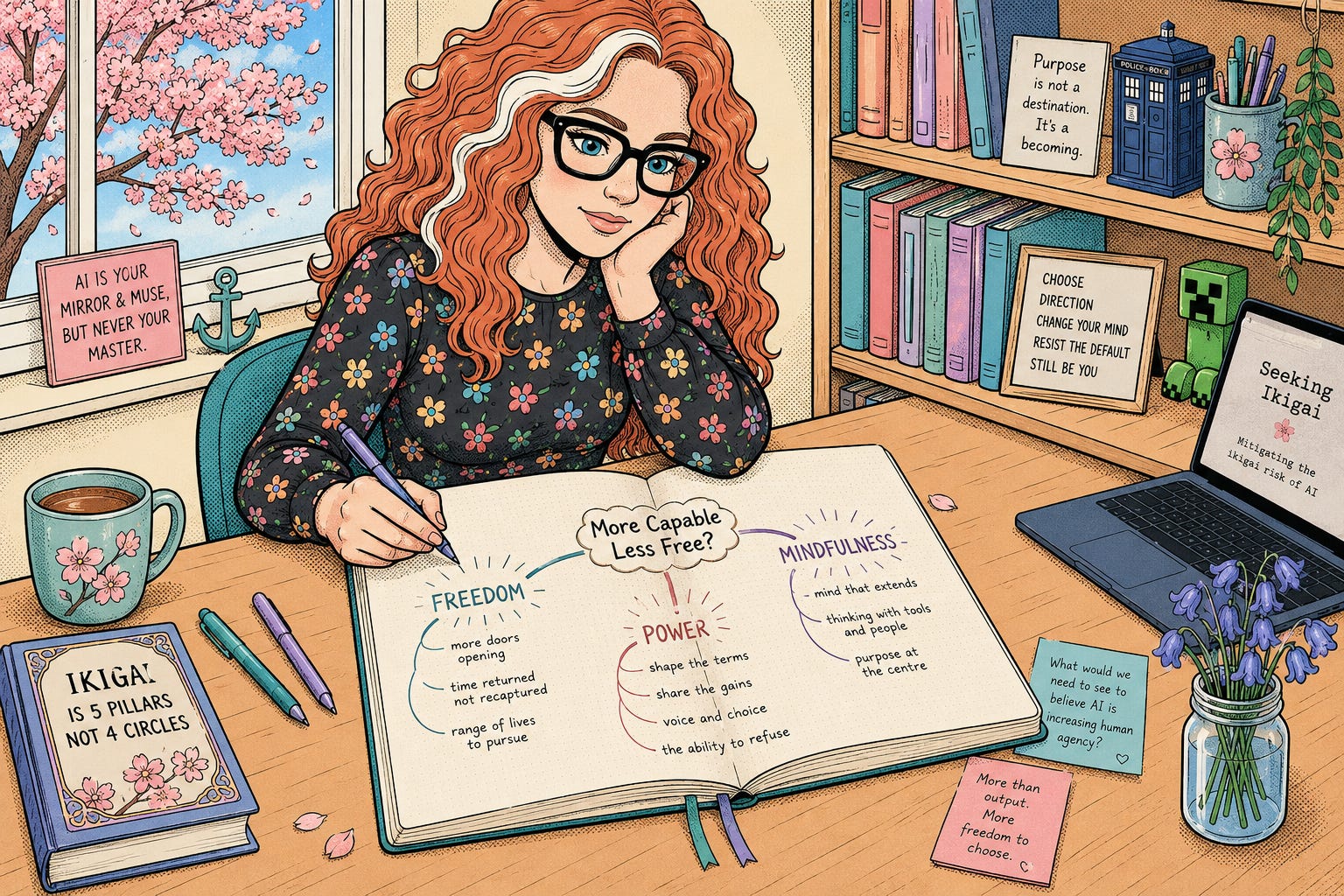
Agency is harder to count. It is the ability to choose a direction, change your mind, resist the default and still recognise yourself in what happens next. It is having a meaningful say over what all the doing is for.
I have described the ikigai risk of AI as the erosion of human purpose as AI takes over work through which we find meaning, leaving us doing more while feeling needed less. Output is a visible symptom, but agency should be the thing underneath.
So I went looking for answers, even if they unsettled my own arguments, I found three to talk about today.
The freedom to pursue a life of your own
The first comes from the economist and philosopher Amartya Sen, who explored people through the different lenses of wellbeing and agency. We are people with aims, commitments and values of our own, and our agency freedom is what we are able to do and achieve in pursuit of them.
The phrase that stays with me is free to do and achieve. Permission to start a business means little without the time, money, confidence and support to act on it. Access to information means little if you cannot understand or use it. Options offer a poor type of freedom when somebody else selected them all for you.
Through Sen’s lens, AI increases agency when it enlarges the range of lives a person can actually pursue. I want to see the woman who has always struggled to put her ideas into polished words finally being heard. The person living with fatigue able to participate without spending every scrap of energy on administration. The nervous beginner asking questions without shame. The tiny business reaching capabilities once reserved for a large one.
More doors opening for more people.
I also want to see saved time staying saved. When AI removes two hours of work, who receives those hours? Does the worker get breathing room, learning time, exercise time, healthier food prep time, a shorter day? Or does the target rise until the gift disappears? Time returned and immediately recaptured is extraction.
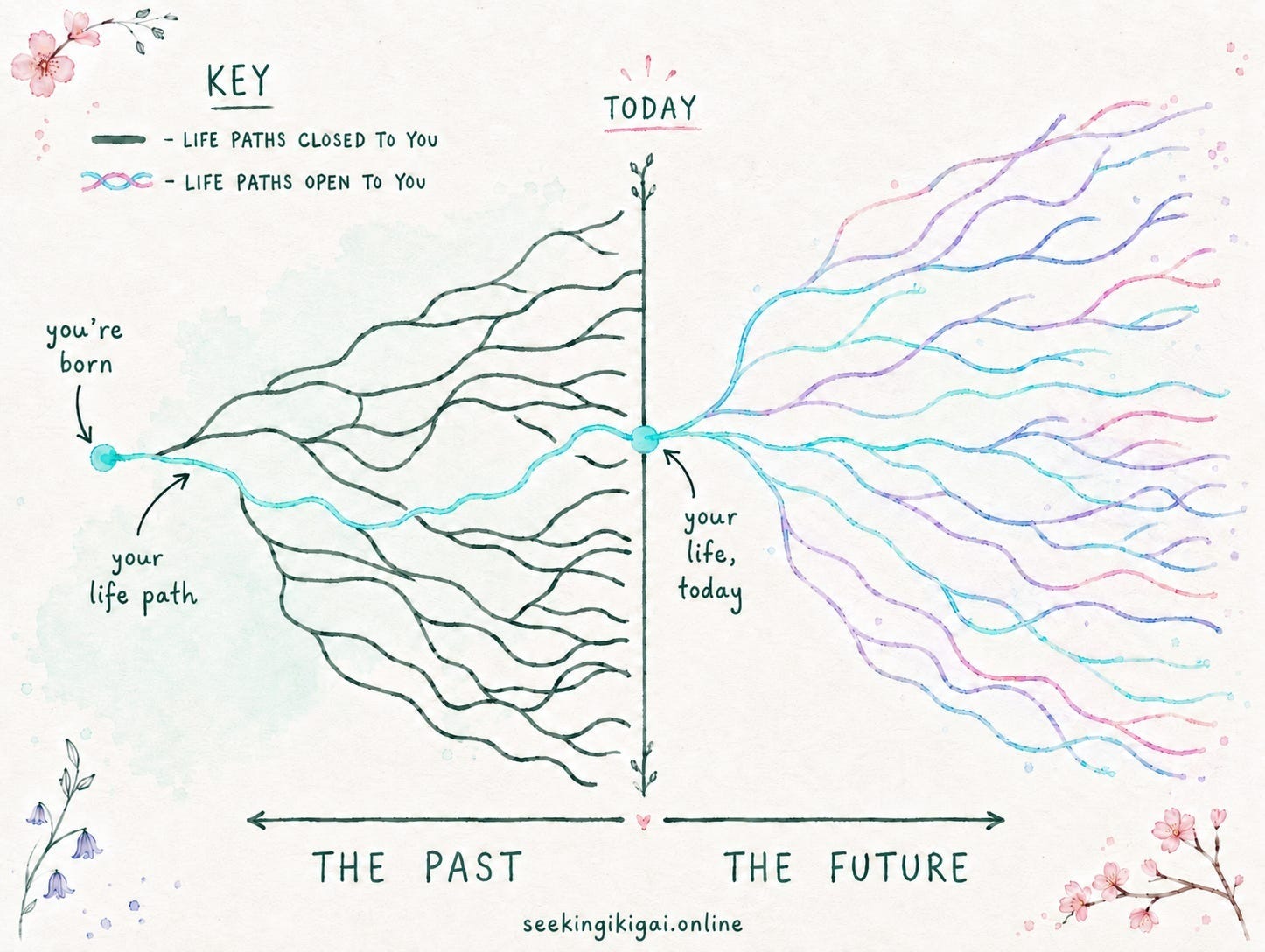
Sen would warn me that I am counting output and calling it agency. More words, faster decisions, better presentations. The real test is whether a person’s map of possible life pathways has grown.
The power to shape the terms
The second answer is less interested in individual empowerment, it wants to know what happens for everyone.
Imagine an AI system saves every employee five hours a week. The organisation celebrates. Six months later the targets are higher, the team is smaller and everybody is producing more in the same number of hours. Capability has soared. Agency has shrunk.
In Building Pro-Worker Artificial Intelligence, Daron Acemoglu, David Autor and Simon Johnson set a demanding standard for technology that serves workers. It should make human skill and expertise more valuable while expanding what workers can do. Both halves matter. A tool can make me more capable of performing a task while making the skill behind it less scarce, less valued and easier to replace.
A powerful tool in the hands of someone with no say makes the system more powerful. The person stays exactly where she was.
Through this lens I would need to see changed institutions rather than impressive demonstrations. Productivity gains shared through better pay, greater security and shorter hours. Workers involved in deciding where AI is used, what it measures and which decisions stay open to human challenge. People keeping rights over the knowledge, creativity and judgement used to build these systems.
And I would need to see the ability to refuse, because a choice only counts when no is still a survivable answer.
This view tells me I have been treating agency as a private feeling of effectiveness, when it also lives in power, ownership and voice. AI can enlarge my reach while shrinking my influence over the world I am reaching into. It can help me climb a ladder while somebody else moves it against the wrong wall.
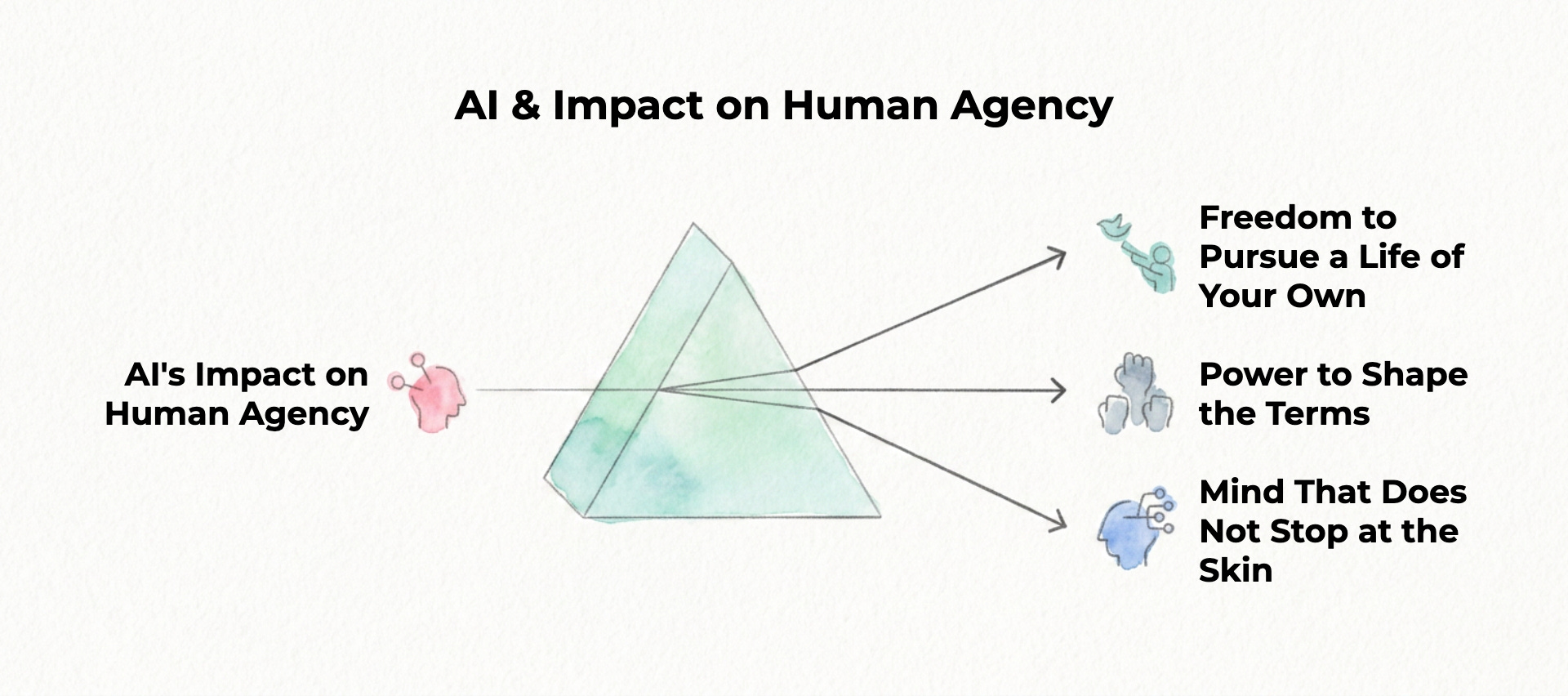
The mind that does not stop at the skin
The third answer challenges my instinct to draw a firm border between human and machine.
In their wonderfully provocative paper The Extended Mind, the philosophers Andy Clark and David Chalmers question whether thinking happens only inside the brain. Their conclusion is cheerfully blunt. “Cognitive processes ain’t (all) in the head!”
We think with notebooks, maps, calculators, language and other people. This feels immediately true to me. My bullet journal has been holding chunks of my memory for years and I have yet to accuse Leuchtturm1917 of stealing my soul. Writing changes what I notice. A list exposes a pattern. A migrated task asks whether I really intend to do it. The notebook participates in the thinking.
Perhaps AI can too.
Becoming less capable without a tool proves very little on its own. I am less capable of navigating a strange city without a map, seeing without my glasses, remembering a whole month without my journal. None of those tools have made me less myself.
The better question is whether the human and the tool form a richer thinking system together. Does AI help me notice what I had missed? Does it offer resistance as well as agreement? Can I still redirect it, correct it and decide what matters?
And yet my notebook waits. It has never invented a source, flattered me or changed its behaviour overnight while I slept. It belongs to me rather than to a company that can rewrite the terms of my access. It cannot finish my sentences before I have discovered what I meant to say.
AI is a pen that can suggest the topic, complete the sentence, praise the result and remember everything I have ever written. That may become a magnificent extension of human thought. It may also become an enclosure so comfortable that we stop noticing that we are fenced in.
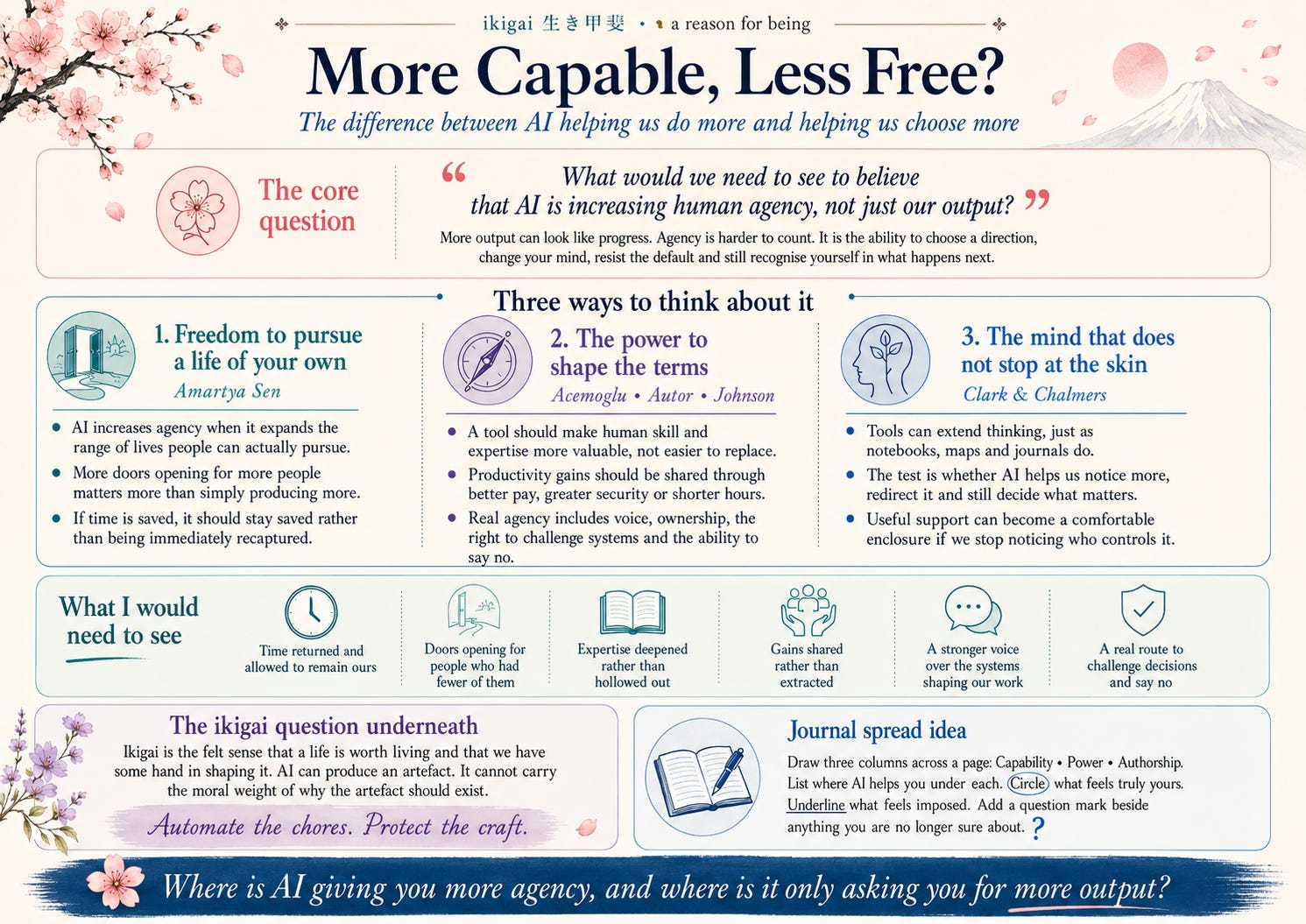
What I would need to see & the ikigai question underneath
Time returned and allowed to remain ours. Doors opening for people who had fewer of them. Expertise deepened rather than hollowed out. Gains shared rather than extracted, hoarded or absorbed. A stronger voice over the systems shaping our work, a real route to challenge an automated decision and a way to say no without disappearing from society.
Most of all, I would need to see AI helping people become better at choosing a direction that helps people and planet thrive. Speed towards a destination somebody else chose impresses me far less.
Ikigai is the felt sense that a life is worth living and that we have some hand in shaping it. Purpose grows through choosing, practising, contributing and occasionally doing something inefficient because the doing is part of what makes us human. AI can produce an artefact. It cannot carry the moral weight of why the artefact should exist.
So perhaps purpose proofing begins with different questions. What human value lives inside this task? Who chooses? Who benefits? Who becomes more powerful and who becomes more dependent? Automate the chores, protect the craft… and pay very close attention to who gets to decide which is which.
We cannot tidy this topic away though. A person who becomes dramatically more capable with AI and less capable without it might be experiencing liberation, capture and integration all at once. All three of my borrowed lenses could be right about her on the same afternoon.
Which is why this ends up being a question about care as much as capability. If AI hands you back two hours this week, I hope you get to keep them. I hope they become a walk, a phone call, a cup of tea with a friend, a page in a notebook. I hope somebody asks what you want to do with them, and waits for your answer.
So I am carrying another question onwards. What would still need to belong to me, even if I relied on AI every day, for that reliance to feel like an extension of my agency rather than a fence built around it?
And I am leaving one for you too… Where is AI giving you more agency, and where is it only asking you for more output?
Sarah, seeking ikigai xxx
PS Bullet journal spread for this week. Draw three columns across a page. Capability. Power. Authorship. List where AI currently helps you under each. Circle anything that feels truly yours, underline anything that feels imposed and put a question mark beside anything you are no longer sure about.
PPS Try this with your preferred AI tool with extended thinking turned on.
“Look at how I use AI across my work and life. Where does it seem to be increasing my agency, where might it only be increasing my output, and what should I keep practising myself if I want to stay meaningfully involved in my own choices? Be warm but honest with me.”
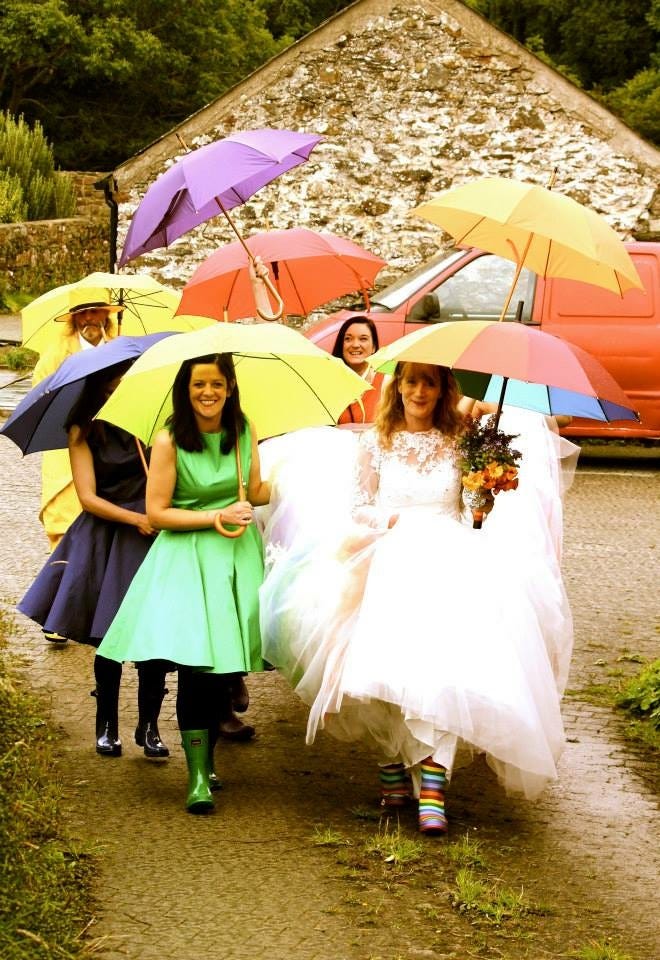
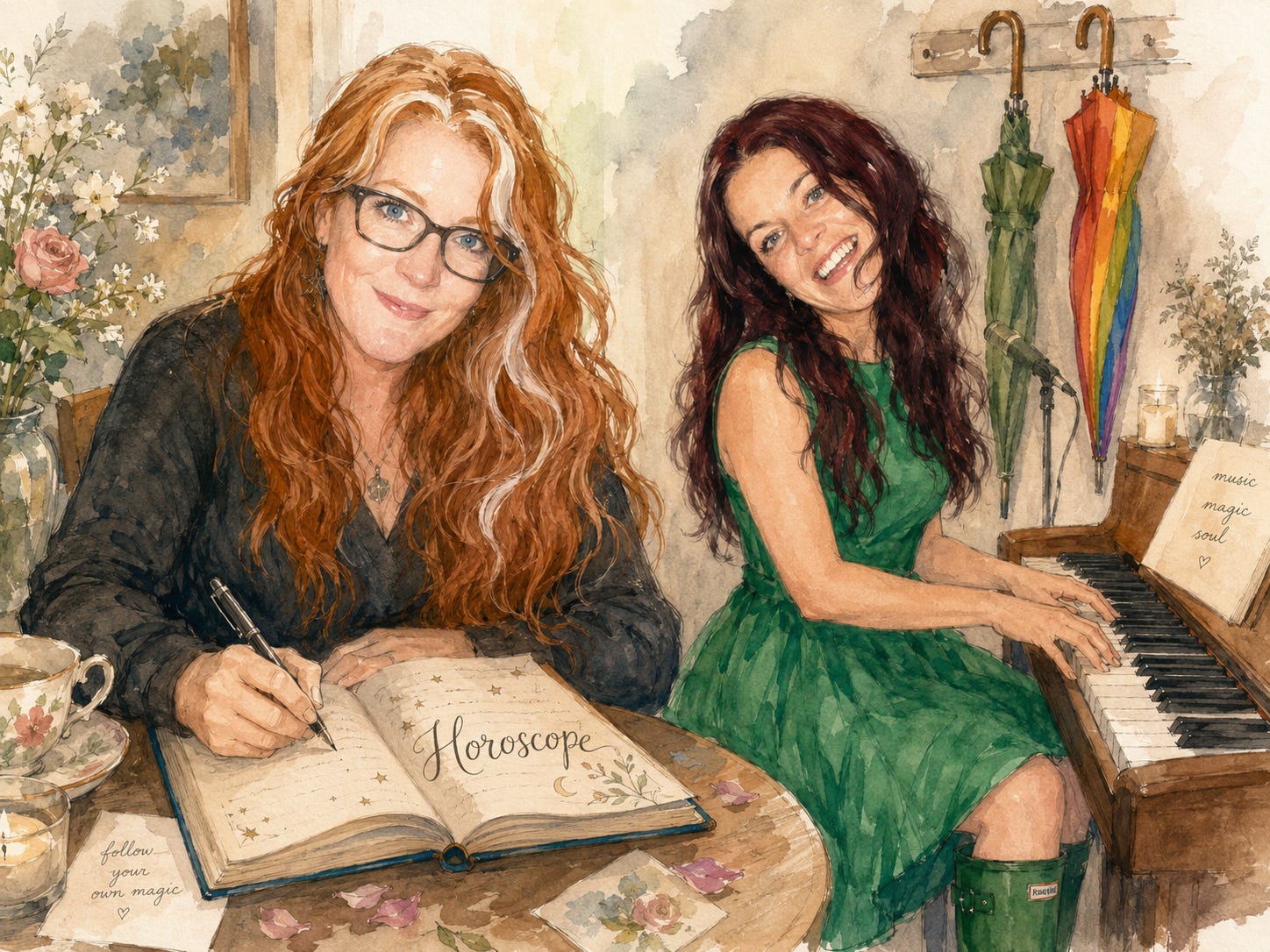
PPPS This week’s soundtrack is a song called Horoscope by my ridiculously talented friend Anna Goldsmith, my beautiful green bridesmaid fairy. It starts with “You’ll find it hard to say exactly what is on your mind” which has never been truer, and ends with “everything will be alright if you find the answers” .. which felt fitting for an essay about big questions… while I may struggle at times with questions, being open and curious and questioning and finding lots of answers is for sure the way forward and something she has taught me in spades over the years…. And you’ve got to love her glorious soaring voice reassuring that things are “gonna go your way” as it closes.
Your question about who actually receives the saved hours is the hinge of the whole essay, Sarah-san. AI may finish the task, yet the fate of those two hours tells us far more about freedom than the finished document does. I’ll be thinking about “Capability. Power. Authorship.” for a while.
What a lovely invitation to hold big questions - something my strong J preference gets in the way of. And to consider big purposes - which I love doing. Thanks you, Sarah.