

🌸 ikigai 生き甲斐 is a reason for being, your purpose in life – from the Japanese iki 生き meaning life and gai 甲斐 meaning worth 🌸
I used to have a comfort blanket in French.
“Je parle le français un très petit peu” I learned to pronounce it perfectly, with just the right apologetic smile. A pre-emptive surrender before I’d even tried to communicate.
I got reasonably good at reading and writing French, and could follow conversations if people spoke slowly. But speaking it aloud? That scared me, so I’d lead with my disclaimer and hope nobody expected too much. Not sure where I learnt that imperfect equals useless.
I hear the same thing often with AI. “I’m not technical.” “I don’t really understand this stuff.” “I’ve tried ChatGPT but I’m probably doing it wrong.”
The comfort blanket phrases change, but the underlying fear does not.
While pondering what we really mean by “AI Literacy” and how to tackle teaching it in service of helping my community thrive … I think we should probably stop treating it like a test we might fail, and instead treat it like a language we’re learning to speak… imperfectly, incrementally and with an accent that’s entirely our own but checking in with others to make sure they understand us! My Island home handed me a helpful metaphor.
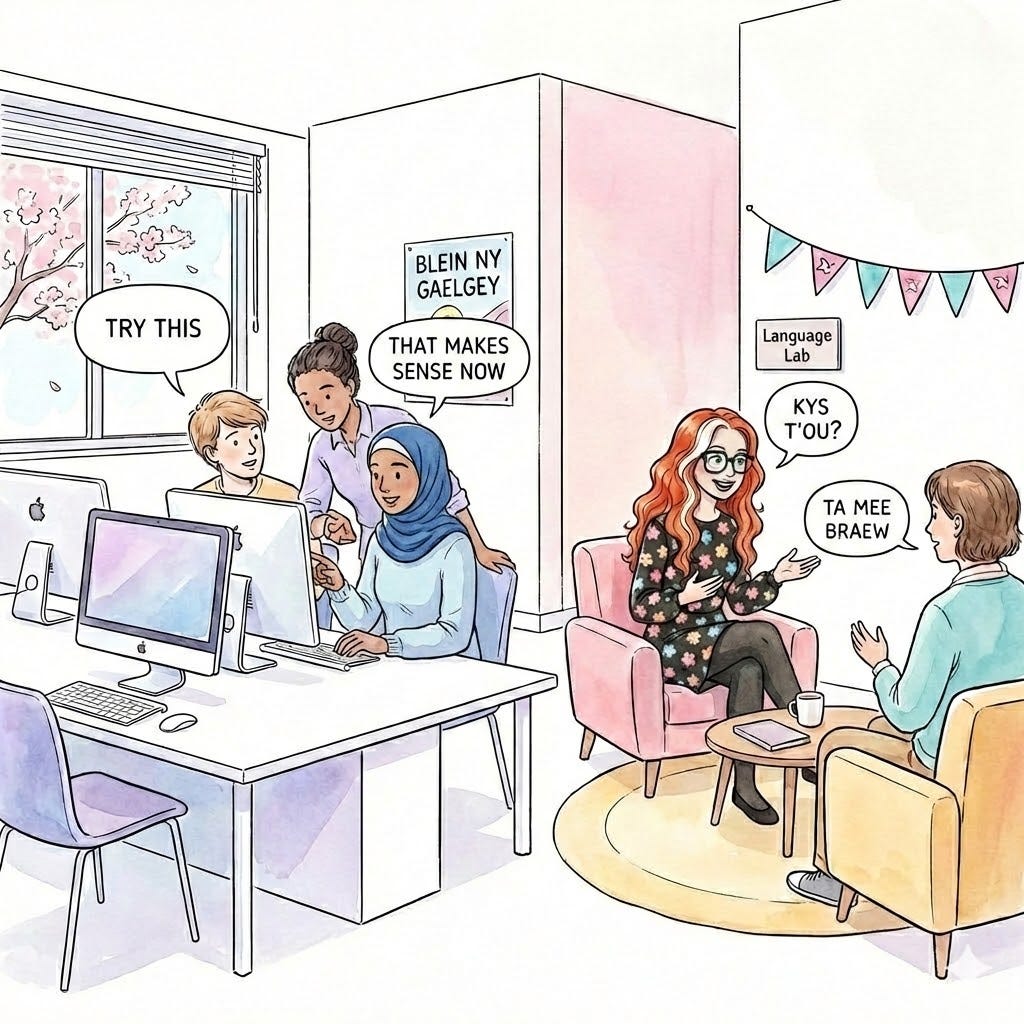
Ta Blein ny Gaelgey ayn!
It’s the Year of the Manx Language here on the Isle of Man.
Such a special thing to embrace as our language nearly died out, English replacing it for the majority towards the end of the 19th century. My Manx nana was born in 1925 and she didn’t speak it, nor did her parents as far as I know (I was blessed to have known them as a tiny child and Nana Kate and Granddad Frank definitely spoke English to me hehe).
Blein ny Gaelgey is a twelve month celebration of our native tongue, organised by Jeebin, the Manx Language Network. Their aim? To ensure that everyone, wherever they’re from, whatever their knowledge of Manx is, knows that this year of language belongs to us all.
I love the framing and ethos of “Manx language for all.”
I’ve put my money where my mouth is, and attend weekly online Manx lessons. It’s been so long since I tried to learn a new language, decades since those French classes, and I’m finding it challenging. It greatly inspires me though that most of the others on my course aren’t even from the Island. People from elsewhere choosing to learn our language. How lovely and cool is that?!
It’s important for our heritage and cultural vibrancy to nurture our Manx revival and even learning a few words helps in that! Something is better than nothing, starting small beats overthinking.
Sound familiar?
Because that’s also how I think about AI literacy. It doesn’t matter if you’ve only typed a few prompts, if you’re an absolute beginner or if you’re confidently building workflows. This technology is bigger than any single app, in the same way the internet is bigger than any single website.
It belongs to all of us now.
Which means the decisions about how it gets used, what problems it solves, whose voices shape its development... those belong to all of us too. But you can’t have a say in conversations you can’t follow. You can’t spot when something’s gone wrong if you don’t understand a little of how it works in the first place.
On our small Island, we’re aiming for 10% GDP growth through AI by 2030. That’s not just a government target, it’s our collective future being designed right now. If our people feel unable to engage, we’re building that future without our community wisdom, with less questioning or concerns heard. The literacy gap isn’t for me about missing out on productivity, it’s about who gets to shape what comes next.
That path to understanding and using AI well looks remarkably like learning a language… messy, gradual, deeply personal.
The vocabulary of doing
Manx speakers don’t wake up one morning suddenly fluent. They practice. They stumble. They ask for words they’ve forgotten. They speak with accents shaped by their own lives and histories.
What if AI literacy works the same way?
What if “being good at AI” means something closer to conversational fluency than native-speaker perfection? The ability to communicate, to get your meaning across, to learn from the moments when you’re misunderstood… and to keep showing up.
People learn the vocabulary of AI by doing, not by memorising definitions or theory.
Someone might not be able to explain what GenAI means in technical terms, but after they’ve spent twenty minutes crafting instructions for Claude to help them write in their own voice? They understand it in their bones. They’ve used the word in a sentence. They’ve made meaning with it.
This is how languages work. You don’t learn French by studying grammar tables (although, fair play, that helps). You learn it by ordering the wrong thing in a restaurant and vowing never to forget pommes did not mean potatoes again grin
I made a custom GPT to help me with Manx translation, you can find it by searching “Manx AI“ in ChatGPT’s custom GPTs. It helps me understand sentences I see written down and figuring out how to respond. AI helping me learn a language, a language helping me understand how AI learning works. I *love* that, so so much.
Studies show that learning another language boosts brain health, strengthens memory, improves attention and encourages more flexible thinking. It makes us more adaptable and better at problem-solving.
The exact capacities we need to navigate a world where AI is reshaping things ever more rapidly.
Don’t stress about your accent
You are allowed to be imperfect at this.
You are allowed to ask questions that feel basic. You are allowed to use AI for “just” drafting emails or “just” brainstorming ideas. You are allowed to be conversational rather than fluent.
I’m at a very awkward and shy stage with Manx. I know a few people who speak it and I could practise with them. But there’s something about opening your mouth and letting imperfect sounds come out in front of someone who knows what they’re doing... it’s vulnerable in a way that typing into an AI tool isn’t.
The same fear shows up with AI. People who can technically use the tools but won’t experiment in front of colleagues. Who say “I’m probably doing this wrong” as protective armour.
Your AI accent… the particular way you prompt, the kinds of tasks you reach for it to help with, the questions you ask… will be shaped by your work, your life, your curiosities.
Community as classroom
One of the most awesome things about the Year of Manx is its emphasis on community. Jeebin brings together educators, families, organisations and learners at every level. There are weekly classes, taster courses, festivals, concerts and gatherings where people simply practice together.
Learning happens in relationships.
I see this every month at our Isle of Man AI Community of Practice. We meet to share what we’re experimenting with, to ask questions we might feel silly asking elsewhere, to troubleshoot together when something doesn’t work. No one expects anyone to have it all figured out. We’re all learning.
My friend Chris and I talk often about being the change we want to see, usually straight after feeling fired up and inspired by our fab CoP group. Maybe I need to create my own community of practice for shy awkward Manx learners… people like me who know a bit, want to know more, but aren’t quite ready to practise with the fluent or confident speakers yet. A safe space to stumble together.
The research says that language learning combats social isolation and fosters community cohesion. It gives people an enhanced sense of place and belonging. I’ve watched the same thing happen in our AI sessions, people arriving nervous and leaving connected, because they’ve found fellow travellers rather than solely learning a new skill.
If you’re feeling overwhelmed by how much you don’t know, find your people. A community of practice. A colleague who’s also curious. A friend who’ll experiment alongside you. The language of AI is easier to learn when you’re not learning it alone.
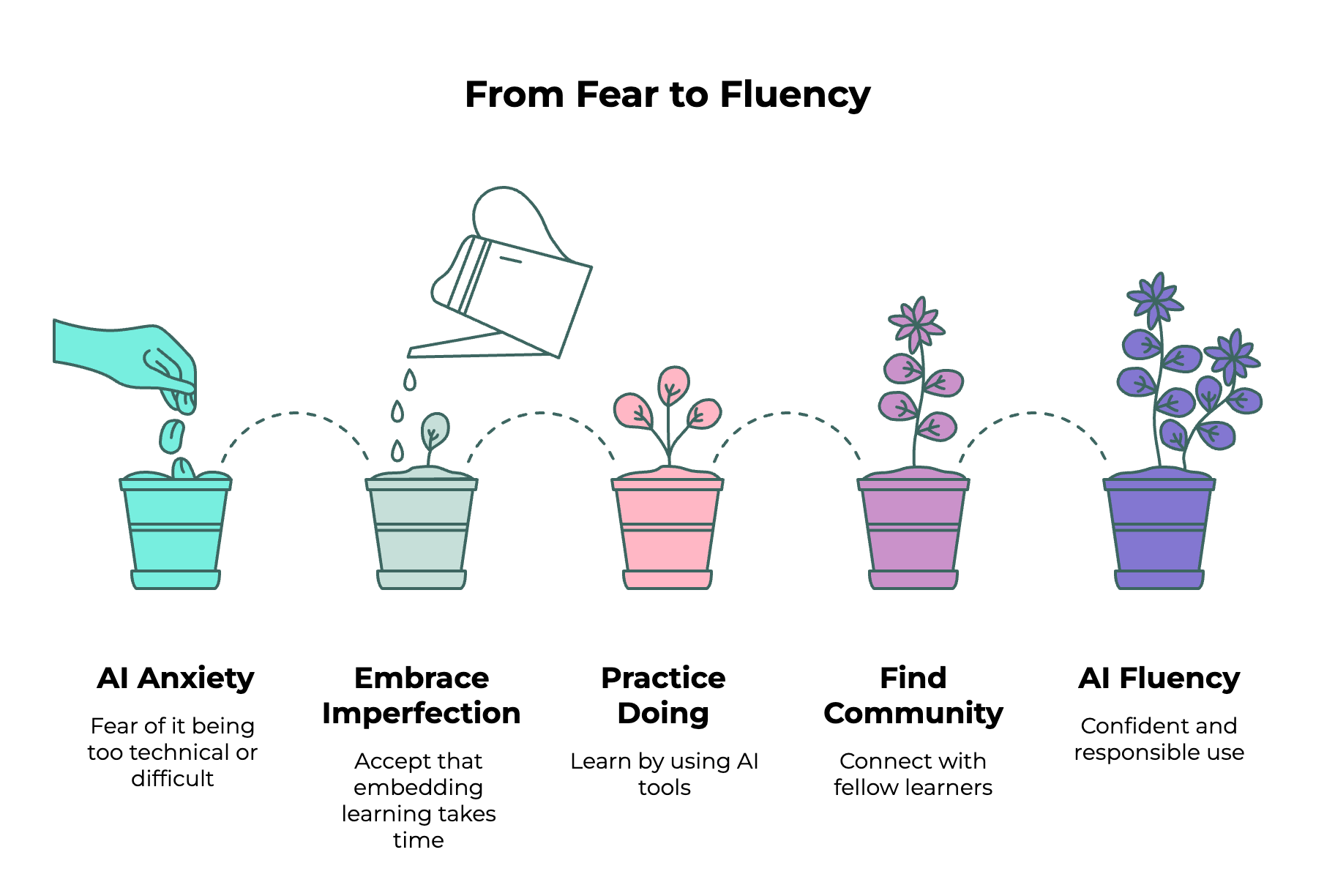
What literacy really looks like
So what does AI literacy mean in practice, stripped of jargon and urgency?
I think it means developing a working vocabulary… not every word, but enough to communicate. It means being able to ask for what you need and understand most of what comes back. It means recognising when you’re being misunderstood and knowing how to rephrase.
It means having the confidence to try, even when you’re not sure you’re doing it right.
It means understanding that you’ll never be “finished” learning, because the language itself keeps evolving. New words emerge. New expressions become common. What felt cutting-edge last year becomes ordinary.
Importantly, it means knowing that fluency isn’t the goal. Connection is. Getting your meaning across. Doing something useful with this strange new capability that’s suddenly everywhere.
The ability to understand, evaluate and responsibly use artificial intelligence technologies in daily life and work. Having the critical thinking to know when NOT to use AI too.
The Manx language was once considered extinct. Ned Maddrell, the last native speaker, died in 1974. And yet here we are, fifty years later, with thousands of speakers and a whole year dedicated to celebration and growth. The language came back because people chose to learn it imperfectly, together.
The best things about learning Manx through Blein ny Gaelgey is that it isn’t a solo sport. You borrow confidence from other learners. You laugh together at your mistakes and try again because someone else is trying too.
That’s exactly how I want AI learning to feel as well. You don’t need to become an expert, and it’s impossible for anyone to understand everything anyway!
Not competitive. Not performative. Not “who knows the most”. Just humans practising a new language together.
So if you’ve been hovering at the edge, thinking you’re behind… come closer. There’s room. There’s time. There are people who’ll stumble with you. You don’t have to arrive fluent. You can arrive shaky.
Speak in half-sentences if that’s all you’ve got today. Ask the “basic” question. Try the small thing. Keep showing up. Fluency doesn’t arrive like a certificate. It grows the way confidence grows… through practice, and through being met kindly.
The moment you start speaking, the language starts becoming yours.
What’s one small “sentence” you could try this week, in AI or in life, even if it comes out a bit wobbly if getting it wrong was allowed? And who could you practise with, maybe even one fellow traveller, so you’re not doing it alone?
Sarah, seeking ikigai xxx
PS Try this Bullet journal spread idea “The Language Learner’s Journal”
Create a weekly spread with four quadrants;
Conversations had – What did you actually use AI for this week? No judgement, just log it.
Words that clicked – What concept or technique suddenly made sense through doing?
The awkward bit – Where did you feel shy, stuck, or like you were “doing it wrong”? (This is data, not failure.)
Next week’s experiment – One small thing to try. Not master, try.
Journal prompts to try;
Who could I stumble alongside without needing to perform competence?
What do people come to me for? Could AI help me do more of that?
If this technology “belongs to all of us,” what’s my share to claim?
At the month’s end, look back. You’re not tracking progress toward perfection, you’re documenting a language coming alive.
PPS Try this AI coaching prompt with thinking mode on;
“Be my AI “language” or literacy tutor. Start by assessing my current vocabulary, ask me what AI tools I’ve tried, what worked, what didn’t land and how confident I feel on a scale of 1-10. Then uncover my fluency in other areas, what am I already good at? What do people come to me for? What energises me?
Now find the bridge, where do my existing strengths meet AI capabilities I haven’t discovered yet? Teach me one new ‘phrase’ a specific technique or approach, that feels like a natural extension of how I already think and work.
Finally, give me homework… one small way to practise this week, and one question to reflect on. End by asking what I want our next lesson to focus on.”
Let it ask you questions, answer honestly and see what emerges.
PPPS This week’s soundtrack - 🎵 “Talk” by Coldplay
There’s a robot in the video, stumbling through a world it doesn’t quite understand, searching for connection. The synth line is borrowed from Kraftwerk’s “Computer Love.” And the song asks us are you lost or incomplete?
Neither, I think. Still learning to communicate.
The song is called “Talk.” That’s all any of us are trying to do… with AI, with each other, with languages old and new. Find the words. Say them imperfectly. Keep the conversation going.
PPPPS – If you’re on the Isle of Man and want to learn alongside others, our AI Community of Practice meets monthly. Drop me a message if you’d like to know more. No fluency required. Accents welcome. To learn more about the Year of the Manx Language, visit yearofmanx.im. Gura mie eu (thank you) for reading.
Sarah, I love this inclusive definition of what AI literacy is. I agree entirely that it's something for us to discover as a collaborative process rather than specific definitions doled by highfalutin academics. The irony of that last sentence is not lost on me...