

🌸 ikigai 生き甲斐 is a reason for being, your purpose in life... from the Japanese iki 生き meaning life and gai 甲斐 meaning worth 🌸
Friday afternoon and three things needed to be done before I could escape the office for the long weekend, and I made some of the same small compromises you often do when time gets short. An email that could have been warmer. A decision that could perhaps have been run past another pair of eyes. The deeper thinking I would have done if I had saved it for Monday morning. By half past four I had three completed tasks but felt no sense of accomplishment… and the old product management triangle came to mind, asking of me;
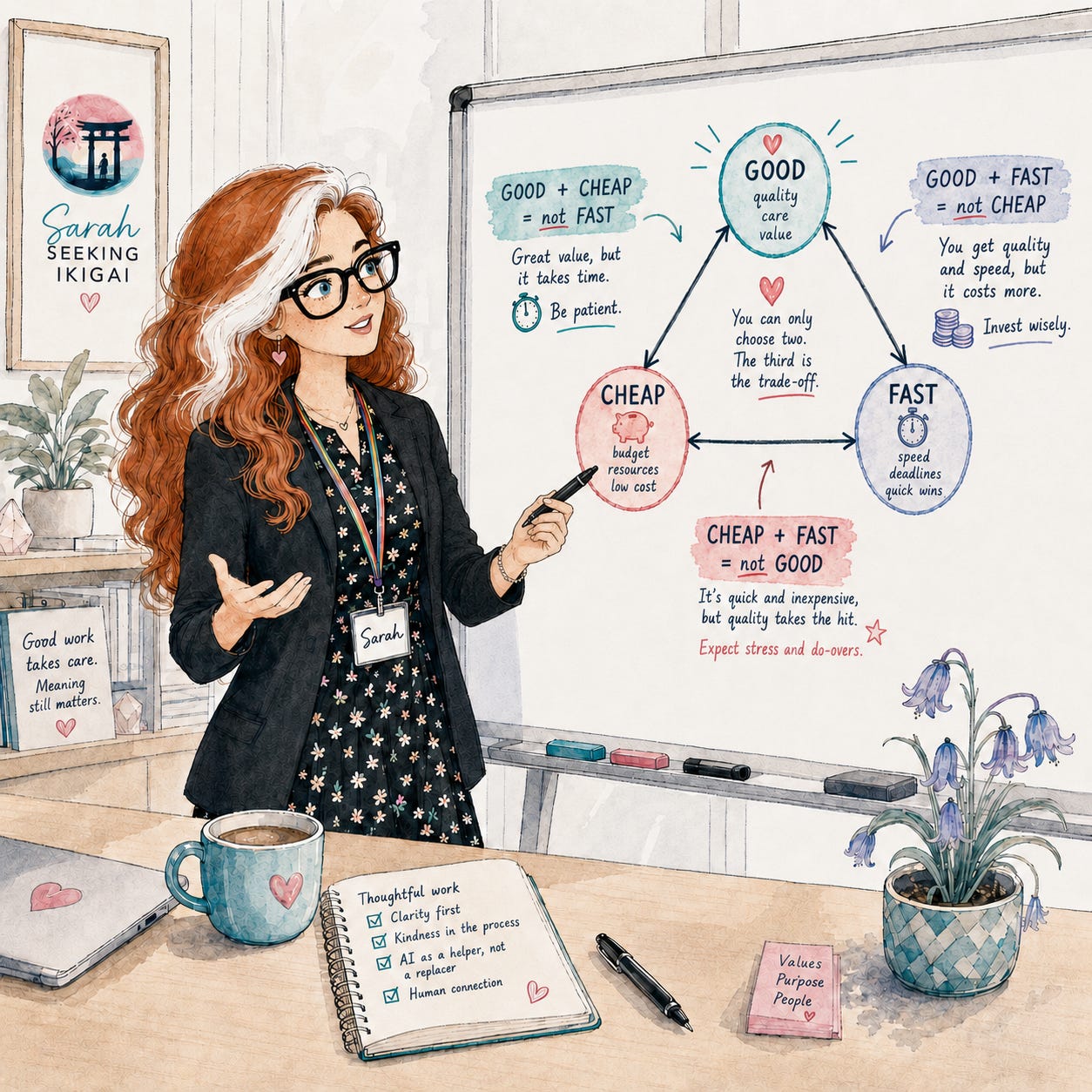
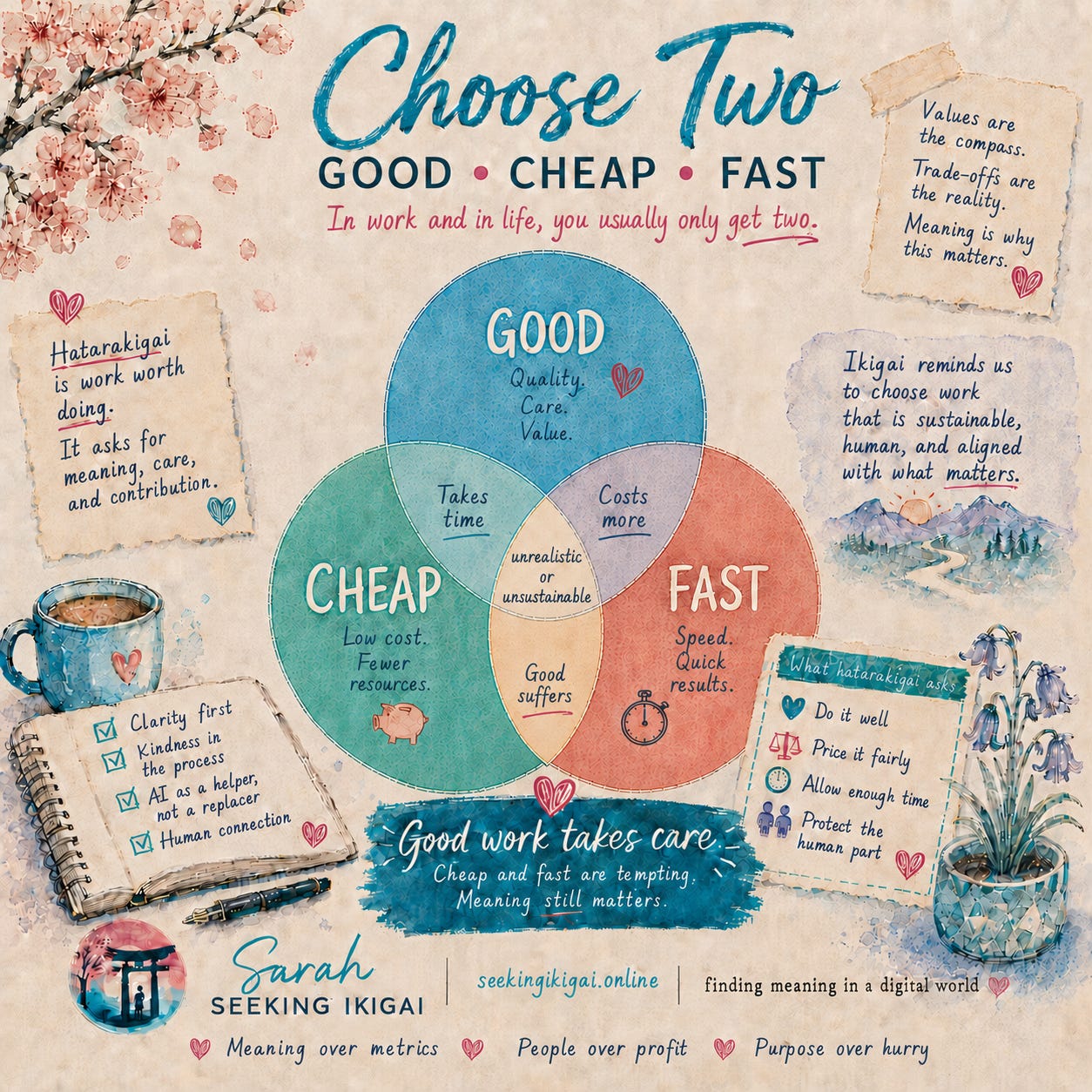
Good, cheap, fast > pick two.
It’s one of those annoyingly useful shorthand frames for thinking.
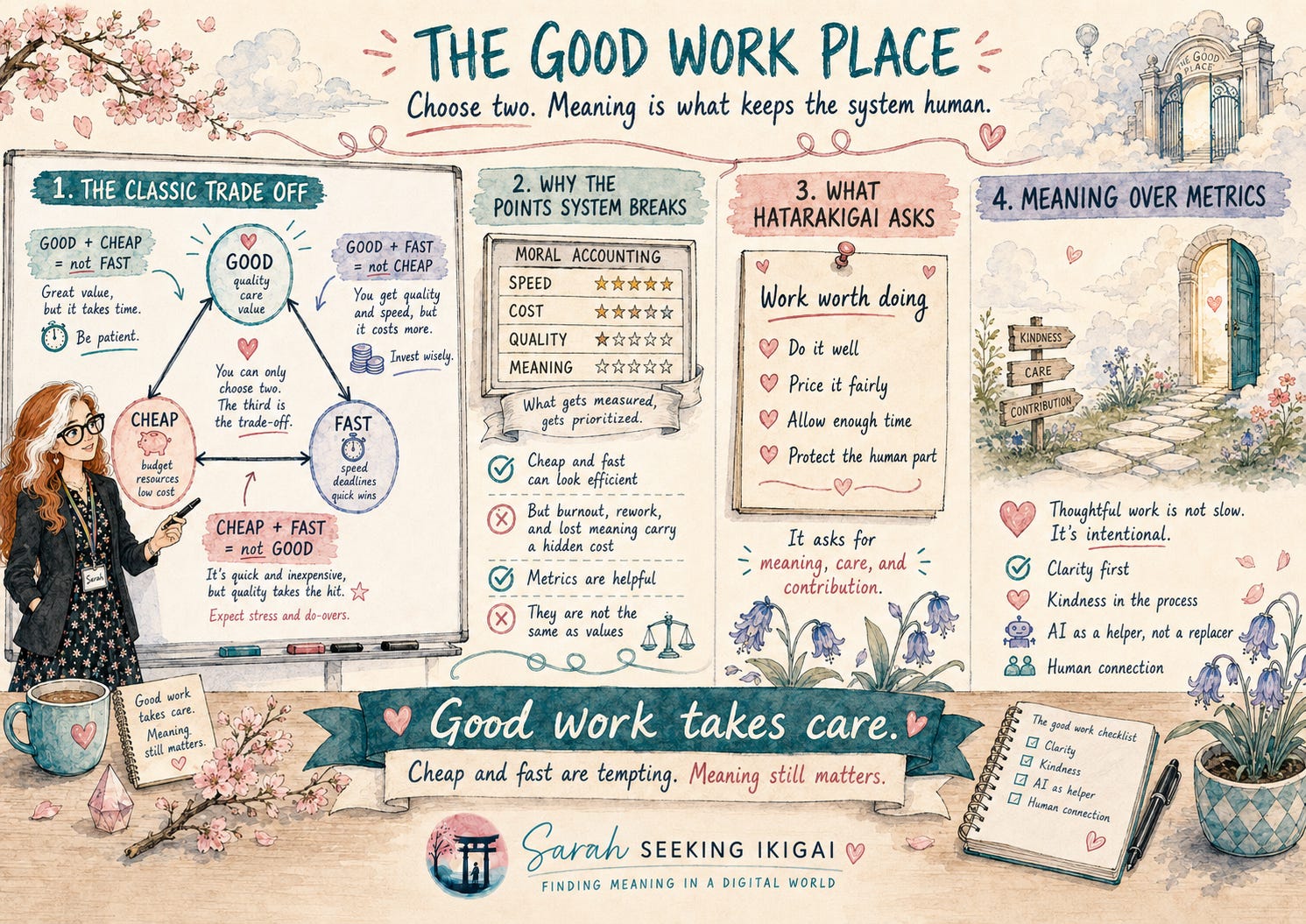
If something is good and cheap, it will probably take time. If something is good and fast, it will probably cost more. If something is cheap and fast, the good usually takes the hit. I know this. You know this. We all know this… and yet modern life keeps trying to get us to deliver all three at the same time ALL the time, and we go along with it because we don’t always feel safe enough to challenge the sometimes ridiculous norms.
The missing good
So yeah, I’ve been turning this over in my mind wandering the prom with Henry, and I think the reason it feels useful to write about now is a lack of people talking about what the missing elements really cost us.
In my old world of product management, the missing good means a downgraded project scope and a scruffier deliverable. Acceptable, fix it next time… move on.
In a life, the missing good means something else entirely.
Sometimes good means care, the kind that turns into someone feeling seen rather than processed.
Sometimes good means ethics, the long version, the one where you think through who pays for the choice you are about to make.
Sometimes good means enough time to think, which is one of the most countercultural requests you can make in 2026 (try saying it out loud at work, watch faces do interesting things).
Sometimes good means a human being on the other end of your decision did not have to absorb the cost of your rush.
Sometimes good means the work has a soul in it. Which sounds airy until you compare it with the work that doesn’t, and then you can spot the difference.
This is where hatarakigai becomes such a useful lens for me. Ikigai is often described as a reason for being. Hatarakigai is its working cousin, the part of ikigai that lives in the daily question of whether your work is actually worth doing.
Work worth doing in the older, slower sense of the words. Work that carries care, contribution, skill, relationship, attention, dignity and enough breathing room for a human being to stay a human being while doing it.
Which is a bit of a ‘mare to be fair… because care is very hard to squeeze into cheap and fast.
The Good Place metrics problem
I’ve been thinking about The Good Place a lot this morning too, partly because it’s one of my fave programmes in recent years but mostly because it figured out something about goodness I think is useful for how we live and work now.
The show opens with a points system. Every action you take in life is scored. Good actions add points, bad ones lose them, and at the end of your life the system tells you whether you’ve earned the Good Place or the Bad Place. Auditable and beautifully spreadsheet shaped. Eleanor (played by Kristen Bell) arrives in the Good Place by clerical error and spends the first season trying to learn how to deserve being there.
What the show reveals is that the points system is broken, that modern life has made ethical living almost impossible to score. Every decision tangled in unseen consequences and the points framework can’t cope with the texture of being alive.
If that sounds suspiciously like our current relationship with productivity metrics, that’s because it is.
We measure outputs, response times, engagement, time saved, cost reduction, efficiency gained… none of it wrong on its own, but all of it incomplete. A piece of work can be fast and harmful. A decision can save money and break trust. A process can be efficient and make people feel like spare parts. A piece of AI-generated content can be polished and say nothing that matters.
The other lead character is Chidi, a moral philosophy professor who’s so scared of making the wrong choice that he becomes incapable of making any choice at all. Forty-five minutes in a frozen yoghurt shop trying to decide a flavour. Chidi is what happens when too much care becomes paralysis. Thinking as a hiding place, research a very well-referenced form of fear. I love him because he’s also learning, good work does needs care, but care without action is not living.
The show beautifully illustrates that goodness isn’t a score you achieve. Goodness is a practice. You get better through relationship and repair, through trying and failing and apologising and trying again. The book Chidi keeps trying to give Eleanor, the one she never wants to read because it’s so dense, is called What We Owe to Each Other. That title, almost an aside, is the answer the whole show is looking for.
The same is true of work. The work that matters is the work that holds together what we owe to each other.
What we owe, fundamentally, is our presence and our judgment. But we live in a culture that treats presence as a bottleneck. Enter the machine, promising to remove the strain.
Cheap, fast and the machine
If we consistently choose cheap and fast in our AI use, what is the missing good?
It’s our judgement. Our voice. Our care. Our ability to know what we think before something else has helpfully told us.
I keep returning to a phrase that’s been showing up in my writing for a while now. Usage is curriculum. Every prompt a small vote for what humans value. If we consistently ask AI for the cheap and fast version, we are teaching the system that cheap and fast is what we want. Billions of times a day, the curriculum is being written… and I fear that the curriculum being written right now leans heavily toward shortcuts.
Some of our work is totally fine to run at speed. The weekly admin. The first pass at a project checklist. The summary nobody will ever quote. There’s no shame in running it through cheap and fast tools. I’d much rather be writing an essay than reformatting a spreadsheet by hand.
The trouble is that not all our work belongs in the shortcut pile. The thing only you can write. The voice nobody else has. The relationship that asks you to be present. The decision that will shape someone’s morning, or month, or life. The slow, irreplaceable work of having a mind of your own.
If we choose cheap and fast in our relationships, the missing good might be presence.
If we choose cheap and fast in our health, the missing good might be strength.
If we choose cheap and fast in our creativity, the missing good might be voice.
If we choose cheap and fast in our organisations, the missing good might be trust.
If we choose cheap and fast with AI, the missing good might be a sense of self.
The trade off is rarely obvious at first, which is what makes it so dangerous. Cheap and fast often looks brilliant in the short term. It looks productive, clever, sharp, like we’re really getting things done. Then weeks or months later we wonder why everyone is tired, the work feels hollow, the relationships feel thin, and the thing we were building no longer resembles the thing we meant to build.
Good is not always slow
I want to be careful not to make good sound precious or ponderous, we’ve already shown Chidi as a cautionary tale.
Good is sometimes swift, because someone has practised for years. Good is sometimes simple, because someone has done the thinking to remove the clutter. Good is sometimes affordable, because a community has shared resources wisely. Good is sometimes rough around the edges and still completely enough.
The point of all this is to think carefully and choose honestly. To stop pretending the tension in the triad doesn’t apply to us. To stop expecting impossible things from ourselves and the people we work with. To know when something deserves twenty minutes and a cup of tea, and when something deserves a workshop, a long conversation, a careful review, a budget, a second pair of eyes and a night’s sleep.
So this is the reminder I am taking with me into next week, when something feels strained, I’ll ask myself which two I’m perhaps unconsciously choosing.
Good and cheap? I need to allow time.
Good and fast? I need to accept the cost, whether that’s money, energy, attention or support.
Cheap and fast? I need to be honest that the good will be limited, and decide whether that’s acceptable. Sometimes it absolutely is. Sometimes it absolutely isn’t.
Questioning helps me stop expecting impossible things from myself. It helps me notice when I’m asking someone else to absorb an invisible cost. It helps me see when AI is supporting the work, and when it’s helping me polish something I haven’t properly thought through.
Most importantly it helps me protect the work that matters most. Because not everything deserves maximum care, but some things do. Your health does. Your relationships do. Your voice does. Your values do. Your contribution does. The work that carries meaning deserves better than being endlessly squeezed through the cheap and fast pipe.
Good work takes care
I love the discipline of my Saturday essay ritual, my weekly refusal to do something cheap and fast. Henry waits, the coffee goes cold, the journal gets opened, and I let the process take as long as it needs to.
The Good Place ends with the idea that people can get better. Through practice, through friendship, through noticing, through failing and apologising and learning and trying again. Real change is really hard to apportion to simple metrics or winning points.
That’s the hope I want to keep hold of. That we can choose with more care. That we can notice what is being sacrificed and that we can stop pretending cheap and fast are free from consequence.
Good, cheap, fast. Pick two.
When the work really matters, when it touches your values, your people, your health, your meaning, your future self, your tiny corner of the world, be very careful before you trade away the good… because good work takes care and so do we.
Who in your life is doing good work the slow way and making everyone around them better for it? I’d love hear about your family, your colleague, your neighbour, the person at the shop who remembers your name.
Sarah, seeking ikigai xxx
PS Bullet journal spread for this week. Draw the venn circles, or a triangle with corner labels of good, cheap and fast. Pick an area of your life or work that feels stretched right now. Which two corners are you defaulting to? Reflect on what is paying the price? What would change if you were able to skew more towards protecting the good?
PPS Try this with your preferred AI tool with extended thinking turned on.
“Help me think through a project or decision I’m wrestling with using the good, cheap, fast triangle. Ask me one question at a time. Start by asking what I’m trying to achieve, then who it affects, then what constraints I’m working with, then what ‘good’ actually means in this specific context. Once you’ve got a clear picture, reflect back the most honest trade off I’m making, and help me decide whether it’s the one I want to be making. Be warm but sharp with me, I’m not looking for comfort, I’m looking for clarity.”
PPPS This week’s soundtrack is All These Things That I’ve Done by The Killers, because underneath all the spreadsheets and shortcuts and second-guessing and second chances, there is still that very human wish to become better without losing ourselves. It feels like the sound of someone standing in the rubble of their own choices, sleeves rolled up, still ready to try again.
This stayed with me: “usage is curriculum.”
It’s such a neat little sentence, and rather inconvenient in the best way. Every shortcut teaches something. Every careful choice does too.
I like that this doesn’t turn slowness into a virtue costume. Sometimes fast is fine. Sometimes the spreadsheet can absolutely have the machine. But voice, trust, judgement, care — those are not admin tasks. They need a human still attached.
Oh I love the good place! Such a good, fun show! With heaps of deeper meaning delivered in such an easy to process way.