


🌸 ikigai 生き甲斐 is a reason for being, your purpose in life, from the Japanese iki 生き meaning life and gai 甲斐 meaning worth 🌸
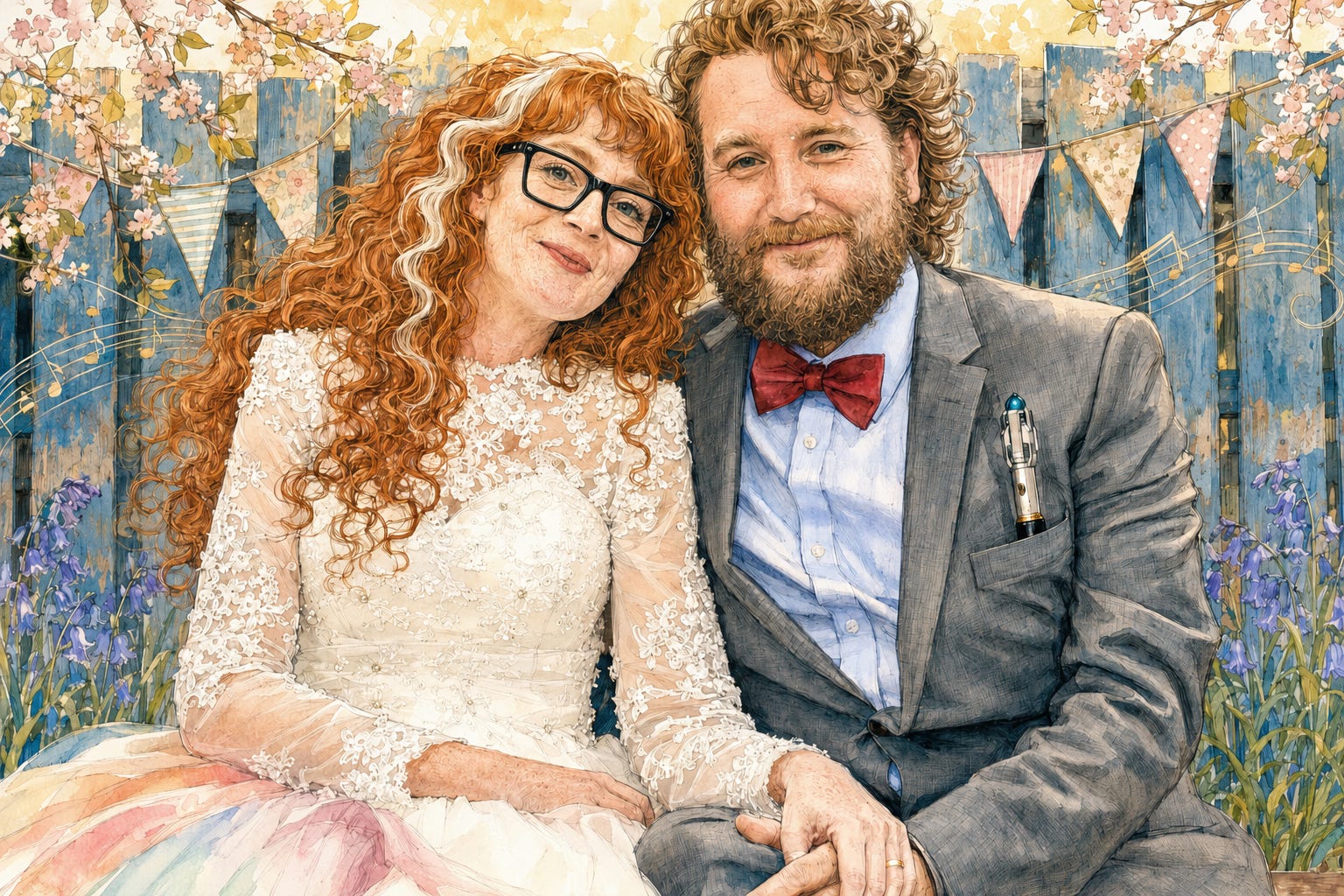
Eleven years ago today, Andrew and I stood in a beautiful field on the Isle of Man and asked the people we love to witness our wedding.
We wrote our Humanist ceremony together, sprinkling in love, honesty, respect and joy. It asked whether we would commit to being best friends, to creating a loving and stable home for our children, whether we would be kind, considerate, tolerant and understanding… oh and whether we would keep working together when hard times came.
We answered, “We do.”
Our wedding rings described as circles looking inwards towards each other and outwards towards our wider community. That we were choosing each other’s children, families and people alongside each other. We placed our marriage inside something larger than the two of us.
It was Wedfest, handmade, heartfelt and perfectly imperfect.
This anniversary has arrived in the shadow of losing Anna. Grief has made me so very appreciative of the fragile privilege of continuing to share a life with someone at all. Loss removes the illusion that presence is ordinary. It also makes you notice what it means to have someone beside you who knows the backstory, remembers who you were before the latest thing happened and can recognise the difference between a bad mood and an old wound. Someone who has lived through the ups and downs of the process of becoming.
That word, witness, means something different to me now than it did in a field eleven years ago. A wedding asks other people to witness your promises. A marriage asks two people to continue witnessing one another. It means remaining interested in the person your partner is becoming, rather than expecting them to remain exactly as they were when you chose them. It means noticing the effort behind their changes and remembering earlier selves without using those memories to hold either of you in place.
I think this is another aspect of ikigai. We strive to unearth many things to live for, but as social creatures we yearn for a special someone to notice that we are living and growing.
The love I want
Long before Andrew, there was an Elton John song.
I remember passionately (often drunky *grin*) singing along to I Want Love many a time, I’d learnt that I didn’t want love at any cost, but that I did still kinda want it. The song is bruised and wary. It carries the longing of someone who wants something healthier and more realistic than whatever hurt before. The accompanying video makes loneliness visible. Robert Downey Jr walking through an enormous empty house, lip-synching the song in one uninterrupted take with pain and longing in those expressive eyes.
I’d learnt something about what I did not want. I knew that frequent tears were a warning. Chemistry could not compensate for incompatibility. Excitement could never build a shared life if somebody was never truly available. Love should never require us to become smaller or live indefinitely on future promises.
I already knew I was capable of being happy on my own, less willing to settle, I sang I Want Love as a refusal to accept the wrong kind of somebody.
Love, respect and fancy
When I went looking on purpose, I wrote an honest and lengthy dating profile. What I valued and how I wanted to live. I figured that anyone worth meeting would need to recognise me from my words. I was looking for a witness before I had the word for it.
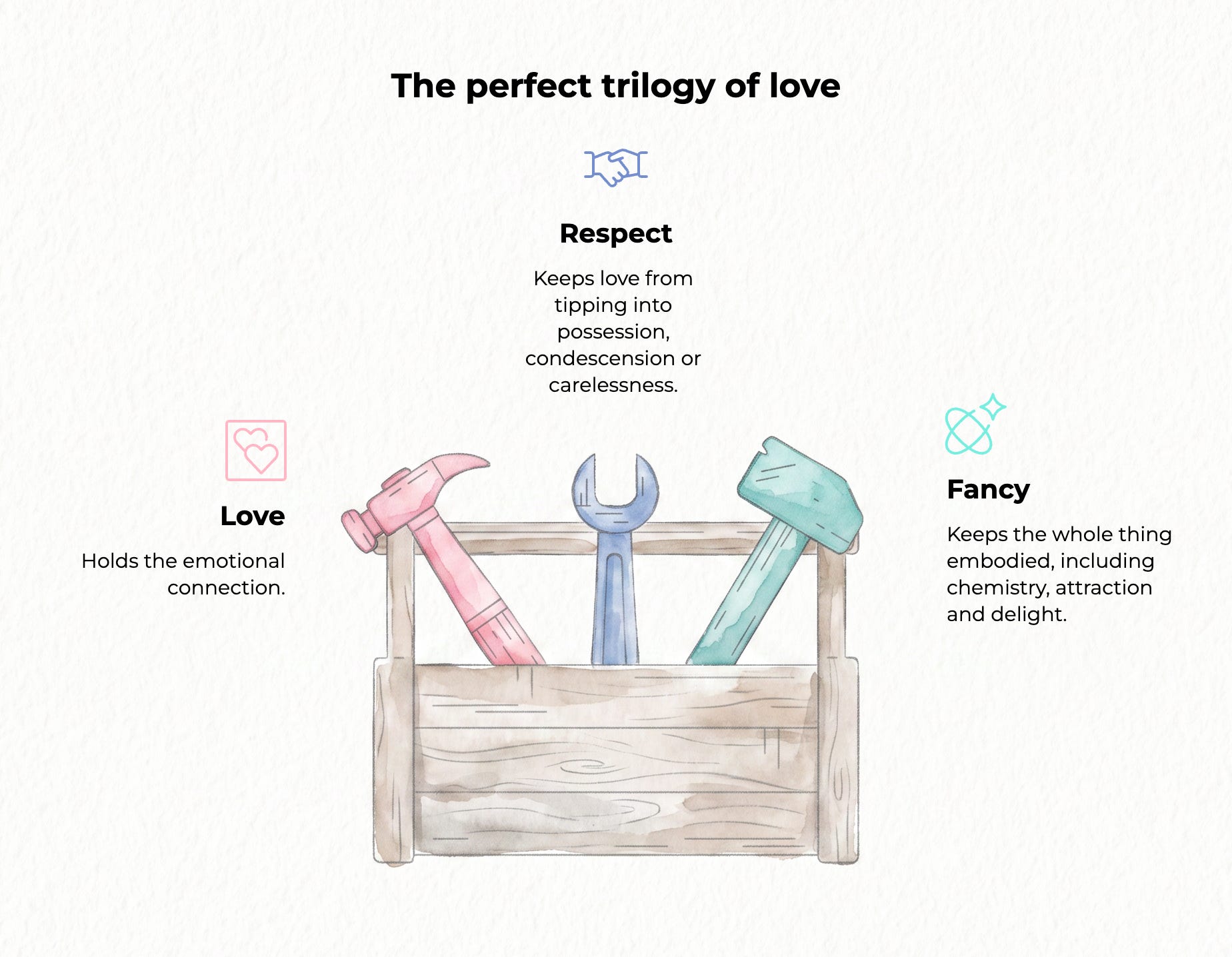
A few months after meeting Andrew, I tried to explain what felt different. I wrote about the lessons I had learnt from earlier relationships and the ways each had helped me understand myself. Then I described what I believed was the perfect trilogy, someone you love, respect and fancy, who feels the same way about you.
I still love that formulation.
❤️ Love holds the emotional connection.
🤝 Respect keeps love from tipping into possession, condescension or carelessness.
✨ Fancy is my unpretentious word that keeps the whole thing embodied. It includes chemistry, attraction and the delight of looking across a room and still being pleased that this particular human chose you too.
With Andrew, there was always an intellectual attraction, an affinity in the way we thought and expressed ourselves and when we had our first date he passed the highly scientific hug and sniff test for the physical too hehe. There was also the experience of seeing what an extraordinary parent he is. Falling in love with him meant welcoming three wonderful young people into my life and Willow into theirs too. I had met someone kind and clever with whom I could imagine creating a real, joined-up life. Someone who had got me from my words alone and wanted to keep learning more.
In that early piece, I wrote that love itself was simple and kind and should not be an effort. I also wrote that when life became trickier, I would “study fecking hard” until it became easier again. Love at its best is simple and kind but people are complicated, and lives are rarely simple. There is a difference between working together on a relationship and constantly working to make cruelty, incompatibility, indifference or instability resemble love. A difference between the effort of understanding another person and the exhaustion of repeatedly persuading them to care. Showing up is meaningful only where there is kindness, safety, respect and reciprocity.
Even when those foundations are present, commitment still involves active choice. You choose each other, and you choose your own attitude. You choose whether to assume the worst or remain curious. You choose whether being right matters more than repairing connection, to keep learning the person in front of you rather than insisting that they remain the person you first met.
You choose to keep showing up. You choose to keep noticing.
Two songs together
This is where the second Elton John song enters.
I could present I Want Love and Your Song as two stages of a romantic journey. First, we long to be loved, then we find someone and want to offer to them what that means to us. Real love loops though, we move between need and offering, between asking to be known and trying to show another person that we know them.
I Want Love faces inwards, carrying a vulnerable desire to be received without abandoning the boundaries that protect. Your Song faces outwards, beginning with the problem of having no adequate gift to express what another person means, so the narrator offers something personal and imperfect instead. One song says, “I want a love that is worthy of me.” The other says, “This is the love I can make for you.”
A lasting relationship needs both, love travels in both directions. Wanting healthy love is an act of self-respect. Offering love is how care becomes visible. That is why Your Song reminds me of Wedfest. We made something from the words, values, people, music and random joy available to us. The ceremony itself was an offering. We chose every part of it together. We said that love in its many forms was the foundation of life. We promised respect, trust, kindness and understanding. We acknowledged that hard times might come and committed ourselves to working through them together.
We described how we felt and how we intended to behave, they were vows about attitude and action.
Being seen into becoming & purpose in the plural
Being witnessed is active. The ways we see the people we love can change what becomes possible for them. There is a relationship psychology concept called the Michelangelo phenomenon. It describes how close partners can help one another move towards their ideal selves through the ways they perceive, affirm and behave towards each other.
A loving partner recognises and encourages the person you are already trying to become. The chisel stays in your own hand. The research found that this kind of partner affirmation was associated with movement towards the ideal self and with personal and relationship wellbeing. Sometimes another person sees our becoming before we can. They remember an ambition we have started dismissing as silly. They reflect back a strength we thought was ordinary. They create enough safety for an unexplored part of us to emerge. They help us remain visible to ourselves.
What is ikigai if not, at least partly, movement towards a life that feels more authentically our own? However, much of the modern conversation about purpose happens in the first person singular. What do I love? What am I good at? What should I do with my life? Ikigai concerns our felt experience of life having value, and very little of life is created alone. Another person shouldn’t become our entire reason for living though, that places an impossible weight on any human relationship.
Some meaning is relational, it is made between us. There are also truths about ourselves that we struggle to see alone. I can talk myself into almost anything and out of most things. A loving witness cannot give me a perfectly objective account, but they can offer another honest vantage point. They can remind me what happened, what it cost and what I cannot always see from inside myself. Connection is not merely a pleasant extra, it is one of the places where our understanding of ourselves is formed, challenged and held.
A person can become part of your ikigai without becoming responsible for it. They can make the world feel more inhabitable and help you notice joy. They can remember your hopes when you have temporarily misplaced them, or stand beside you during experiences neither of you would have chosen and help you remain recognisable to yourself. Losing Anna has made me think about how much of us is held in the memories of other people. The people who know our backstory are living libraries of shared language, earlier selves, half-forgotten hopes and moments that mattered. Grief has made the continuing presence of those I love feel newly precious. Loss changes the focus. It makes ordinary presence extraordinary again, and it reminds you that your life has always been a shared document, written and checked by many hands. If you are reading this having lost the person who knew your backstory, I am SO sorry. I have no other words, only love and the hope that you are being witnessed by others and that you remember that what they saw in you is still true.
We still do
Our Humanist ceremony ended with a toast to “love and laughter, today and forever more”. Forever is far too big to experience all at once. It arrives in ordinary days, built up through small kindnesses, difficult conversations, shared responsibilities, ridiculousness, mutual respect and the decision to return to one another after life pulls attention elsewhere.
Eleven years of marriage is millions of small choices. The romance is that we have continued to meet one another’s changing selves and say, in all sorts of ordinary ways, “I am here for this version too.” When I met Andrew, I wrote that perhaps we had already had our last first kiss and fallen in love for the last time. I adore the joy of the woman who wrote that and I’ll keep practising choosing the same person through lives that keep changing.
I still want love. This love, grounded in kindness, respect, attraction, trust and the freedom to remain fully ourselves.
I still want to offer love. Something handmade, personal and made visible.
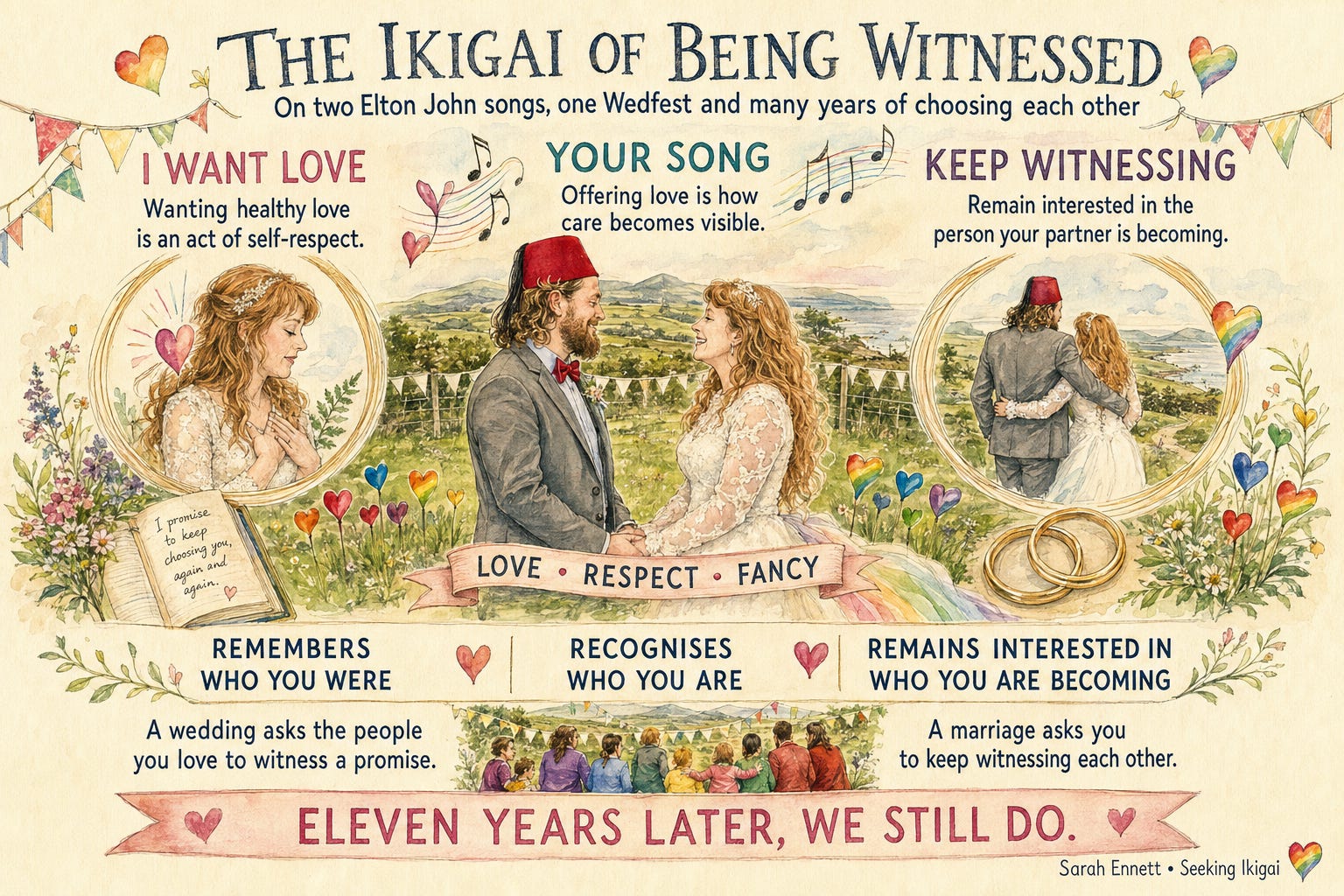
The ikigai of being witnessed is knowing that someone remembers who you were, recognises who you are and remains interested in who you are becoming.
A wedding asks the people you love to witness a promise, a marriage asks you to keep witnessing each other. Eleven years later, we still do.
“How wonderful life is while you’re in the world.”
Happy anniversary, Andrew.
Sarah, seeking ikigai xxx
PS A love, respect and fancy review
This is an invitation to notice what is alive within a relationship, we don’t need scorecards!
Divide a journal page into three sections headed Love, Respect and Fancy.
Under Love, record the small actions that make care visible.
Under Respect, notice the ways you encourage one another’s autonomy, growth, opinions, responsibilities and boundaries.
Under Fancy, include attraction, chemistry, play, laughter and the pleasure you take in each other’s company.
Then on your next free page reflect on what Choosing in your relationship means, ask yourself what you are choosing together now, what attitude you want to bring to it and how you can show up without abandoning yourself. Then ask who else witnesses this relationship, and when you last let them.
The exercise can also be adapted for friendships and family relationships by replacing Fancy with Delight. Who makes you glad to see their name appear on your phone? Who makes life feel warmer, funnier or more possible?
PPS An AI prompt for a gift that shows you notice
I want help choosing an anniversary gift for my partner. Ask me one question at a time, five questions in total, covering how many years we are celebrating, what they have been into lately, something they have said they miss or want more of, a private joke or shared memory between us and roughly what I want to spend. Then suggest five gift ideas. At least one should nod to the traditional material for that anniversary year, at least one should cost nothing but time and at least one should be something handmade or personal. For each idea, tell me what you think it would show them I had noticed.
Eleven years is steel, apparently… though the best gifts have less to do with the material and everything to do with whether the other person felt cherished or seen.
PPPS The soundtrack
Begin with I Want Love and remember the part of you who wants love without having to settle for its poorer imitations.
Then play Your Song, thinking about the love you have received and the imperfect, handmade ways you continue to offer it.
Aww...I wish I could travel back with the Doctor and witness your Wedfest. xxoo
Aww what a beautiful piece.🩷🦩