

🌸 ikigai 生き甲斐 is a reason for being, your purpose in life – from the Japanese iki 生き meaning life and gai 甲斐 meaning worth 🌸
Someone is trying to steal your want.
Not your attention, we already know the battle of the infinite scroll. We’ve been fighting that for years and mostly losing *grin*. Some of the smartest people in Silicon Valley are building systems designed to understand what you intend to do before you’ve quite decided for yourself. Mining your dreams like a gold rush.
Your deepest motivations and half-formed desires. Your whispered “what if” moments... those are the new currency.
I think we need to get to them first.
I’ve been thinking about this since listening to Dr Laurie Santos on The Happiness Lab this week, chatting with Dave Evans and Bill Burnett from Stanford’s Life Design Lab. They were talking about how to live a meaningful life and described it all as “the story of becoming”.
The story of becoming, and the fact it is never ending.
I know it might seem obvious when you read it like that, but we don’t think about how important a concept this is to really come to terms with day to day, do we? We often think about getting somewhere. We optimise and plan and set goals and imagine some future version of ourselves who has finally figured it all out and is sitting in a sunlit room feeling whole.
That person doesn’t exist. She never will... she doesn’t need to.

The Nothing is here
Have you seen The NeverEnding Story?
I LOVED it as a kid, and it lodged itself in me deeply. I adored Falkor the flying luck dragon, was traumatised by the scene with Artax in the swamp… but what really got to me was The Nothing.
The Nothing was the force destroying Fantasia. It wasn’t war or some dark army but the absence of imagination, of desire. The absence of humans caring enough to dream. Fantasia was dying because people had stopped wanting things, stopped believing their inner worlds mattered.
I worry that we are inviting The Nothing in.
Opening your phone and an hour evaporates into other people’s curated lives, or nonsense. Every time an algorithm decides what I should want before I’ve had the chance to sit with my own desires. Every time someone tells me AI will “handle” the creative bits so I can focus on... what, exactly?... that’s The Nothing wearing a Silicon Valley hoodie and calling itself progress.
I don’t think I’m being *too* melodramatic. I think it’s a defining tension of our time and lots of us feel it in our bones even if we struggle to articulate it.
The battle has moved
For two decades, the attention economy was the game. Capture eyeballs. Monetise scrolling. Turn human curiosity into advertising revenue. We all know this story. We’ve read the articles, watched The Social Dilemma, felt guilty about our screen time and then picked up our phones again anyway.
But things are changing, and I want to tell you about two very different visions of what comes next.
Back in 2006, a writer and technologist called Doc Searls coined the term “the Intention Economy.” He wrote a book about it and spent years building tools and communities to make it real, and his vision is genuinely lovely.
Searls imagined a world where you declare your intentions and the market responds to you. Where customers lead and systems follow. Where your agency is the starting point, not the target. He wrote that “relationships between customers and vendors will be voluntary and genuine, with loyalty anchored in mutual respect and concern, rather than coercion.” His Intention Economy was always about putting humans in charge of their own desires and decisions.
I love that vision. It aligns so deeply with everything I believe about how AI should serve us.
And then, in late 2024, researchers from Cambridge published a paper in the Harvard Data Science Review that used the same term for something that feels like its shadow. They described a future where AI systems don’t just capture your attention but learn to predict and shape your motivations before you’ve fully formed them yourself. Searls has publicly and rightly asked them to find a different label, because what they’re describing is the opposite of what he’s spent nearly two decades building.
I agree with him. So I’m going to call the dark version what it actually is: desire mining.
Think about it. When you type a prompt into an AI tool, you’re sharing something far more intimate than a Google search. You’re sharing your desires in full sentences. “Help me write a resignation letter.” “I want to feel less anxious.” “How do I tell my partner I’m unhappy.” These aren’t search terms. These are confessions. And every single one of them is data that tells a system what you want, what you fear, where you’re vulnerable and what you might pay to feel better.
In the attention economy, your gaze was captured. In the age of desire mining, your choices could be shaped before you even fully form them. Not to serve you, in the way Searls envisioned, but to sell to you. To keep you in a loop of wanting things you didn’t know you wanted until the algorithm showed you them at exactly the right moment.
That’s The Nothing in 2026. Sophisticated, personalised and wearing a face you trust.
Becoming on purpose
So here’s what’s been bubbling in my brain, and where ikigai meets life design meets a children’s fantasy film from 1984 in a way I hope makes sense.
In The NeverEnding Story, the whole of Fantasia is saved by one act. Bastian, the boy reading the book, has to give the Childlike Empress a new name. He has to want something. He has to name his desire out loud, into the storm, with everything falling apart around him. And he does. He screams his mother’s name into the wind. One clear, human, aching intention.
That’s the antidote. Then and now.
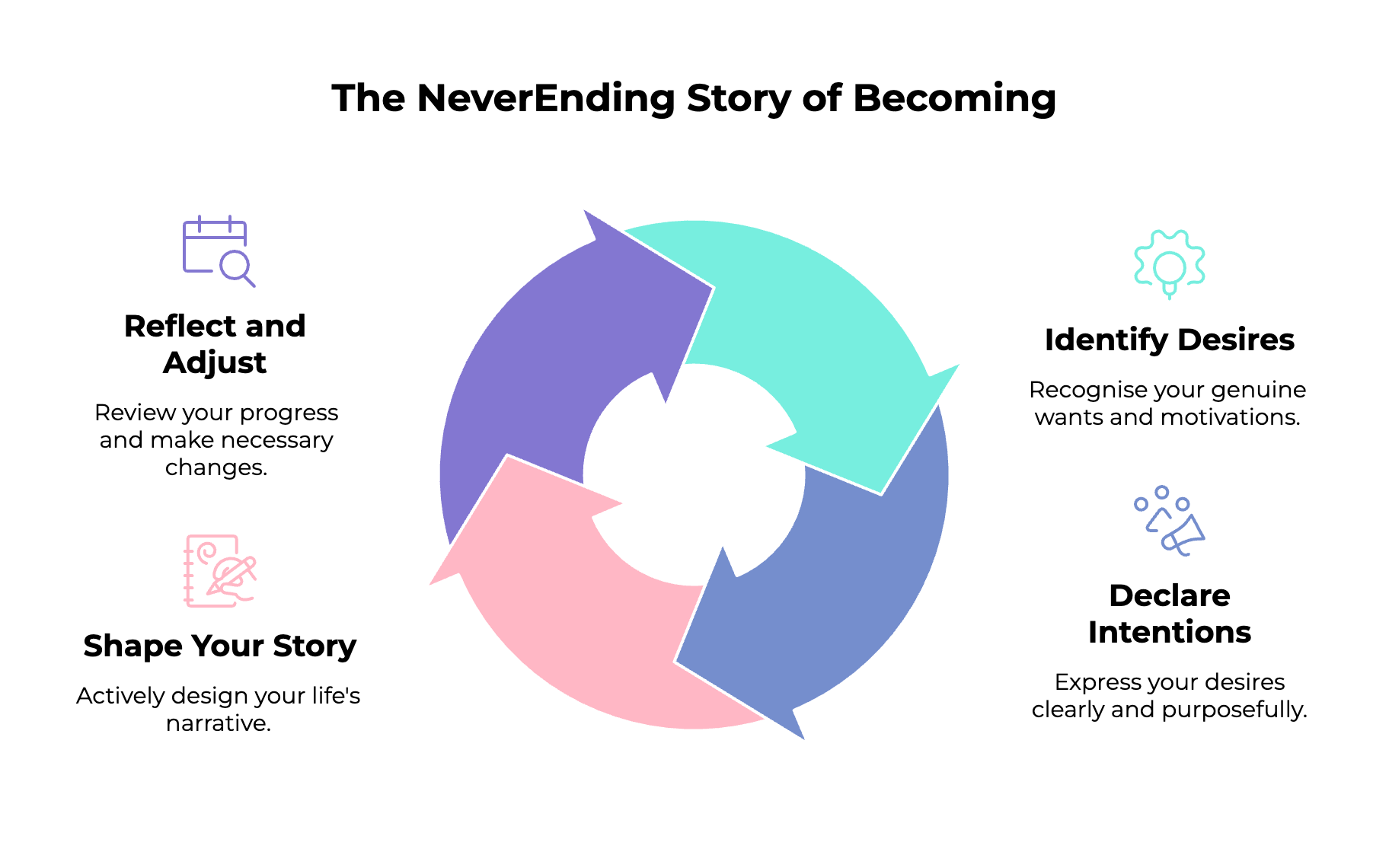
When Bill Burnett talked about life design as “the story of becoming,” he was describing what ikigai practitioners have known for centuries. The Japanese verb form for this... ikigai ni naru means “to come into one’s ikigai.” To become your purpose rather than to find it, language stating that purpose is a process, not a destination.
This is what Evans and Burnett teach at Stanford using design thinking. Curiosity. Bias to action. Reframing. Awareness. Radical collaboration. Five tools as a framework for the practice of becoming... ikigai in a Stanford blazer, same wisdom, different accent. Their latest book is called How to Live a Meaningful Life and Burnett said on the podcast;
..one of my favorite quotes is if you can’t find enlightenment right where you are, where do you expect to find it? Is it over there? Is it over there? It’s right here. And it’s in just little moments.
Right here, right now… in the becoming.
I wrote in my very first manifesto that “happiness is a way to travel, not a destination.” I’ve believed that for years, but I think desire mining threatens the travel itself. If our desires are being shaped and predicted and commodified before we’ve had the chance to feel them properly, we lose access to our own becoming. We become passengers in someone else’s version of our story.
And that... that is the ikigai risk I keep writing about, showing up in a new disguise.
Getting to your want first
We can’t opt out of the world we live in. I’m not going to tell you to delete your apps and move to a commune, as tempting as that is at times... but we can get to our own intentions before the algorithms do. We can practise wanting things on purpose.
This is what my bullet journal has always been for, I think, even before I could articulate it this way. When I sit down with my pen and a blank page and write “what do I want this week?” I am performing an act of resistance. A small, quiet, powerful act of declaring my own intentions in my own handwriting before any system gets to shape them for me.
The Japanese concept of kaizen (改善) fits here too. Continuous small improvement. Each day a fraction better, a fraction clearer, a fraction more you. Not the dramatic reinvention that some feeds try to convince you that you need. The gentle, persistent, compounding becoming that happens when you pay attention to your own life with intention and kindness.
I keep coming back to what Burnett and Evans describe as the design thinking approach. They say you don’t need to spend ten years developing a meditation practice. You need to flip a switch in any given moment from going through the motions to actually being here. The shift is available to all of us, all the time. But we have to choose it, and choosing requires knowing what you want.
The attention economy stole our time. Desire mining wants to steal our direction. But direction is something you can reclaim every single morning with a pen, a question and five minutes of honesty.
Your NeverEnding becoming
So here’s what I think you should really think about… what if the goal was to never arrive?
What if every essay I’ve written, every journal prompt I’ve shared, every framework I’ve sketched out has been circling the same simple truth? That the point of ikigai, the point of life design, the point of all of it... is the becoming. The daily, imperfect, often surprising, always evolving becoming.
Every day we get to design a little more of the story. Every day the scale tilts a fraction upward and to the right. We can’t achieve something monumental every single day, but we can show up and say “today, I want this.” Intentionally and on purpose. Before anyone or anything else can tell us to want something else.
The NeverEnding Story works as a title because Bastian’s adventure didn’t finish when he saved Fantasia. The book itself tells you it goes on forever. That was always the point. The story is the point. The becoming is the point. The wanting is the point.
With the forces in our world increasingly wanting to do your wanting for you, it feels like an important point to make.
What are you becoming, beautiful soul? And are you the one deciding?
Sarah, seeking ikigai xxx
PS ✍️ Your Intention practice
Try this in your journal this week. Ideally before you pick up your phone and check anything, open to a fresh page and answer three questions.
What do I want today?
What does the next version of me care about? If you zoomed forward six months, what would you be glad you started paying attention to now?
Who am I becoming? Who are you already in the process of becoming, based on the choices you’re making right now?
Date the page, come back to it and notice what changed.
If you want to go deeper, try creating a “Becoming Map” spread. Draw yourself in the centre. Around you, map the forces currently shaping your intentions... the people, the platforms, the habits, the algorithms. Circle the ones you chose. Underline the ones that chose you. That gap is your design space.
PPS 🤖 An AI prompt to try
Lots of prompts we write for AI start with “Can you...” or “Help me with...” This week, try starting every prompt with “I want.” Here’s one to get you started;
“I want to understand what I’m really looking for right now. I’m going to share a few things I’ve been drawn to lately... articles I’ve saved, ideas I keep coming back to, conversations I can’t stop thinking about. Help me find the thread I’m following but haven’t named yet. What am I becoming?”
Then paste in whatever’s been lighting you up recently. Screenshots, quotes, notes, links, voice transcriptions, photos from your journal. Let AI help you see your own patterns, to recognise what you already want and might not have said out loud yet.
Like Bastian in the storm. Name it.
PPPS 🎧 Soundtrack “The NeverEnding Story” by Limahl
Was there ever any other choice? This glorious unashamedly 80s anthem is peak Gen X emotional memory. And listening to those lyrics again as a grown woman in 2026 perhaps explains my rainbow obsession… every time I hear that soaring chorus I want to ride a luck dragon and scream my intentions into the wind. If that’s not ikigai energy, I don’t know what is.
Turn it up and let yourself want something magical today “there upon the rainbow is the answer to a never ending story” 🌈
What a beautiful weaving together of NeverEnding Story, ikigai, and design thinking. That moment where Bastian has to name his desire, not figure it out but declare it, is exactly where I avoid doing. I Sometimes wait for certainty before speaking my truth. But you’re spot on that purpose emerges through naming and doing, not through endless seeking. Ikigai as verb, not noun. Becoming through practice. That reframe from passive discovery to active creation is everything.