

🌸 ikigai 生き甲斐 is a reason for being, your purpose in life – from the Japanese iki 生き meaning life and gai 甲斐 meaning worth 🌸
Marc Winn, the ikigai guy, is from Guernsey. It’s thanks to him I came across the concept of ikigai back in 2018, but more recently I just bloody love how much thinking and writing he does on innovation and human flourishing, he’s a huge inspiration.
A Linkedin post of his this week especially hit home for me;
“We are surrounded by the idea that technology will fix our biggest problems. AI will sort out public services. New platforms will connect us. Clever gadgets will make life easier. It is a comforting story.
But most of the real challenges in our communities are not technological at all. They are human. Loneliness. Burnout. Disconnection. Institutions built for a different time. Families stretched to the point of breaking.
None of that gets solved by an app.
The biggest transformations I have ever seen started with something much more ordinary. A conversation. A shared coffee. A neighbour checking in. A small group of people deciding to care about something together. Progress growing through networks of trust rather than tools.”
I felt *such* a recognition reading this.
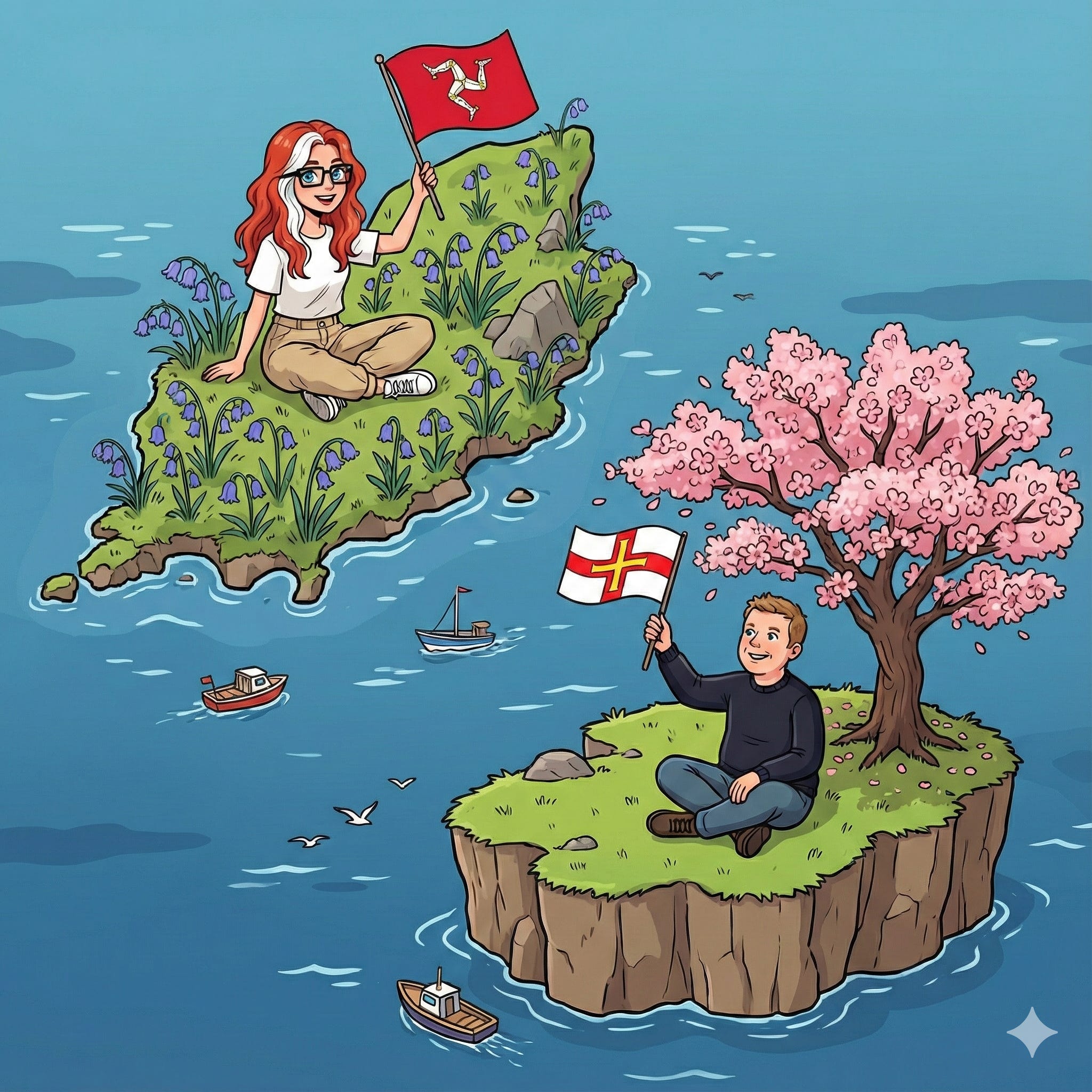
The ikigai guy from a small island. The ikigai girl from a small island… the same truths from different shores.
There’s a quiet conviction that comes with age and observation. You watch systems failing. You see what actually moves hearts and changes minds. You realise that the transformations Marc describes, the ones that stick, definitely start with humanity.
The happy side effect of levelling up, idealism overlaid with hard-won wisdom and the humility to watch, listen and learn from what actually works.
What Islands remember
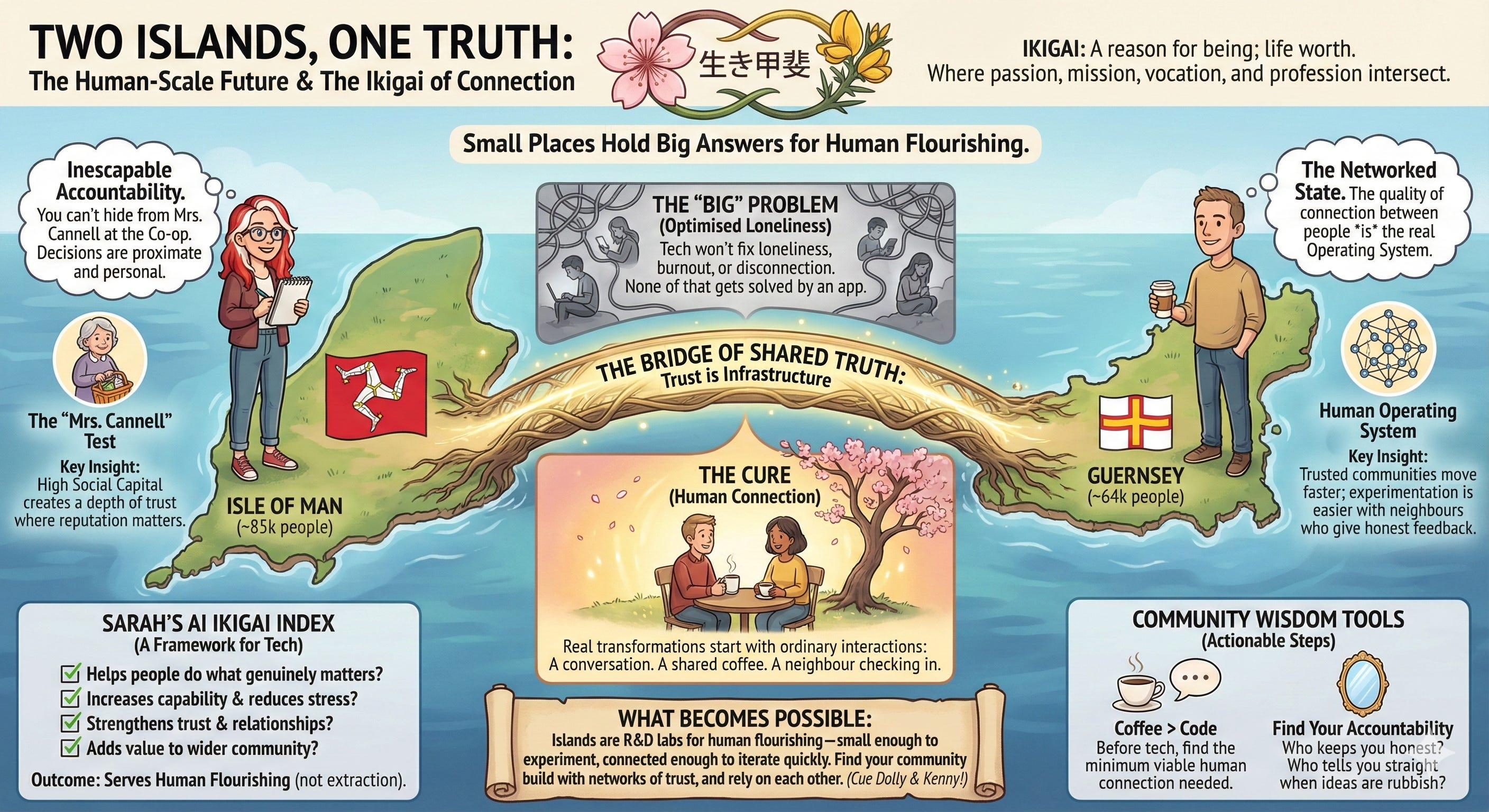
I can’t hide from Mrs Cannell at the Co-op.
If I stand by and allow policies (on AI, or any topic for that matter) to be drafted that don’t really serve our people, I’ll hear about it whilst picking up milk. When you live amongst and care about your community, you want to build different systems. You think longer-term. You move more carefully. You fix things when they break because the person affected isn’t an abstract “user” in a database, she went to school with your grandparents.
Marc writes about Guernsey holding “an enormous amount of social capital” where “people still stop to talk in the street.” In the Isle of Man, we have that same gift. That depth of trust you can feel. The way reputation still matters. The knowledge that consequences are real and proximate.
This is the magic of stopping to talk… ancient, irreplaceable and apparently revolutionary these days in many locations around the world.
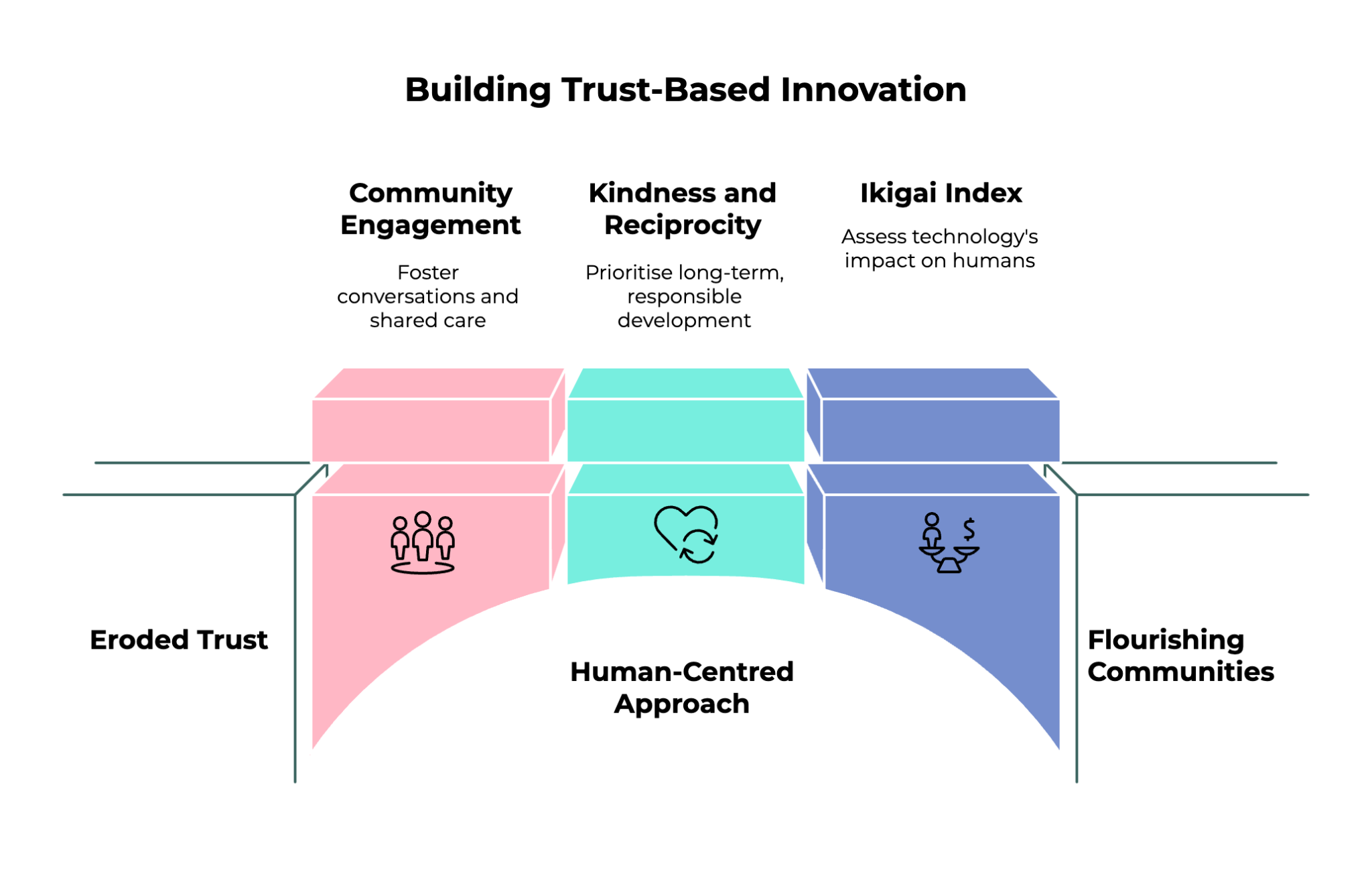
What gets preserved when escape isn’t an option? Kindness, because cruelty has nowhere to hide. Reciprocity, because you’ll see these people again soon. Long-term thinking, because space is precious and we need to develop responsibly and innovatively.
Islanders never fully bought into extraction capitalism because the maths doesn’t work at this scale. You can’t just take and move on, there’s nowhere else to go.
We look for people who recognise what we have here and want to help protect and grow it. People escaping the uncertainty of places where trust has eroded and consequences feel distant. People who value beautiful surroundings with space to breathe, but who also understand that this breathing room comes with responsibility.
Neighbours we hope become friends (and no this isn’t a setup to have Angry Anderson as the soundtrack of the week, though now I come to think of it… *makes a note in my essay ideas bullet journal spread*)
The magic number
Marc’s Guernsey has 64k people living there, my Isle of Man 85k. There’s something in these numbers.
He calls it the Networked State, where “the quality of connection between people becomes the real operating system.” I wonder if it allows us to run software like an ikigai index for AI adoption, a framework to assess whether technology serves human flourishing?
Do people trust each other enough to do hard things together?
Trust looks different at small Island scale than it does in the millions. When your whole nation fits into a football stadium, it’s possible to know most of the decision-makers. Not just know of them, actually know them. You went to school with their cousin *grin*. Decisions affect us directly, and we all know it.
This does change things, especially the way it feels to live here.
The relationship between social capital and innovation capacity fascinates me. Marc observes that “when people trust each other, things move. When communities feel cared for, they become braver and more imaginative.”
He’s absolutely right. Trusted communities can move faster because they don’t need as many layers of approval or defensive bureaucracy. Experimenting is easier because failures affect people who’ll help you fix things rather than sue. Iteration based on real feedback from neighbours who’ll tell you straight what’s working and what isn’t.
We have something else too, the Isle of Man can legislate differently. We could move faster than larger nations, to fix broken things without waiting for Westminster or Brussels or Silicon Valley to decide what’s good for us.
We probably shouldn’t want solutions that work for millions or billions.
Maybe human-scale technology serves humans better than inhuman-scale technology.
Maybe the problem is that stuff got too big.
The laboratory advantage
Islands are living laboratories. The Isle of Man a perfect test bed for innovation, due to a supportive government, agile regulatory environment, high-quality infrastructure and small size that makes it easier to implement and test solutions on a manageable scale.
We already have the core infrastructure that bigger places are desperately trying to rebuild… people who genuinely care about each other, networks of collaboration that function on trust and the ability to reach decision-makers quickly.
We also seek out other brilliant people who want to be part of our experiment. Those who are tired of systems that don’t work. Who want to do something new in a place that values what they bring. Who understand that innovation comes from diversity and collaboration.
An invitation to leave a legacy of protection and growth. To build whilst being surrounded by beauty and the space to think clearly.
I’ve had a profound realisation that changes how I move through the world. There’s no adultiest adult coming to save us. No expert with all the answers. No benevolent institution that will fix things if we just wait patiently enough.
We can all just... do things.
If you don’t like something then try to change it, or even better get a group of people together who share your values and ethics, who care about our culture and community… and make something even better.
It’s glorious to see what changes when we start from care for our people’s flourishing. We all want efficiency gains and GDP growth as that’s how our societies currently work, but when you treat social capital as seriously as economic health, different questions emerge; “will this help humans feel purposeful?” and “does this strengthen trust and relationships?”
Progress without human connection isn’t progress at all, it’s just optimised loneliness.
On the Isle of Man, I’ve been sketching what this looks like in practice. An Ikigai Index that assesses any AI project by four measures: Does it help people do what genuinely matters to them? Does it increase capability and reduce stress? Does it strengthen trust and relationships? Does it add value to the wider community?
When you apply this framework, certain technologies fail immediately. AI slop flooding our information ecosystem? Fails the value test. Character AI marketed to children as companions? Fails across the board.
But other applications shine. Tools that help preserve Manx Gaelic while supporting human tutors. Systems that make government services more accessible whilst maintaining human backup. AI that augments human capability rather than replacing human agency.
One serves extraction, the other human flourishing.
Small places can experiment with this. We can say no to things that fail our tests. We can insist on human-centred implementation. We can move kindly and fix things rather than moving fast and breaking them.
What becomes possible
Two islands, separated by sea, connected by conviction.
I’ve not had the pleasure of seeing Marc in real life yet, or visiting gorgeous Guernsey…. But I hope to.
I believe that good ideas emerge from good conditions. That communities with high trust produce people who can see clearly what matters.
If you’re feeling that same recognition... if you’re tired of places where trust has eroded... if you want to work alongside brilliant people in a beautiful place where you can get to know the decision-makers... we have room for you here.
What can be learned from places that never forgot how to be communities?
That trust is infrastructure. That the quality of your relationships determines the quality of your future. That technology serves us best when it strengthens human connection rather than substituting for it.
Islands are R&D labs for human flourishing. Small enough to experiment, connected enough to iterate quickly, accountable enough to care deeply about getting it right.
Find your magic place, even if you aren’t ready to relocate… find a size of community where you feel genuine accountability. Find your tribe and work together to solve problems.
Find your Mrs Cannell. The person who keeps you honest. Who’ll tell you straight when your bright ideas are actually terrible. Who represents the real people affected by abstract policy or product development.
Find your coffee conversation. The ordinary interaction that could matter more than any app. The neighbour checking in. The shared concern that becomes shared action.
Marc’s right. Real change depends on the strength of our relationships. Always has. Always will.
We can build something better with our networks of trust.
Two Islanders believe in this deeply, what if we’re right?
Thank you for reading, beautiful souls… if this resonates I’d love to hear from you.
Sarah, seeking ikigai xxx
PS – Here are some bullet journal prompts to explore your own community wisdom this week;
The Mrs Cannell Test; Who keeps you honest? Who would tell you straight if your ideas were rubbish? Who represents the real people affected by abstract decisions you may be making? Write their name at the top of a page, describe them in detail and let that guide your thinking this week.
Coffee > Code: List three challenges in your community. For each one… do you understand it well enough to think about technological solutions or does it need conversation? If tech, what’s the minimum viable human connection that must also wrap around it? If not, who could you have a coffee conversation with this week that might advance your understanding?
PPS – AI Coaching Prompt;
“Help me map my trust network and innovation capacity. Ask me about the size of my community, how well I know decision-makers and what challenges we’re facing. Then help me identify: (1) three problems that need conversation not technology, (2) one small experiment we could try that builds on existing social capital, (3) how to measure success by relationship quality rather than just efficiency. Guide me to design something human-scale that could teach lessons to larger systems.”
PPPS – Soundtrack; Islands in the Stream – Dolly Parton & Kenny Rogers. Two voices in harmony, joy in collaboration, and yes it’s both cheesy and cheeky but also perfect. This is a celebration of what some places kept, an invitation to build together, and an appreciation of human connection “And we rely on each other, ah-ah” … Plus, the island reference could not be passed up and it is above all else a CHOON!!!
I love that Dolly Parton song. Thanks for those kind words. It would be great to hang out for coffee in the real world.