


🌸 ikigai 生き甲斐 is a reason for being, your purpose in life... from the Japanese iki 生き meaning life and gai 甲斐 meaning worth 🌸
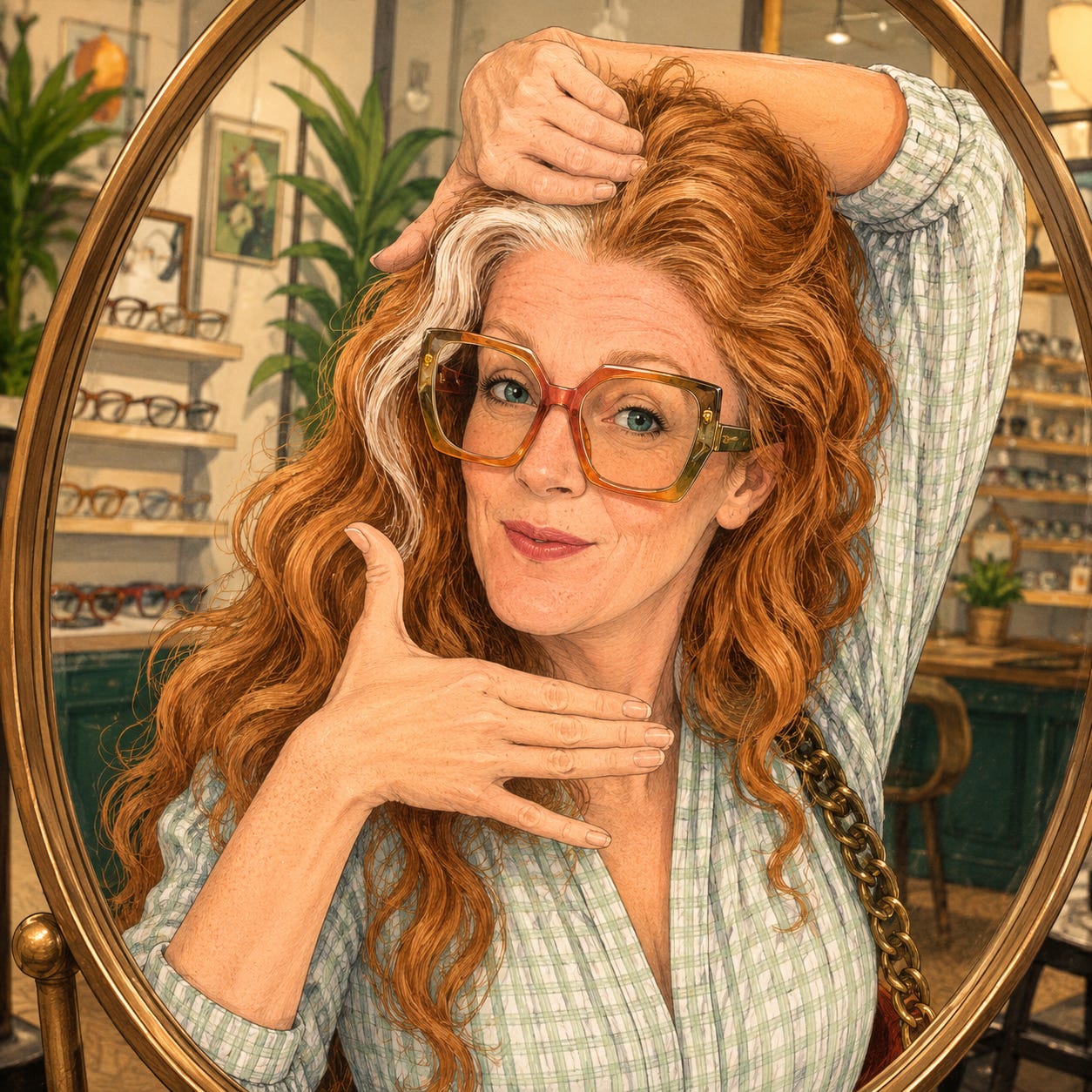
A new pair of glasses arrived last week, and they are bolder than anything I have ever worn before.
I chose them in the usual way, which is to say, almost completely blind.
A colour combination I would normally talk myself out of. It’s still a shock when I catch sight of them in a reflection, I feel a flutter of something. Part delight. Part “who do you think you are” slash “what on earth were you thinking?!”.
I have needed glasses since I was ten. I am fifty now, and only just learning to be a little braver with what I choose.
For most of those forty years it has been a love hate thing. Contacts were my confidence trick, the way I stepped out from behind the frames and felt most like a pretty version of me (on a good day)... right up until age started to change my prescription in a different way, and the need for varifocals arrived and took that option off the table. So here I am, back in glasses, full time, for good. Glasses are a peculiar sort of purchase. They are assistive technology I genuinely cannot live without, and they sit right there on my face, next to my colouring and my eyes and hair and everything that says me. Function and identity, an awful lot to ask for one thing to be.
The most expensive blur you’ll ever buy
Choosing glasses is really challenging when your eyes are as rubbish as mine.
I am up at the very short sighted end of things. The minus eight, minus nine plus club... where are my myopic peeps? Being this short sighted does cruel things to the act of buying specs.
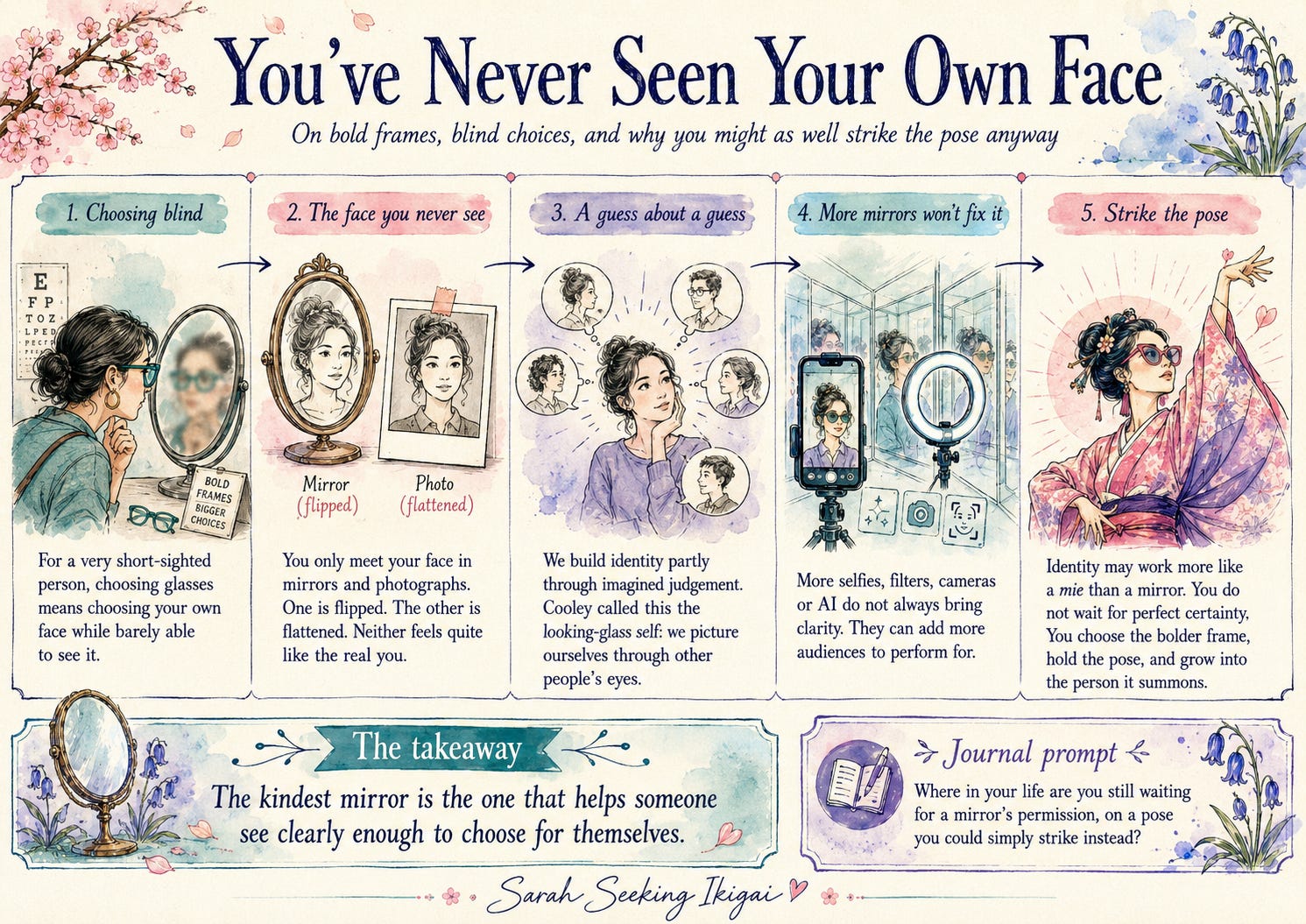
First, the moment my old glasses come off to try a new frame, the world dissolves. I lean in towards the mirror and there is no me there to assess at all, just a pink and ginger blur swimming in a silver rectangle. I am choosing my own face while completely unable to see it, nose against the glass and still blind to the thing I am deciding on.
Second, my lenses are thick. So thick that a good half of the frames in the shop simply will not take them, or would leave me peering out of two jam jar bottoms. To make them wearable at all I pay extra, sometimes a lot extra, for the lens thinning magic that stops me ending up with bug eyes and edges an inch deep. Stack varifocals on top of that now, and we are not talking about a cheap and cheerful accessory. We are talking long hundreds of pounds. For one pair. Which I will then wear every single waking minute, for a year, two, sometimes three, because I am not made of money and a spare set is a luxury, not a given.
A few minutes in a shop, unable to see and choosing something I need but has to sit there on my face, that I cannot swap out to suit my mood or my outfit… many hundreds of pounds, riding on a blurry guess I then have to live with for years.
(I have a recurring daydream, by the way, of building the optician the very short sighted actually deserve. Frames designed to carry a serious prescription and ones that can snap in and out easily so that people can try them on properly and swap out frame colours more easily… served by someone who truly gets varifocals and doesn’t so much as blink at minus nine or higher. If I ever get the chance... grr, and relax, hehe, anyway I digress.)
It is, when you say it out loud, a slightly outrageous thing to ask of a person. And yet millions of us do exactly this our whole lives.
The face you’ll never see & a guess about a guess
In all forty years of squinting at myself trying to choose new frames, I’d never really thought in more depth about how weird it is you just have to take a punt, you can’t see yourself properly until the new ones arrive… but I’ve just twigged that it isn’t only in the optician that I can’t see myself, I have never seen myself properly, none of us have.
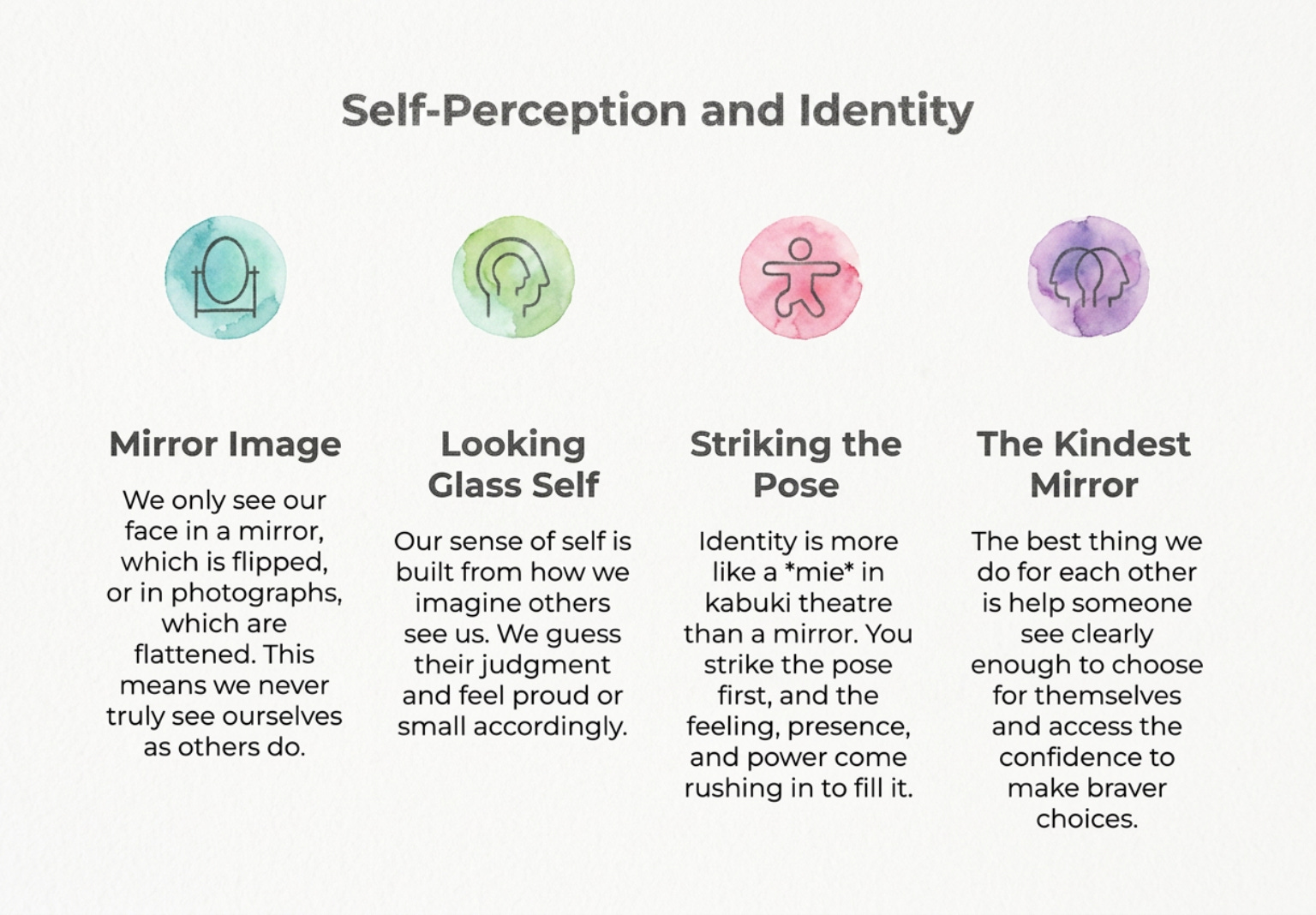
You have only ever met your face in two forms. In a mirror, where it is flipped, left swapped for right… and in photographs, which freeze and flatten it, which nearly always looks a little bit wrong to you.
That wrongness isn’t vanity, it’s documented. Back in 1977 researchers, Mita and colleagues, showed people photographs of themselves, some printed normally and some reversed. People preferred the mirror version, the flipped one. Their friends preferred the true, unreversed one. The reason is simply familiarity, you have spent a lifetime greeting the mirror version, so that is the face you have grown to love. Everyone who loves you, meanwhile, has fallen for the version you find faintly off.
The most visible thing about us, the thing the people we meet navigate by, is hidden from us. Some of us have to choose frames blind in a shop, but really we are choosing blind for a lifetime.
It gets stranger still when you move from seeking clarity on your image to your sense of self.
A lovely old idea from sociology calls this the looking glass self. Charles Cooley coined it back in 1902, and the gist is that we build our sense of who we are not from some clear inner readout, but from how we imagine other people see us. We picture ourselves through their eyes, guess at their judgement and feel proud or small accordingly. Which means the self most of us carry around is a guess... about a guess. Blurred face, borrowed mirror, imagined verdict. No wonder we find ourselves so hard to get.
More lenses won’t fix it, the pose comes first
So what do we reach for, faced with all that not seeing? A clearer mirror, higher prescription lens, a better quality camera, is often our instinct.
More mirrors. More photographs. The front facing lens, the ring light, a filter that smooths and widens and “improves” … and now AI that will happily render a thousand polished versions of your face and your words in minutes. We are the most mirrored generations in human history.
Has it made us feel any clearer? By most measures we are more anxious about how we look and who we are, not less. Because if the self is built from imagined judgements, then every new lens just adds another imagined audience to perform for. This doesn’t sharpen the picture, it scatters it or distorts like in a hall of mirrors.
Which brings me to a concept I have completely fallen for, mie (見得).
In kabuki theatre, a mie is a big dramatic pose. At the emotional peak of a scene the actor stops and holds a powerful frozen posture, eyes open wide and the audience shouts the actor’s name. The actor does not wait until they feel the emotion to strike the pose. They strike the pose, hold it, commit to it utterly... and the feeling, the presence, the power, comes rushing in to fill it. The pose summons the person, not the other way round.
I think identity works more like a mie than like a mirror. You do not get to study a clear reflection, confirm exactly who you are and only then step out as them. You strike the pose first. You choose the bold frames before you can see yourself in them, and you wear them until they become you. Courage, here, is simply being willing to act before the confirmation arrives.
For forty years I chose the sensible frames. The colour that wouldn’t clash, the shape that wouldn’t draw a glance. I told myself it was taste, it was mostly fear. This time, blind in the shop and still not a millionnaire *ahem*, I struck a different pose.
I’m just going to argue with myself for a brief moment. “Just choose, never mind the mirror” can curdle into something I don’t mean at all. A sort of chest puffing, who cares what anyone thinks individualism that isn’t true to how humans work, because the looking glass self is real. We ARE social animals and we *do* need other people to help us see, so a life lived entirely without that mirror is just lonely, and sometimes a bit deluded.
So it’s a both/and, as these things so often are. The danger isn’t using a clearer mirror but handing that process over completely... letting others choose your face, dimming you to whatever won’t clash, urging you to be the smoothed down average on purpose. Other people can help you see but they cannot choose for you. Hold both, and I reckon you’re roughly in the right place.
The kindest mirror to strike a pose in
Which is where this loops back to a concept that has been front of mind for me recently, the idea that clarity is a form of care.
The very best thing we do for each other is to help someone see clearly enough to choose for themselves, and to help them access the confidence that brings to make braver choices. The friend who comes to the opticians with you, looks at you properly and says “those are so you“ isn’t handing you an instruction, she’s handing you back your nerve. She has held up a warm, honest reflection which opens out the options... and then left the choosing where it belongs, with you.
That is the mirror worth being for the people you love.
Madonna made it sound so easy. Strike a pose, there’s nothing to it… and from the outside, maybe it looks that way... a woman in bold new frames, looking pleased with herself.
But you and I know what it actually took. A few blind minutes in a shop. A few hundred pounds I had to think very hard about. A few years of living with whatever I landed on. The pose is never nothing. The pose costs and we strike it anyway.
The bold frames are on my face now, as I type this. I still struggle to see myself in them some days, but I chose them. The people I love are smiling… and somewhere, faintly, I can hear an imagined audience shouting my name.
We never get to see our own face. So we may as well choose it brave. Strike the pose, hold it, and grow into the person it summons… and hold up the kindest, clearest mirror we can for each other while we’re all at it.
I’d love to know... where in your life are you still waiting for a mirror’s permission, on a pose you could simply strike instead?
Sarah, seeking ikigai xxx
PS, for the bullet journallers, a little “Strike the Pose” spread for the week:
Draw out a mindmap box, and doodle some glasses to decorate… in it think through what this brings up for you; What is the bolder “frame” I keep talking myself out of? (A look, a stance, a yes, a piece of work, a sentence in a meeting... anything.)
Prompt: Where have I been calling fear “good taste”? What sensible version of myself am I choosing on autopilot?
Prompt: Which mirrors do I let define me, people, the scroll, the camera roll, AI, and which could I try turning off this week?
Prompt: Who has been a kind, clear mirror for me lately... and have I told them?
PPS, an AI prompt challenge for the week.
This one is a mirror that hands the choice to you;
You are going to act as a clear, honest mirror, not a stylist. I will paste in some of my recent writing or notes, and a few words about a decision I keep hesitating over. First, reflect back to me, in plain language, the bolder version of myself that keeps showing up between the lines... the stances I almost take, the things I clearly care about but soften. Then show me, specifically, the places I seem to play it safe or hedge. Do not tell me what to do, do not flatter me, and do not tidy me into something generic. End with three braver “looks” I could try on, phrased as questions and leave every choice with me.
[PASTE YOUR WRITING / NOTES HERE] [DESCRIBE THE CHOICE YOU’RE HESITATING OVER]
I’d love to see what it holds up for you, share and tag me!
PPPS, today’s soundtrack, there was only ever going to be one... Vogue, Madonna. Strike a pose, there’s nothing to it. Ha. There is everything to it, Madonna, it’s hundreds of quid and three years of commitment and I cannot see a thing in that mirror... but the spirit is bang on. You decide who you are going to be, you strike the pose, and you let the confidence come running to catch up.
Sarah, this piece reminded me of how I once saw myself in a mirror holding one of my cats. She was a pretty long-hair with dark fur on the top of her head, and a white triangle over her nose. I’d had her for about 5 years at that point. And I remember being startled to realize, when seeing the mirror image, that the triangle on her face was much more asymmetrical than my brain had gotten used to thinking it was.
I’ve also worn glasses most of my life and enjoyed your insights on not being able to see yourself well when trying on frames, and choosing safe ones over the years. Thanks for sharing this!
The phrase "a guess about a guess" stayed with me.
As a translator, I spend a lot of time trying to understand how people see themselves, and how others see them. The distance between those two versions is often where the interesting stories live.
Also, as someone who has made a surprising number of life decisions before feeling fully ready, I suspect mie may explain more of my life than I would like to admit.
A wonderful piece. Thank you.