


🌸 ikigai 生き甲斐 is a reason for being, your purpose in life – from the Japanese iki 生き meaning life and gai 甲斐 meaning worth 🌸
There’s a brand new journal on my desk.
It sits alongside my trusty turquoise bullet journal which is covered in stickers and dog-crumpled pages where I’ve scribbled things like “WHAT IS THE POINT OF ALL THIS” in capital letters on a particularly difficult day.
This one is different, a Leuchtturm1917 Thesis Journal with a structured process printed right into its pages. A methodology for turning a question into something defensible.
I’ve written on the first few pages. Tentatively, as if I’m stepping into cold sea water, one toe at a time.
It feels a little scary and I’ve been reflecting on that feeling, trying to work out why.
Oh and this essay idea woke me at 2.33 am this morning and I had to dictate the bones of it to Wispr Flow before I could fall back asleep!

A man in a tower
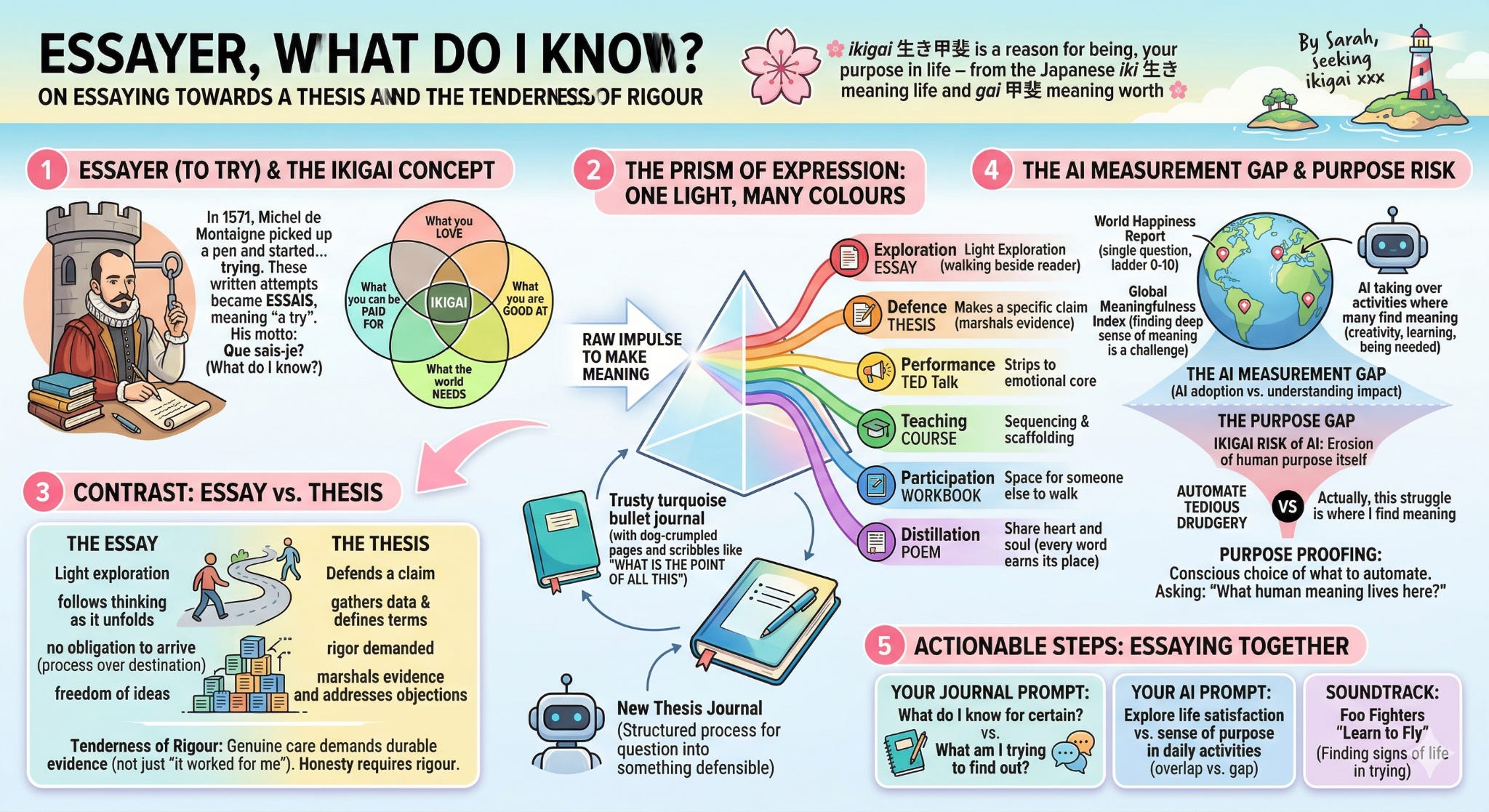
In 1571, a 38-year-old Frenchman locked himself in a tower. Michel de Montaigne was tired of politics and performing certainty in a world that made no sense. So he picked up a pen and started... trying. He called these written attempts essais. From the French essayer, meaning to try, and from that beautifully honest admission, an entire form of writing was born.
Here I am, on my tiny Island between England and Ireland, even on a gloriously sunny Saturday I am driven to block it all out and write, the impulse is the same as he had.
Trying to make sense of things by writing about them. Trying to be helpful without pretending I have all the answers.
Montaigne’s motto was Que sais-je? What do I know? As the most honest place from which to begin.
One light, many colours
I used to blog. For years I wrote about my mental health, about my days, about feelings I needed to untangle by putting them into words. Sometimes those posts were rambly word salad poems and I loved them fiercely. They helped me, and (to my genuine surprise) they seemed to help other people too. It’s SO tempting to say “I was only blogging” but I take that back immediately. It was brave and beautiful and necessary.
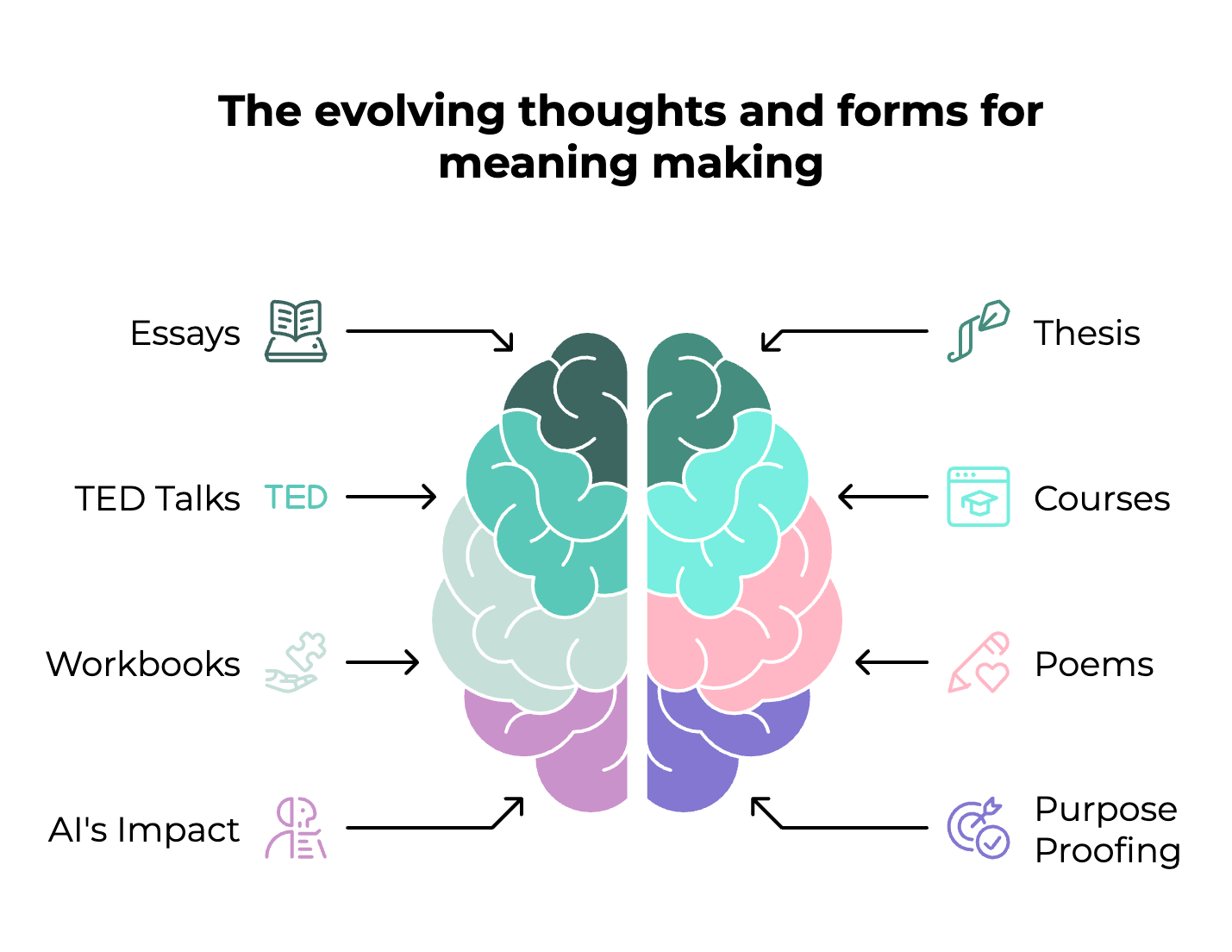
Somewhere between my old blogs and this Substack, between processing my feelings and processing my ideas, I started essaying. Attempting. Reaching for something bigger than “here’s how I feel today” and toward “here’s how I think the world works and how I want to move through it”.
Now, with that thesis journal on my desk, I’m reaching again.
Imagine light entering a prism. White light... the raw impulse to make meaning... hits the glass and splits into its component colours. A blog post. An essay. A TED talk. A book chapter. A thesis. A course. A workbook. A poem. Each colour is the same light, expressed differently and reaching eyes the others cannot.
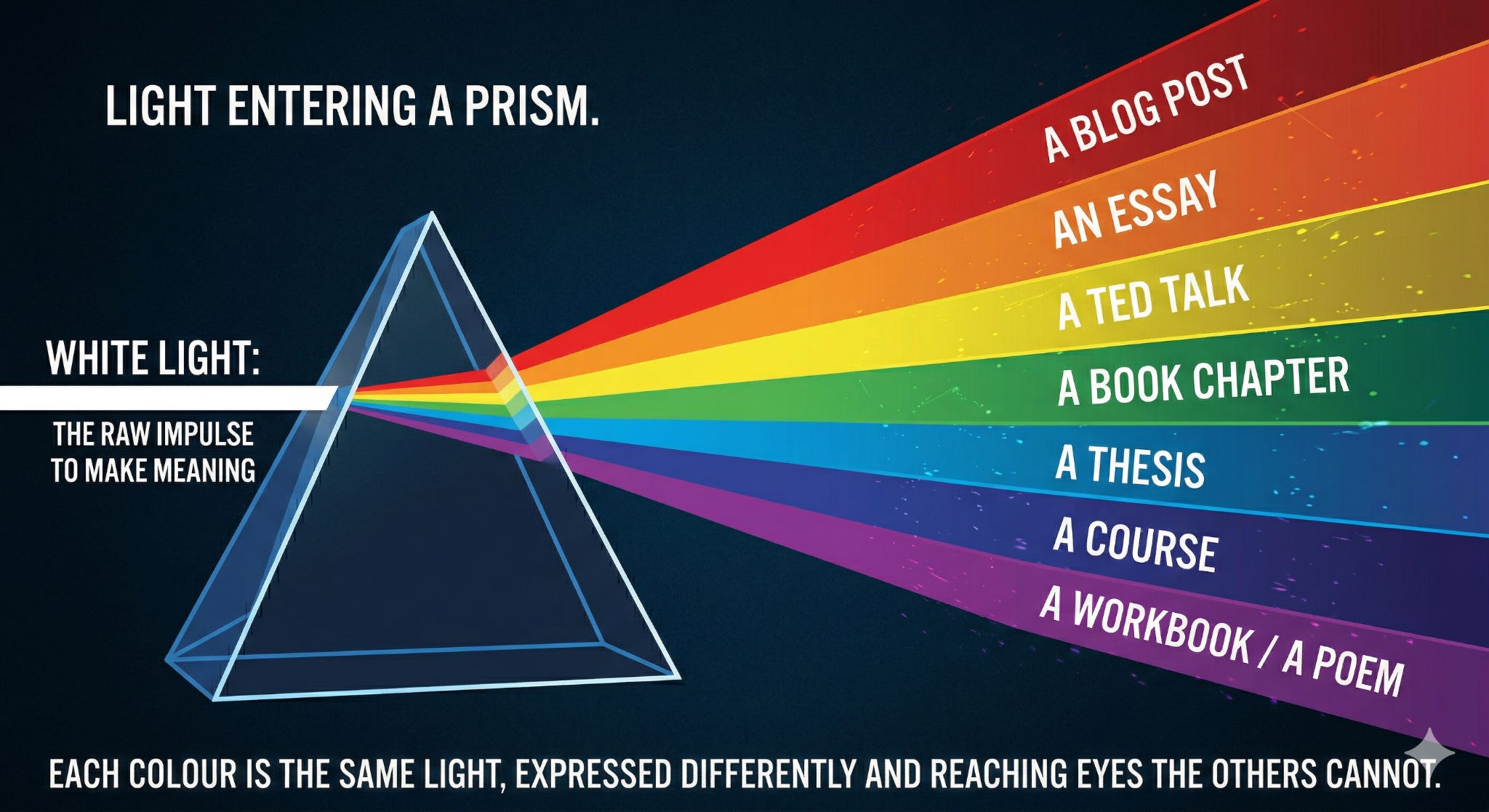
An essay, structurally, is a (relatively) light exploration. It follows the writer’s thinking as it unfolds. You start somewhere honest and you walk forward and you let the reader walk beside you. There’s no obligation to arrive, Montaigne certainly didn’t. He would contradict himself from one page to the next and leave both versions standing, because the point was never the destination. It was the walking.
I love this. I love writing essays and can’t see myself stopping in the near future. There is something irreplaceable for me about both the discipline AND the freedom of it, the way ideas can breathe on the page and morph over time.
A thesis (or dissertation) is a different beast I think. Where an essay explores, a thesis defends. It makes a specific claim about the world and then marshals evidence to support it. There are rules and methodology. You have to define your terms, gather your data, anticipate objections and address them honestly. It is rigorous in a way that perhaps demands you know what you think before you start writing in earnest, rather than discovering it along the way.
These aren’t competing impulses though, they’re complementary ones;
🔴 Exploration (essay) - writing essays about purpose helps me feel my way into what matters
🟠 Defence (thesis) - working through my thesis journal forces me to sharpen a feeling into a defensible claim
🟡 Performance (TED talk) - strips everything back to its emotional core because you’ve got 10-15 minutes and an audience who needs to feel something
🟢 Teaching (course) - designing a course demands I think about sequence and scaffolding and what someone needs to understand first before they can understand what comes next.
🔵 Participation (workbook) - asks me to stop holding the idea and create a space where someone else can walk into my question with their own answers
🟣 Distillation (poem) - sharing your heart and soul, forcing a kind of distillation where every single word has to earn its place
Each medium asks a different question of the same idea, and every time I answer that question, I understand the idea a little better. The prism doesn’t just split the light, it reveals what the light was made up of.
The “content” flinch
The world now seems to call all of this “content” and it makes me recoil a tad, even as I use the word myself at times as it is so ubiquitous.
Content is what fills a container. Content also conveys undifferentiated stuff, measured in engagement metrics that can’t really quantify impact. When we call an essay “content” we flatten it into the same category as a product listing or a sponsored carousel or an algorithm-friendly hot take fired off quickly by someone who may not care heart and soul about that topic.
AI can take this flattening even further. To a large language model, everything we write becomes training data. Our love letters and our grocery lists and our attempts to understand what it means to be alive... all reduced to tokens. Patterns to be predicted. Meaning to be statistically approximated.
Montaigne gave us the word essai > Attempt.
Algorithms gives us the word content > Filler.
I know which side of the spectrum I’d rather be responsible for *grin*
The tenderness of rigour
So here I am with my thesis journal, and I want to tell you something that might sound contradictory. I want to help people, and I want to be rigorous about it.
Those two impulses are often positioned as opposites. The warm fuzzy helper versus the cold hard scientist. Heart versus head.
Genuine care demands evidence though. If I tell you that seeking ikigai can improve your one wild and precious life, I want to mean it in a way that goes beyond “it worked for me and I reckon it might work for you too”. I want to know. I want data. I want to be able to defend this with something sturdier than my own enthusiasm.
The most tender thing I can do for you is also the most honest, real honesty requires rigour.
The gap nobody is measuring
Which brings me to what I’m scribbling in those early tentative pages.
The World Happiness Report for 2026 was launched this week. Its core measure of happiness is a single question > “Imagine a ladder from 0 to 10. Best possible life at the top, worst at the bottom. Where do you stand?” The Isle of Man isn’t listed separately, and the UK scores a rather depressing 29th.
That tells us something important about life satisfaction. What it doesn’t capture is whether people feel their life has purpose. Whether they wake up with a reason to get out of bed that goes beyond obligation. Whether the things they do each day feel like theirs. Gallup had previously measured “purpose well-being” in their “State of Global Well-Being” report from 2014 where out of the five elements they measured purpose was the one struggling the most.
There are people working on this though. The Global Meaningfulness Index, published by the Voluntās Foundation, surveyed over 18,000 people across 31 countries in 2025. Despite high GDP and material wealth, countries like the UK (ranked 25th) and Sweden struggle with a deep sense of meaning in life, while people in nations facing far greater economic challenges report significantly higher levels of it. Their research on meaningfulness at work found it accounts for 49% of our overall sense of meaning in life. Half of our felt purpose, wrapped up in what we do every day.
Now layer AI on top of that.
If purpose is already a weak link in human wellbeing, and under strain in the wealthiest parts of the world, and AI is rapidly taking over activities through which many of us find meaning (our creative work, our problem-solving, our learning, our sense of being needed), then we have a problem. Nobody is properly measuring it yet. Researchers are calling the space between AI adoption and understanding its impact on the workforce “the AI Measurement Gap.” I think there’s a deeper gap underneath that one, a purpose gap which is the one I want to try to measure.
This is why I am so drawn to the concept of the ikigai risk of AI. Not the dystopic risk of superintelligent machines, or the economic risk of job losses (though they matter hugely too). The creeping risk to human purpose itself. The gradual erosion of the feeling that what you do each day is yours, and it matters and the world is slightly different because you showed up.
What I want to defend
Here’s what I think my thesis journal is reaching toward. I’m writing this as an essai, an attempt, because I haven’t figured it all out yet and Montaigne would tell me that’s the point.
I want to explore whether ikigai, the felt sense of a life worth living, can be meaningfully measured. Something that captures whether you feel you’re growing, contributing and creating in ways that feel authentically yours.
Then I want to understand what happens to that felt sense when AI increasingly features in that picture. Does your purpose increase when AI handles some of the tedious stuff and does it free you for meaningful work? Or does it decrease when AI starts doing the things that used to make you feel capable and needed and alive?
If or when it decreases, what do we do about it?
I think part of the answer lives in conscious choice. In things like what I’ve been calling Purpose Proofing... asking, before you hand something to AI, “what human meaning lives here?” Sometimes the answer is “none at all, please automate this immediately and save me the drudgery”... and sometimes the answer is “actually, this struggle is where I find meaning, leave it alone”.
I don’t have a fleshed out methodology yet. I have a thesis journal with a few tentative pages and a head full of questions and a stubbornness to not give in or pretend to have answers I haven’t earned.
Montaigne didn’t have answers either. He had attempts, and 450 years later, those attempts are still teaching us how to think.
Essaying, together
So this is me, trying. Stepping into the cold water one toe at a time. Light hitting the prism and beginning to see the colours.
The essays will keep flowing. The thesis journal will keep filling. Somewhere in between, maybe a talk will take shape, or a course, or a poem that says in twelve lines what this essay needed two thousand words to reach toward.
If you’re also trying to figure out what you’re for in a world that’s changing faster than any of us can process... maybe we can try together?
I’ll bring the thesis journal and you bring your thoughts and questions.
Que sais-je? What do I know?
Not much in the grand scheme of things, but I’m willing to investigate and learn.
Sarah, seeking ikigai xxx
PS - Your journal prompt this week;
Open a blank page and write at the top “What do I know for certain?” Underneath, write everything you can. Then turn the page and write “What am I trying to find out?” See which list is longer and which entries make you feel the most alive.
PPS - Your AI prompt this week;
“Please help me work out whether there is something in me that wants to be written, spoken, taught, researched, or shared. Ask me reflective questions about the ideas I cannot stop returning to, the things I feel protective of, the questions I wish more people asked and the experiences that seem to contain more meaning than I have fully articulated yet. Then help me explore what form that emerging idea might want to take; an essay, a poem, a talk, a thesis, a course, a workbook or something else. Please end by helping me name the idea succinctly and suggest the smallest possible first step to honour it.”
PPPS - This week’s soundtrack “The Whole of the Moon by The Waterboys”
It felt right for an essay about perspective. About the difference between looking and truly feeling or knowing. Between having a question and learning how to hold it well. Also, it opens with “I pictured a rainbow”, which gives it extra points from me *grin* 🌈🎵
Very much enjoyed your article this morning, Sarah - It was very enlightening, especially how you use your thesis to still engage your creative side's need to ask questions - by hypothesizing, you may help to prevent stagnation from over-reliance on the AI models. Love it!