


🌸 ikigai 生き甲斐 is a reason for being, your purpose in life – from the Japanese iki 生き meaning life and gai 甲斐 meaning worth 🌸
We fireproof our buildings. We soundproof our walls. We childproof our kitchens. We waterproof our coats (or grab an umbrella).
Whenever something matters, we learn to protect it from forces that could erode it. We do not wait for the downpour to think about waterproofing. We do not wait for the fire to think about fireproofing. We look at what we value and we say this thing needs deliberate protection and then we build that protection in.
So here is my question.
If your sense of purpose, your ikigai, your reason for getting up and doing the thing that makes you feel most alive, matters to you (and I suspect it does, or you would not be reading this), why are you leaving it unprotected amidst the most disruptive technological shift in human history?

The words that were missing
I have spent over two years exploring the ikigai risk of AI. The idea, in its simplest form, is this; as artificial intelligence takes on more of our cognitive and creative work, it does not just change what we do. It changes why we do it. And if we are not careful, it displaces the things that give our lives meaning.
That was the diagnosis.
What I did not have, until recently, was the words for treatment.
Purpose Proofing is that.
Purpose Proofing is the deliberate, ongoing practice of protecting what gives your life meaning from being displaced by artificial intelligence’s relentless efficiency. It is not a one-time act. It is not a checklist. It is a way of living alongside AI that keeps your humanity at the centre of every decision about what to automate, what to delegate and what to keep fiercely, beautifully yours.
Why “proofing” and not “protecting”?
Language matters, so let me explain why I chose this particular word.
When we “proof” something, we are making something resilient from the inside out. A waterproof jacket does not avoid rain. It walks straight into the storm and stays dry. A soundproofed room does not pretend noise does not exist. It acknowledges the noise and creates conditions for that to exist alongside quieter spaces.
Purpose Proofing works the same way. It does not ask you to avoid AI or pretend the disruption is not happening. It asks you to build your relationship with purpose so deliberately, so consciously, that the forces of displacement cannot erode it from underneath you.
This is different from “future-proofing,” which is the term you will hear often in the AI conversation. Future-proofing feels reactive to me. It starts from fear. It asks what might go wrong? and scrambles to prevent it. It is about survival.
Purpose Proofing is generative. It starts from intention. It asks what matters most to me? and builds outward from there. It is about thriving.
One braces for impact, while the other chooses a direction.
The ikigai foundation
If you have been reading these essays for a while, you will know that ikigai, the Japanese word for ‘life worth’... which I interpret as having a reason for being, is the bedrock of everything I explore here. Ikigai is NOT a career strategy or a productivity framework (despite what the internet would have you believe with its four-circle Venn diagram). Ikigai, as understood in Japan, is something simpler and more intimate than that. It is the feeling that your life has value. It is the thing that gets you out of bed. It is something you become rather than something you find.
Purpose Proofing takes ikigai seriously enough to protect it.
I have come to understand through two years of writing and thinking and journaling and arguing with AI and arguing with myself… that knowing your ikigai is not enough. Not in this particular moment in history. The forces working against human purpose right now are too pervasive, too seductive and too invisible to be met with awareness alone.
You also need practice and habit. You need a framework that helps you notice when your sense of meaning is being replaced by convenience.
You need proofing.
What purpose proofing looks like
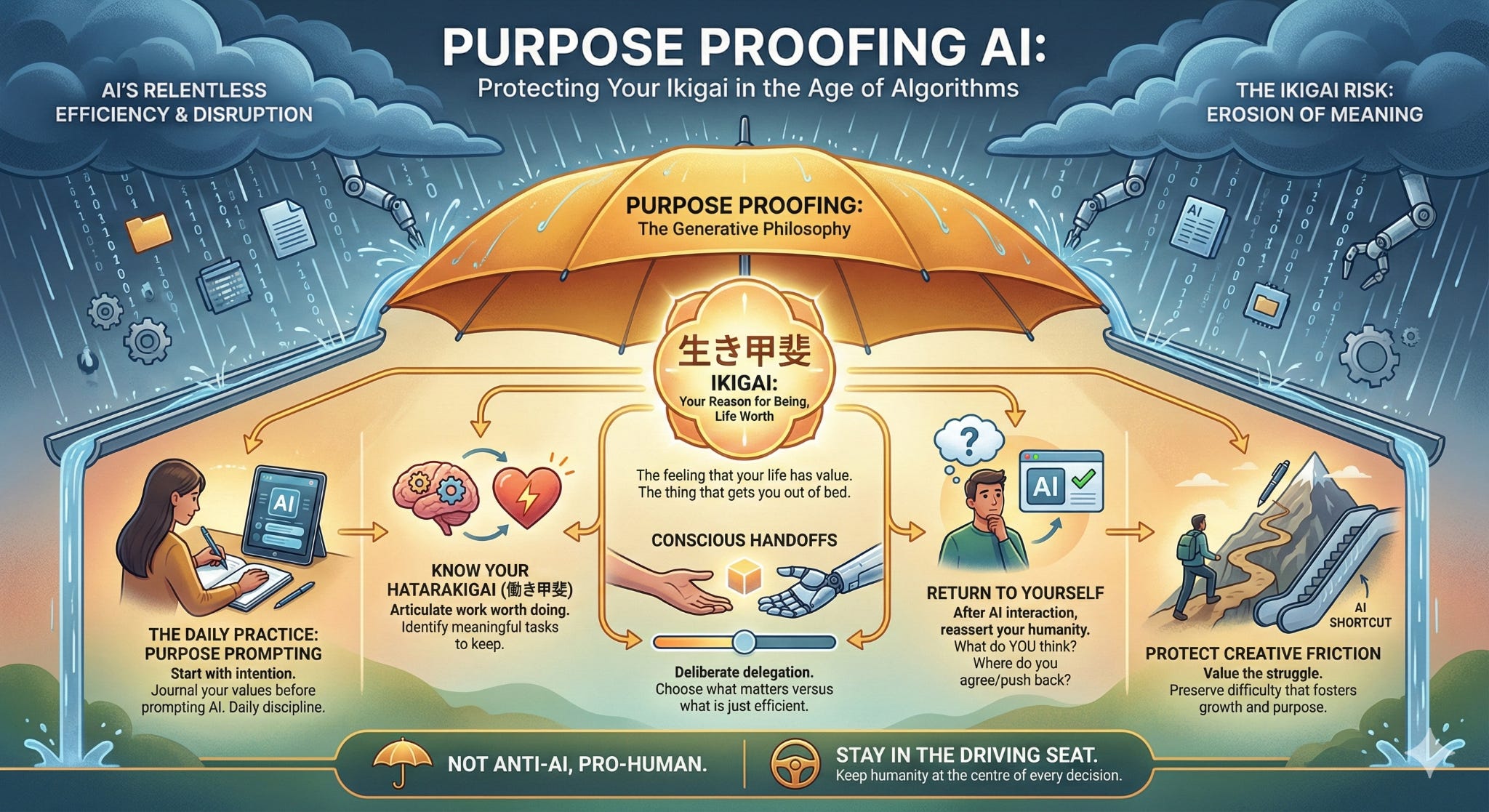
Purpose Proofing is not a single practice. It is a philosophy that expresses itself through many practices. Think of it as an umbrella (the waterproofing metaphor extends *grin*) under which specific habits and frameworks live.
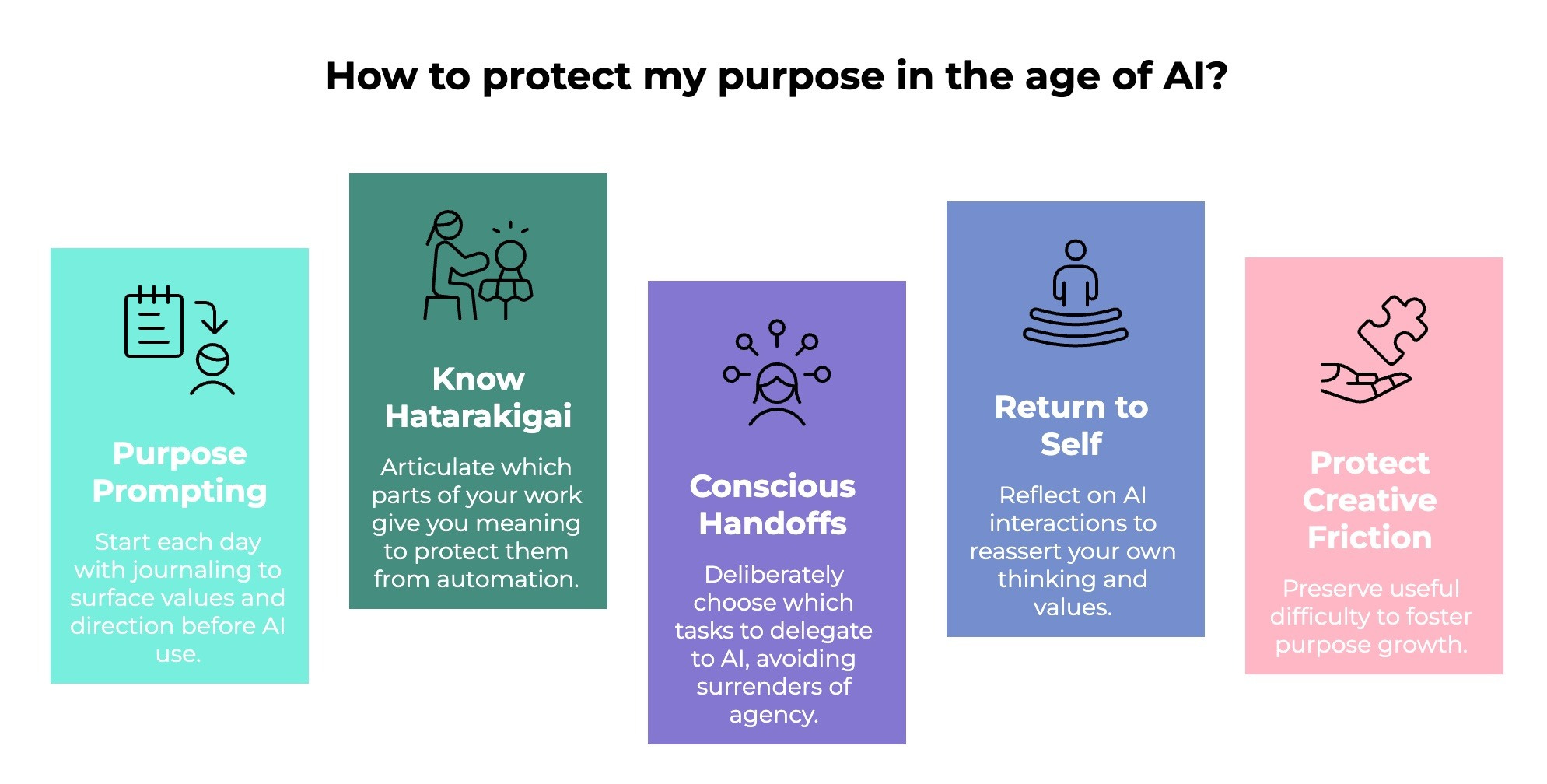
Purpose Prompting is one of those practices. Last week I wrote about the daily discipline of prompting yourself before prompting AI, using reflective journaling to surface your values and direction before handing anything to an algorithm. Purpose Prompting is how you start each day with intention. It is the daily layer of proofing.
But Purpose Proofing is bigger than any single daily habit, it also includes;
Knowing your hatarakigai. Hatarakigai (働き甲斐) is the Japanese concept of “work worth doing.” I have written about this before, and it becomes even more important in the age of AI. If you cannot articulate which parts of your work give you meaning, you cannot protect them from automation. You will hand over everything that seems “efficient” to hand over, and one day realise that efficiency has consumed the parts that made the work feel like yours.
Choosing your handoffs consciously. Every time you delegate a task to AI, you are making a choice about what matters. Purpose Proofing asks you to make that choice deliberately rather than automatically. Some handoffs are genuine liberation. Others are small surrenders of agency that compound over time. Learning to tell the difference is a skill, and it is a skill worth developing.
Returning to yourself. This is the step most people skip. After every meaningful AI interaction, Purpose Proofing asks you to come back to your own thinking. What did the AI suggest? What do you actually think? Where do you agree, where do you push back, and what did the interaction reveal about your own values? The return is where your humanity reasserts itself.
Protecting your creative friction. Not all difficulty is bad. The struggle of writing a first draft, the uncertainty of making a decision without all the data, the discomfort of sitting with a question that has no easy answer... these are the conditions in which purpose grows. Purpose Proofing recognises that some friction is useful and deliberately preserves it.
Who this is for
If you are reading this and thinking yes, but I love AI, I use it every day, this sounds like it is asking me to go backwards, I want to be very clear about something.
Purpose Proofing is not anti-AI… it is pro-human.
I use AI every day and LOVE it more than I can say. I use it to think, to create, to explore patterns in my own journaling, to challenge my assumptions and to build on ideas I’d struggle to build alone. Purpose Proofing does not ask you to stop doing any of that.
What it asks is that you stay in the driving seat.
That you know why you are using these tools, not just that they are there. That you can tell the difference between a task you delegated because it freed you to do something more meaningful and a task you delegated because it was easier not to think. That at the end of a day spent working alongside AI, you can look at what you created and say this has my fingerprints on it and reflects what I care about. This is mine.
Purpose Proofing is for anyone who has felt that tension between excitement about what AI can do and concern about what it might displace. It is for journal keepers and technologists, for coaches and consultants, for leaders wondering how to keep their teams purposeful and for individuals wondering how to keep themselves purposeful.
It is for anyone who suspects that the question “what is my purpose?” deserves more than an algorithm’s answer.
Why now
Viktor Frankl wrote that “He who has a why to live for can bear almost any how”.
AI is reshaping the “how” of lots of things. How we work. How we create. How we communicate. How we learn. How we make decisions. The speed of this reshaping is extraordinary, and it is accelerating.
But the “why” has to come from you. It always did of course, but it mattered less when the “how” was slow enough that you had time to think. When writing a report took all day, you had space within that labour to feel why it mattered. When researching a problem required real effort, the effort itself connected you to the question.
AI can compress the “how” to almost nothing, and in that compression, the “why” loses its natural footing.
Purpose Proofing rebuilds that deliberately. It creates space for meaning that AI’s efficiency would otherwise fill with output.
This is not a future problem. It is happening now, in boardrooms and kitchens and classrooms and creative studios all over the world. People are already feeling it, even if they do not have language for it yet.
The MIT Sloan Management Review is writing about the “existential crisis” facing professional services. The World Economic Forum is discussing meaning displacement. The conversations at every major AI conference in 2025 and 2026 have included tracks on human purpose and AI. The world is waking up to the ikigai risk.
Purpose Proofing is what we do about it.
The practice and the philosophy
Let me draw the relationship clearly, because I think this matters for where we go from here.
The ikigai risk of AI is the observation. It names the problem. It says that when AI handles more of what humans do, it risks eroding the sense of purpose that comes from doing meaningful things.
Purpose Proofing AI is the philosophy. It is the commitment to actively, intentionally protecting your purpose in an AI-saturated world. It is the umbrella under which everything else sits.
Purpose Prompting is one practice within that philosophy. It is the daily discipline of surfacing your values through journaling and then bringing that clarity into your AI interactions.
There will be more practices. This is an evolving framework, not a finished product. I am building it in public, one essay at a time, because I believe the best way to develop ideas this important is to think out loud with people who care about the same questions.
An invitation
If you have read this far, you are already someone who takes purpose seriously. You are already someone who senses that the AI conversation is missing something important, something about meaning and agency and the deeply human need to feel that your life has worth.
Purpose Proofing AI is my attempt to name that something. To give it a framework. To make it practical enough to live by and philosophical enough to matter.
I do not have all the answers. I have one hundred and twenty five essays, a daily journaling practice, an ongoing argument with Claude and a deep conviction that the question “what gives your life meaning?” has never been more important than it is right now.
If that resonates, you are in the right place. Stay. Write back. Tell me what Purpose Proofing means to you. Tell me where I have got it wrong. Tell me what I am missing.
Because this is a practice remember… and practices get better when they are shared.
Beautiful souls, what would you purpose-proof? If you could waterproof one thing about your life from the storm of AI, what would it be?
Sarah, seeking ikigai xxx
PS ✍️ Bullet journal prompt ideas
The Japanese concept of mamori (守り) means to safeguard what is precious. Write about one thing in your life that is precious precisely because it is fragile. What makes its fragility part of its value?
If purpose proofing is about protecting what matters, what are you currently over-protecting? Where might you be clinging to something familiar and calling it meaningful when it has actually stopped serving you?
We talk about “finding” purpose as though it were lost property. But what if purpose is not something you misplaced? What if it is something you are actively building, and the real question is whether you are building it consciously or letting the current carry the materials away?
PPS 🤖 AI prompt to try:
“I have been thinking about what ‘proofing’ means in the context of my life. We waterproof and fireproof the things we value. I want to explore how I would purpose-proof AI. Here are my reflections from today’s journaling. Help me see what I am unconsciously protecting already, what I might be leaving exposed, and where my instinct to protect might actually be holding me back from growth. Be honest with me.”
PPPS 🎵 Soundtrack “Umbrella” by Rihanna
Rihanna offered to be an umbrella for anyone who needed shelter. “When the sun shines, we’ll shine together. Told you I’ll be here forever.” Purpose Proofing AI is that same promise, except you are making it to yourself. You are saying that whatever storms AI brings, whatever the world reshapes around me, my sense of meaning has shelter. It has me.
The best philosophy is to live loudly. You can stand under my umbrella, your purpose can too.
This essay is a companion piece. Last week I explored What Is Purpose Prompting? which defines the daily practice of surfacing purpose through journaling and intentional AI use. If you missed it, start there and come back. Together, these two essays lay a foundation; Purpose Prompting is the daily practice, Purpose Proofing is the philosophy that holds it.
This is not the last you will hear of either. Both ideas will weave through future essays as I continue to explore what it means to live purposefully alongside AI. But for now, the foundation is laid. Next week, something different I’m sure *grin*
One more thing. If the ikigai risk of AI is an idea that has got under your skin, you can now read my longer exploration of it in print. I wrote Chapter 4, “The Ikigai Risk of AI,” for the forthcoming book AI Everywhere, Volume 1: How Women Are Changing The World With Artificial Intelligence. It is written by 26 women and nonbinary authors from the She Writes AI community, spanning 14 countries and 24 topics in AI, and I am ridiculously proud to be part of it. The book is already the #1 Hot New Release in Social Aspects of the Internet and in Human-Computer Interaction, and it has not even been released yet. Pre-orders are available now for the ebook at an introductory price of US$0.99 via mybook.to/aieverywhere1, with print editions coming soon. You can learn more about all the chapters and authors at aiEverywhereBooks.com.
Such a thoughtful post, Sarah. As we adopt AI, it’s a good reminder to stay grounded in purpose, judgment, and critical thinking. AI can speed up decisions, but it can’t take them over. Looking at it through the Ikigai lens is a great way to protect the deeper “why” behind our work, so tech amplifies meaning instead of replacing it.