


🌸 ikigai 生き甲斐 is a reason for being, your purpose in life – from the Japanese iki 生き meaning life and gai 甲斐 meaning worth 🌸
I’ve been doing something for ages that I didn’t have a name for.
Every morning, before I pick up my phone and see what the internet thinks I should care about today, I pick up my bullet journal and a pen and I write a question. Sometimes it’s a big one, what am I actually building here? Sometimes it’s gentler, what would make today feel like it mattered? Then I sit with whatever surfaces. Just me and the question and whatever honest answer my hand decides to write before my brain can edit it too much.
Later, I might take what I’ve written and share it with Claude. To see what patterns an AI helper can spot that I’m too close to notice. Where am I circling the same fear? What thread keeps appearing that I haven’t spotted yet? The AI support is a mirror, reflecting back a version of my own thinking that helps me see more clearly.
And then I go back to the journal and write what I think about what the AI said.
This loop… purpose first, then AI, then back to purpose… has become the most important practice in my life. It’s how I write these essays. It’s how I make decisions about my life and work. It’s how I stay grounded when the pace of change makes my head spin. It’s how I figure out what to say yes to (and what to walk away from).
I’m calling it Purpose Prompting.

A philosophy needs a practice
I’ve written before about the ikigai risk of AI, the idea that as artificial intelligence handles more of our cognitive and creative work, we risk losing something essential about human purpose and fulfilment. It’s a concept I first encountered through the work of Ken Mogi and AI researcher Roman Yampolskiy, and it’s one I keep returning to because it feels more urgent by the month.
Purpose-proofing AI, making sure we don’t lose what makes us distinctively human as these tools reshape our lives, has become a kind of philosophical North Star for me. It’s the big why behind everything I write and teach and care about.
But a philosophy needs a practice. You can believe wholeheartedly that human purpose matters in the age of AI, and still wake up tomorrow morning and doom-scroll for forty-five minutes before you’ve had a single original thought. Trust me, I’ve done it. The belief alone doesn’t save you.
Purpose Prompting is the practice.
It’s the daily, practical, how of purpose-proofing your life. The thing you actually do, with your hands and your pen and your AI tools, to make sure your sense of direction comes from inside you rather than being mined from your data and sold back to you as a recommendation.
The double meaning that makes it work
I love that “prompt” means two things right now.
In the journaling world, a prompt is a question that sparks reflection. What would you do if money weren’t a factor? What did you love doing at ten years old that you’ve forgotten about? These are purpose prompts in an older sense, invitations to dig deeper into who you are and what you’re here for. Journaling is a proven way to engage in a timeless ritual of self-discovery, connecting us to a lineage of thinkers reaching back to Marcus Aurelius who discovered that the simplest way to heal the mind is to write one’s way through it.
In the AI world, a prompt is an instruction. It’s what you type into Claude (other AI helpers are available *grin*) to tell it what you need. The quality of what AI gives you depends entirely on how much purpose you bring to the conversation. Vague prompts get vague outputs. But when you prompt AI with clarity about what you’re trying to build, who you’re trying to become, what actually matters to you… the results can be incredible, and life changing.
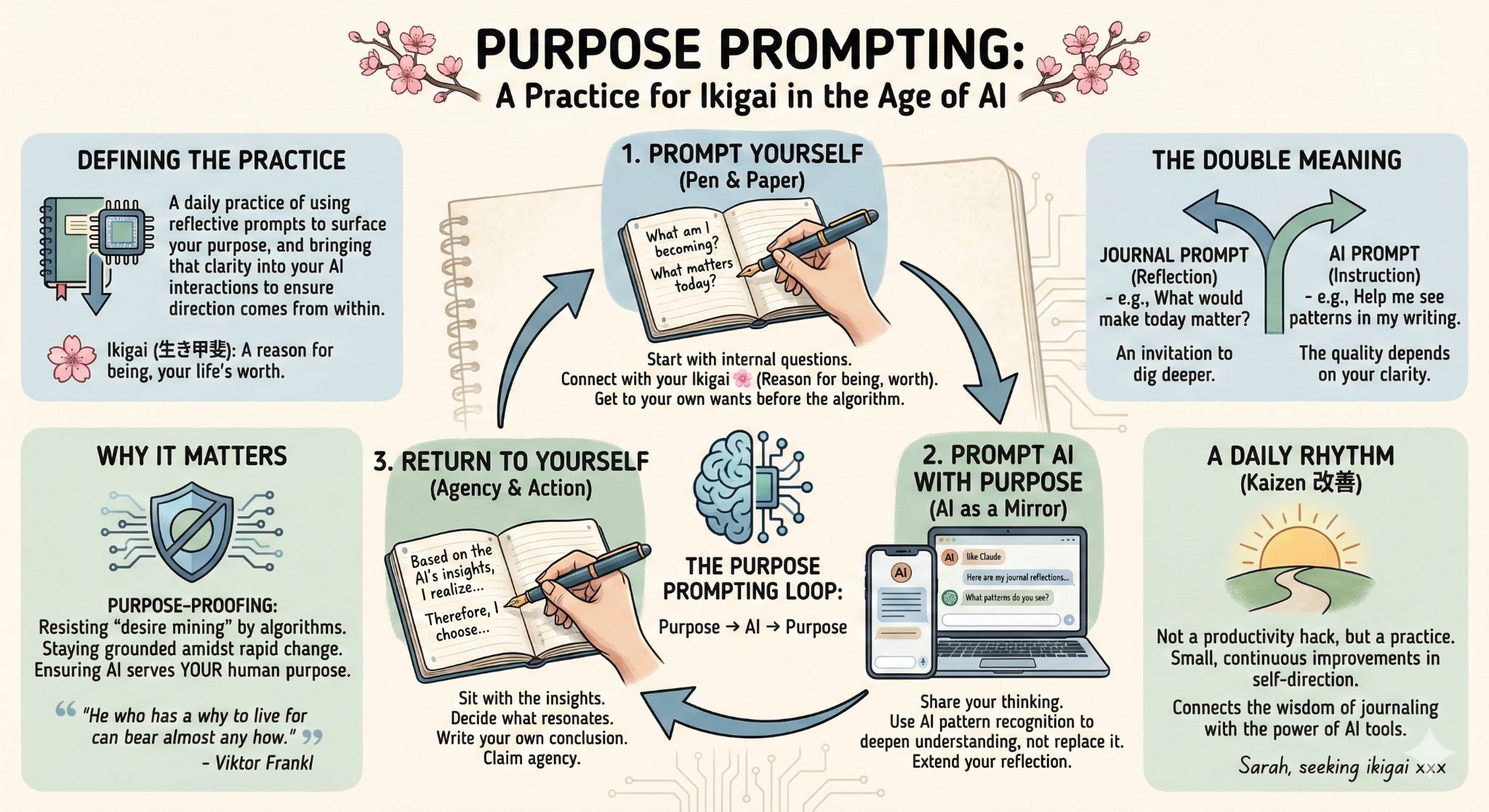
Purpose Prompting sits right at that intersection. It’s the practice of using reflective prompts to surface your purpose, and the practice of bringing that purpose into every interaction you have with AI.
One feeds the other. The journal prompt helps you get clear. The clarity makes you a better AI collaborator. The AI reflection helps you see patterns you missed. Those patterns go back into the journal. And slowly, steadily, you build a relationship with both your purpose and your tools that feels intentional rather than reactive.
What it looks like
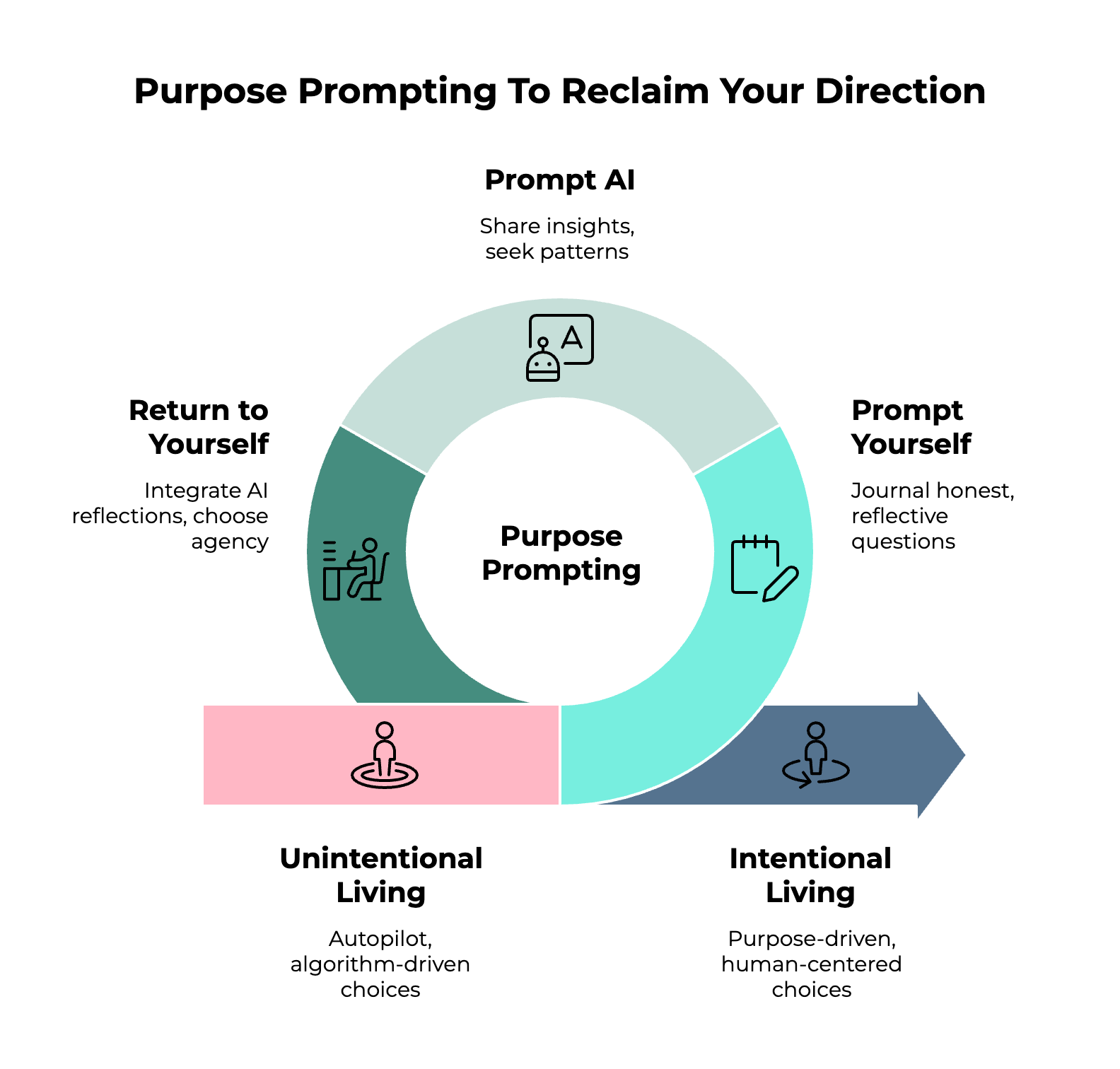
Purpose Prompting isn’t a rigid system. It’s more of a rhythm, and it has three movements.
First, you prompt yourself. Pen and paper. A question that matters. This is where ikigai journaling lives… the specific practice of using your bullet journal to explore your reason for being, your values, your direction. It doesn’t have to be profound every day (some days my journal prompt is literally what do I want for dinner tonight and why can’t I decide? which often turns out to be about something bigger than dinner). The point is that you start with yourself. You get to your own wants and intentions before any algorithm does.
Then, you prompt AI with purpose. Armed with that clarity, you bring your thinking to an AI tool to extend your reflection rather than outsourcing it. You share your journal thoughts and ask, what patterns do you see here? What am I circling? What might I be avoiding? The AI becomes a mirror, not a master. You’re using its pattern recognition to deepen your own understanding, not to replace it.
Finally, you return to yourself. You take what the AI reflected back and you sit with it. You decide what resonates and what doesn’t. You write your own conclusion in your own handwriting. This last step is everything, because it’s where agency lives. The AI suggested stuff but *you* chose. That’s purpose-proofing in action.
Where this came from (or the dots I’ve been joining)
If you’ve been reading these essays for a while, you’ll know I’m obsessed with the intersection of purpose (ikigai), paper (bullet journaling) and pixels (AI). I’ve been writing about this intersection for over two years in essays like Purpose, Paper & Pixels, exploring how these forces work together.
Purpose Prompting is what happens when you stop exploring the intersection and start practising it. It’s the framework becoming a verb.
As I’ve been writing and describing moments uploading a photo of my journal to Claude and the AI illuminated connections I hadn’t seen. That was Purpose Prompting before I had the term for it. When I wrote about the NeverEnding Becoming and the importance of getting to your own wants before the algorithm does, I was describing why Purpose Prompting matters. The desire mining age I warned about? Purpose Prompting is how you resist it.
I’ve been circling this idea for a while and it’s only now crystallising into something I can name and share. Which is making me smile as that’s exactly how Purpose Prompting works itself anyway… you sit with something long enough, journal about it enough times, bounce it off enough AI conversations and eventually the pattern reveals itself.
I Purpose Prompted my way into discovering Purpose Prompting *grin*
Why this matters now (more than ever)
We are drowning in AI news and tools. Every week there’s a new one that promises to revolutionise your productivity, your creativity, your whole life… some of them are genuinely brilliant. I use AI every single day and LOVE it.
But all the productivity in the world is worthless if you’re being productive towards the wrong things. If your AI tools are helping you sprint in a direction you never consciously chose, you’re not being efficient, you’re being efficiently lost.
Purpose Prompting flips the equation. Instead of starting with what can AI do for me? you start with what do I actually want, and how can AI help me get there with my humanity intact?
As Viktor Frankl wrote, “He who has a why to live for can bear almost any how”. We’re living through one of the most dramatic “hows” in human history. AI is reshaping the how of nearly everything. But the why? The why has to come from us. The why has to come first, and Purpose Prompting is a way to make sure it does.
Who this is for
Anyone who’s ever felt that tension between excitement about AI and a worry that something important might get lost in the shuffle.
If you’re a journal keeper who’s curious about AI but doesn’t want to lose the magic of pen and paper, this is for you. If you’re an AI enthusiast who secretly feels like you’re consuming more than creating, this is for you. If you’re somewhere in midlife, with decades of wisdom and lived experience and an instinct that tells you these tools should serve your purpose rather than distract from it, oh, this is especially for you.
I’ve said before that those of us in Gen X are uniquely positioned for this moment. We grew up pre-internet, lived through the digital revolution and now we’re watching AI reshape the world. We know what it’s like to think without Google. We remember what it’s like to be bored and let our minds wander. That experience is a superpower right now, if we use it.
It’s a practice, not a hack
I want to be really clear that Purpose Prompting isn’t a productivity hack. It’s not “5 killer prompts to 10x your output.” The internet is full of that and I have no interest in adding to the noise.
This is a practice. Like meditation, like running, like journaling itself… it’s something that compounds over time. The first time you sit with a journal prompt before checking your phone, it might feel a bit awkward. The first time you share your journal reflections with an AI and ask it to help you see your patterns, it might feel weird or vulnerable. That’s okay. The Japanese concept of kaizen (改善) teaches us that continuous small improvements are more powerful than dramatic reinventions.
Purpose Prompting is kaizen for your sense of direction. A fraction clearer and more intentional every day. A fraction more you.
Purpose Prompting at its heart is the daily act of naming what you want, what you’re becoming, what matters to you, before anyone or anything else can name it for you.
It’s pen and paper and honest questions and AI reflections and the courage to keep asking.
Becoming was always the point, and Purpose Prompting is how you make sure the becoming is yours.
So beautiful souls, what sort of words would get you started if you opened your journal and wrote ‘what do I actually want’?
Sarah, seeking ikigai xxx
PS ✍️ Your Purpose Prompting practice
Try this tomorrow morning, before you pick up your phone. Open your journal to a fresh page and write the date and one of these questions;
What do I want today? (Not what do I need to do, what do I want)
If I could only work on one thing this week that aligns with my purpose, what would it be?
What am I becoming? (Based on the choices I’m actually making at present)
Write for five minutes, or as long as you can. Then, if you want to go deeper, take a photo of what you’ve written and share it with your AI tool of choice. Ask it: “What patterns do you notice in my thinking? What might I be circling but haven’t named yet?”
Then, and this is important, go back to your journal and write what you think about what the AI said. That’s the full loop > Purpose → AI → purpose.
PPS 🤖 An AI prompt to try
Here’s a Purpose Prompt you can paste straight into Claude or your favourite AI helper;
“I want to understand what I’m really working towards right now. I’m going to share some recent journal reflections and things that have been on my mind. I’d like you to help me see the thread connecting them, what am I gravitating towards that I might not have fully articulated yet? Please be honest and specific, not generic. Help me see my own patterns.”
Then paste in whatever’s been lighting you up recently. Your journal pages, screenshots, voice notes, saved articles, half-finished ideas. Let the AI help you see you, then decide for yourself what you think.
PPPS 🎧 Soundtrack – “Once in a Lifetime” by Talking Heads
And you may ask yourself, well, how did I get here?
Was there ever a more perfect Purpose Prompting anthem? David Byrne wrote this song about exactly what happens when we don’t prompt ourselves with purpose, we operate on autopilot and end up with a house and a job and a life we never consciously chose. When asked about it, Byrne said the lyrics were about the unconscious: “We operate half-awake or on autopilot and end up, whatever, with a house and family and job and everything else, and we haven’t really stopped to ask ourselves, ‘How did I get here?’”
That question how did I get here? is the ultimate anti-Purpose Prompt. It’s what you ask when you haven’t been doing the practice. Purpose Prompting is how you make sure you always know the answer.
I love that the song isn’t despairing about it. Brian Eno said Byrne combined “the blood-and-thunder intonation of the preacher” with something genuinely optimistic: “It’s saying what a fantastic place we live in, let’s celebrate it. That was a radical thing to do when everyone was so miserable and grey!”
Radical optimism in the face of everyone being miserable and grey, sounds very me hehe.
This song hits especially hard this week. My friend Arthur passed away, and I’ve been sitting with how he lived and how present he was. Once in a lifetime. We say that phrase so casually, but it’s literal, isn’t it? We get one, and we never really know how long that one is going to be. I miss him already, but the best way I know to honour someone who lived so fully is to take that energy and pour it into something real. So here I am, writing about purpose on a Saturday morning, choosing to celebrate alongside the sadness. For Arthur. For all of us who are still here, still becoming.
Turn it up. Let David Byrne’s glorious awkward dancing remind you that the point isn’t to have it all figured out, the point is to keep asking the question, on purpose, with your whole weird beautiful self 🎶
I Purpose Prompted my way into discovering Purpose Prompting *grin* - amazing!!! This is gold. ❤️
This post made my morning. I love the prompt to use with Claude, and have already hit him up with it this morning. Most of all I love the stopping and allowing time to think about purpose. I tend to be great at to-do lists and hurrying and stressing a little when today's tasks have to be rolled into tomorrow - so this is great medicine for me. My handwriting makes doctors look like calligraphers, so I won't be using a paper and pen, but I did find this morning that using the Heptabase notes app in its journal section gave me good clarity as long as I stayed away from all other screens.