


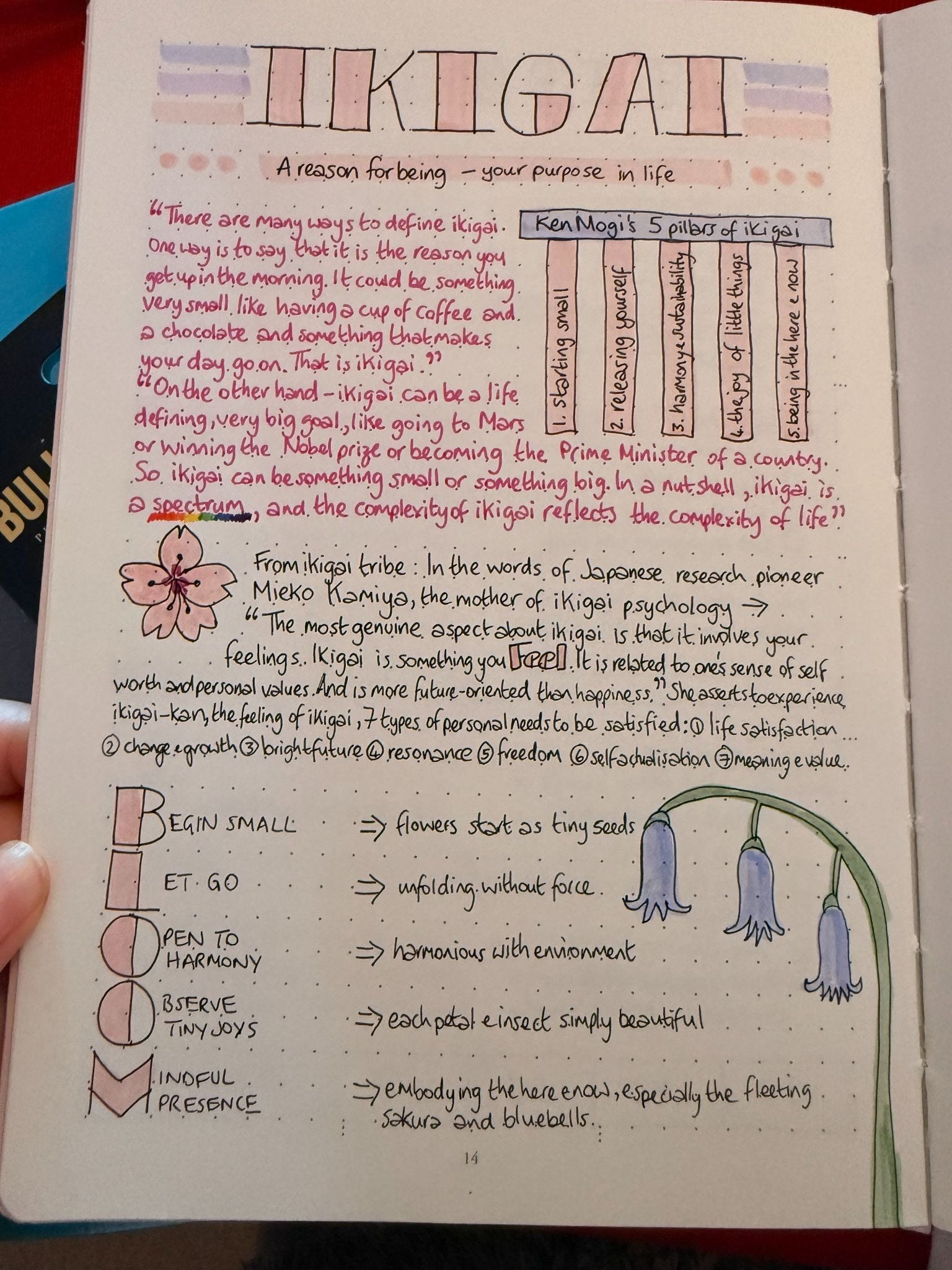
🌸 ikigai 生き甲斐 is a reason for being, your purpose in life - from the Japanese iki 生き meaning life and gai 甲斐 meaning worth 🌸
I’m a huge bullet journal geek, so this is one of my absolute favourite times of the year *SO excited* for new journal setup time in betwixtmas!
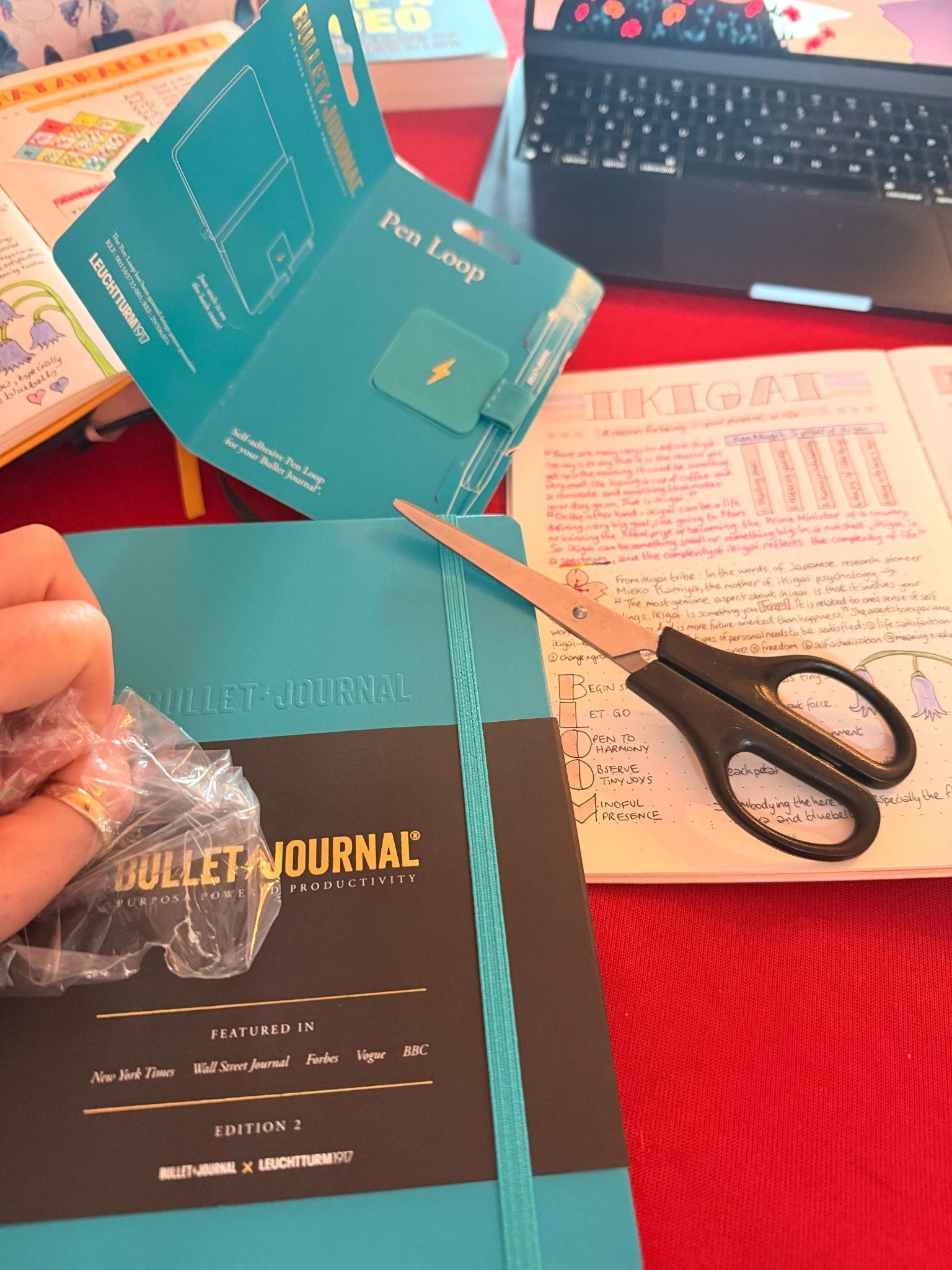
I’ve peeled off the plastic from my shiny new turquoise Leuchtturm Bullet Journal, attached the pen loop and picked out the Tombow I feel matches the cover just right (452 if you were wondering).
Now comes the ritual I’ve performed for many years… writing my name on the first page, setting up the future log, indexing pages that will hold half a year I haven’t lived yet.
I’m writing my future, one dot grid page at a time.
But first, I flip backwards. Through 2025 and 2024 in particular, watching myself change on paper. There’s a page called “Labels n Loves” with many identities scribbled in clouds; wife, mother, daughter, feminist, ikigai seeker, AI enthusiast, bullet journaler. Some I’d forgotten I’d claimed. Some I should perhaps abandon. Pages like that sat there, patiently waiting as a backdrop to the conversations I have with Claude about ensuring AI doesn’t hollow out human purpose itself.
It occurs to me that AI has the potential for perfect recall but no actual memory, or any notion of a felt sense of our lives.
It can retrieve everything yet remembers nothing.
AI = You must KNOW what you’re looking for to retrieve it
Journal = You DISCOVER what you needed by accidentally stumbling on it
This is the difference between search and serendipity… between “I need to find that thing about...” and “Oh! I’d completely forgotten I was thinking about this!”
A journal lets you flip and find things you didn’t know you’d lost. AI requires you to already remember enough to search for it. That’s the real paradox.
How do we capture and integrate “You can only find what you remember to look for” vs “You find what you forgot you needed”?

The archaeology of becoming
Yesterday, I asked Claude for help thinking through my 2026 ikigai spread. I uploaded pictures of two previous versions and shared my thinking and my questions. Should I evolve it? How? What would make it world-class? We brainstormed five different directions. Analysed them against a rubric and chose a new direction that felt right together.
That entire conversation will vanish from Claude’s awareness the moment the chat window closes. Oh, the data exists and Anthropic’s servers hold the transcript. But my Claude won’t really remember our thinking. It won’t recall the moment we realised combining Option 2’s framework with Option 4’s radical transparency might be genuinely new territory.
I’ll remember it when I look at my H1 2026 page 14 and 15 spread forever.
I can also flip to page 18 of my H2 2024 journal and see my values spread. Pink background, Van Gogh almond blossom wash tape. “In order for it to be EASY” written across the top in my handwriting. Kindness. Optimism. Calm. LOVE in capitals.
A small note added at a later point at the bottom… “learn how to let go and protect your energy for those who matter.” I wrote when I was struggling with life being decidedly NOT easy earlier this year. Today though I smile at past-me leaving gorgeous messages for future-me, they wait there, coffee-stained and patient, until a day I need reminding that protecting my energy isn’t selfish.
That’s real memory, heartfelt and learned in our bones. That’s a thing AI can’t easily do.
Which makes me wonder what else we’re losing in the shift from pages to prompts.
What gets lost in perfect retrieval
I’ve been thinking about this a lot, because I do use Claude for lots of things now. Honing my philosophical thinking. Testing new approaches. Drafting essay structures and ideas. Strategic thinking. Debugging ideas. Every single one of these interactions adds to a vast corpus that could theoretically be searched, indexed, retrieved. But retrieval isn’t memory.
Last week I spent twenty minutes searching my Claude chats for ‘that thing about agency and AI’ before giving up, because I couldn’t remember if I’d called it autonomy, or control, or something else entirely. Meanwhile, I found it in three seconds flipping through my journal because I’d drawn a little doodly diagram in my notes for that day.
Memory is the archaeology. The layers. The you-shaped sediment that builds up over years of returning to the same questions in slightly different ways.
When I draw my ikigai diagrams for the umpteenth time, and I will draw them again in this turquoise journal, probably slightly differently than the last two times, I’m not necessarily optimising. I’m not iterating towards some perfect final version. I’m attending. Like you return to visit a park or garden, not a summit you conquer once.
The repetition is the point.
AI doesn’t have repetition in this way. Every chat is new, even when it’s the same question you asked six months ago. There’s no easy “oh, we’re back here again” recognition unless you actively try to build for that within one chat thread, which then risks forgetting the earlier parts the longer you go on. No pattern that emerges from circling the same territory for years. No coffee stain that reminds you how certain problems follow you around.
I can ask Claude the same question I asked in March and get a completely different answer, uninfluenced by the shape my thinking had taken back then or the things that have happened since. Sometimes that’s brilliant, beginner’s mind on demand. But sometimes I lose the thread of my own becoming.
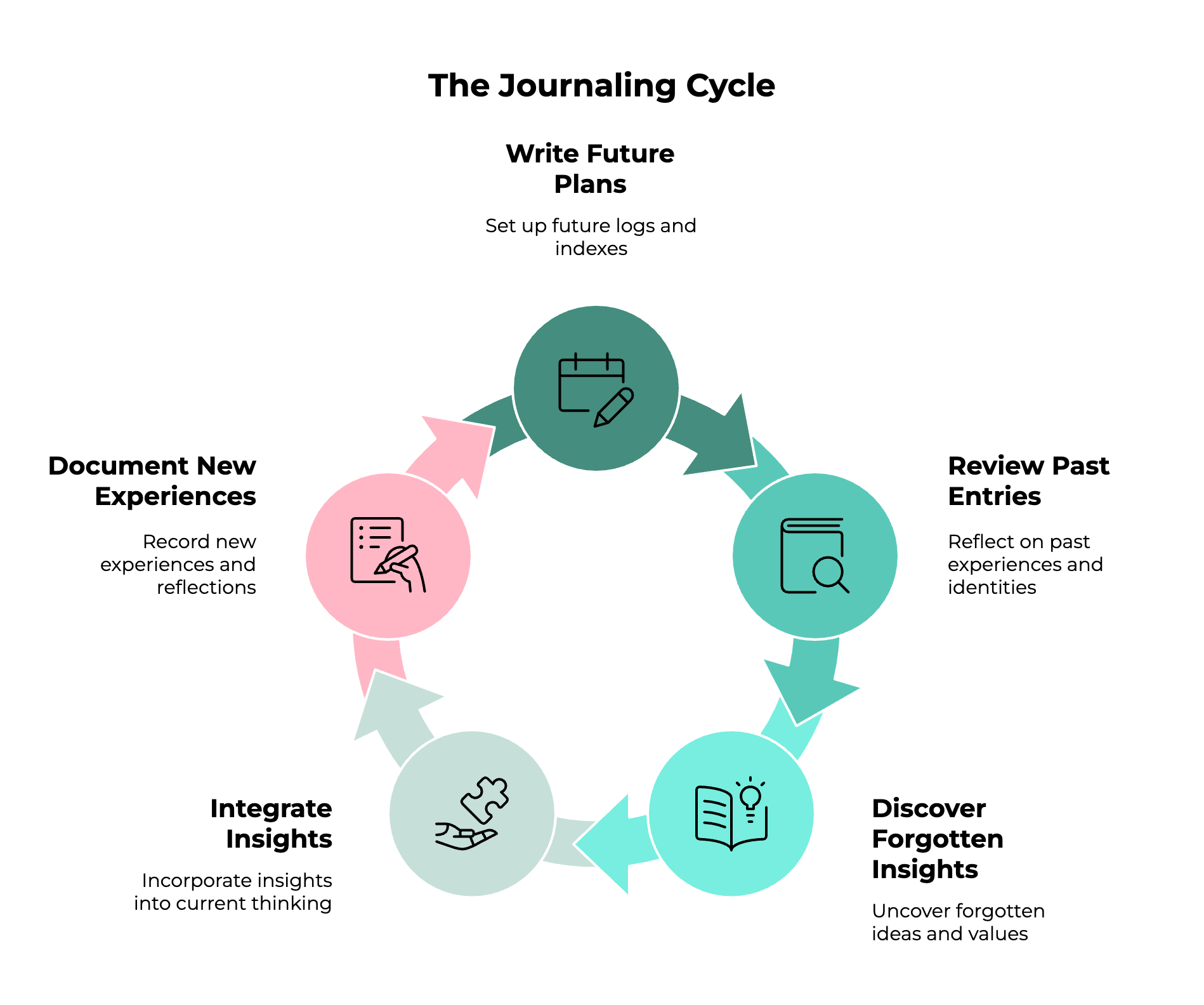
Write the future, record the present, learn from the past
My desk has a stack of bullet journals strewn across it at present, open to various pages as I contemplate what I want to do differently next year. Red, orange, yellow, green, teal, burgundy and more going back to 2017. Each one a different chunk of my life. Some thick with washi tape and pages stuck in. Some sparse, abandoned during difficult periods. All of them holding the messy, non-linear story of who I’ve been.
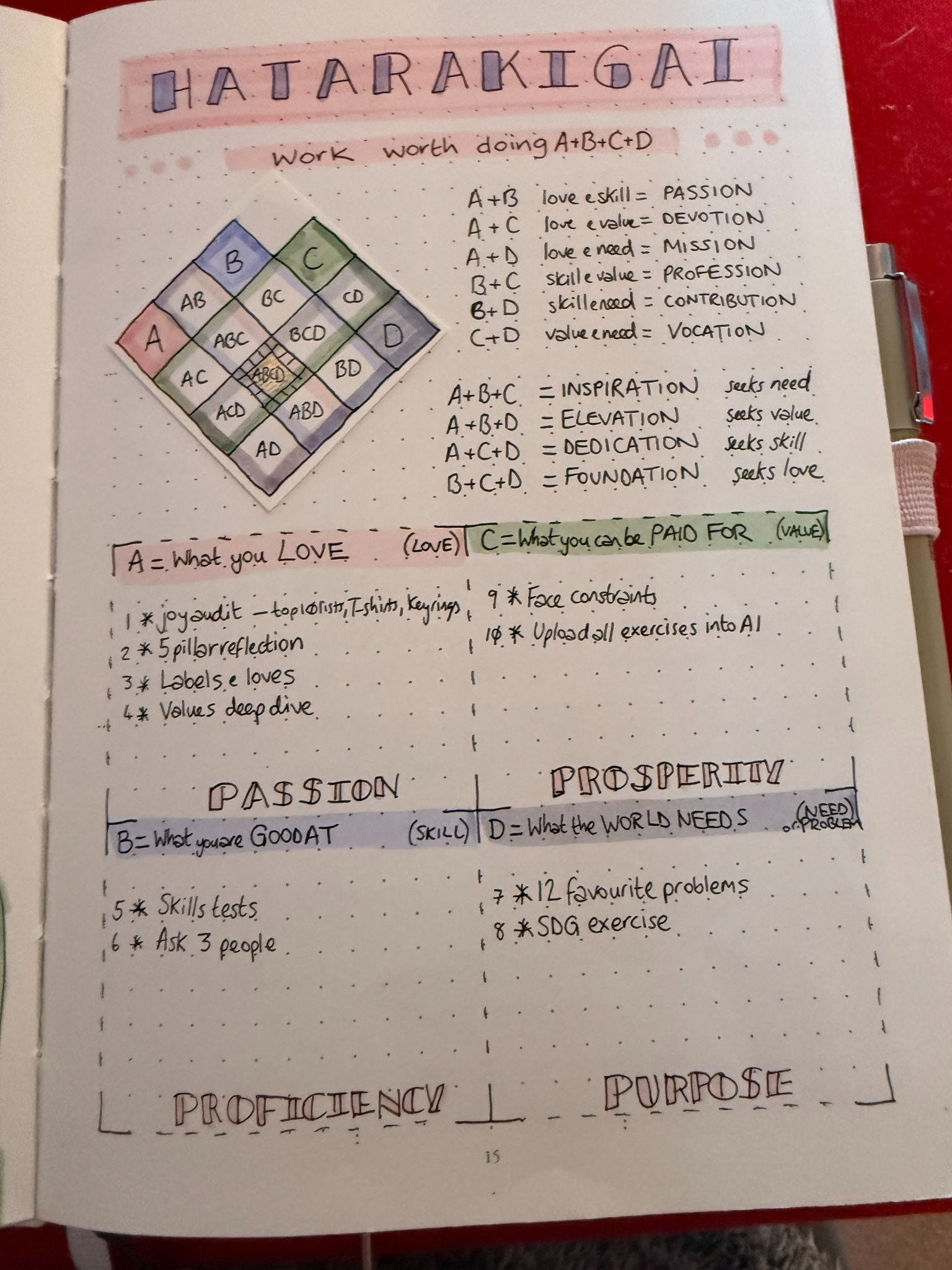
I can see when “AI” first appeared in my labels cloud. I can trace when “kindness” moved from a nice-to-have value to a core principle. I can find where I first drew that hatarakigai diagram that’s become my process for testing whether work is worth doing.
This is a control group. The before, a record of what human intention looked like pre-AGI.
I’m maintaining it deliberately, building evidence while others seem quick to hand over so much to AI. I know what thought feels like when it flows through a hand holding a pen, reflection can’t be delegated. I don’t want a planning system to optimise me without consent.
So here’s one of the things I’m doing differently with 2026.
I’m keeping an ikigai spread with the definitions, Ken Mogi’s five pillars, my BLOOM mnemonic that grounds me. But I’m adding something new. A section on ikigai risk. What happens when technology threatens our reason for being. Loss of agency when AI does instead of amplifies. Voice replacement when systems speak for us. Purpose displacement when work that gave meaning becomes obsolete.
I’m documenting the threat in the same place I document the meaning.
Because here’s what I’ve realised through conversations with Claude, through flipping backwards through years of ink… every time I draw something by hand, I’m making choices AI can’t make for me, intentions more than optimisations.
And intention leaves traces. Coffee stains. Crossed-out goals. Pages you forgot about until you flip past them and remember… oh yes, I was thinking about that. I was becoming something there.
AI can store some of the pre thinking. But it can’t work on the process for you, and it definitely can’t hold it. Can’t return to it with the weight of accumulated visits. Or feel the difference between information retrieved and wisdom revisited.
The thing you feel
Mieko Kamiya, the mother of ikigai psychology, said something I copied into my 2025 journal: “The most genuine aspect about ikigai is that it involves your feelings. Ikigai is something you feel.”
You feel it. Not retrieve it. Not query it. Not process it.
And feelings need somewhere to land. Somewhere that holds them across time. Somewhere you can flip backwards through and see your own patterns emerging, your own changes happening, your own voice getting clearer or cloudier or stronger or more scared.
I use AI to expand my thinking. To brainstorm directions I wouldn’t have found alone and to refine my ideas.
But then I often take what we’ve created together and I write it out by hand. In 2026 that will happen in this turquoise journal, on the next blank page, with the Tombow 452. Something happens in that transfer. The ideas change shape. Get warmer. More mine. The skeleton Claude helped me build gets wrapped in muscle and breath.
That’s the practice and a thing I’m protecting.
Usage is curriculum
I’ve written before about how every AI interaction teaches these systems what humans value. Usage is curriculum. Every prompt says this is what matters to us. This is what we’ll delegate. This is what we consider not worth our attention.
So what am I teaching when I maintain this stack of journals? When I draw the same ikigai diagram three times instead of asking AI to generate a perfect version once? When I choose the turquoise pen that matches the turquoise cover even though any pen would do?
I’m teaching that intention matters. That repetition isn’t failure. That the archaeology of your becoming is more valuable than the efficiency of your arrival.
I’m teaching myself, mostly. But maybe I’m also teaching future-me what past-me valued. And when I flip backwards through these pages in 2030, when AI can probably write better than I can, when automation has hollowed out some of the work that currently gives my life meaning, I’ll have the evidence.
I’ll be able to see what thinking felt like. This is what intention looked like. This is what I chose to attend to when I could have delegated it.
The pages will remember, even if I don’t.
I’d love to hear your thoughts beautiful souls… Have you ever searched your AI chat history looking for something you knew you’d discussed... and given up because you couldn’t remember the exact words to find it? What’s something you stumbled on flipping through old notes that you’d completely forgotten but absolutely needed?
Sarah, seeking ikigai xxx
PS ✍️ Your journal archaeology practice
If this essay sparked something, here’s a mini-process to try;
Step 1: The Backward Flip (5 minutes)
Look through anything you’ve written or created in the past year; notes app, old journals, voice memos, photos. Find one thing that surprises you, something you’d forgotten you cared about or noticed.
Step 2: The Pattern Hunt (10 minutes)
Ask yourself: Have I returned to this theme before? Has this question followed me? Write down where else you’ve seen it show up.
Step 3: The 2026 Container (15 minutes)
Design a simple structure to hold this pattern as you continue exploring it, could be;
A single page in a journal where you return monthly
A voice note series with the same opening question
A photo collection of moments when the theme appears
A document where you paste quotes/ideas as you find them
The structure doesn’t need to be elaborate. It needs to be yours, something you’ll recognise when you flip backwards a year from now.
Step 4: The First Entry
Make the first mark. Write the first sentence. Take the first photo. Date it. This is your stake in the ground “I was here. I was noticing. This mattered.”
PPS 🤖 An AI prompt to try
Most of us use AI to help us move forward, brainstorm, draft, create… try this instead;
“I’m going to share [3-5 things I’ve created/written/worked on over the past year]. Please analyse them for patterns I might not see in my own thinking. What themes keep appearing? What questions am I circling? What’s the through-line I’m following but haven’t named yet? Don’t tell me what to do next, tell me what I’ve already been doing that I haven’t noticed.”
Then paste in; old emails you’re proud of, social media posts that got strong reactions, journal entries, project outlines… anything that felt important when you made it.
What AI gives you back is a mirror. The archaeology of your own attention, reflected back so you can see the shape you’ve been making all along.
PPPS 🎶 Soundtrack for this moment
Hazy Shade of Winter, specifically The Bangles version (don’t come at me, I’m a huge S&G fan, but this is an AWESOME cover!) …. Bells in honour of Christmas time, and of course those lines about time and “see what’s become of me” land differently when you’re holding years of your own handwriting. The urgency in it. The recognition that we’re always becoming something, whether we’re paying attention or not. Better to notice whilst there is still time to write new stories!
Thoughtful reflections on taking the time to look back before plotting the course ahead. Thank you for sharing this, Sarah.
Love this Sarah! And for me at least it is extremely true. I still remember exact places and moments for journal entries I wrote by hand over 2 decades ago. Maybe something also to do with the smell of IRL journals as well?