


🌸 ikigai 生き甲斐 is a reason for being, your purpose in life, from the Japanese iki 生き meaning life and gai 甲斐 meaning worth 🌸
Have you ever been so tired and emotionally drained that you don’t quite trust what you’ll say next?
I’ve been running on fumes this week.
A bit under the weather, tired and missing Anna SO much it knocks the wind out of me at the strangest of moments... and feeling a little lost and scared too, the fear has no obvious shape just foreboding about who I might become when this worn out. My reactions can let me down with stuff feeling too loud and too close. Is this thing in front of me really such a big deal? A brief word or phrase reads like a telling off and I can feel retorts forming before I’ve decided whether they are a good idea or not.
That’s the part that scares me. When you feel lost, it’s very easy to grab at anything that gives you a sense of control... and being cross seems to be an easier thing to hang on to than other emotions. Plenty of people around me seem to be in the same boat. Worn thin, tired and carrying things others don’t necessarily see. So I’ve been wondering what would actually help us in those moments and I realised that I’ve written more careful instructions for AI than I have ever written for myself. Use British English. Be honest. Challenge my assumptions. Please stop saying delve or crucial. I can be wonderfully specific about how I want a chatbot to behave, yet apparently I expect myself to navigate grief, tiredness and everyday stuff and nonsense with no instructions beyond “try not to be a knob”.
There may be room for improvement here.
The difficult thing is that knowing what really matters doesn’t automatically make you serene about everything else. You can understand, with horrific clarity, how short and precious life is and still get ridiculously het up… then feel cross with yourself for wasting energy being cross, the joys of being a human in this messed up timeline.
So what would actually help? “Life is short” is true, but it doesn’t tell me what to do with the terse reply I’m about to give which will probably make things ten times worse. “Be calmer” is an admirable ambition and a deeply irritating instruction when I’m already wound up.
I think we need a reminder to reach for when we don’t have the energy to talk ourselves all the way back to perspective. Something that helps us decide what to do next. Which is what drew me to philosophical razors this morning.
A rummage in the razor drawer
Philosophical razors are short rules of thumb for cutting through tangled thinking. I wondered whether I could borrow a few of these ideas and make some of my own, for the everyday business of being a human when life feels a little pooey. For example, “try muddle before malice” gives me a useful place to start with an abrupt email. Before deciding someone is being mean, I can check what they meant. The email hasn’t changed but I’ve given myself another possible explanation, and a choice about how to respond.
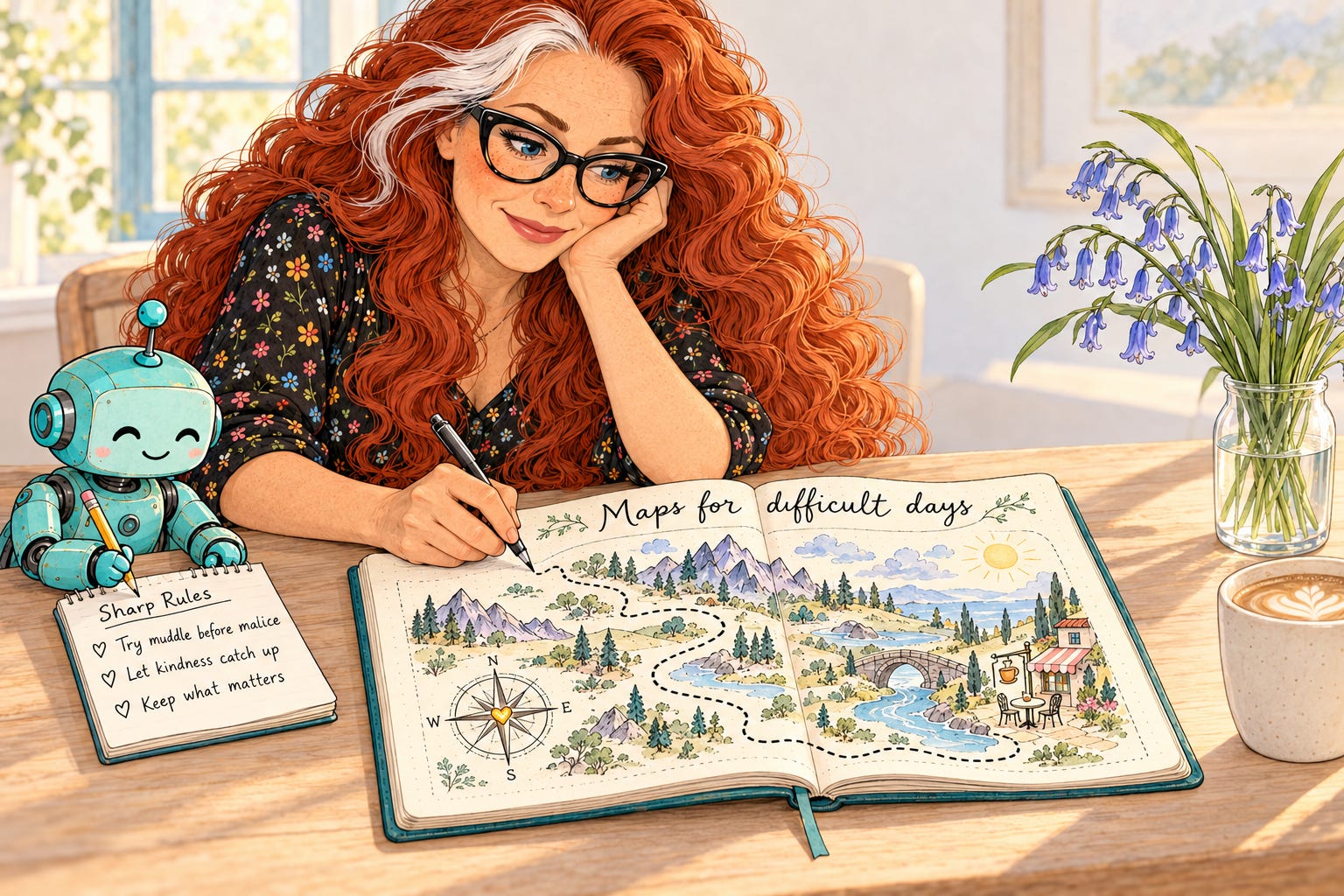
That’s how a little rule becomes useful as a map. I know the direction I want to go in... towards kindness, towards those I love, towards spending my time on things that matter to me. But when I’m tired or upset, I can lose sight of the next turn. A few words, chosen while I’m thinking clearly, might help me find it again. I could still be sad. The day could still be difficult. But perhaps I could get through that moment without adding a row, a regret or hours of stewing to everything else I’m already carrying. That feels like a useful, achievable kind of hope.
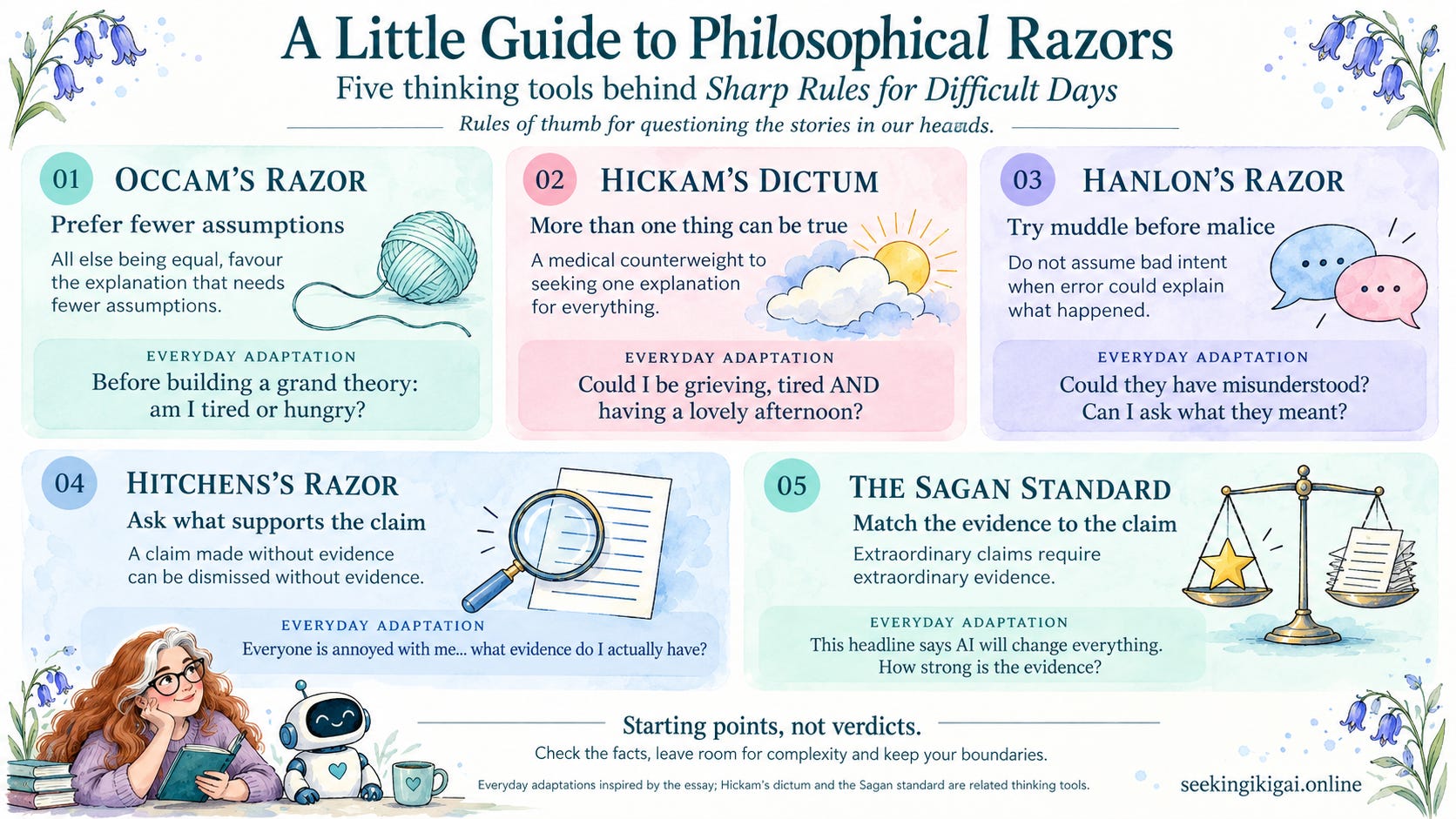
Before making my own, I went looking at a few of the originals. These are starting points for thinking, and each has its limits. You still have to pay attention to what’s actually happening.
The famous one is Occam’s razor, named after the medieval friar and philosopher William of Ockham. The principle recommends searching for explanations constructed with the smallest possible set of elements, paraphrased as ‘the simplest explanation is the most likely’ has roots even older than Ockham, a rule about simplicity has a complicated history. For everyday purposes, I like this version; “before constructing an elaborate theory about why everything feels awful, check whether you’re tired or hungry” *grin*.
Then there’s Hickam’s dictum, a medical counterweight commonly attributed to the physician John Hickam. “Patients can have as many diseases as they damn well please.” One neat explanation doesn’t necessarily account for everything. I’m borrowing that idea very loosely for feelings. You can be grieving AND tired AND annoyed about something that really is annoying. You can also laugh, look forward to something and have a lovely afternoon. You can have as many feelings as you damn well please.
Hanlon’s razor appeared under that name in Murphy’s Law Book Two in 1980. “Never attribute to malice that which is adequately explained by stupidity.” I’d prefer “muddle” to “stupidity”, especially this week. People forget. Instructions confuse. Someone thinks someone else has done the thing, I have absolutely been someone.
And two more that feel very relevant against a backdrop of noisy AI news Hitchens’s razor says that what can be asserted without evidence can be dismissed without evidence. The Sagan standard says extraordinary claims require extraordinary evidence. Useful when a headline announces that AI will either save civilisation or finish it off. Useful, too, when my own brain presents “everyone is cross at you” as a researched finding. Whatever my tired brain asserts my rested brain is allowed to question. I can take a concern seriously while asking what actually supports it.
The appeal of these little rules is that they give a question to ask before committing to the story in our heads.
Custom instructions for this human
Asimov set out his Three Laws of Robotics in Runaround in 1942, then spent years exploring how apparently clear rules could get complicated in practice. That feels relevant to anyone who has ever resolved to “be more patient” and subsequently encountered other people.
I’m borrowing the idea of custom instructions from robots and AI. A few reminders and rules about how I want to respond when things get messy. Mine need to be short enough to remember when I’m tired, and forgiving enough to be useful after I’ve already got something wrong.
If the machines get guardrails, so can we and ours should be gentler.
There’s a song running through all this for me too. Maps by Yeah Yeah Yeahs, one of my favourite songs of all time, tangled up with fab nights out with Anna and our other friends... it feels like the right soundtrack for trying to find my bearings this week.
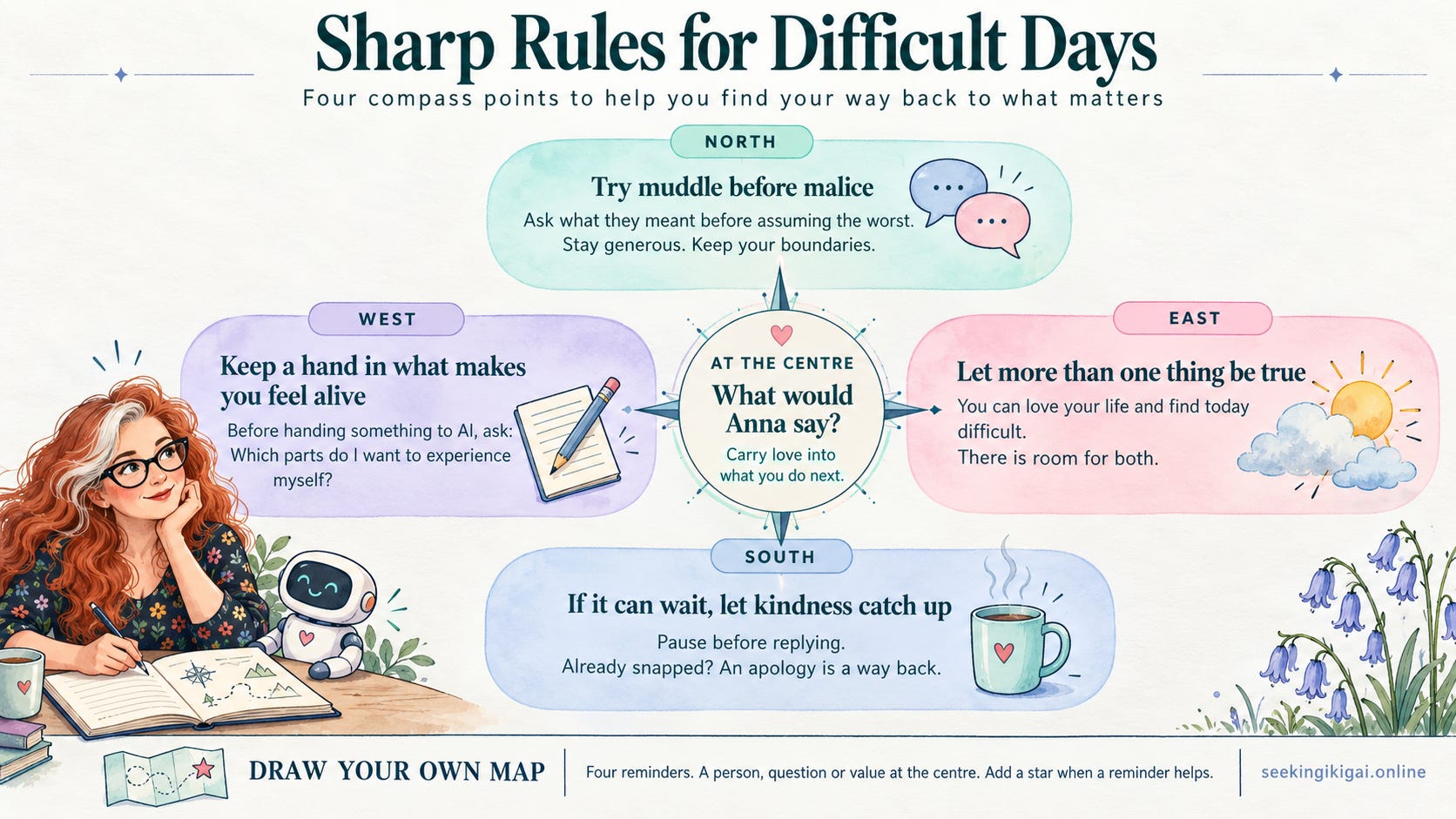
So here’s my map. A reminder for when I’m judging someone else, one for when I’m judging myself, one for when I’m about to react and one for deciding what I want to keep doing myself. Four compass points and someone very important in the middle. Sarah’s Razors if you will;
North... try muddle before malice
Before deciding someone is being deliberately difficult, leave room for a less dramatic explanation. Perhaps they misunderstood. Perhaps they’re overwhelmed. Perhaps the email I’ve mentally added a sarcastic voice to was written by someone in a rush to get out of the door and home to their family I can ask what they meant. I can also notice patterns and set boundaries when behaviour keeps causing harm. Starting generously leaves room to change my mind when I know more.
I’d quite like to extend some of that generosity to myself. Being below my best doesn’t mean I’ve become a dreadful person. It just might mean I’m below my best.
East... let more than one thing be true
Thank you, Dr Hickam. This is the one I need when I catch myself thinking I should be handling everything better because I know what really matters. I can love my life and find today difficult. I can miss Anna and enjoy a ridiculous joke. I can be hopeful about AI and worried about what we lose when we hand too much over.
None of those feelings requires me to cancel another. There’s room for all of them, even when I’d prefer a simpler arrangement.
South... if it can wait, let kindness catch up
The important bit is “if it can wait”. Some things need addressing now. Plenty of things can survive a cup of coffee, or a day or two to reflect before I address them. That reply I’m composing with my shoulders up around my ears? It can probably wait. I might still need to say something afterwards. I might say exactly the same thing, with fewer sharp edges and a much better chance of being heard.
And if I’ve already snapped, kindness can catch up through an apology. “Sorry, that came out badly” is a perfectly good way back.
West... keep a hand in what makes you feel alive
This is my AI razor, and a small piece of what I’ve been calling Purpose Proofing. Before handing something over, I ask myself what I would miss if I stopped doing it myself. Sometimes the answer is absolutely nothing. Wonderful, off it goes. Other times, the effort contains something I treasure. Finding my words, learning a skill, making a wobbly drawing, choosing what I really think. AI can help with those things too. The question is which parts I want help with and which parts I want to experience. Getting a finished thing and having the experience of making it can matter in different ways.
That’s part of the ikigai risk of AI for me. I could get so efficient at producing things that I gradually remove the bits that make doing them worthwhile. This little rule asks me to notice while I still have a choice.
At the centre... what would Anna say?
This one makes me smile and ache at the exact same time.
I can ask myself that question and remember the person I knew. I can think about what her friendship taught me, the good times we had and how I want to carry that love into the way I treat people now. She was curious about AI too, we spoke about it in relation to creativity and what might it make possible. I’d have loved to be talking to her over a carrot cake about razors, I’m also thinking that often she’d tell me to stop worrying so much and that sometimes it IS the other person acting like a knob.
Perhaps my next useful move is a coffee, an awesome tune, a hug or a conversation. Every map has a legend, the key that helps you understand what you’re looking at. Anna, a legend in both senses of the word, belongs at the centre of mine. Some people keep helping us find our way long after we wish, desperately, that we could ask their advice in person.
Finding my way back
I don’t want to give grief a job. It doesn’t have to become positive fuel or teach me something every week. Missing someone is enough to be carrying. But when I have a little energy, I can choose where some of it goes. Towards a friend. Towards making something. Towards a kinder reply. Towards putting on a bloody brilliant song and letting myself enjoy it, even if I cry as well.
There’s ikigai in those ordinary choices. The things that make a day feel worth being here for, including the days when we don’t achieve very much of anything at all.
I’m sure I’ll forget every one of these rules at some point. That’s why I want them in my journal, where I can find them again. A map is most useful after you’ve taken a wrong turn. Perhaps making the most of today can be as manageable as giving a little more attention to something I love. A message to someone I’ve been meaning to catch up with. A bit of patience for the tired woman writing this.
Beautiful souls, what’s a little rule that helps you find your way back on a difficult day? It can come from a philosopher, a fictional character, someone you love or your own hard won experience… I’d love us to build up a library we can all borrow from when needed.
Sarah, seeking ikigai xxx
PS ✍️ Draw your own map and compass
Open your journal and draw out a lovely fantasy land map and next to it a compass. Give each point a reminder you’d find useful on a rubbish day. In the centre, put a person, question or value that helps you centre and find your bearings.
Each time you reach for a reminder, draw a little star beside it. At the end of your journal period, notice which ones helped the most, you’re allowed to redraw your map in your new journal with refined reminders.
PPS 🤖 A little help finding your bearings
Try this with your favourite AI tool:
“Here’s something that’s been getting me het up: [share one example].
Help me turn this into a personal ‘razor’: a short, memorable rule of thumb to guide me when something similar happens again.
Start by asking me questions, one at a time. Explore what bothered me, what I might be assuming, what matters to me and what’s within my control. Follow my answers rather than a fixed checklist. Don’t rush to offer advice or automatically agree with my interpretation.
Once you understand enough, suggest one razor in words that sound like me. Make it specific enough to help me choose my next action, and check whether it feels right.
Then help me test it: what would following it look like in my example, and when might it be unhelpful? Refine it with me until it earns a place on my little map back to what matters.”
You get the final edit, especially if it starts sounding too much like a motivational poster *grin*
PPPS 🎧 This week’s soundtrack, Maps by Yeah Yeah Yeahs
One of my favourite songs of all time, takes me back to fab nights out with Anna and our crowd. That mixture of love and longing means something else now of course, but I love that it contains the repeating refrain about maps and love, for sure how to find your way forward on difficult days… turn it up and sing along with me.