

🌸 ikigai 生き甲斐 is a reason for being, your purpose in life - from the Japanese iki 生き meaning life and gai 甲斐 meaning worth 🌸
Some days I feel like I’ve swum a marathon before lunch.
My brain spots a broken system. Then another. Then seventeen more. Each one feels urgent, fixable, wrong. The gap between how things are and how they could be stretches out like an ocean, and I start paddling furiously toward the horizon.
You probably know this feeling. Lots of areas of our societal norms serve up so much that desperately needs changing ALL the time… inefficient processes that waste people’s time, unkindness baked into policies, talented humans ground down by structures that were never designed to serve them.
Why aren’t these things fixed though?
Somewhere along the way, I absorbed the message that caring means fighting. That acceptance is surrender. That if we’re not exhausted, we’re not trying hard enough.
What if that binary is a trap and holding me back?
This essay is also an attempt to answer a question… how do you care deeply without drowning?
The riptide problem
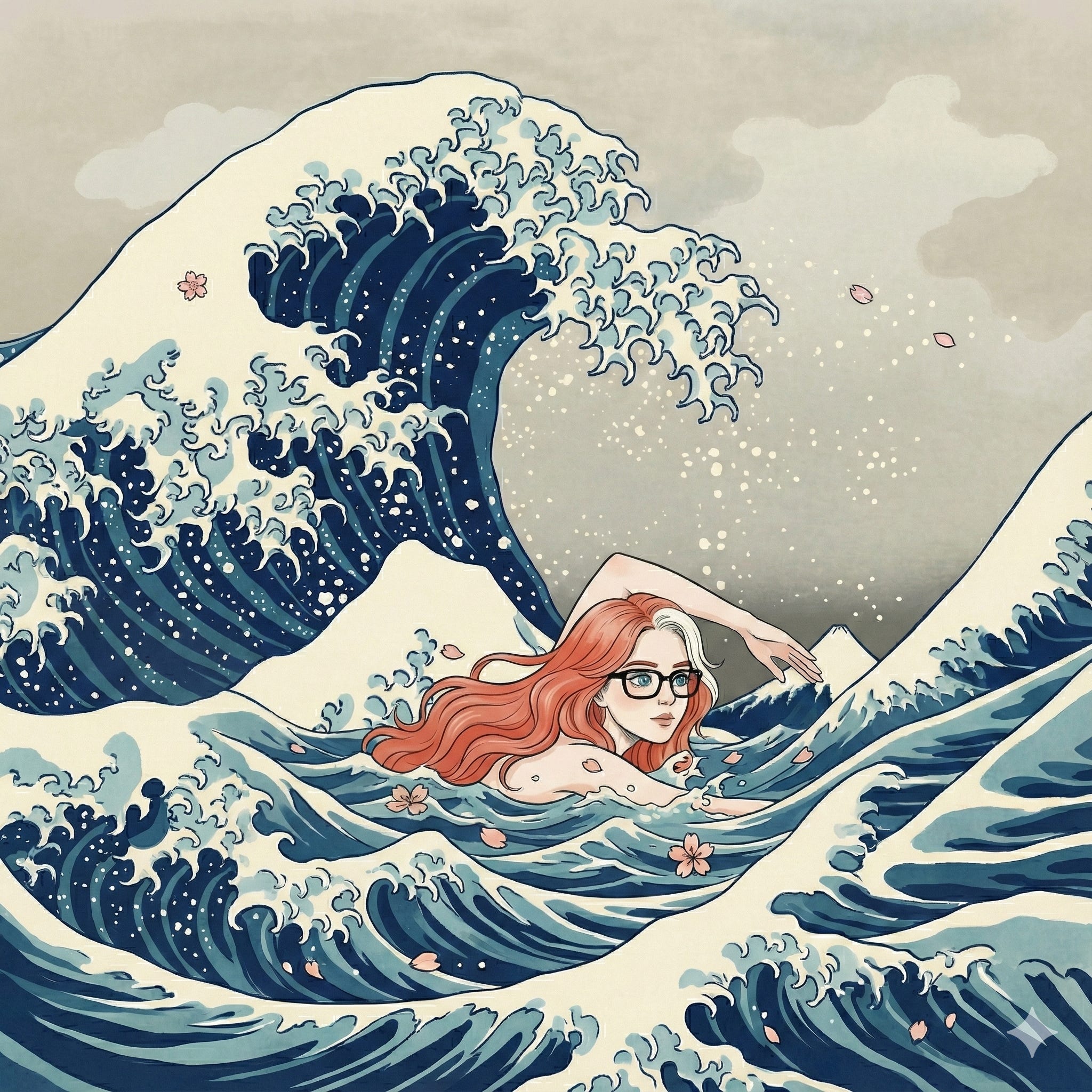
When you’re caught in a riptide, every instinct screams at you to swim directly toward shore. To fight the current with everything you’ve got. This is precisely how people drown.
The survival advice seems counterintuitive… swim sideways. Don’t battle the force that’s pulling you. Don’t give up and let it take you either. Find the third option, the one that works with the water rather than against it, until you’re free of its grip and can make your way back on your own terms.
Weirdly I think that balance was never meant to be a fixed state. We’ve been sold this lie that balanced people have everything figured out, that they exist in some permanent equilibrium where acceptance and agency always sit perfectly weighted on either side. This creates guilt every time one tips, as if the tipping itself is failure.
Tides don’t balance, they flow. They have seasons, rhythms, movements. Sometimes the water pulls out and sometimes it rushes in. Fighting that rhythm exhausts you. Working with it... that’s where wisdom lives.
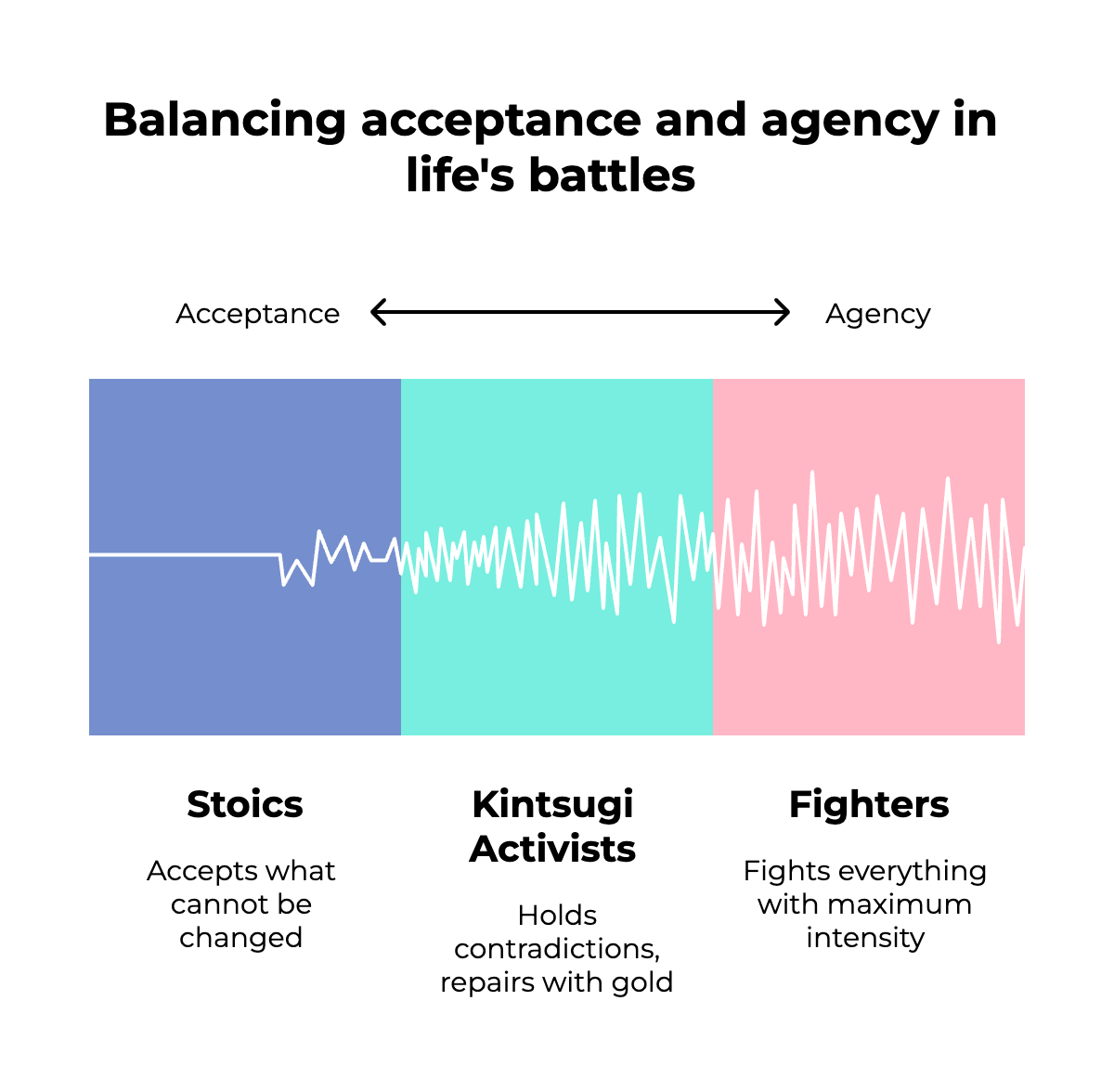
The Stoics had it partly right, of course there’s genuine peace in accepting what we cannot change. But Stoicism can become a comfortable hiding place when it slides from wisdom into passivity. “Accept what is” starts to sound suspiciously like “stop trying.”
And yet the opposite extreme… fighting everything, all the time, with maximum intensity… is its own kind of drowning. Rage is sacred fuel, but it burns out quickly. Pour it everywhere and you’ve got nothing left for the fires that actually need you.
The point isn’t acceptance OR agency. It’s not even about balancing them. I think a good reflection question is… which tide am I in right now, and am I swimming in the right direction?
How do you know it’s yours?
Before you can choose between accepting something or fighting to change it, there’s a harder question lurking underneath… is this even my battle?
Society handed us scripts so early that most of us can’t remember who we were before we learned the lines. We absorbed causes, values, definitions of what matters, often before we had the capacity to question them.
Distinguishing your authentic desires from your conditioned ones might be the most underrated skill for finding purpose. A missing ikigai skill for many.
Not every injustice you notice is yours to fix. Not every broken system is waiting for you specifically. This sounds obvious, but I find it genuinely difficult. When you care about making things better, *everything* can feel urgent and personal.
Here’s how I’ve learned to tell the difference between a fight that’s truly mine and one I’ve accidentally adopted;
The body knows. When something is genuinely yours, the anger feels clean… like fuel, not poison. There’s energy in it, direction, clarity. When you’ve borrowed someone else’s outrage, it sits differently. Heavier. More like obligation than fire.
It keeps coming back. My thing is gender imbalance and the way systems built without women’s input end up being less caring, less nuanced, less good than they could be. I didn’t choose this fight; it chose me. It’s been tapping on my shoulder since I was young, and every time I try to walk away from it, something pulls me back. That persistence means something.
You’d do it even if nobody knew. The fights that are truly ours don’t need an audience. If you’d still care about this issue with no social media and no recognition, it’s probably yours. Comparison sneaks in so insidiously… even when we think we’ve escaped it, we can find ourselves fighting for things because they look admirable rather than because they’re genuinely ours.
It grew rather than arrived. Planted desires often have a “should” quality. I should care about this, good people care about this. Desires that grew naturally feel different. They emerged from lived experience, from something that touched you personally, from patterns you couldn’t help but notice.
The beautiful thing about identifying your real fights is that it gives you permission to let the others go. It’s not that the others don’t matter, but because someone else is meant to carry them. Your job is to swim your stretch of the ocean, not everyone’s.
I’ve noticed that people who truly know their fights almost have a quietness to them. They’re not frenetic, not trying to prove anything. The energy they’ve saved by releasing borrowed battles becomes a steadier fuel supply for the ones that matter. Peaceful AND powerful. That’s the goal.
Kintsugi activism
I love the traditional Japanese craft and art form kintsugi, where broken pottery is repaired with gold. The cracks aren’t hidden or smoothed over, they become the most beautiful part. The breaking and the mending are both honoured.
I’ve been wondering lately if that’s what a sustainable, purposeful life really looks like.
Not resolving the tension between acceptance and agency, but gilding it. Making the contradiction itself the point.
The Western obsession with consistency, with “having your shit sorted”, makes us feel like contradictions are problems to solve. But holding contradictions is a sign of maturity, not confusion. The either/or mindset is primitive; it’s fight-or-flight thinking. The both/and mindset requires something more evolved, a willingness to hold complexity without collapsing it into false simplicity.
Our nervous systems evolved to care about maybe 150 people, our immediate tribe. The modern world asks us to carry emotional weight for 8 billion humans and every injustice happening simultaneously across the globe. We’re running ancient hardware on impossible scale. No wonder we’re exhausted and feel like we’re failing.
Think about Eleven from Stranger Things (yes, I’m exceedingly very excited for the finale *grin*). Her power doesn’t come from having her life sorted out. It comes from holding impossible things together… the trauma of what was done to her AND the choice to fight against it. She hasn’t resolved that contradiction. She lives it. The crack between those two truths is her gold.
I’ve felt this in my own life and work this year. I care deeply about AI’s risks… the threat to human purpose and meaning, the voices being left out of its development. AND I genuinely love what it enables, the creativity it unlocks, the connections it makes possible. Perhaps I thought I needed to pick a side. Now I think the contradiction IS the side. Both things are true, both me.
Maybe that’s what kintsugi activism looks like in practice. Caring deeply about changing the world AND accepting that you cannot fix everything. Feeling genuine rage at injustice AND choosing where to direct it wisely. Being realistic about how slowly systems change AND continuing to subvert norms anyway, one small rebellion at a time.
The most purposeful people I know aren’t consistent. They’re gloriously, productively contradictory. They hold their broken pieces together with gold.
Finding your sideways
So where does this leave us, those of us caught between the pull of peaceful acceptance and the fire of wanting things to be better?
Swimming sideways, I think.
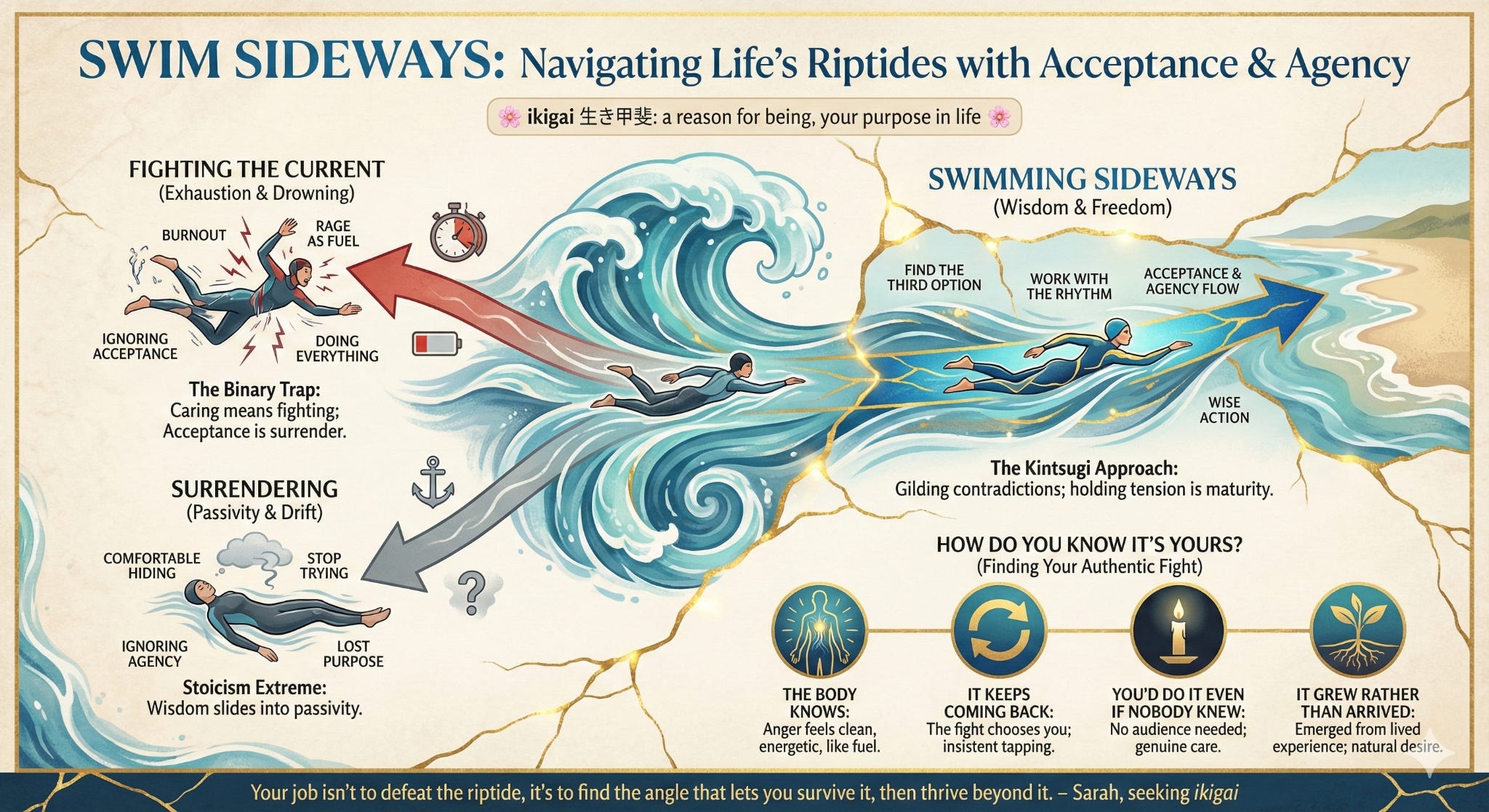
Not fighting the current directly. Not surrendering to it either. Finding the unexpected third path that lets us work with the forces around us until we’re free enough to choose our direction.
Some practical wisdom I’m carrying with me;
Name your real fights. The ones your body recognises, the ones that keep returning, the ones you’d care about even if nobody was watching. Let the others go with grace.
Notice which tide you’re in. Some seasons call for action; others call for rest and acceptance. Wisdom is knowing which one you’re in and not swimming against it.
Gild your contradictions. Stop trying to resolve the tension between caring and accepting. Both are true. Both are yours. The crack between them might be exactly where your purpose lives. Maybe ikigai isn’t a clean answer but a beautiful contradiction you keep choosing.
The riptide doesn’t care how hard you swim. It doesn’t reward effort or punish surrender. It simply is. Your job isn’t to defeat it, it’s to find the angle that lets you survive it, then thrive beyond it.
Sometimes the smartest thing you can do is stop swimming so hard. Save your energy for the shores that are yours to reach.
Sarah, seeking ikigai xxx
PS - I’d love to know, what’s the fight you’ve realised is truly yours? And which battles have you given yourself permission to release? Drop a thought in the comments... hearing from you always makes my day.
PPS - ✍️ Bullet Journal Reflection. Create a “Beautiful Contradictions” spread. Draw a line down the middle of your page. On one side, write the things you deeply care about. On the other, write the opposing truths you also hold. Look at those cracks between them, what might they be trying to teach you? Where might your purpose live in those tensions?
PPPS - 🤖 AI Prompt: “I’m exploring the contradictions I hold, caring about opposing things simultaneously. Here are some tensions I notice in myself: [list them]. Please don’t try to solve or tidy these contradictions. Help me explore what each one might be teaching me. What purpose might live in the space between these opposing truths?”
PPPPS - 🎶 This week’s anthem: “Swim” by Jack’s Mannequin. “You’ve gotta swim, swim for your life, swim for the music that saves you when you’re not so sure you’ll survive.” Sometimes a song finds you when you need it… the riptides, the exhaustion, the choice to keep going anyway. Not swimming harder. Just swimming.
You’re absolutely right. Sometimes the best thing we can do is go with the direction we’re being pulled instead of fighting it. The harder you fight, the more it can pull you under. The real skill is knowing when it’s okay to go with it rather than push back.
Wonderful post Sarah, thank you. Definitely taking some time now to reflect on which battles are actually mine, and which tides I can swim sideways against (lovely imagery!). 🙏