


🌸 ikigai 生き甲斐 is a reason for being, your purpose in life - from the Japanese iki 生き meaning life and gai 甲斐 meaning worth 🌸
I live on a tiny Island, so lighthouses are never far away. There’s one I walk past when my head is full, which this week it very much was…and I pictured whoever used to keep it working before everything was automated.
Imagine her logbook. Hours the lamp burned. Oil used. Glass polished, weather noted, wicks trimmed… every entry countable, a tidy record of a faithful working life.
But the number closest to the purpose of it all was one she could never write down, the ships that didn’t sink.
I have been refining a dashboard at work... columns, measures, the strategy of how best to show that what our team does adds up to something… or help us change course more rapidly if some things aren’t working as hoped… and somewhere between mapping out the definitions of these columns (and where what we do and how we count it fits), I realised I am that keeper.

Four columns
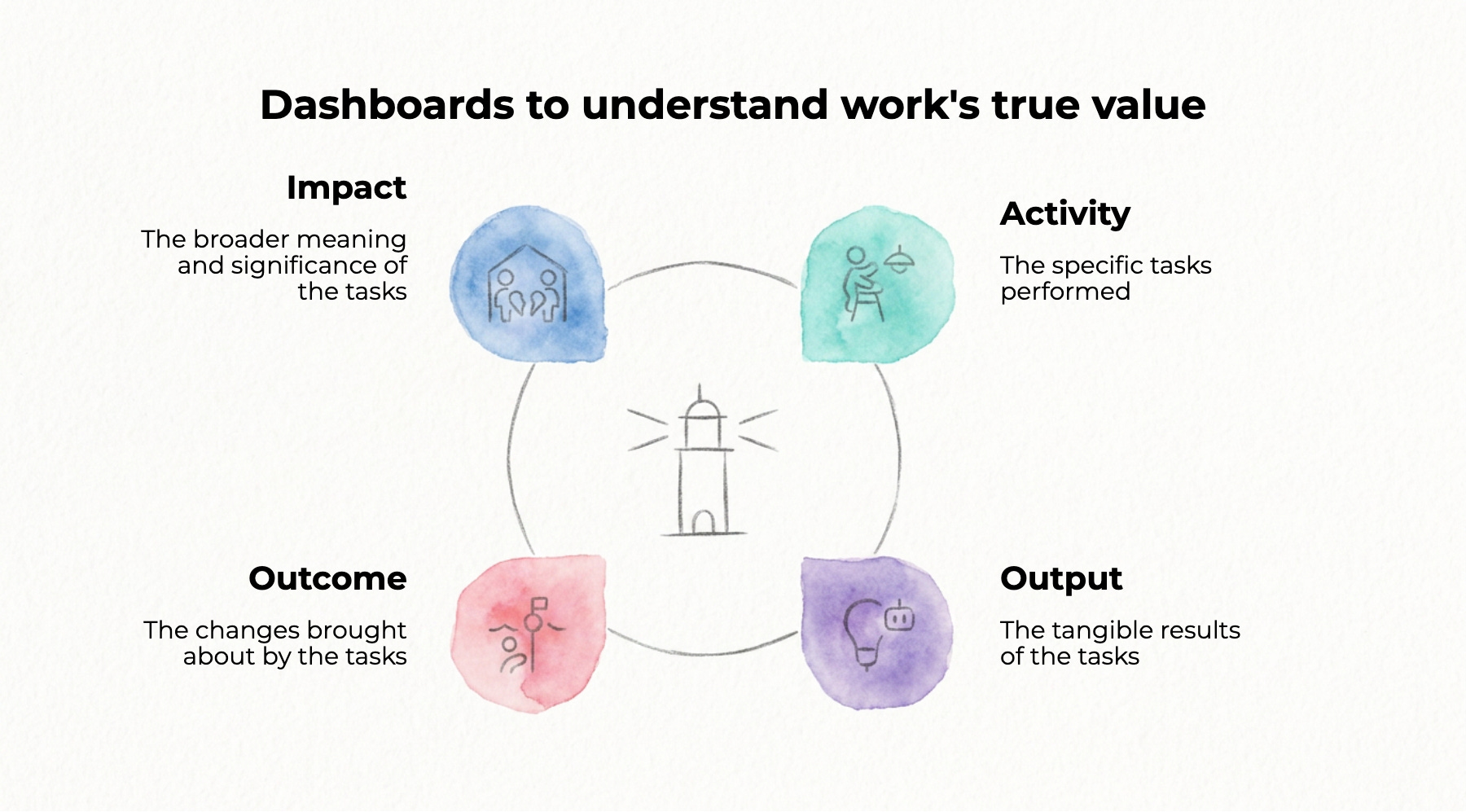
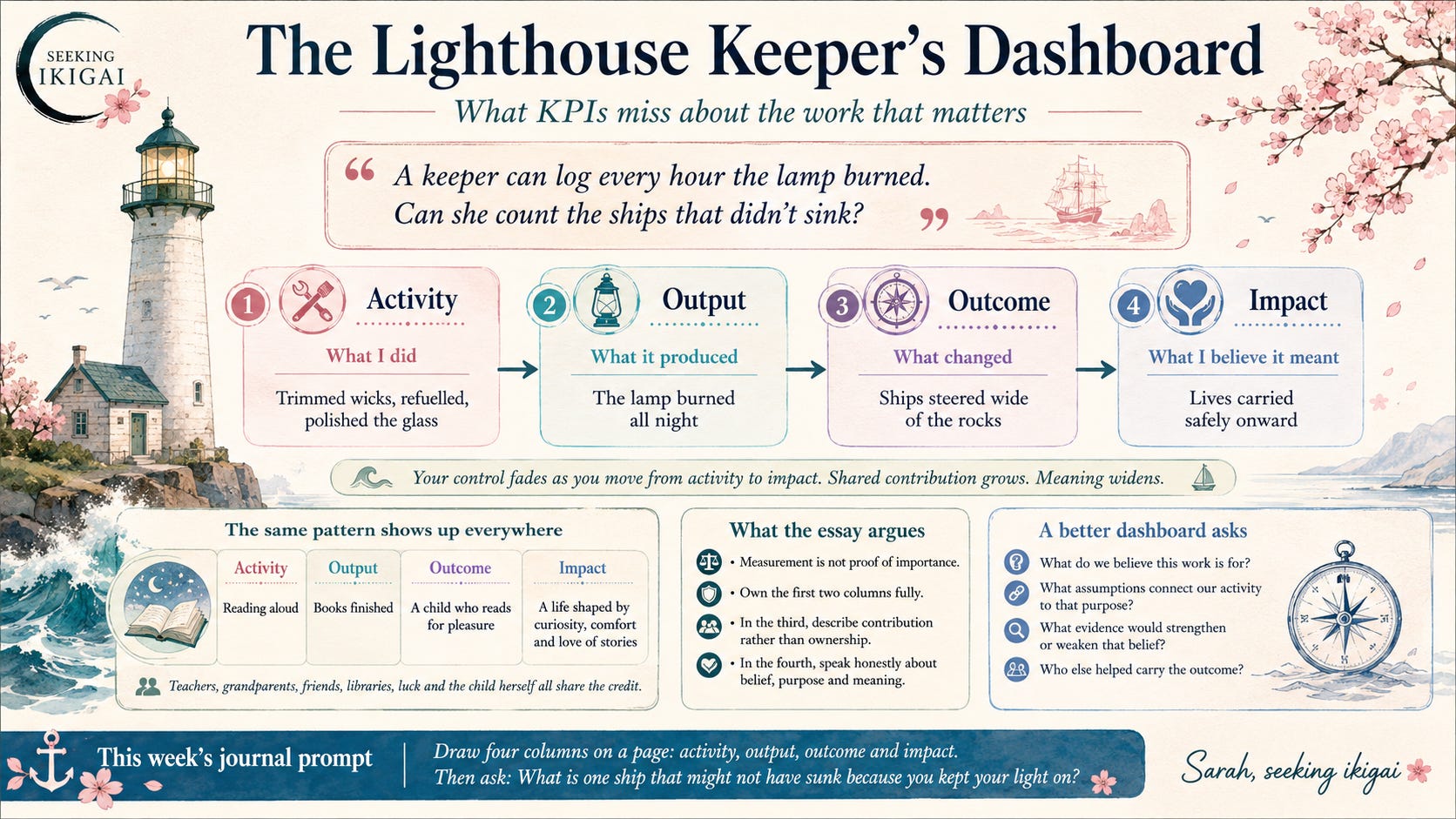
Strip a good dashboard back to its bones and you find four columns hiding inside it. Activity, output, outcome and impact > what I did, what it produced, what changed and what I believe it meant.
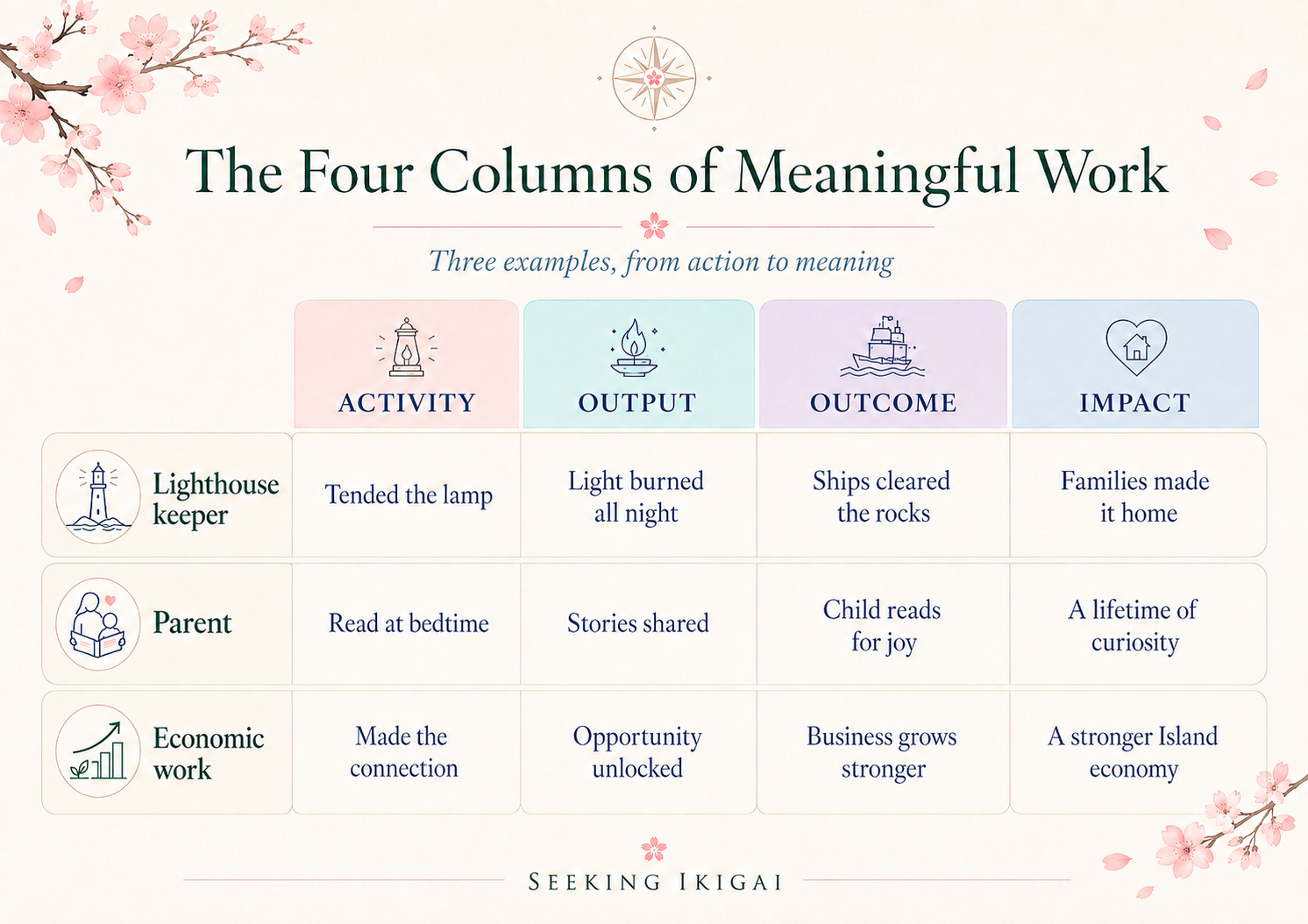
The keeper can show you the first two without breaking sweat. Activity she trimmed wicks, refuelled and polished the glass. Output the lamp burned all night. The third column, outcome, is harder but sometimes still visible if you squint… ships steering wide of the rocks… and the fourth column, impact, or meaning... families whole at breakfast tables she will never see, in ports she will never visit. That is what the work was for and also the column she cannot prove.
The keeper did not steer the ships. She did not choose their routes, train their captains or calm the weather. She changed the conditions in which a safe passage became more likely. She could claim the light, but not the whole voyage. She changed the odds. She did not own the outcome.
There is strange arithmetic to these four columns. Your control fades as you move along them. The meaning you can see widens. The first column tells you how you kept the lamp lit. The fourth tells you what you hoped the light made possible. Neither is meaningless without the other. The column you can prove most easily is often the one furthest from the reason you began, the column closest to that reason may be the one you can only believe rather than prove.
Measurement is not proof of importance. It is a discipline of telling the truth about what is in our control, what is shared, and what we believe. We are not often taught to sit with that. We are taught to close the gap, to drag proof further and further along the chain until everything has a number attached. But some gaps are simply the shape of meaningful work.
That does not release us from the responsibility to measure. The lamp still needed oil, the glass still needed polishing, and somebody still needed to notice if the light went out. Measurement keeps us honest about whether we did the work. It cannot tell the whole story of why the work was worth doing.
And this is not only true for lighthouses and departmental dashboards.
You can’t KPI a child
I read to my daughter most nights for about a decade. If you had asked me to report on it, I could have counted the books, maybe even the minutes. What I could not count was the thing I was actually doing it for... a grown woman, somewhere in the future, who reaches for a story when the world gets loud.
Run the bedtime story through the four columns; Reading aloud = activity. Books finished = output. A child who reads for pleasure = outcome. A person who stays curious all her life and appreciates art and beauty = some of many impacts. I controlled the first column completely. The last one was never mine to control, lots of the impact I could only wish for, and others I may never have imagined.
And the attribution! Teachers own a share. Grandparents. Friends, libraries, luck. The child herself, most of all.
Sharing the credit tells the truth about how a life is made. I did not author the woman my daughter became. I contributed a shelf of stories, thousands of evenings and one dependable signal that books were a place she could go.
Nobody stands at the school gate demanding evidence that the bedtime stories worked. We simply keep reading, and we believe. Yet at work we blush to say “I believe this matters” without a chart behind us. At home, we seem able to accept this mixture of evidence, contribution and hope. At work, we become much less comfortable, perhaps because there somebody always asks the question that dashboards hope to answer.
What difference did you make?
Someone asked me that recently, not what I do but what difference it makes.
We could stake a claim and defend the lot. Staple our name to every good thing within reach and call it evidence.
I think that reflex is where trust goes to die, the honest answer is a better sort through of factors. Own the first two columns completely, they are yours. In the third, look for contribution rather than ownership. Say what you helped make possible, what conditions you changed and who else carried the outcome with you. Then say the fourth out loud as a belief, because it’s rarely yours to prove alone.
When somebody says impact, listen closely. It is yet another of those words asked to do far too many jobs. Sometimes they mean output, what was produced. More often they mean outcome, what changed. Occasionally they mean the fourth column, the wider human meaning that change was supposed to serve.
Even the third column can be difficult to capture and quantify accurately as it is mostly written in other people’s books. In my day job, the proof that a business grew healthier lives inside that business’s own accounts. Their margins are their own business, in both senses. Whether the Island as a whole is better off shows up later, in stats with names like GVA, gathered and correlated by patient people in other offices long after the doing is done. And the counting itself is seasonal rather than accessible live data, a census here, a tax return there, a survey each spring. So you end up drawing a line from a conversation last March to a number published in November this year if you are lucky, with a ruler that only exists on certain days of the year.
That does not mean our contribution is imaginary, but we need to describe it with care. We can record the introduction made, the barrier removed, the advice acted upon or the opportunity unlocked. We can sometimes show that these things contributed to what happened next. What we cannot do is claim the whole result as ours.
We should be held to account. We should draw the line as carefully and as far as the evidence allows. But wanting a tidy line and possessing every number it needs are two different things. The gap between them is often due to where the relevant evidence lives.
The keeper knew this gap. The ships that steered wide kept their own logs, in cabins she would never enter. Her third column sailed past the window every night, fully documented, in books she was never going to be allowed to read. Her lack of access placed a boundary around what she should claim, it did not erase her contribution.
There are best practices for all of this, for example UK Government keeps its methods in colour-coded books, a Green one for deciding what to do and a Magenta one for learning what happened, both freshly revised this year (there are more... Orange, Aqua, Teal... a civil service rainbow, which pleases me more than it probably should *grin*). The economists even have a word, additionality, for subtracting the ships that would have missed the rocks anyway. And What Works Growth grades the world’s evidence on a five-point scale of rigour, where top marks go to studies with thousands of matched firms and years of linked data.
We try to use what fits, but gold standards were built for big countries with big datasets, and we are an Island of 85,000 people, where samples run small. So at our scale the craft becomes humbler and harder. Say plainly what we count and why we believe it matters. Question our assumptions and show our workings where people can see… and keep the lamp room door open, because the people out on the water can often see weather patterns we cannot.
Okagesama (おかげさま) is a gorgeous Japanese phrase that translates to “thanks to you” or “because of you”. It is used to acknowledge that one’s success, well-being or good fortune is due to the invisible support, hard work and kindness of others… thanks to the unseen, it is built into the politeness of the language, this idea that credit is never entirely yours. Imagine if our reporting had that grace in it.
That is the kind of honesty I want the dashboard to have.
The columns a spreadsheet can’t hold
A few months ago I wrote about money, and how we don’t talk about it. I am starting to think metrics are the same silence in a different currency. Money talks, we don’t. Metrics speak numbers, meaning in stories.
Notice the asymmetry hiding in your own week. Activity is often what tires you, meaning is what feeds you. We spend our days in the first column and our reasons in the fourth, and then wonder why a full calendar can feel so empty.
But perhaps I have been a little unfair to the first column. Meaning does not live only at the far end of the dashboard. There was worth in the keeper polishing the glass properly, even before a single ship passed. In keeping a promise. In becoming skilful. In doing an ordinary task with care because another person might depend upon it. Sometimes the work matters because of what it eventually changes. Sometimes part of its meaning is contained in the way we choose to do it.
And notice the two documents that bookend a working life. Job descriptions list activities. Eulogies describe impact. Nobody’s funeral dwells on their inbox management. But eulogies do remember how somebody did the work. She noticed when people were struggling. He never made the junior person feel foolish. She took pride in getting the small things right. Meaning is not only the distant consequence of our labour. It gathers in our manner of doing it too.
Somewhere between those two documents sits everything I mean by hatarakigai, the worth of the work itself... the sense that your labour is pointed at something that deserves it, and that you can recognise yourself in the way you carry it out.
There is a song in Rent that counts a year out in minutes, all 525,600 of them, then spends its remaining breath auditioning better units until only love will do. Audiences have wept along to that arithmetic for thirty years, and not one of them has ever asked to see the supporting data.
We understand this instinctively in songs, stories and the lives of people we love.
At work, however, the fourth column is expected to fit inside Excel.
The fourth column wears a lanyard
Or perhaps work made its peace long ago but just won’t admit it. Watch any decision closely enough and you will find a feeling underneath it. Even in enormous corporate purchases, when two options look equally credible on paper, trust and human chemistry can tip the choice towards the supplier whose account manager remembered your team lost on Saturday and commiserated properly.
And why wouldn’t we? The best products and services exist for fourth column reasons. Somebody believes a service could help, a policy could protect, a business could strengthen a place or a product could leave one small corner of the planet shinier than they found it, and the work begins ahead of the proof. Evidence follows, and sometimes it proves the belief wrong, but it always arrives after the beginning. So many organisations I admire began as somebody’s unproven belief.
Judgement and evidence are usually more entangled than the finished business case admits. We make sense of the numbers through experience, trust and pattern recognition, then write the decision up as though maths arrived at it alone.
So I wonder why love is welcome in the buying and barred from the reporting. We will decide millions on trust and chemistry, then file the feeling under anecdote when it is time to report. Imagine a board paper with a belief column, read as information rather than confession. Not a place to hide poor results or make grand claims beyond the evidence, but a place to state honestly what the work is trying to protect, create or make possible.
What do we believe this work is ultimately for?
What assumptions connect our activity to that purpose?
What evidence would strengthen or weaken that belief?
Who else would need to contribute for the hoped-for change to happen?
The lamp burns no less brightly because the keeper loved the ships and the people on them.
Ships that didn’t sink
The keeper never fully solved her logbook problem. She could record the lamp hours, and perhaps somebody elsewhere could compare routes, weather and wrecks over time. But she could never produce a complete list of the ships that did not sink, or the lives that carried on because her light was there.
She kept it lit anyway. That is not a failure of measurement. Perhaps the ships were the purpose, but tending the light faithfully was the practice. Hatarakigai lived somewhere between the two.
So here is a small experiment for the week, straight from my bullet journal to yours. Draw four columns on a page; what I did (activity), what it produced (output), what changed (outcome), what I believe it meant (impact). Fill in the first two from memory; they will come easily. Fill in the third carefully. Write down what changed, then ask what part you genuinely contributed. Name the other people, choices and conditions that helped carry the outcome. Share the credit generously, including with the person whose life or work changed.
And then get brave with the fourth. Write down, in ink, the ships you believe didn’t sink because you kept your lamp lit. The argument that didn’t happen because you listened. The colleague who stayed. The town that still has a library. Do not mistake belief for proof. But do not mistake the absence of proof for the absence of meaning either.
What would yours say? What is one ship that might not have sunk because you kept your light on?
Sarah, seeking ikigai xxx
PS. This week’s journal prompt. Someone kept a lamp lit for you once... a teacher, a nurse, a friend who kept turning up for you. Open a fresh page and write down the ship of yours that didn’t sink because of what they did. Then, if it feels right and it is still possible, tell them. And if it is not, write the words anyway. Fourth columns are lovelier read aloud, but some keepers have to be thanked on paper.
PPS. This week’s AI prompt, extended thinking on.
A machine can now fill in your first column effortlessly and endlessly, so make it earn the other three. Let it help you see further, not claim further.
Paste in your diary or task list from the past week and add this:
“Here is my first column, what I did.
Interview me one question at a time to help me complete the other three:
What it produced, output.
What changed, outcome.
What I believe it meant, meaning.
Be strict about attribution. Do not let me claim more than is mine, and do not let me claim less either.
For every outcome, ask who else contributed, what conditions helped, and what evidence connects my activity to the change.
Label each statement as evidence, inference or belief.
Challenge me if I jump directly from something I did to a large result without showing the steps in between.
When we finish, create a four-column table and show me:
The row with the strongest evidence.
The row where my contribution was most shared.
The row where belief is doing the heaviest lifting.
Then ask me which of those rows feels closest to the reason I began.”
PPPS. This week’s soundtrack was only ever going to be Seasons of Love from Rent... a year counted out in minutes, a life asking to be measured in something kinder, and a room full of people singing the answer at the top of their lungs. The keeper would approve.
Lovely analogy...all the ships that didn't sink.