


🌸 ikigai 生き甲斐 is a reason for being, your purpose in life... from the Japanese iki 生き meaning life and gai 甲斐 meaning worth 🌸
I drew out the four circles in the hatarakigai Venn diagram for you two years ago. Then realised I got it wrong just over a year ago, ahem!
Regardless though, it’s a really helpful model I’ve been thinking about ever since.
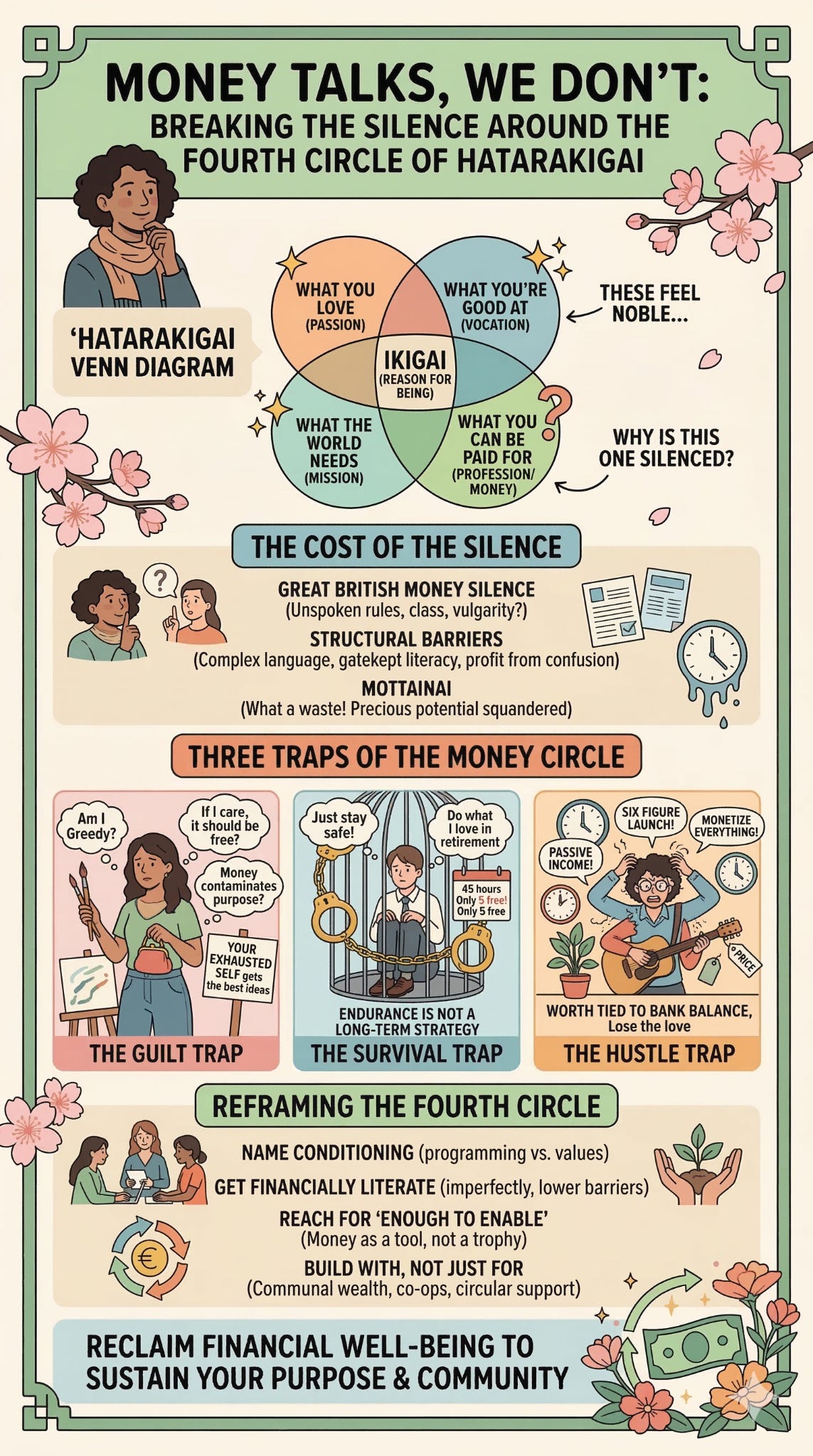
🌸 What you love
🌸 What you’re good at
🌸 What the world needs
🌸 What you can be paid for
Three parts of this feel noble… pure, even. You can talk about passion and purpose and mastery at dinner parties without anyone shifting uncomfortably in their seat.
But that fourth circle? The money one? She’s the guest nobody quite knows how to introduce. We know she has to be there... we can’t sustain anything without her in our current societal models... but we’d rather she sat quietly in the corner and didn’t make a fuss.
I think it’s time we had a proper conversation with her.
Most of us spend at least 45 hours a week working or getting to work. Forty five hours. That’s not a footnote in our search for meaning. For most of our waking adult lives, work IS the main event. Hatarakigai says that those 45 hours don’t have to be a tax on your purpose, they can be a contributor to it. How bloody gorgeous would that be? If the thing that takes up the lion’s share of your time fed your ikigai rather than draining it?
It’s tricky to get there if we keep whispering about the money circle. If we keep treating her like she’s somehow less important, or less worthy of honest examination, than the other three.

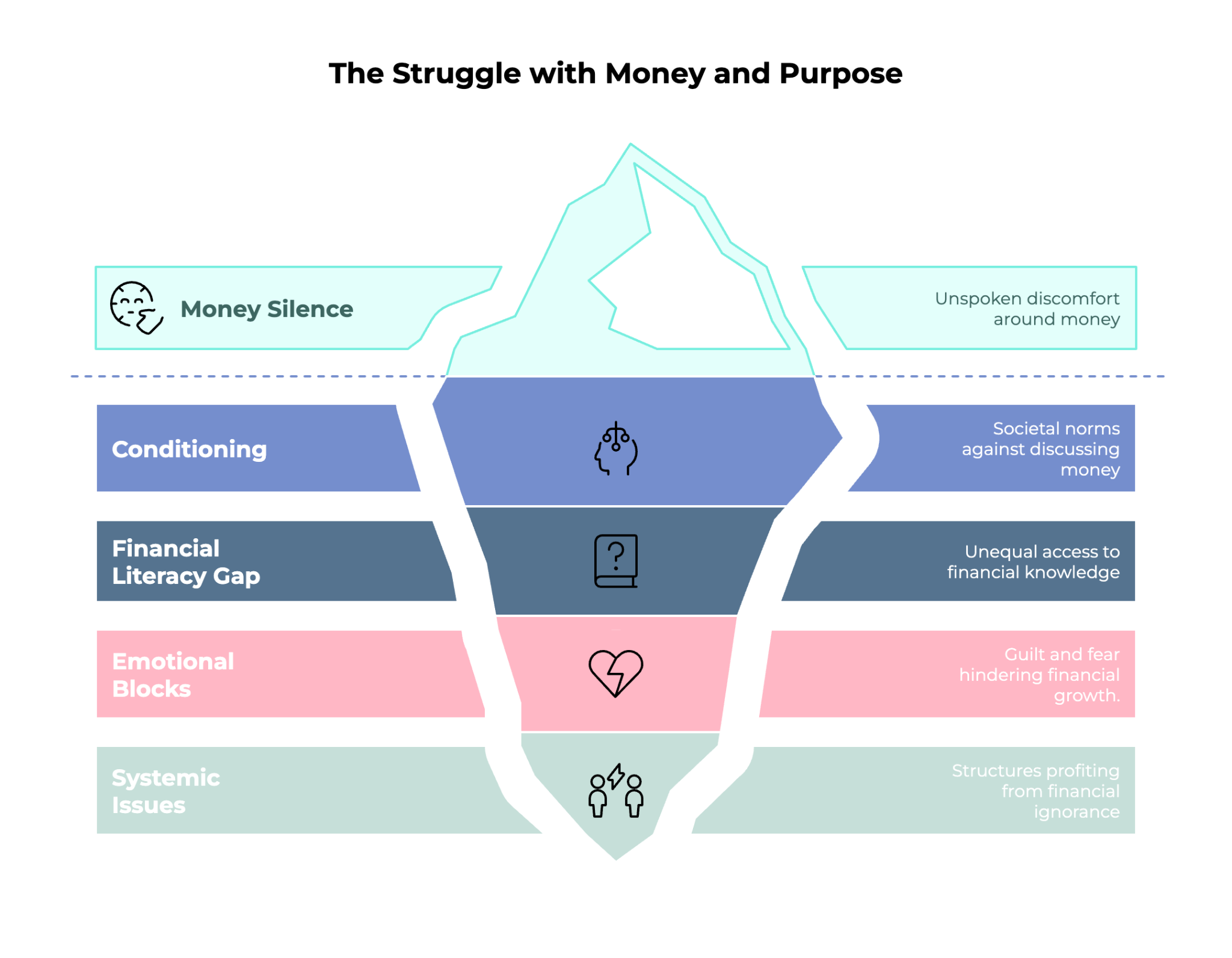
The great British money silence
I grew up poor on a council estate on the Isle of Man. Working class roots I guess, and an unspoken rule that we don’t talk about money. Not how much you earn, what you do with it or don’t do with it. Money talk is vulgar.
I think this is partly a British thing. We’ve been collectively trained that discussing money is rude, right up there with asking someone’s age or commenting on their weight. This polite silence doesn’t help anyone, it protects the systems that benefit from our ignorance.
It’s a weird class thing too, obviously. Some people just seem to know that you can structure things in certain ways. That salary alone rarely leads to freedom so you need to create businesses and assets. That there are ISAs and pensions and investment vehicles and tax efficiencies that nobody teaches you about in school but everybody in certain circles understands intuitively. Financial literacy isn’t equally distributed. It’s passed down in families and networks and dinner table conversations that some of us are never invited to.
Nobody makes it easy either. The language is deliberately complicated. The forms are impenetrable. The advice industry profits from your confusion. And so millions of intelligent, capable people... people who can navigate complex careers and raise children and manage households with military precision... feel stupid and overwhelmed when it comes to money.
That’s structural.
It keeps us distracted. While we’re busy feeling embarrassed or confused or guilty about money, we’re not learning the things that could change our lives. We’re not seeing the exits. We’re not building the security that would give us the freedom to align our work with our purpose.
The silence protects the status quo and not our dignity.
The good girl and the fourth circle
I grew up with a strong work ethic and huge drive to never be poor again, to be able to provide for my own daughter. So I pushed myself and worked hard and as a result I have a reasonably well paid job.
A job I’m grateful for, at an organisation whose values I share, doing work that contributes to my community. By many measures, I’m fortunate. And I struggle with money thoughts anyway. Not as often with bills anymore (though my broken boiler and knackered car are competing to make that true once more *grr*), but with the feelings. The guilt. The weird internal flinch when I think about wanting more.
Because I do want more. And writing that sentence makes something in my chest tighten.
I don’t really go on holidays. I haven’t got a flash car. Our house hasn’t got the latest and greatest of everything in it. We’re careful. We’re sensible. We’re fine.
But “fine” is that word again, isn’t it. The one I wrote about in Human Should Be Baseline. The performance of fine that Gen X women have turned into an art form.
When I start to think about how I protect myself in future... how I build security... how I create more headspace and more options... it all feels weird. Greedy, even. I catch myself mid-thought and the inner voice pipes up “you don’t NEED more, Sarah. Other people have far less. Who do you think you are?”
This is where it gets really tangled. Because if I had more money? I wouldn’t hoard it. I know exactly what I’d do.
I’d spend it with women building better societal systems. I’d support people trying to build something meaningful. I’d give more to charity. I’d have more headspace to show up for my community in bigger ways. I’d invest in the kind of work that lights me up and lights other people up too.
The money isn’t the goal. The money is the enabler. But the guilt doesn’t care about that distinction.
There’s a voice... she’s been with me since childhood... that says wanting more is the same as being greedy. That good girls don’t ask for stuff. That if your purpose is real, the money shouldn’t matter. That somehow, caring about financial security undermines the authenticity of everything else you’re trying to build.
She means well, but she’s also keeping me stuck.
Three traps (pick your poison)
I’ve been sitting with this for a while now, and I think the money circle catches most of us in one of three traps. Sometimes we rotate between them. Sometimes we’re stuck in two simultaneously. See if you recognise yourself.
The Guilt Trap
This is mine. The feeling that charging for purpose work makes it less pure. The hesitation before turning on paid subscriptions, before launching a paid workshop or asking to be valued in pounds as well as praise. The belief that money contaminates meaning.
The guilt trap whispers if you really cared, you’d do this for free. It conveniently ignores the fact that doing it for free means you can only do it in the margins. Evenings. Weekends. The scraps left over after the work that pays. Which means your best ideas, your deepest purpose, gets your most exhausted self.
How is that serving anyone?
I could have started building something years ago, well, once the kids were old enough. But it took too many years to learn that loyalty to a job wasn’t really rewarded. Also the good girl in me waited for permission. Wondered if it was okay to build for myself, worried about doing the right thing. While other people... people who perhaps didn’t carry the same conditioning or who had been taught to expect more, or were the types of people the system was designed for... just got on with it.
I’m not bitter about that but I notice it. The head start that comes with not having been taught to ask permission before wanting things.
The Survival Trap
This is the one where you stay in work that pays but doesn’t align, and try to find purpose in the remaining 5 hours of your evening. Golden handcuffs. The “I’ll do what I love when I retire” bargain that so many of us make.
The survival trap says be grateful for what you’ve got. Gratitude is real and important, but it can also become a cage if it stops you from honestly assessing whether your 45 hours are contributing to your ikigai or eroding it.
If you’re spending the majority of your waking life doing work that doesn’t feed any of your other three circles... if the only thing your job gives you is money, and nothing else... that’s endurance, and survival is a terrible long term strategy for a joyful life.
The Hustle Trap
This is the overcorrection. The one where you monetise every hobby, turn every passion into a side hustle, slap a price tag on everything that brings you joy. When “what you can be paid for” swallows the other three circles.
The hustle trap says your worth is tied to your bank balance. Social media reinforces this constantly with six figure launches, passive income streams… the relentless optimisation of every human impulse into a revenue opportunity.
I see brilliant, purposeful people fall into this one and lose the love. The thing that made their work meaningful gets hollowed out by the pressure to scale, to convert, to perform. The hatarakigai that started as genuine alignment between purpose and prosperity becomes just... commerce wearing a purpose costume.
Most of us don’t sit squarely in one trap. I’m primarily guilt, with occasional field trips to survival (the gratitude cage) and brief, uncomfortable flirtations with hustle (usually prompted by something in my feed that makes me feel like I’m behind).
Where does your relationship with money get stuck most?
The mottainai of silence
Mottainai (勿体無い), the Japanese word and concept for a feeling of deep regret over waste. It’s often translated as “what a waste!” and it carries a sense of something precious being squandered.
I think our silence about money is mottainai.
What a waste... that intelligent, purposeful people don’t understand how to build financial security because nobody taught them and asking feels shameful.
What a waste... that women with extraordinary ideas and genuine purpose hesitate to charge for their work because they’ve internalised that wanting money undermines wanting to help.
What a waste... that the fourth circle of hatarakigai, the one that could enable everything else, sits neglected and unexamined while we pour our emotional energy into the other three.
What a waste... that entire communities remain excluded from financial literacy because the system profits from their confusion.
And what a waste... that some of us could have started building years ago, but the conditioning said wait, ask permission, make sure it’s allowed, be good.
The silence costs us more than money. It costs us time, options, freedom… the ability to fully occupy all four circles of our hatarakigai diagram without flinching at one of them.
There are other ways
I don’t think the answer is to simply “get over” our money discomfort and become the bestest capitalists. The discomfort isn’t entirely wrong. Some of what we’ve been taught about money IS true... hoarding wealth while others suffer IS a problem. The relentless pursuit of profit at any cost IS corrosive. Greed IS real and IS destructive.
The problem is that caring about the ethics of money has become confused with refusing to engage with money at all.
There are people who have always known this, who have been building different structures for centuries.
Indigenous communities who understood that wealth is communal, circular and relational long before anyone drew a Venn diagram. Black women who built mutual aid networks and savings circles because traditional financial systems excluded them, and in doing so created models of economic solidarity that the rest of us are only just discovering. Co-operatives where the people who do the work own the work. Movements like Buy Women Built, where supporting each other’s businesses is strategic.
These aren’t radical new ideas. They’re ancient wisdom that the dominant economic model tried to bury.
What if the fourth circle of hatarakigai didn’t have to look like traditional capitalism? What if “what you can be paid for” could also mean “what your community values enough to sustain”? What if the money circle was less about individual accumulation and more about collective investment in each other’s purpose?
I find that thought enormously freeing, because it reframes the question entirely. It’s not “how do I get rich from my purpose?” It’s “how do we build structures where purposeful work can sustain itself and the people who do it?”
That’s ikigai made visible, by the way. When your community sustains your purpose and you sustain theirs... when economic support flows in circles rather than upward... that’s not just a nicer way to do business. That’s a reason for being. Yours and theirs, intertwined.
That feels like a really important mission.
Can AI help us?
We’ve established that financial literacy has been gatekept by class, by jargon, by systems that profit from our confusion. The private club conversations some of us were never invited to.
AI is pulling up a chair to that table.
I can ask Claude to explain an ISA in plain English. I can upload a pension statement I don’t understand and ask it to walk me through what it actually means for my future. I can say “I earn X, I spend Y, I have Z in savings, and I feel paralysed... help me understand my options” without anyone judging me for not already knowing. The financial literacy that was passed down in certain families? AI can start to democratise it. Not as a replacement for proper financial advice, but as a way to get past the embarrassment and start asking the questions you’ve been too ashamed to ask a human.
That excites me, another language made accessible by removing the fear of getting it wrong.
But I’d be a rubbish ikigai writer if I didn’t name the other side too.
AI also makes the hustle trap more seductive than ever. It can build you a landing page in minutes, draft your sales copy, optimise your pricing, automate your email sequences. The distance between “I have a purpose” and “I have a monetised purpose” has never been shorter. And that speed is genuinely dangerous if you haven’t done the slower work of examining your relationship with money first. Desire mining applied to your financial aspirations... algorithms showing you what you “should” be earning from your passion, what other people are charging, what’s possible if you just scale... that’s the hustle trap wearing a very convincing AI hoodie.
The ikigai risk here is real. AI can help you engage with the money circle more honestly. It can also help you skip the honesty entirely and go straight to hustle. The tool doesn’t care which you choose, so you have to.
Looking at the fourth circle honestly
I’m not going to pretend I’ve resolved this… but I am learning to look at the fourth circle without flinching quite so hard. Here’s what I’m practising, in case it helps you too.
Naming the conditioning. When the guilt flares, I try to notice it and ask… is this my values speaking, or is this my programming? There’s a difference between genuinely not caring about money (rare, and fine) and having been taught that caring about money makes you a bad person (common, and limiting).
Getting financially literate, imperfectly. The same way I’m learning Manx... badly, slowly, with an accent that’s entirely my own. The same way I learned to prompt AI... by doing, not by memorising theory. Also being unembarrassed to call out the systems that don’t make sense, asking for help, demanding that the barriers are lowered.
Reframing “more” as “enough to enable.” Not more for more’s sake. More so that the other three circles have room to breathe. More so that I can invest time in the work that matters. More so that the people I love aren’t getting the scraps. More as a tool, not a trophy.
Building with, not just for. Seeking out the co-ops, the women-built spaces, the mutual aid models, the communities where economic support is also circular and sustainable. There are people who want to see me succeed, and I want to see them succeed, and those two things aren’t in competition.
I think the fourth circle has been waiting for this conversation. She’s not embarrassed to be there, we’re the ones who’ve been making it awkward.
Maybe it’s time we pulled her a chair, poured her a cuppa, and asked her what she actually needs.
I think she’d have a lot to say.
So beautiful souls, when was the last time you had an honest conversation about money? Not bills or budgets. But what money means to you... what it enables, what it costs you emotionally, and whether your relationship with it is helping or hindering the life and work you’re trying to build?
Sarah, seeking ikigai xxx
PS - Here’s a bullet journal prompt that might help. Create a “Money Circle Audit” spread across two pages. On the left, draw your hatarakigai ovals and score each out of 10 for how honestly you’ve examined it... not how good you are at each one, but how honestly you’ve looked at it. On the right, create three columns: Guilt, Survival, Hustle. Under each, list the specific thoughts, behaviours and stories you tell yourself that keep you in that trap. Things like “I should be grateful for what I’ve got” or “if I just launched that course...” or “real purpose work shouldn’t need to be paid for.” Now reflect and underline the ones that aren’t really yours... the ones you absorbed from family, class, culture, gender, society. Those borrowed beliefs are the ones to question first. What shifts in your body when you imagine letting them go?
PPS: And an AI prompt to try with Claude or ChatGPT: “I want to examine my relationship with money and purpose honestly. Here’s my situation: [describe your work, what you love doing, what you’d do with more financial freedom, and the feelings that come up when you think about money]. Please help me with three things. First, based on what I’ve shared, tell me which money trap I’m most stuck in: guilt (believing money contaminates purpose), survival (staying safe but misaligned), or hustle (monetising everything and losing the love). Second, help me trace where my money conditioning came from... what messages did I absorb from family, class, culture and gender about what’s ‘okay’ to want? And third, help me draft a one paragraph ‘money manifesto’ that honours both my values AND my right to be financially secure and thriving. Challenge me if I’m being too soft on myself.”
PPPS: This week’s soundtrack is “Dirty Cash (Money Talks)” by Adventures Of Stevie V. A proper late 80s banger that most of us danced to without thinking too hard about the lyrics. “Money talks, money talks, dirty cash I want you, dirty cash I need you.” It captures something honest about the push and pull... we want money, we need money, and we’ve been taught to feel a bit grubby about admitting it. The song doesn’t apologise, maybe we should stop apologising too.
Yes to all those traps!!!! Argh!!!