

🌸 ikigai 生き甲斐 is a reason for being, your purpose in life, from the Japanese iki 生き meaning life and gai 甲斐 meaning worth 🌸
I got a lump in my throat this morning explaining to ChatGPT why I couldn’t give up my bullet journal. I’d asked it to interview me in voice mode, and when it asked me to name something AI could potentially do faster or better than I could, yet I’d feel sad to hand over, the answer arrived immediately… journalling.
AI can organise the events of my day, notice patterns in what I talk about, summarise my hopes and fears and produce an elegant account of my life. I already use AI for some of these things. It’s helpful for coaching and loosening loud voices from my brain. I love having those chats and grateful the tools make them possible. But my journal is something else. It’s how I organise my life, yes, but also an outlet for creativity and a way of making my values, hopes and fears external. Something I can carry around with me. A physical manifestation of me, in all my tangly torment and hopeful, soppy optimism.
It’s about the senses, the embodiedness of it. When I’m writing about something sad, the way I write changes. The marks on the page reflect something I might not yet have found the words to explain. It is feeling and thought and colour, all bound up with the particular moment in time and space in which I’m recording something. The touch of the paper matters so very much. That’s the bit that caught in my throat as I was talking, realising that having the finished journal, however beautiful, would not be the same as doing my journalling.
I suspect most of us have something like this… cooking a meal for someone you love rather than ordering in, composing a photograph rather than collecting snaps, learning to play a song on an instrument when you could listen to a recording… the result isn’t all (or much) of the point. The experience of doing it matters, and that distinction, between something being done for us and finding meaning in doing it ourselves, is one reason I care so much about this.
I didn’t expect anyone else to talk ikigai AND AI
I became infatuated with the Japanese concept of ikigai when thinking about sadness and disconnection, why so many people seem to be struggling and whether we make life a little better by becoming more conscious of the things that give it meaning. I don’t think ikigai needs to be a grand calling or a perfect career, often it’s the ordinary, almost invisible stuff. A walk with the dog, an interesting conversation, the pleasure of learning or finding time to make something with your hands. Japanese neuroscientist Ken Mogi’s five pillars of ikigai particularly resonate with me, especially the joy of little things and being in the here and now, we don’t have to earn a sense of purpose by doing something grand.
The year after starting this Substack, I was asked to work on a national programme to accelerate AI awareness, education and adoption across the Isle of Man. The ambition was there, but the learning materials weren’t, so I began exploring how to help people understand technology that was changing as quickly as I could learn about it. I’ve spent much of my career making new digital ideas accessible, and I was already a little in love with AI. I grew up on a diet of sci-fi and never lost my fascination with robots and imagined futures.
Here were two HUGE strands of my life, one about how we find meaning and the other about what increasingly capable machines might do, travelling alongside each other. Then I heard Roman Yampolskiy talking to Lex Fridman about AI safety. Alongside existential risk (x-risk) and suffering risk (s-risk), he mentioned the ikigai risk (i-risk), the possibility that if machines eventually become better than us at everything, we might struggle to find purpose or feel we have anything left to contribute.
I remember thinking, oh my gosh, the two subjects I cared heaps about had just been smushed into one. It felt like a massive green flag to keep thinking, learning and asking questions.
I haven’t found a perfect definition or solution, and that’s part of what fascinates me. It feels like a wicked problem I could spend a lifetime approaching from different angles. Yampolskiy’s concern looks towards a possible future of superintelligent AI, where humans might struggle to find work or ways to contribute. That’s a possibility, not a certainty. The version I keep returning to is nearer, more ordinary and reaches far beyond our jobs.
What could we lose while we’re gaining so much?
In an earlier essay The Ikigai Risk of AI I tried to articulate why it resonated so much;
I think it’s because even in the optimistic scenarios where AI only enhances rather than threatens humanity, we still *do* face a unique challenge to what makes us fundamentally human, our need for meaningful work and contribution.
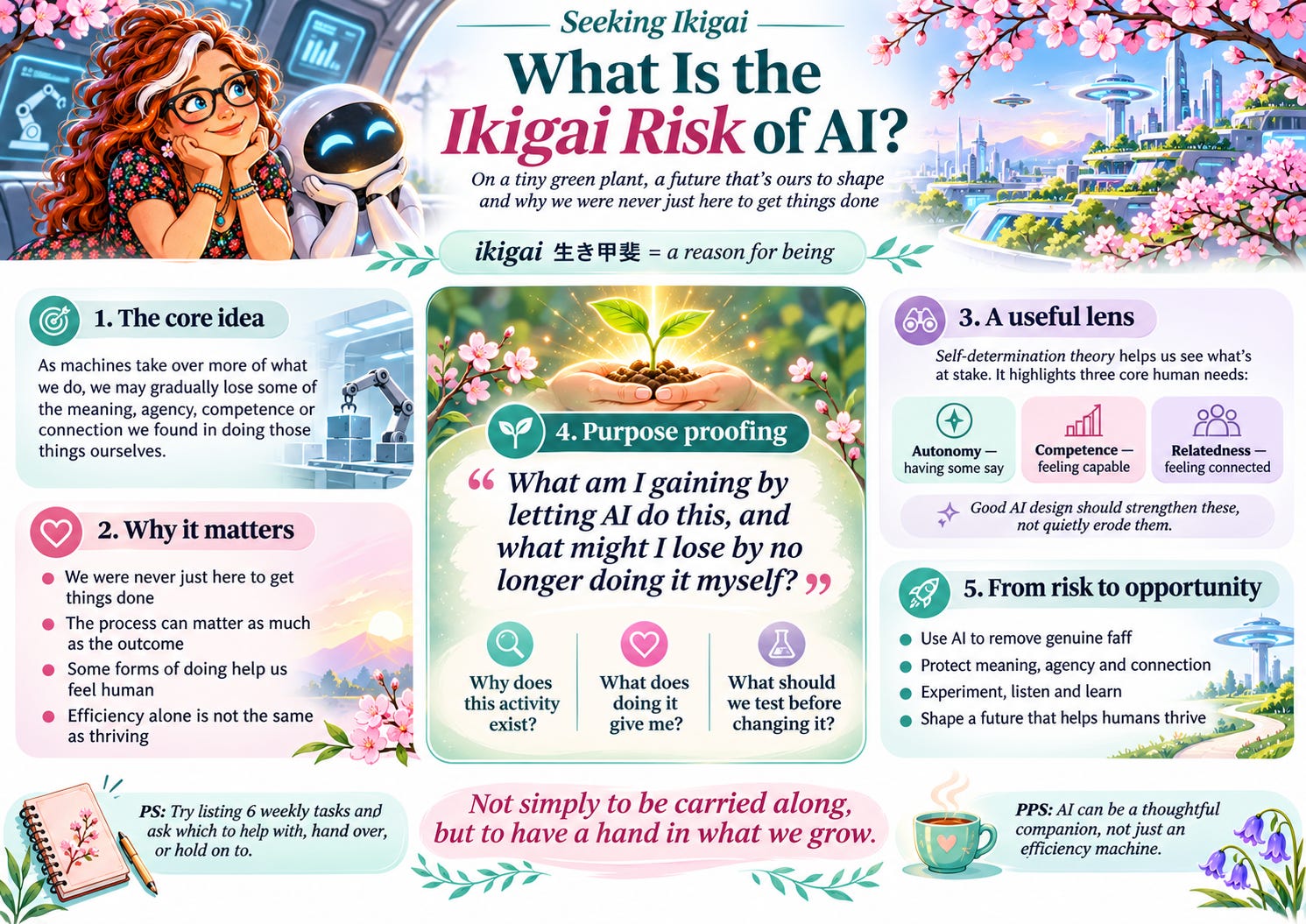
I still believe that, but my thinking has broadened beyond work. The ikigai risk of AI, sometimes written as ikigai-risk or shortened to i-risk, is the possibility that, as machines take over more of what we do, we gradually lose some of the meaning, agency, competence or connection we found in doing those things ourselves. It’s the erosion of that feeling that what we do each day is ours and that it matters.
Human worth has never depended on productivity. Quite the opposite, we were never just here to get things done. Our lives contain so many different sources of meaning, and that’s why I don’t want us to assess AI only by how quickly it can complete a task.
Psychologists Richard Ryan and Edward Deci describe three basic psychological needs in their work on self-determination theory; autonomy (having some say in our lives), competence (feeling capable) and relatedness (feeling connected to others). It’s a useful lens for considering whether AI might strengthen or weaken the things that help us thrive.
What worries me is how imperceptible the change could be. We gradually get used to asking AI to write, plan, solve problems or remember things for us. Each decision might seem perfectly reasonable, even liberating. But what happens to our opportunities to practise judgement, discover what we’re capable of or experience that lovely satisfaction of working something out for ourselves? And what about the social bits, the conversations with colleagues, the shared uncertainty, the moments when we help one another? I don’t know that we always recognise what an activity gives us until we stop doing it.
None of this means I want to make life unnecessarily difficult. I love technology and I’m an enthusiastic cheerleader for AI, especially when it opens doors for people who’ve previously been excluded or helps someone learn, communicate or create in new ways. I’m certainly not suggesting we throw away our calculators or start handwashing our laundry in pursuit of purpose! I simply want us to remember that the finished output isn’t always the only valuable part of an activity.
Work makes this even more complicated. When somebody asks what I’d most like to automate, a few reports spring to mind immediately. Pages and pages produced because they’ve always been produced, assembled at considerable effort and sometimes barely read. If I’m dragging my feet every time, doing something largely because I’ll get shouted at if I don’t and struggling to explain what value it adds, that’s a pretty obvious candidate for change. But perhaps the most useful question isn’t whether AI could produce the same report in six minutes instead of six hours. Perhaps it’s whether the report needs to exist at all.
But what about the less obvious things? What if some of those less exciting tasks scattered throughout our days are doing something useful for us, even if they look inefficient? Perhaps they give us breathing room between difficult conversations or space for an idea to wander into view. And if we filled our working days entirely with the things we find most fun, stimulating and energising, might that eventually become exhausting? Or even boring? I genuinely don’t know, and that’s precisely why I think we should be experimenting rather than assuming we already understand what makes a good working day.
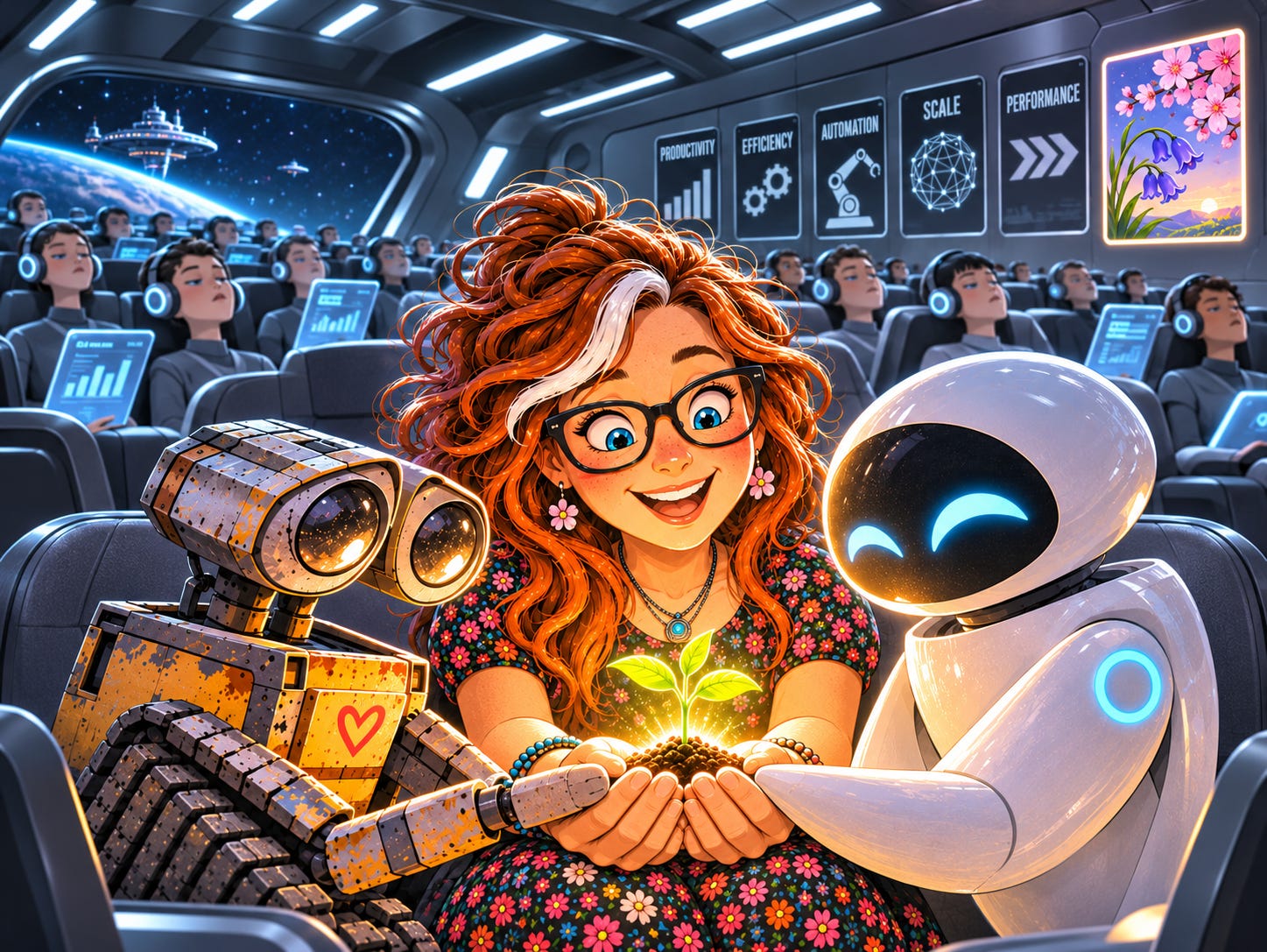
In Pixar’s WALL·E, people live aboard the Axiom, their needs anticipated and their days organised by technology. They drift around in chairs, absorbed in their screens, barely noticing the world or one another. It’s funny, and a little uncomfortable to recognise bits of ourselves in it. But what I love most is that tiny green plant, a reminder that there’s still something worth nurturing and a future worth participating in. The captain begins making decisions, people rediscover one another and the story doesn’t end with everyone smashing the robots. In the closing credits, humans and robots work together to restore the Earth. It’s such a hopeful alternative to the idea of humans versus machines. We can have the benefits of technology without becoming passengers in our own lives.
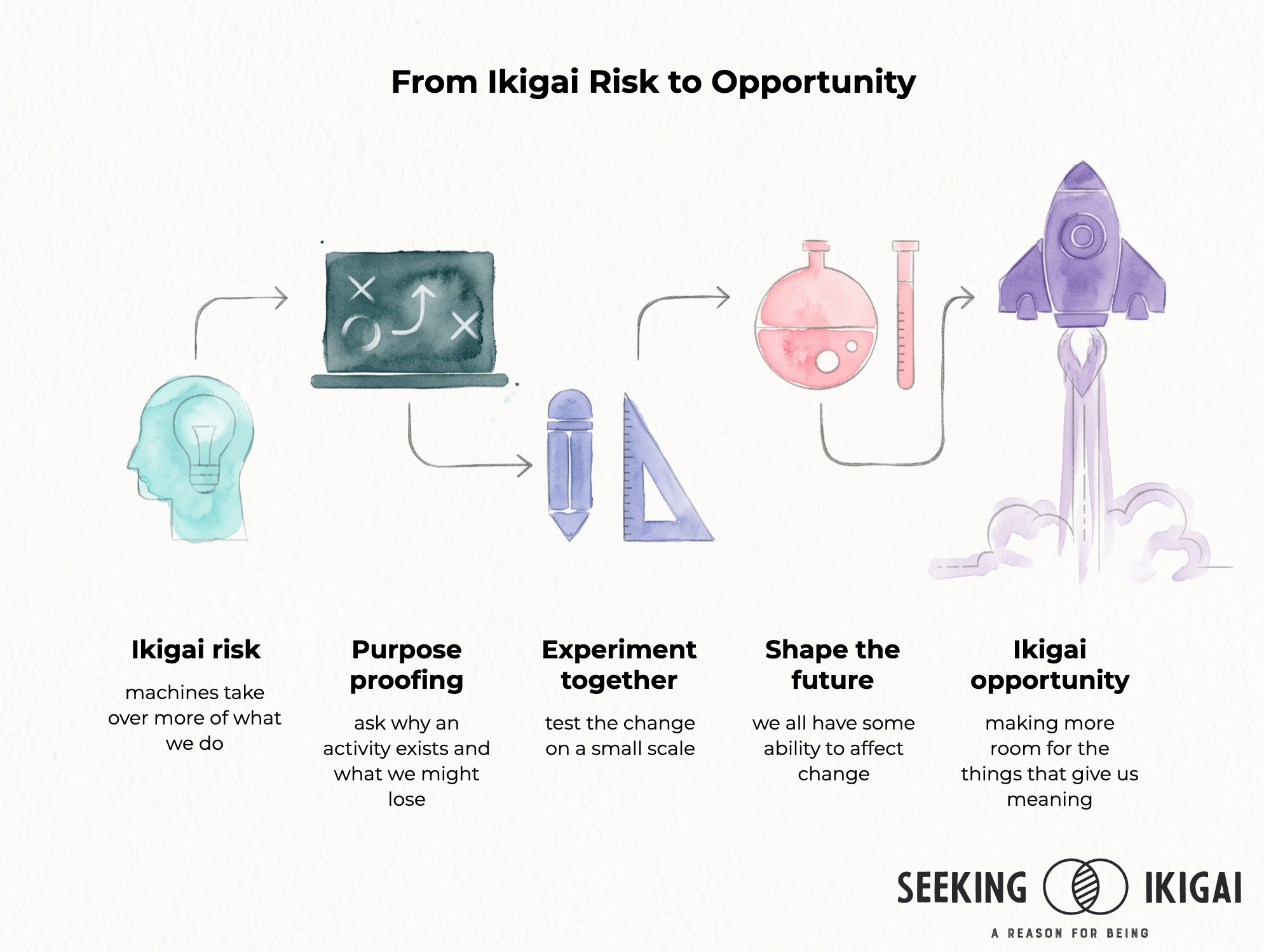
That’s why I’m developing my idea of purpose proofing. Before handing an activity over to AI, I think we should ask a deceptively simple question; What am I gaining by letting AI do this, and what might I lose by no longer doing it myself? That means considering why the activity exists, who benefits from it and what the experience of doing it gives us. Then experimenting on a small scale, listening to the people affected and paying attention to what actually changes. Not just whether something becomes faster or cheaper, but whether people feel more capable, connected and free, or simply end up with more work squeezed into the time they’ve supposedly saved.
We’ve seen what happens when we don’t ask enough questions
Part of my concern comes from having lived through another extraordinary period of technological change. I remember the excitement about social media and its promise of connection and community. Some of that promise came true. I’ve found friendships, ideas and conversations online that I wouldn’t want to give up. But we’ve also seen the consequences we didn’t fully anticipate, from misinformation and the effects on our attention to the concentration of enormous power in a handful of companies.
I don’t think we should let the same mistakes play out again without asking better questions. AI could influence so many areas of our lives, and I worry about us sleepwalking into decisions that deepen existing inequalities simply because one approach seems more profitable or efficient. We’ve been given a chance to learn from what came before.
Which brings me to a question I often pose, who gets to decide which parts of our lives are worth automating? An employer might see hours that could be saved, while the person doing the work might experience relief, or perhaps a loss of confidence, belonging or pride. They might feel both. The company developing the technology, the organisation adopting it and the people living with its consequences may all see things differently. If the only voices in the room are the people building the technology and the people funding its adoption, we’re going to miss an awful lot of what matters.
I want diverse voices in that room. People with different experiences, needs and ideas about what makes a good life. People who are excited about AI and people who really don’t like it. I’m not asking everyone to agree with me, and I certainly don’t expect everybody to become an AI enthusiast. But I’d love us to stay curious, learn from one another and speak up in our own circles. If you’re sceptical about AI, your perspective matters too. Find people who approach it differently, share what you know, explore what you don’t and challenge each other’s assumptions. We need thoughtful criticism just as much as enthusiasm, not simply another shiny demonstration of what the technology can do.
This is about agency as much as technology. When change feels like something being done to us, it’s easy to become frightened or resigned. But when we have a say, we can question what isn’t working, influence how AI is introduced and adapt it to the needs of our own teams and communities. And perhaps most importantly, we can do more than make change less frightening. We can make it better, more useful, more hopeful and more human.
From an ikigai risk to an ikigai opportunity
I don’t want our ambition for AI to stop at not making things worse. Avoiding harm matters of course, but surely we can aim higher? I want us to use these tools to help people thrive. If AI gives us back time, who gets to spend it, and on what? Could we make more room for learning, creativity, looking after one another or the thoughtful work that gets squeezed out of busy days? Could it help more people participate and discover what they’re capable of?
I’m an optimist, but I can see how easily we might get this wrong. There are powerful incentives to prioritise speed, cost and output, with no guarantee that the benefits of AI will be shared fairly. If a machine saves somebody an hour, that doesn’t automatically become an hour of freedom. It might mean they’re expected to do more. That’s why I don’t think we can separate the economic arguments from the human ones. A society where people feel disconnected, excluded or unable to thrive has costs of its own, even when they don’t appear on a balance sheet.
There’s no one simple answer, because what feels liberating to one person might feel like a loss to another. Our values, circumstances and sources of meaning differ. That’s why I worry about making sweeping decisions that reshape our working lives without checking whether those changes actually make things better. We need to experiment, listen, measure what matters and be willing to change course. I want us to slow down enough to be thoughtful, not stop being curious or ambitious.
Which brings me back to my journal. I love that AI can help me spot patterns in my thinking, explore ideas and learn something about myself. But I still want the paper, the pens, the colours and the feel of the page beneath my fingers. I don’t have to choose between the two. AI can add something wonderful to my life without replacing the experiences I treasure. Finding that balance will look different for everybody, and I think that’s the work.
What keeps me coming back to this subject is that I don’t believe we’re handed a done deal. The future isn’t something we just watch arrive. We all have some ability to affect change, even in our own little corner of the world. We can ask an awkward question in a meeting, invite a sceptical colleague into the conversation or notice when an apparently efficient change has made somebody’s day worse. Enough people making small changes can become a movement, even when it doesn’t feel like one from the inside.
So yes, I worry about the ikigai risk of AI. That we could become wonderfully efficient yet somehow feel less connected to what we’re doing. But I care just as much about the ikigai opportunity of AI, the possibility of making more room in our lives for the things that give us meaning, and making that room available to more people. I want us to shape a future in which technology helps us thrive rather than deciding for us what a worthwhile life should look like. Not simply to be carried along, but to have a hand in what we grow.
And if I’m going to spend years thinking about a wicked problem, I’d quite like it to be one where we still have a chance to make things better. Preferably together.
I’d really love to know whether the ikigai risk of AI resonates with you. Is there something in your life that you’d never want to hand over to AI, even if it could do it better than you? Or perhaps something you’ve already handed over and found yourself missing? This is a conversation I want to keep having, and I’ll keep sharing thinking along with experiments we can try to understand what helps us thrive as AI becomes part of our lives. If this resonates, please join in the comments or subscribe to come along for the journey. The more voices we bring into this, the better 🌱
Sarah, seeking ikigai xxx
PS - A bullet journal idea
Try a two-page spread called Help, hand over, or hold on? On the left, jot down six things you do in a typical week, including one you love and one you find a complete faff. On the right, give each one three little prompts: What does doing this give me? What could AI usefully take off my hands? What would I miss if I stopped doing it? You might find an obvious candidate for automation, or something surprisingly meaningful hiding inside an ordinary task. Circle one small change to experiment with, then come back to the page in a fortnight and ask whether life actually felt better.
PPS - An AI prompt “Purpose proofing before automating”
I want to think carefully about whether and how to use AI for [describe an activity or task]. Please act as a thoughtful, curious coaching companion. Ask me one question at a time about why I do this, what I enjoy or dislike about it, what it gives me in terms of autonomy, competence, connection or breathing space, and who else might be affected. Help me see what AI could improve, what I might accidentally lose, and what I might want to keep doing myself. Then help me design one small, reversible experiment and decide what to pay attention to afterwards. Please don’t assume that faster automatically means better, and don’t make the choice for me.
PPPS - The soundtrack: Down to Earth, Peter Gabriel featuring the Soweto Gospel Choir
Of course it had to be the song from the end credits of WALL·E… people and robots learning to grow things together, a future in which we still get to make a difference, get our hands dirty and find reasons to get up in the morning.