


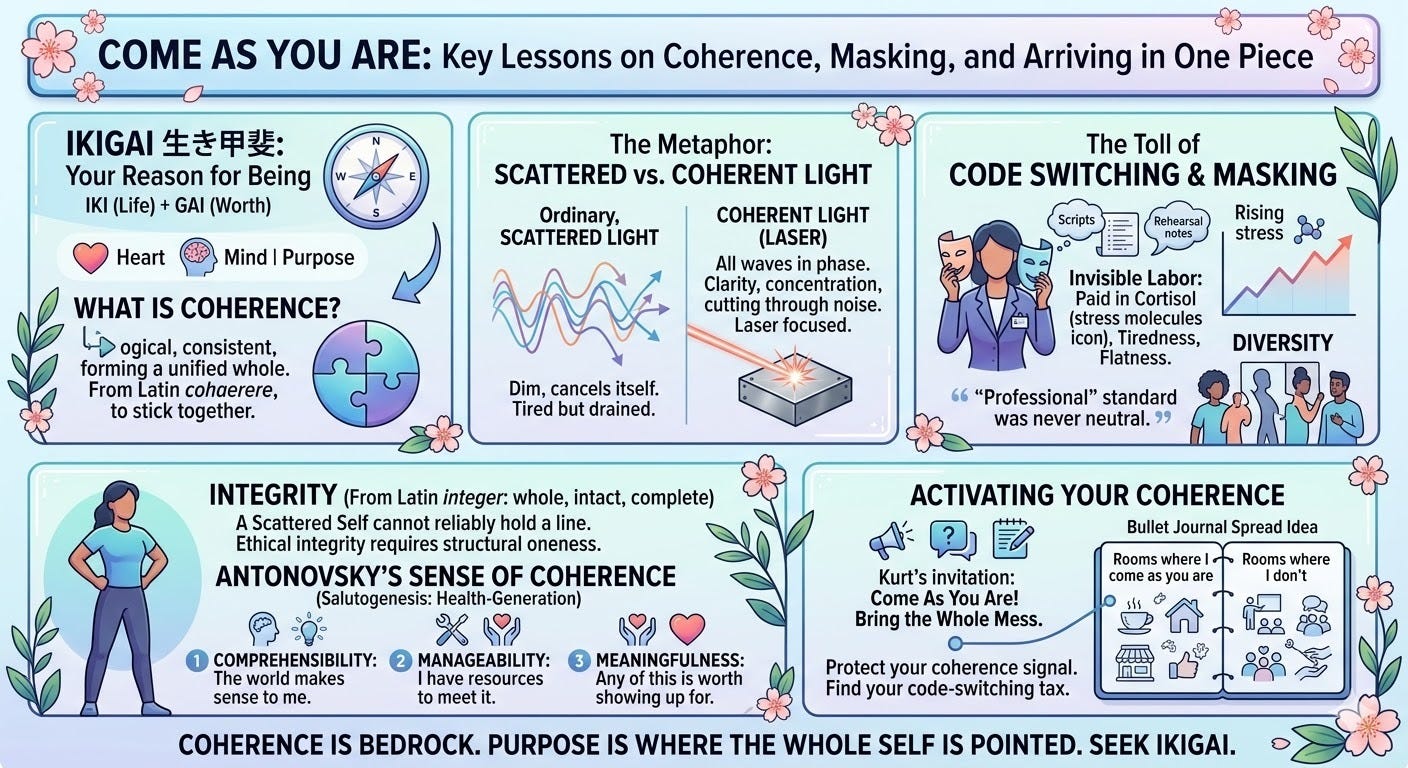
🌸 ikigai 生き甲斐 is a reason for being, your purpose in life... from the Japanese iki 生き meaning life and gai 甲斐 meaning worth 🌸
I walk into a room and I trim a little of me. I sand down a corner, soften a word, swap an opinion for a question. By the time I’m sat in the meeting, or on the Zoom, I’ve already done a little edit of myself. Not a conscious performance exactly, just a translation.
Last week I said coherence is the first component of meaning, the foundation that lets everything else grow. I said it means this makes sense of who I am. I’ve been sitting with that all week, wandering along the prom with Henry Hound and musing on how to go deeper into the WHY of my thinking on this.
The dictionary says that coherence is the state of the parts fitting together;
Coherence/kə(ʊ)ˈhɪər(ə)n(t)s/ is the quality of being logical, consistent and having all parts fit together to form a unified whole. It refers to the connection of ideas in writing, the structural integrity of a system or the fixed phase relationship between waves in physics. It implies consistency, clarity and orderly structure.
It’s from the Latin cohaerere, to stick together. I find it fitting that the word I reached for first, instinctively, as a key component of meaning or purpose, makes you question how stuck together or whole you really are… and whether you are allowed to be.
So yeah, it’s even bigger than the story you tell yourself inside your own head. It’s also the version of you that walks through every door roughly the same shape and size. Perhaps an outrageously unreasonable thing to ask for in a world hell bent on making you fracture into increasingly smaller and duller pieces.
And yet this is exactly where ikigai can begin. Without coherence, the reason for being has nowhere to settle. Nothing to stick to. No self in one piece for it to rest on. Which might be why one of the most generous four-word invitations of my lifetime has been on repeat in my head all week.
Come as you are, Kurt Cobain sang in 1991, on an album called Nevermind (possibly the most Gen X shrug ever committed to vinyl *grin*) “Come doused in mud, soaked in bleach” … bring the whole mess… bring the contradictions… come anyway.
Kurt was a beautiful soul who struggled, and I wish life had been easier for him. The invitation he wrote thirty five years ago is still one of the most generous things ever set to a melody.
Come as you are. What an astonishing thing to be offered. What a difficult thing to do.

Coherent light
Go back to that definition for a second. I almost skipped over the physics mention... it reads technical, dry… but I was hunting for a metaphor, something that would let me feel coherence in my bones rather than just define it. A little voice said “go and look that up properly”... so the dictionary led me somewhere I did not expect, down a rabbit hole into optics.
Ordinary light, the kind pouring through my living room window as I type this, is scattered. Waves moving at different angles, bumping into each other, cancelling as often as they help. It’s enough to see by, or to warm the air a little.
Coherent light is different. Same photons. Same energy. The only thing that has changed is that all the waves are moving in phase. When you line them up, something extraordinary happens. The light gets strong enough to cut through steel, we call it a laser.
I think our lives can work a bit like that too. You have the same hours, the same attention, the same strange and specific collection of things you care about. Scattered, they dim. They cancel each other out. You arrive at Friday evening knowing you were busy all week and having no real idea what any of it added up to.
In phase, those same hours can do something else entirely. You feel it as clarity… as concentration. The beautifully bewildering experience of being tired by the weekend but NOT drained.
I realised that the ‘sanding’ I do to myself in those rooms creates the very texture that scatters light. Every softened word and swapped opinion acts like a rough, uneven surface, sending my energy in a dozen conflicting directions.
Being recognisably yourself in every room is a kind of concentration. It’s waves finally in phase. You walk in and nothing in you has to fight anything else in you to be there. Cut through the noise as laser focused you.
The cost of code switching
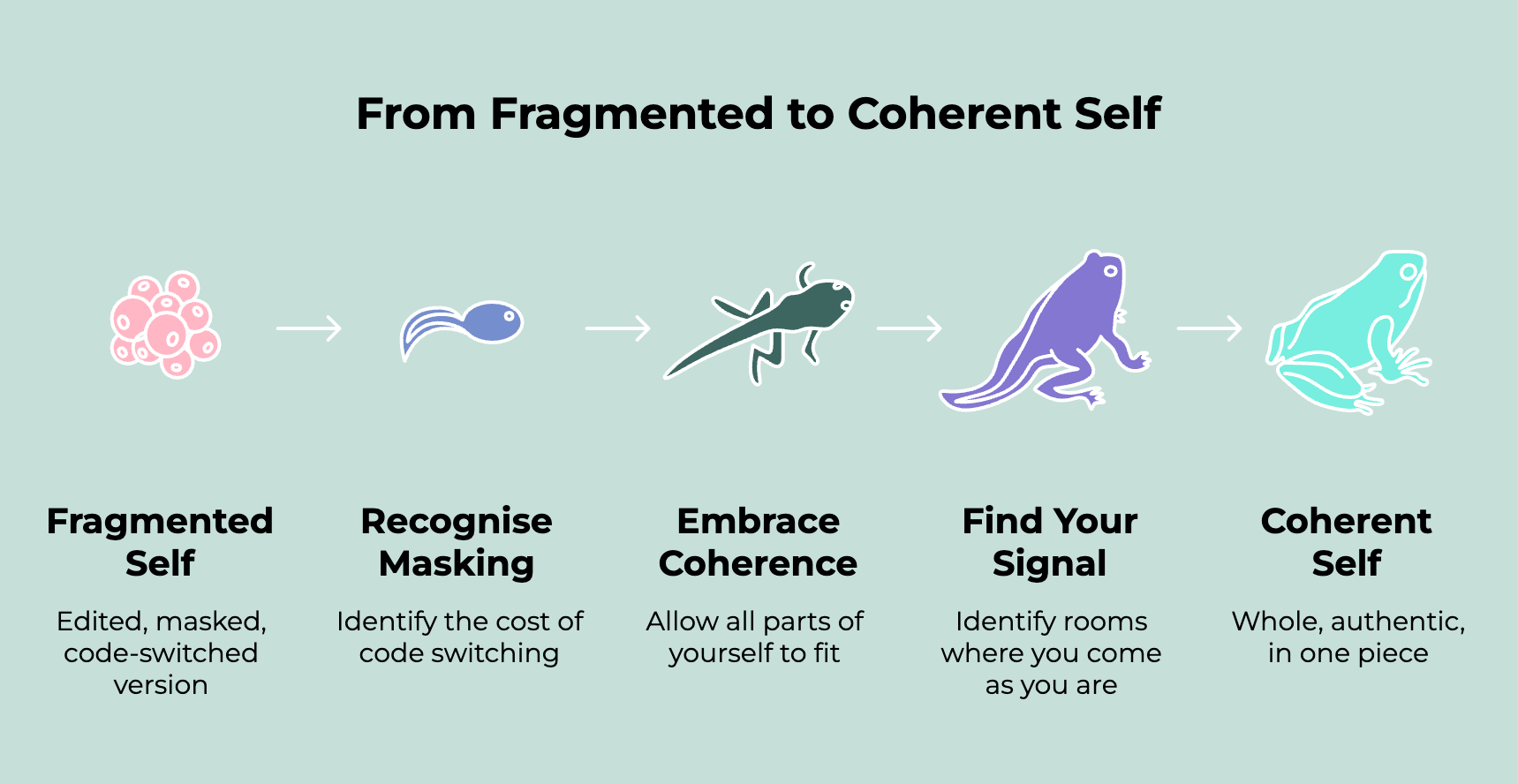
Masking is exhausting. The invisible labour of scripting and rehearsing. Checking which version of yourself this particular room asks for. That labour has a price, paid in cortisol and flatness, paid in tiredness.
This is a human truth that neurodivergent people have been kind enough to articulate first. The work of naming an experience that sits harder on some bodies than others but lives somewhere in almost all of us.
For a very long time we’ve taught people to “be professional”. We didn’t always notice that “professional” was never a neutral standard. It was one particular way of being in the world, shaped around a particular class, a particular gender, a particular race, a particular neurotype. If you happen to fit that shape, professional is easy, just be exactly who you are. If you don’t, professional is a performance you have to learn and maintain, at a personal cost nobody is in any hurry to count or adjust for.
Deeply coherent people often get labelled “difficult”. Their values are held together brilliantly, feeling the injustice of the systems around them so deeply they just can’t keep quiet. The system asking them to contort is the thing that’s broken and harmful to human thriving. We call the coherent ones awkward because the incoherence comes from the rooms, and they are much harder to rebuild apparently (though I’m sure healthy humans would cost society MUCH less overall), the framing I can’t unsee.
And now AI has arrived, learning from the way we live within these weird system designed rooms we don’t talk about enough.
It does worry me that coherence struggles to get prioritised, even when we are conscious of it! The words we type, the emails we draft, the posts we polish, the prompts we sharpen... these are often our code switched selves. Our professional voice. Our sanded, trimmed, translated version. When AI learns from those, it’s learning the mask. The face underneath (the expressive, emotional, contradictory and very much alive and human version of us) barely makes it into the training.
Which means the more we code switch into these tools, the more AI becomes a mirror of our code switching. It will cheerfully help us produce even more of the acceptable, professional, polished selves that were already costing us so much to maintain. Usage is curriculum, and the curriculum we’re writing is that humans are their edited versions.
That’s the cost of code switching and increasingly, it’s the thing we’re teaching the machines to amplify. Of course, used well, AI can also help us notice the mask and hear ourselves more clearly again…but only if we bring more than the polished version to the exchange.
In one piece
Here’s another word I’ve been turning over in my journal all week…integrity.
I’ve always understood integrity to mean being decent or honest. That’s how we use it now. Person of integrity. Code of integrity. Question of integrity. It lines up, roughly, with ethics.
Integrity comes from the Latin integer, meaning whole, intact or complete. The word we still use for whole numbers carries the original meaning perfectly, while the ethical version has drifted. Before integrity meant honesty, it meant oneness. A person of integrity was someone complete, in one piece. Not fragmented or split.
You cannot really have integrity in the ethical sense without integrity in the structural sense. A scattered self cannot reliably hold a line, because there are too many selves and too many lines. The coherent self keeps its word, obvious once you see it.
Aaron Antonovsky, a medical sociologist spent his career asking a really good question. Instead of “what makes people ill,” he asked “what keeps people well” He called this salutogenesis, health-generation, rather than pathogenesis, disease-generation. The thing he kept finding, across cultures and decades and populations you wouldn’t necessarily expect to be resilient, was something he named the Sense of Coherence, with three named ingredients.
🌸 Comprehensibility (the world I’m in makes sense to me).
🌸 Manageability (I have the resources to meet it).
🌸 Meaningfulness (any of this is worth showing up for).
He was writing decades before Martela and Steger. Here we are again, finding coherence at the root of what keeps humans functioning. Not thriving, mind… functioning that’s how foundational this is.
Coherence is the state of the parts fitting together. Integrity is the same thing, wearing older clothes. Antonovsky’s Sense of Coherence gives us a useful way to think about what helps that fitting-together hold. Underneath all of it is the same truth. A human in one piece can do things a human in pieces simply cannot.
Where the signal is
So this is where I am, this Saturday morning, coffee gone cold next to me, Henry sat in the bay window waiting for his lunchtime walk, my turquoise journal open.
Coherence is what happens when the whole of you gets to walk through the door. When the waves move in phase. When the Latin integer holds. When Antonovsky’s three ingredients show up at once. When Kurt’s invitation to come as you are stops being a rhetorical ache and starts being a practical possibility.
This is where ikigai begins. With the simple, difficult act of showing up as the whole of who you are. Iki gai, life-worth, needs a life in one piece to settle into.
Coherence is bedrock because everything else needs something whole and strong to stand on. Next week I want to write about purpose through this lens of the components of meaning. If coherence is who you are, purpose is where that whole self is pointed. You can’t point a scattered self anywhere.
Before we get to that though, as you interact with the world and the machines this week remember Kurt’s invitation. Where do you already come as you are? Which room? With who? Start there, that’s where the signal is. And while you’re there, consider this too. The AI tools you reach for, do they get the whole you or the polished version? Because they’re learning from whatever you give them.
Your face is beautiful exactly as it is and worth showing, even to a machine.
Sarah, seeking ikigai xxx
PS - Bullet journal spread idea
Make two columns. On the left, list or doodle three rooms where you come as you are. On the right, three rooms where you don’t. Just name them initially. Then perhaps a day or so later look back at the two lists and ask yourself what the left-hand rooms allow that the right-hand ones don’t. That’s your coherence signal. Notice it, protect it and try to spend more time there.
PPS - Purposeful AI prompt to try with your preferred AI tool with extended thinking turned on;
“I want to think about where I’m coherent in my life and where I’m not. Interview me. Ask me one question at a time. Start by asking me to describe a room, meeting, relationship or context where I feel most like myself. Then ask me about one where I feel least like myself. After we’ve done a few of each, help me notice the patterns. What is the first list allowing that the second list isn’t? Be warm but sharp with me. I’m not looking for comfort, I’m looking for where I’m paying a tax in code switching that I could work towards not paying.”
PPPS - This week’s soundtrack is “Come As You Are” by Nirvana, arriving in 1991 the year I turned sixteen. Coherence as an invitation and an insistence.
Kurt Cobain said about the lyrics
“The lines in the song are really contradictory. One after another they are kind of a rebuttal to each line. It’s kind of confusing I guess. It’s just about people and what they are expected to act like.”
That image of you in the Kurt cardigan is gold!
Awww cheers lovely, I still like a scruffy cardie to this very day 🥰