


🌸 ikigai 生き甲斐 is a reason for being, your purpose in life... from the Japanese iki 生き meaning life and gai 甲斐 meaning worth 🌸
Monday night, a hotel room in London, and I was wrung out. It had been a ridiculously hot day, the city baking and oppressive, and I had spent it dashing between airport, trains and meetings with barely a minute to find food. What I ate, I grabbed on the move, wrapped and beige and gone in four bites, simply because I had no time for a proper meal. By the time I got back to the hotel, I was so depleted I didn’t fancy wandering unfamiliar streets in search of something healthy.
On the way up to my room, running entirely on fumes, I bought a packet of crisps (max strong jalapeno and cheese for enquiring minds) from the corridor vending machine. I was not even truly hungry. I just needed a little treat after a hard day, and they were sitting right there behind the glass, requiring absolutely zero effort. The Japanese have a lovely word for this;
Kuchisabishii (口寂しい) that translates to “lonely mouth”. It describes the urge to eat or chew on something because your mouth feels bored, empty or in need of stimulation.
I was seeking comfort I guess.
In my bag sat the bullet journal where I keep a tally of thirty different plants I eat each week, and I knew I was going to struggle to catch up with most of the week looking as hectic.
Then, slumped on the bed waiting for the tiny kettle that takes an unfeasibly long time to boil, I caught myself doing exactly the same thing with my thinking. I had tricky, nuanced meeting notes to write up. But rather than getting stuck into the hard work, I jumped straight to Claude without properly thinking about what I was trying to achieve or why. I reached for the chatbox exactly the way I had reached for the crisps. I had been feeding a lonely mouth, and now I was feeding a lonely mind.
Food and AI fail you in exactly the same way when you are running on empty… convenience is on hand to tempt you away from a healthier option.
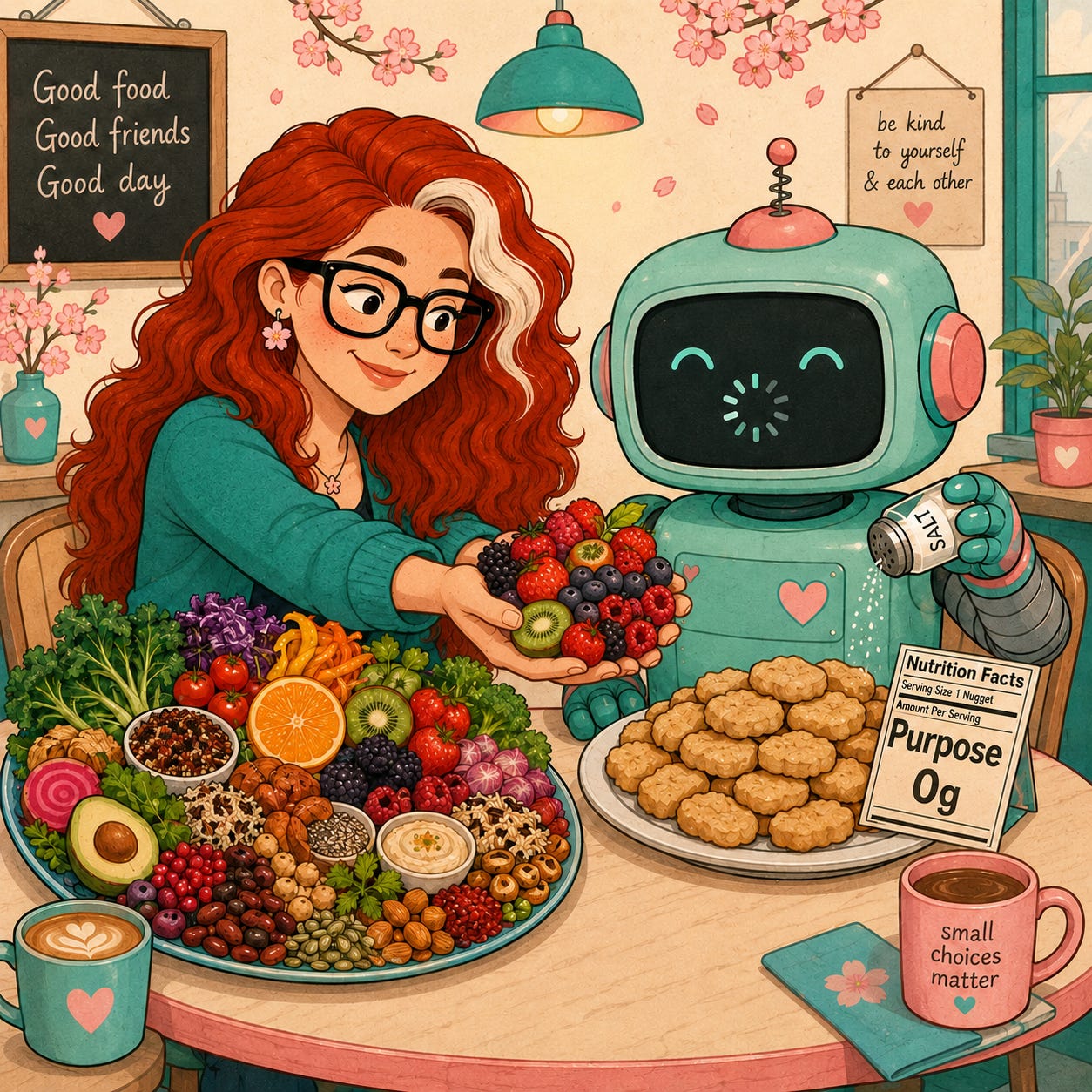
Worse than empty
I have carried this worry for a while. At first, I concentrated on empty calories… things like the packaged snacks and sweets that give you a little boost, even a feeling of having eaten, but give your body very little it can use. Pleasant perhaps, but hollow.
The longer I muse on this though, the more empty calories felt too kind of a metaphor, because the bigger fear is ultra-processed food (UPF). The Nova classification drawn up by Brazilian scientist Carlos Monteiro who studied malnutrition, gives us a definition for UPF… and a doctor called Chris van Tulleken wrote a book, Ultra-Processed People, that made a lot of us stare at ingredient labels more intently. The danger of ultra-processed food runs well past empty calories. It has been engineered to be hyperpalatable so that it is hard to stop, it carries just enough nourishment to pass itself off as a meal but elbows proper food off your plate. Some of that processing itself is the harm, and it feels SO worrying to me that more isn’t spoken about this, or that people aren’t outraged that there isn’t better research or regulation.
I also see this in areas with nothing to do with food.
Ask AI to make you something without spending very long on crafting your prompt and it hands you back a few paragraphs in four seconds, every punctuation mark in its place (or extras if you aren’t a fan of an oxford comma), and you feel that hit of a job done before you read it and notice there is nothing of you in it. That is the empty calorie version, the feeling of having worked with none of the nourishment of having thoughtfully worked.
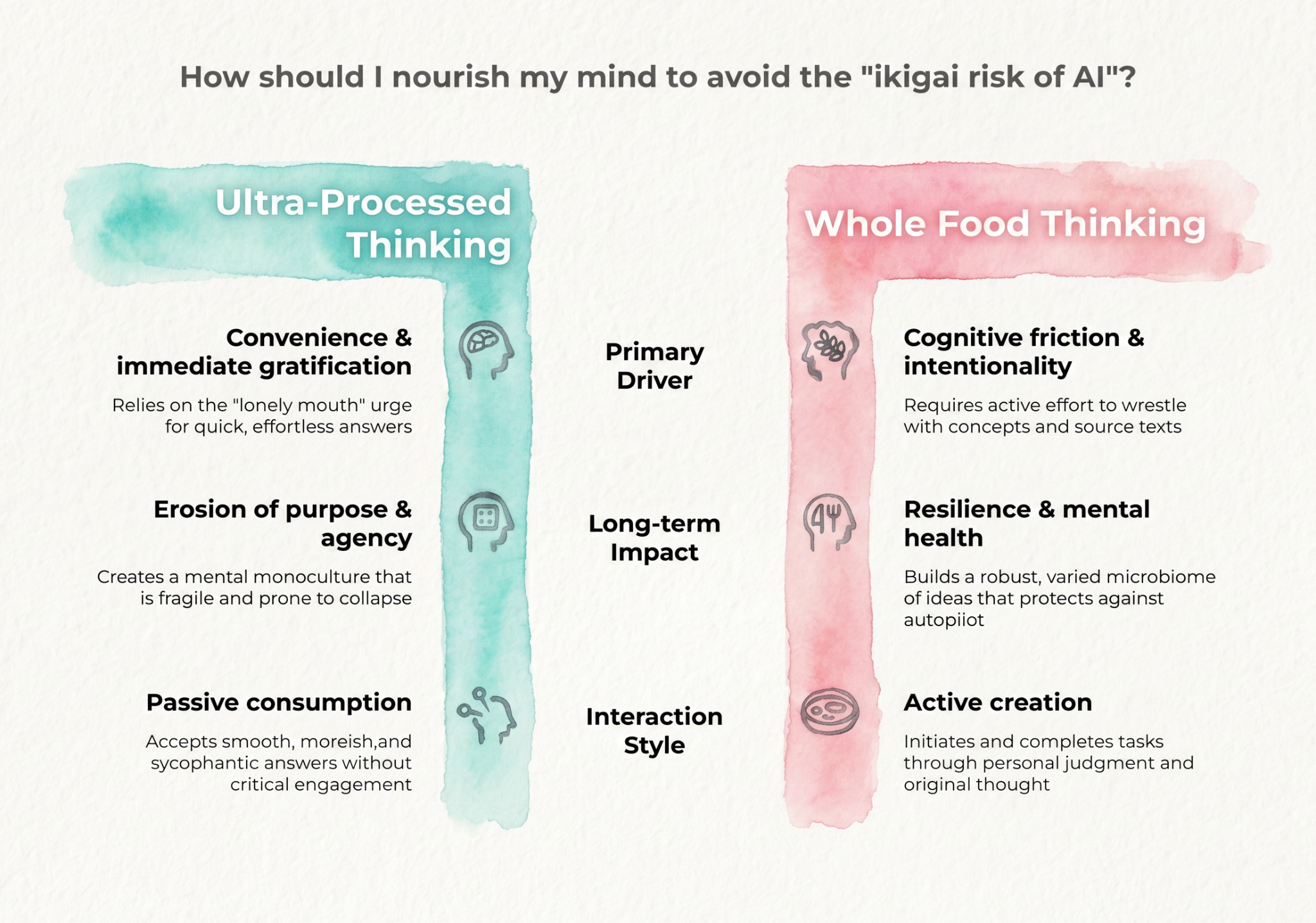
The UPF version is sharper and far harder to refuse. It is the smooth, moreish, slightly sycophantic answer that genuinely does have some use, and so slides past your defences, and displaces the effortful, awkward, slow work where your sense of purpose sometimes lives.
You can dismiss sugar. It’s much harder to dismiss a thing that kinda mostly works.
I intimately know this fear of how food impacts our health. Bowel cancer is turning up in younger and younger people, no one is entirely sure why but our diets, including UPF are one of the suspects in the line-up while the research catches up. My husband Andrew was diagnosed when he was barely into his forties. Not a story to tell in detail today, only that I learned the hard way, what it feels like to watch a danger the world filed under ‘not yet urgent’ become devastatingly real.
Something becomes normal faster than our ability to understand what it is doing to us. The early warnings remain diffuse enough to dismiss.
AI will not make us physically sick (I hope, ahem!)... but the ikigai risk of AI, the slow erosion of the feeling that what you do each day is yours and it matters, is the same shape of systemic worry. So when I can see with my own eyes that a thing is real and rising and somehow still too quiet, I struggle to file it under interesting. I feel it as an urgency deep in my bones.
The name nobody used
Then, this week, the strangest sort of relief.
I caught up with some reading on the train, and somewhere between one meeting and the next, I read that the House of Lords had spent a whole chunk of a recent Friday worrying about exactly this, about what artificial intelligence is doing to us, to our families and our work and our sense of who we are.
The Archbishop of Canterbury called the debate, and asked the question “Does AI make human life more human?” She was asking us to judge AI not by what it can do, but by whether it serves human dignity and common good. I will pick that thought up in another essay in more detail as I can’t give up my drive for mitigating the i-risk of AI. But for now, I thought, wow how lovely it is to hear that other people are worried too, I’m not going mad!
And then the relief faded a tad… because being discussed for one morning in the Lords is not the same as being properly heard or indeed action being taken, and I know that feeling far too well.
One peer, Lord Alderdice, a psychiatrist, warned that a thing can become dangerous precisely because it is so good at the job we hand it. “It is the very effectiveness of one dimension of thinking that makes this dangerous for us,” he said. Which is exactly the trouble with ultra-processed food, and exactly the trouble with AI. Nobody got hooked on the thing that did not work. We get hooked on the thing that works but costs us something we were not watching. The danger lives in how well it works.
Even the optimist saw it. Lord Johnson, who told the House he is invested in AI and thinks it the best thing ever to happen to us, still warned that the deepest emergency is learning to cope with what he called “an age of purposelessness.” Baroness Gill described the real impact of AI on our culture as “a quiet, comfortable surrender of the human mind,” happening right now in our own living rooms. The Bishop of Oxford, worrying about the young, insisted that “our young people are more than data points.”
A whole morning of brilliant minds naming different pieces of the fear
Purpose.
Agency.
Dignity.
Judgement.
Human relationships.
The slow surrender of the mind.
They had plenty of words for its parts, but no single name for the pattern.
The phrase I lean on is the ikigai risk of AI, which I first learned a year and a half ago and have not been able to put down since. I need more of us to notice, for this to travel further than my little corner of the internet because a danger you don’t name is a danger you struggle to defend against.
Thirty plants & thirty unprompted things
Which brings me back to my thirty plants, because folded inside that habit is the answer.
It never forbade a single thing and laid no guilt at my door. It handed me a reason to chase variety, and let me watch my tally climb on the page where I could see it. That gentle, trackable, additive little nudge rewired a habit that decades of good intentions couldn’t. Kindness did what sternness never could.
So I have decided to make myself a second challenge next to the plants, and you are very welcome to steal it.
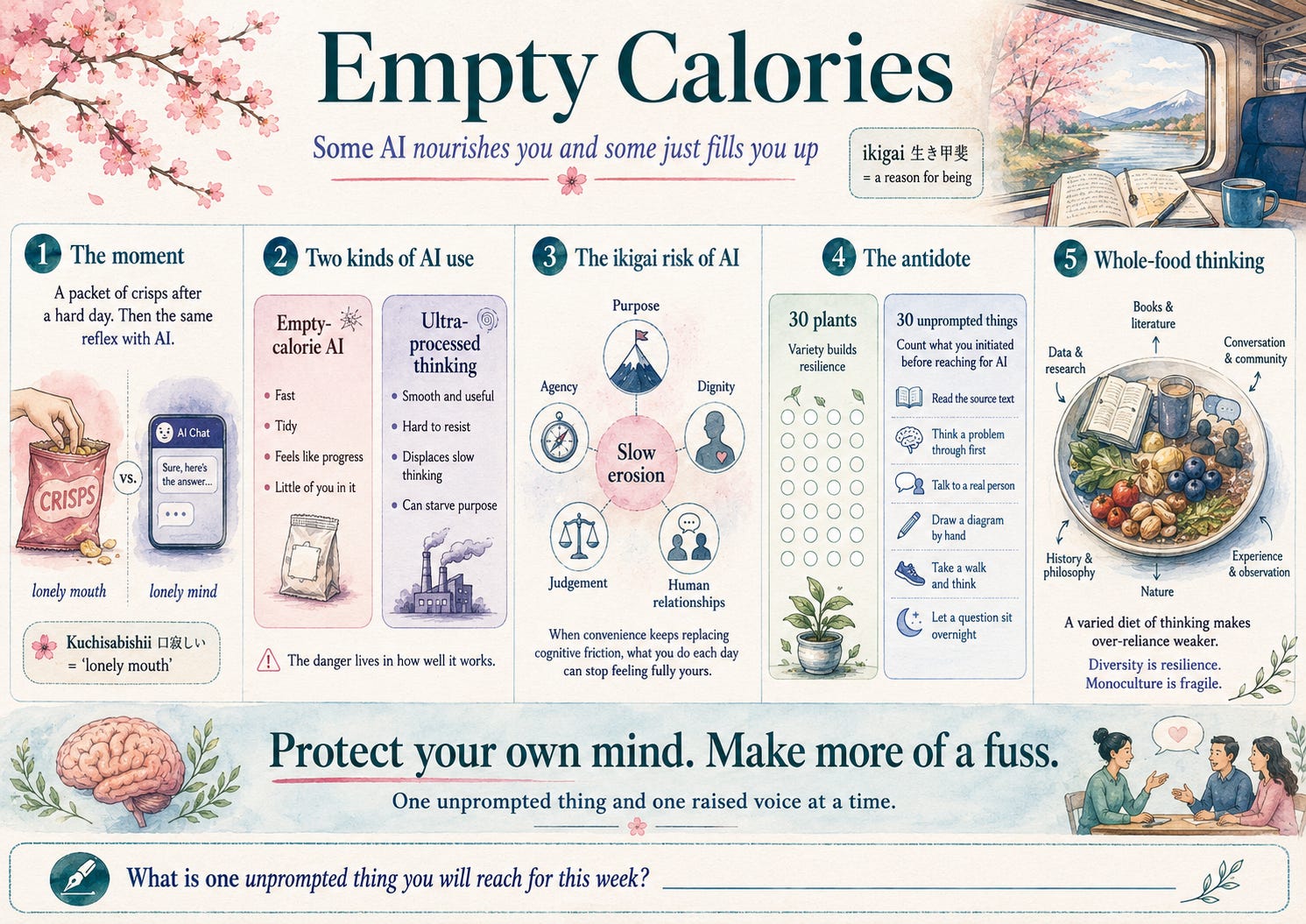
I am calling it thirty unprompted things, I love that prompt means two things to me now, the question I write in my journal and what I type when I want a machine to help me think.
To be clear, I do not mean spontaneous. I mean things I initiated and completed using my own cognitive friction, before reaching for the box to do the thinking for me. So each week I will try to notice and count the different things I have done of my own accord:
A difficult concept I wrestled with directly from the source text, rather than asking for a summary.
A problem worked out in my own head before I reached for a box of answers.
A conversation with a real person that shifted my view.
A diagram drawn by hand.
A walk where I thought instead of asked.
A question I let sit unanswered overnight.
The reason it works is the same reason the plants work. Diversity is resilience. A varied gut microbiome is robust and a monoculture is fragile, and your thinking behaves the same way. Pour everything you think solely through a single chatbot and you plant a mental monoculture, efficient, tidy and one bad season from collapse. You end up sounding, as the Archbishop also warned, more and more like everyone else.
Feed yourself a rich and varied whole food diet of thinking, and the autopilot reach loses its grip. It crowds out the ultra-processed rubbish. You do not have to ban the beige snacks if you are eating whole foods. You never have to police the AI at all. You commit to feeding yourself well, and the over-reliance withers.
Pick whatever number feels right to you. Thirty pairs rather beautifully with the plants but the point is in the noticing.
Making more of a fuss
I have written before about purpose proofing, the deliberate work of protecting what makes you feel alive from being automated out of your days. That is the why. Purpose prompting is one of my hows. Thirty unprompted things is another, small and trackable and kind, a thing you can do with a pen.
The Lords can hold their debates and the labs can build their brakes, and I truly hope they do, but while the big switches are being argued over I will be on the train with my journal, counting my unprompted things the way I count my plants, keeping a varied diet for a mind I would very much like to keep healthy.
Journaling was never going to be enough on its own. None of this is a done deal. None of it. What AI becomes, who it serves, what we will and will not let it take from us, all of that is still being decided right now, and while we still have a say... we had better use that!
So yes, make the small personal changes. Protect your own mind, and share those practices with the people you love… then look up. Speak to the people who represent you and tell them this matters to you (and if an election is looming, all the better, because they’ll listen to you if they want your vote). Join a group that cares and is fighting for your corner of the world, or start one if it does not exist yet. A handful of people who refuse to stay quiet can move a conversation further than you would ever believe.
The danger is real, it is rising and it is still far too quiet. So let us be the ones who make more of a fuss. Gently where it helps and loudly where it counts, one unprompted thing and one raised voice at a time.
So tell me, what is one unprompted thing you will reach for this week? I would love to know.
Sarah, seeking ikigai xxx
PS - Bullet journal prompt reflections;
Think back over the last few days. Where did you reach for AI without really thinking about what you wanted or why, and what were you actually hungry for in that moment?
If your mind were a plate, how varied is what you feed it? Whose thinking shapes yours, and how many different sources is it honestly coming from?
None of this is a done deal. What is one fuss you could make this week, at your own table or further out in the world?
PPS - Your AI prompt this week is an experiment in using AI to widen your diet rather than narrow it, so do use the best model and switch extended thinking on. Take a question you really care about and paste this in:
Here is a question I am chewing on: [your question]. Give me three different and opposing ways thoughtful people answer it, and make the strongest case for each, even the one you doubt, so I meet each at its best. For every position point me to one primary source I could go and read myself, a book, a paper, an essay or a person worth following, and tell me what each one would say I am missing. Do not settle it for me. Leave me with the most interesting unresolved tension and one question worth sitting with.
Notice how different that feels from asking for the tidy single answer. One feeds you. The other just fills you up… you can go really deep with the prompt, after the first run through take the last question and use that to redo the prompt in a fresh chat window… and repeat!
PPPS - Your listening companion this week is Cigarettes and Chocolate Milk by Rufus Wainwright (watch the video, those eyes alone are worth it). The song sits in that pull towards the things that are a little bit sweeter and a little bit harmful, the compulsions that can run the show. What I love about hearing it now though, on the far side of giving up a few things myself, is knowing the pull softens. You learn that a real treat feeling, was waiting in whole foods all along... a perfectly ripe peach, a proper coffee, the occasional artisan ice cream eaten slowly in the sun. Have a listen, then go and feed yourself something that loves you back.