


🌸 ikigai 生き甲斐 is a reason for being, your purpose in life - from the Japanese iki 生き meaning life and gai 甲斐 meaning worth 🌸
It was just over a year ago that I wrote How to Find Your Ikigai a battle-tested roadmap for getting from “I haven’t a clue what my purpose is” to “I can see several pathways forward.” I still stand by it, but a couple of things have grown so it’s worth a fresh essay rather than a stealth edit.
I’ve now run this process with more people, more times, and found where it was thin. One whole quadrant of the famous framework was barely served and almost every exercise asked us to think, never to try. Reflection is lovely but good intentions need to translate to action.
The ground keeps moving too. We need to actively consider the ikigai-risk of AI in our future planning, the erosion of human purpose that can happen even when AI goes well. What makes life worth living when the machine can do the very things that used to give us meaning? If we’re going to talk about finding work worth doing, we have to weave those protections into the same process.
Also the use of the word work over and above ikigai in the title, it means more than paid employment of course. Humans have always cared, made, repaired, grown, taught, organised and contributed, long before modern economies existed, so even if money eventually matters less, the question of what feels worth doing will remain.
So, same roadmap but a little sharper, more practical and honest about this weird timeline we’re all trying to build a meaningful life inside.
It’s the half-year reset point and I’ve just migrated my bullet journal to a shiny new lilac notebook, and re-drawing these spreads is exactly what sent me back to revisit them. You can’t copy a framework across in your own handwriting without noticing what’s shifted in you, and what you’d now do differently. This is what fell out of that migration.
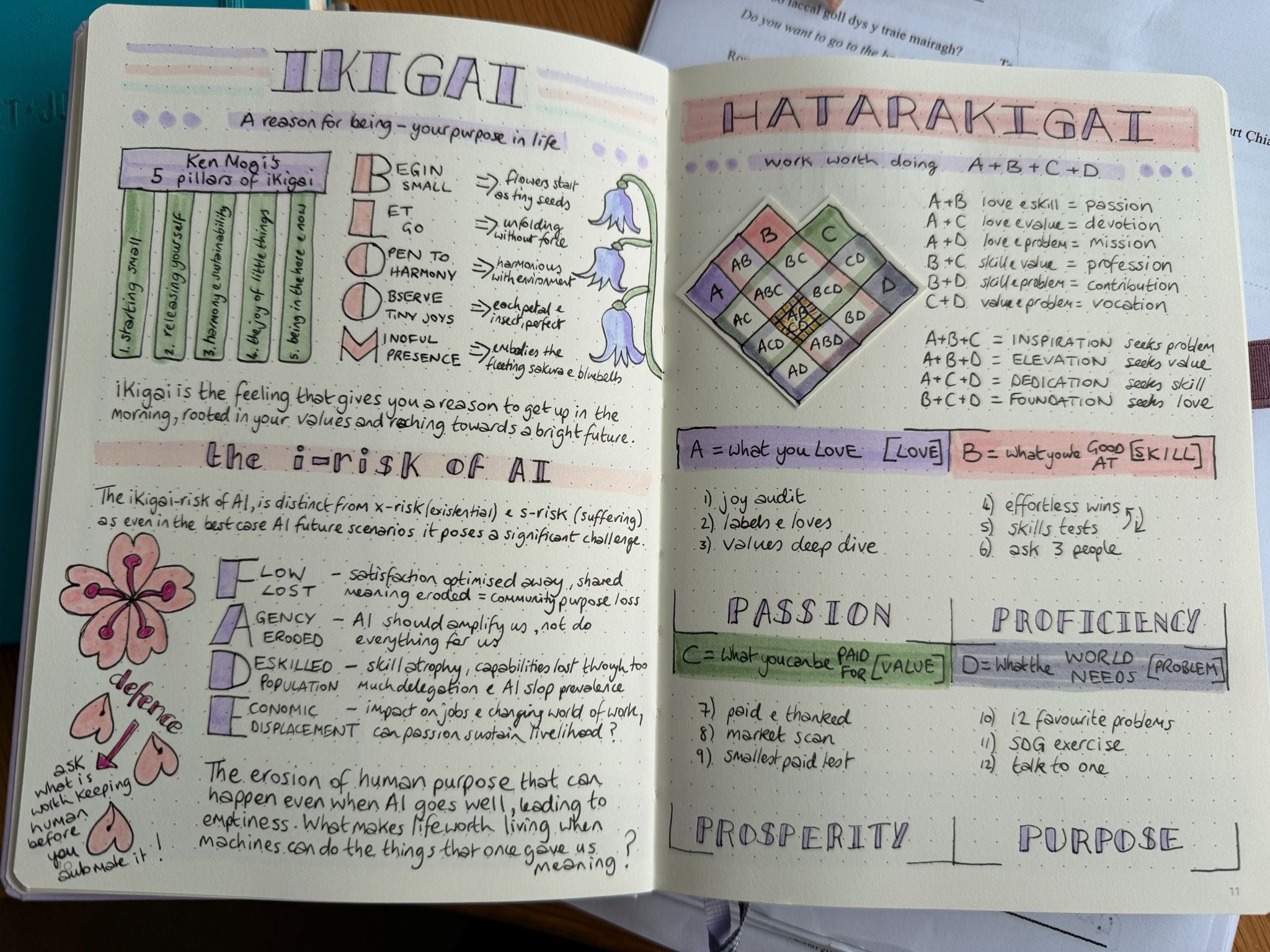
📸 the spread that started it, my ikigai and hatarakigai pages, re-drawn and rethought in the new lilac journal.
A quick refresher before we get started… ikigai itself is a felt sense, a knowing in your bones that *this* is enough. It lives in verbs far more than nouns and it’s often already there in how you make your coffee or the focus of an hour’s good work. The four-circle diagram everyone posts is not ikigai. When drawn correctly it’s a fab design tool for hatarakigai, work worth doing. We reach for it because most of us spend 40+ hours a week working, and if those hours crush your soul, no amount of downtime meditation will make that ok. The aim isn’t for work to be your only source of ikigai. It’s for work to stop fighting it, and start feeding it.
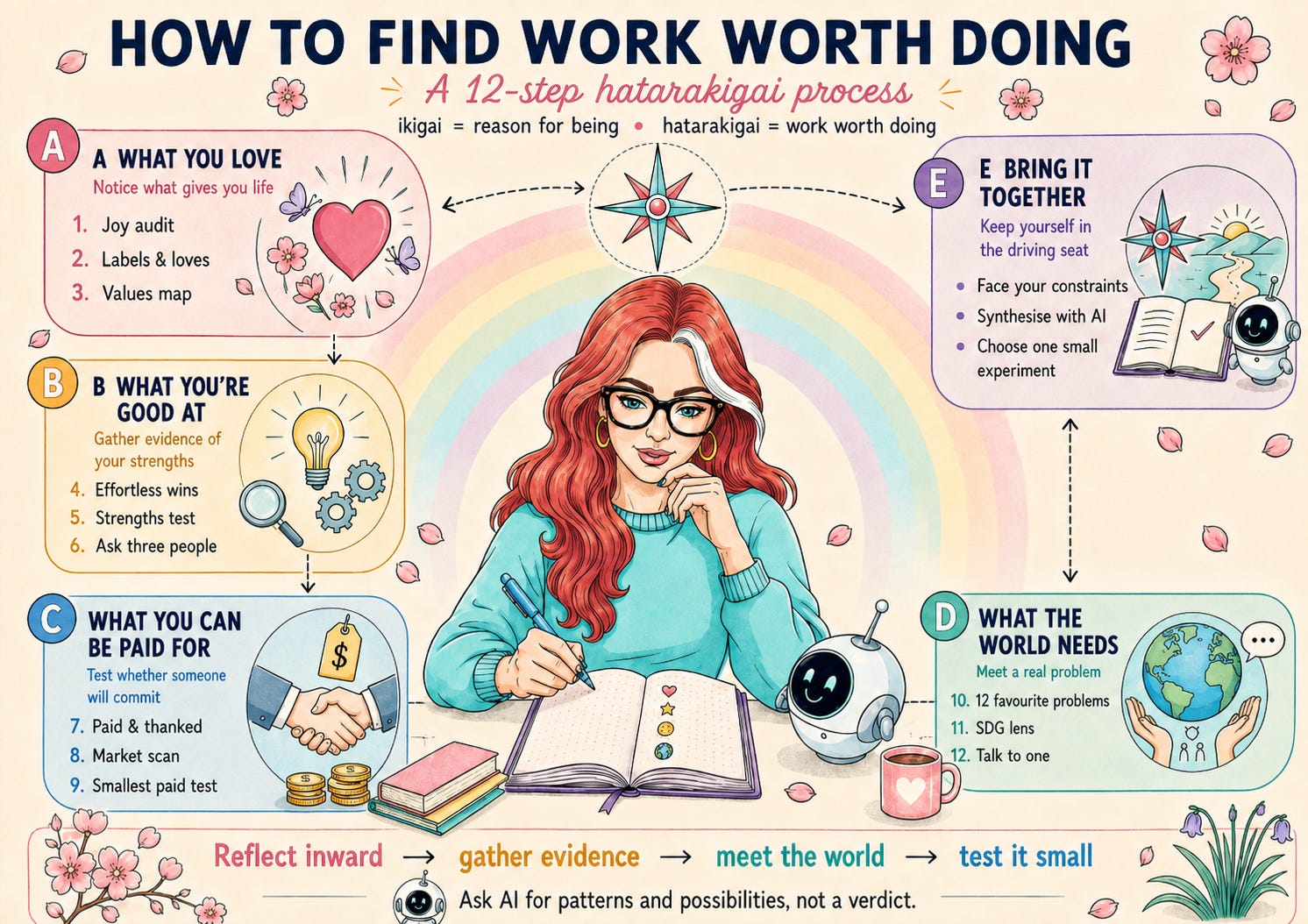
This new version is strategically moving us forward, look inward, check outside yourself, then test it small. Reflection tells you what you believe is true about yourself, a small experiment tells you what actually is. It’s also the only known cure for the analysis-paralysis that swallows so many purpose-hunts… the endless journalling that never quite touches the world. Notice the shape of the journey, we move from the most inward thing, what you love, to the most outward, what the world needs and what someone will pay you for. The balance tilts as we go, at the start it’s almost all reflection, because you can’t market-test a feeling… by the end it’s almost all experiment, because you cannot think your way to what people will pay for. You find that out by asking them.
This is what I mean by building purpose literacy, the ability to feel when you’re moving towards meaning or away from it. You only get that signal when you actually move.

Phase 1: the foundation, and what you love
Ground yourself first, real ikigai is distilled in Ken Mogi’s five pillars; starting small, releasing yourself, harmony and sustainability, the joy of little things, and being in the here and now. On my ikigai spread I came up with my own “BLOOM” acrostic to embed what it means to me, maybe try the same for yourself (AI prompt example to copy).
A) what you love
1 Joy audit
In your journal, list at least five moments from the past week or so that sparked joy or gratitude. Small is the point. Mine are things like an essay comment, making someone smile, a perfectly satisfying bullet-journal spread.
2 Labels & loves
Set a ten-minute timer and brain dump every label that describes you; roles, traits, interests, quirks, the lot, flattering and unflattering. Don’t edit. Mine runs to ginger, optimist, ikigai seeker, AI enthusiast, bullet journal nerd, equality advocate, speccy four-eyes, introvert, Minecraft fan, walker.. These are the ingredients in your recipe. We aren’t describing boxes to contain you.
3 Values deep dive
Circle up to ten values that resonate today, not your polished ideal-self list. Then map them, the Schwartz values wheel is perfect for this. Mine cluster around universalism and benevolence, which explains which rooms and roles leave me feeling hollow. The magic is in the links between your labels and your values, that’s where what you actually love is hiding, as opposed to what looks impressive on LinkedIn.
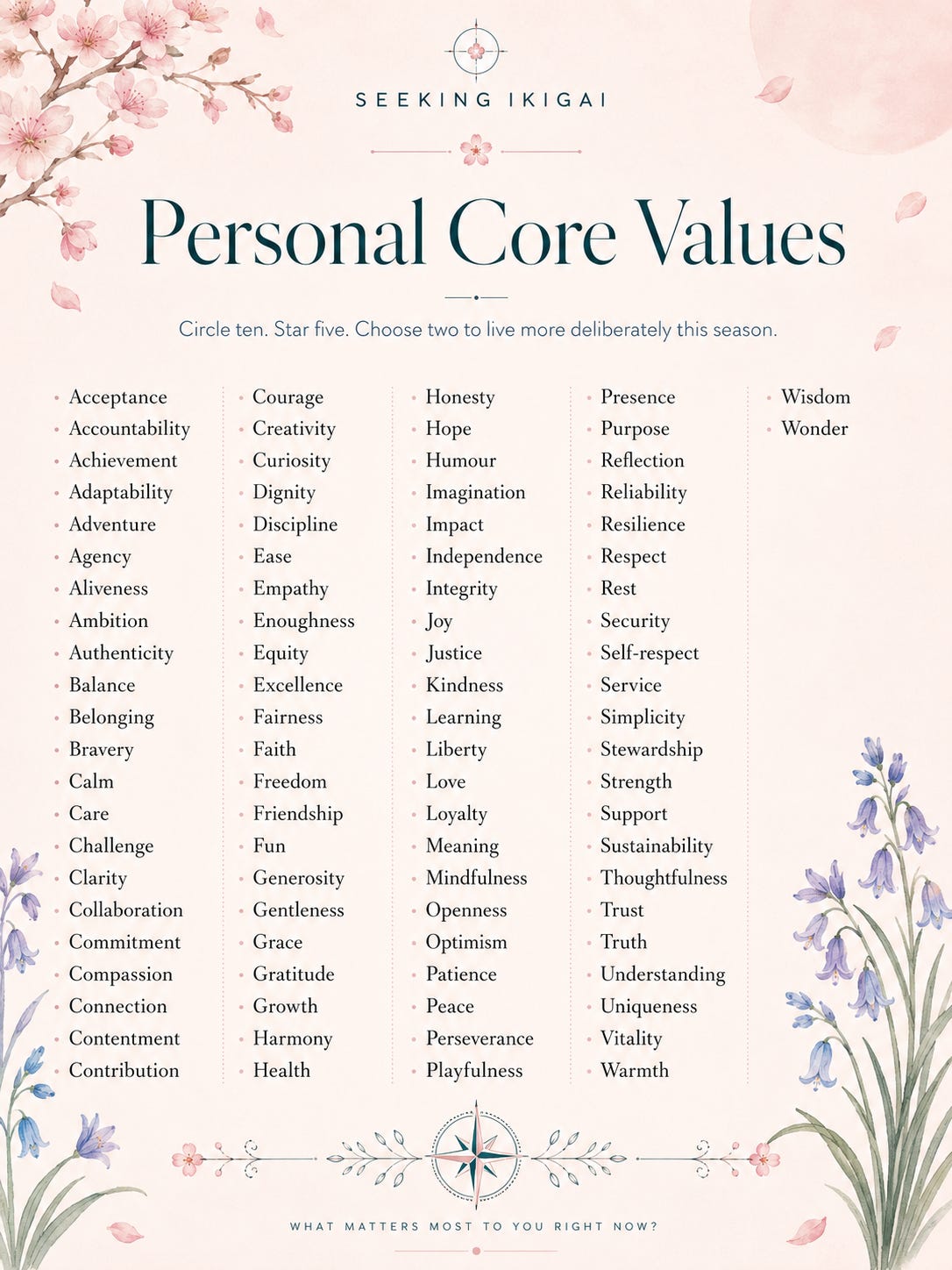
Love is the one element that’s almost entirely an inside job, which is why all three exercises are really the same gentle looking, from three directions. Hold that thought, because from here on the experiments get louder.
Phase 2: designing the work — skill, value, problem
B) what you’re good at (skill)
Your strengths often feel so natural that you dismiss them, and other people may see them more clearly than you can.
4 Effortless wins
List the things that come easily to you but that others visibly find hard. That gap, easy-for-you, hard-for-them, is your most undervalued strength, and the one you’re most likely to have talked yourself out of because “surely everyone can do that.” They can’t.
5 Skills test
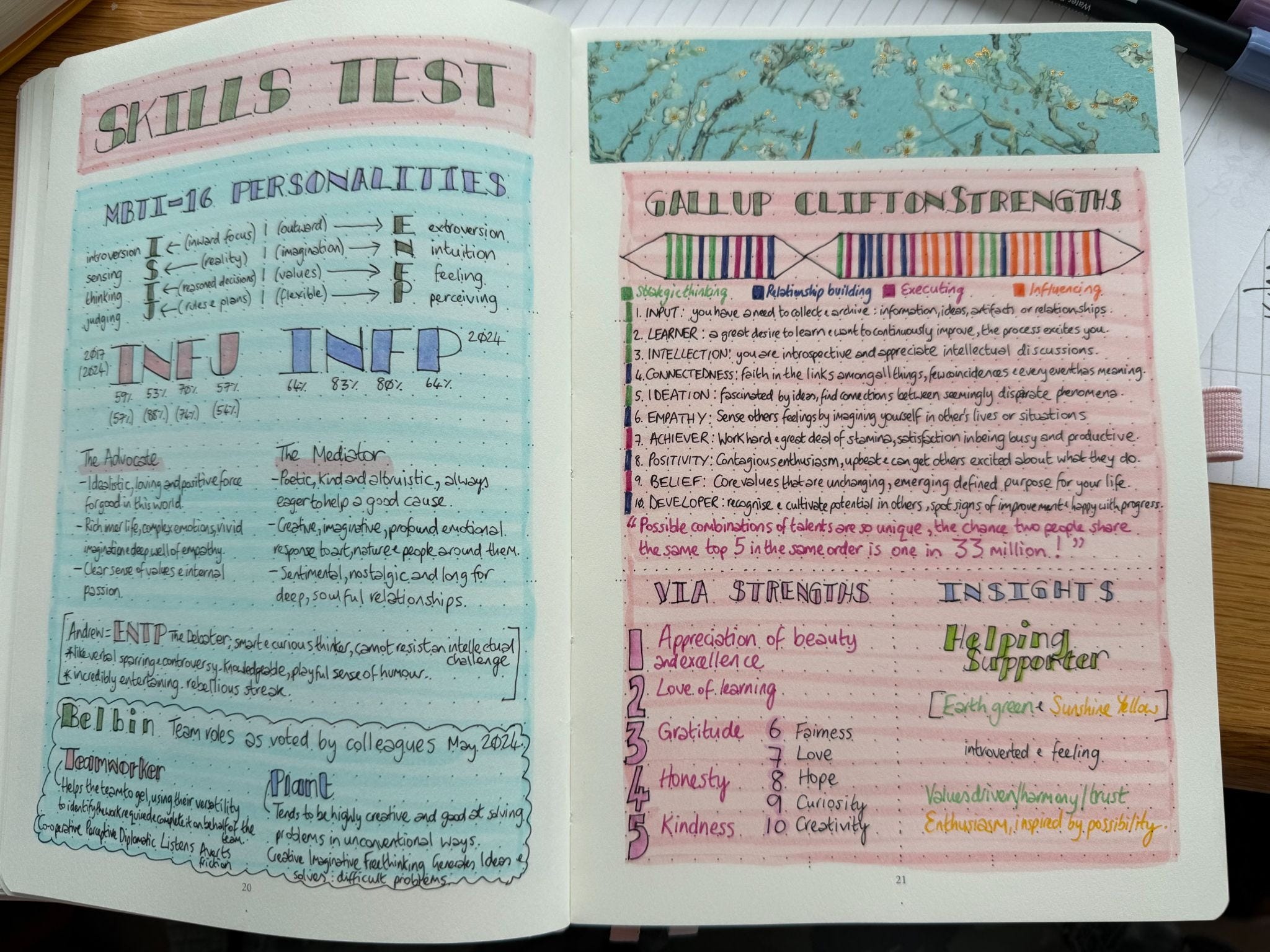
Take a proper assessment, I’m serious, it’s SO worth it. CliftonStrengths reframed how I see myself completely; my top five (Input, Learner, Intellection, Connectedness, Ideation) turned “scattered and bookish” into “wired to gather information and spot unusual patterns.” If you have no spare funds then the VIA Character Strengths test is free and also pretty cool.
6 Ask three people
Message three people who know you well and ask “what would you say are my natural strengths?” Their answers tend to surprise you, we’re oddly blind to our own superpowers.
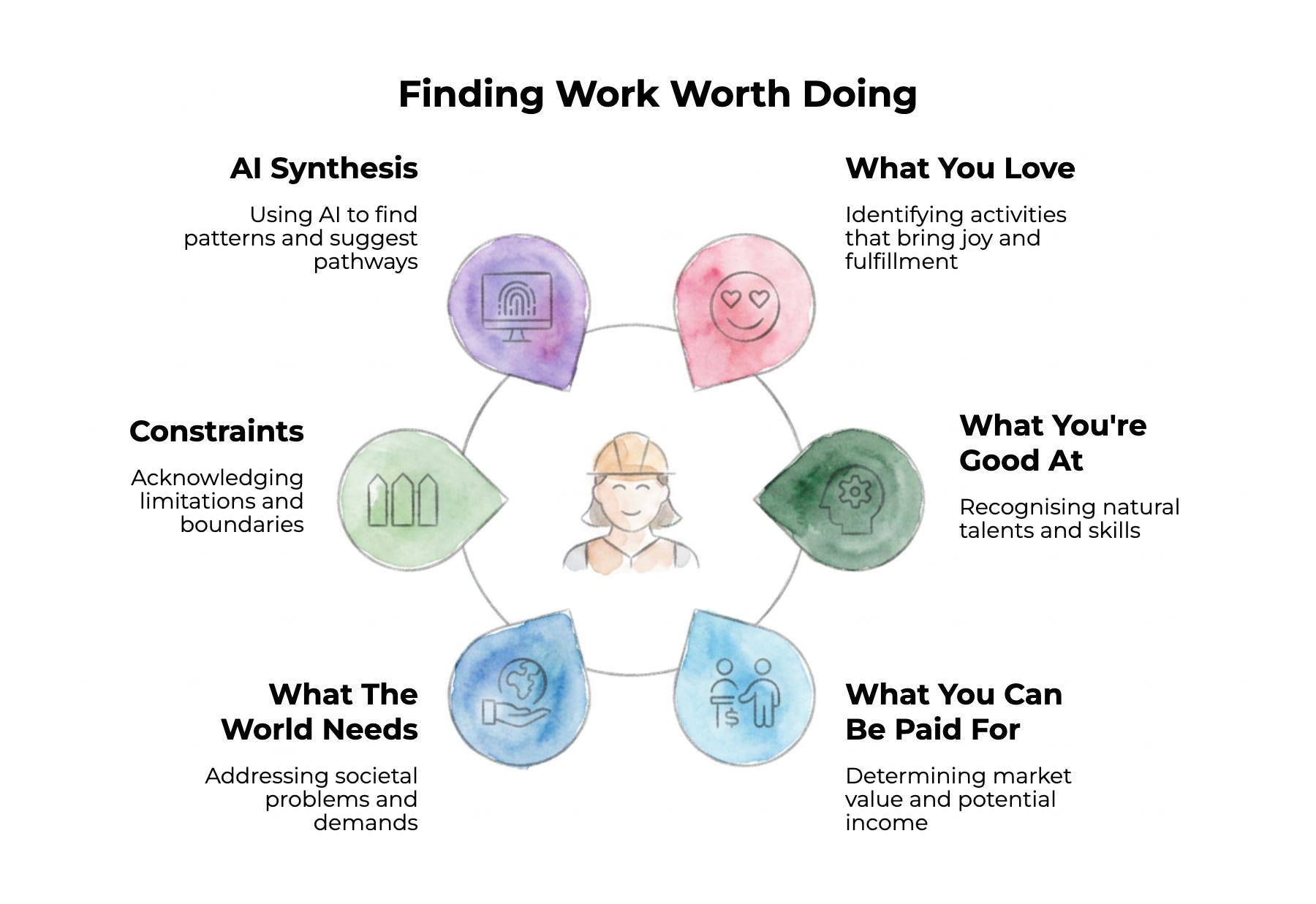
C) what you can be paid for (value)
The original essay skipped this quadrant. “Face your constraints” and “upload it all into AI” were standing in for it, and neither actually helps you work out what someone will pay you for. So this box is rebuilt and the last move is a real experiment.
7 Paid & thanked
List every time someone has paid you (or offered to, or gave you a gift or service in kind) for something, and separately, every time someone thanked you for a thing you’d happily have done for free. Money leaves a trail, so does gratitude, and the trails can be revealing.
8 Market scan
Take some love-and-skill combinations and go looking for where money already flows around them… consider job titles, freelancers, small companies, courses or services people buy. You’re not often inventing a market from nothing, so check whether a path already exists. It nearly always does, sometimes in a shape you hadn’t considered.
9 Smallest paid test
The experiment, and the most uncomfortable step in the whole essay. Offer a tiny version of a thing and see whether one person will commit, a £5 offer, a pre-order email signup, a paid discovery call, one freelance afternoon. Value is an element you cannot reason your way to from your journal. One real “yes, here’s my money” tells you more than a month of lovely reflection.
D) what the world needs (problem)
Not “solve climate change” or a vague “help people”, the specific problems that make your heart race with possibility or fury.
10 twelve favourite problems
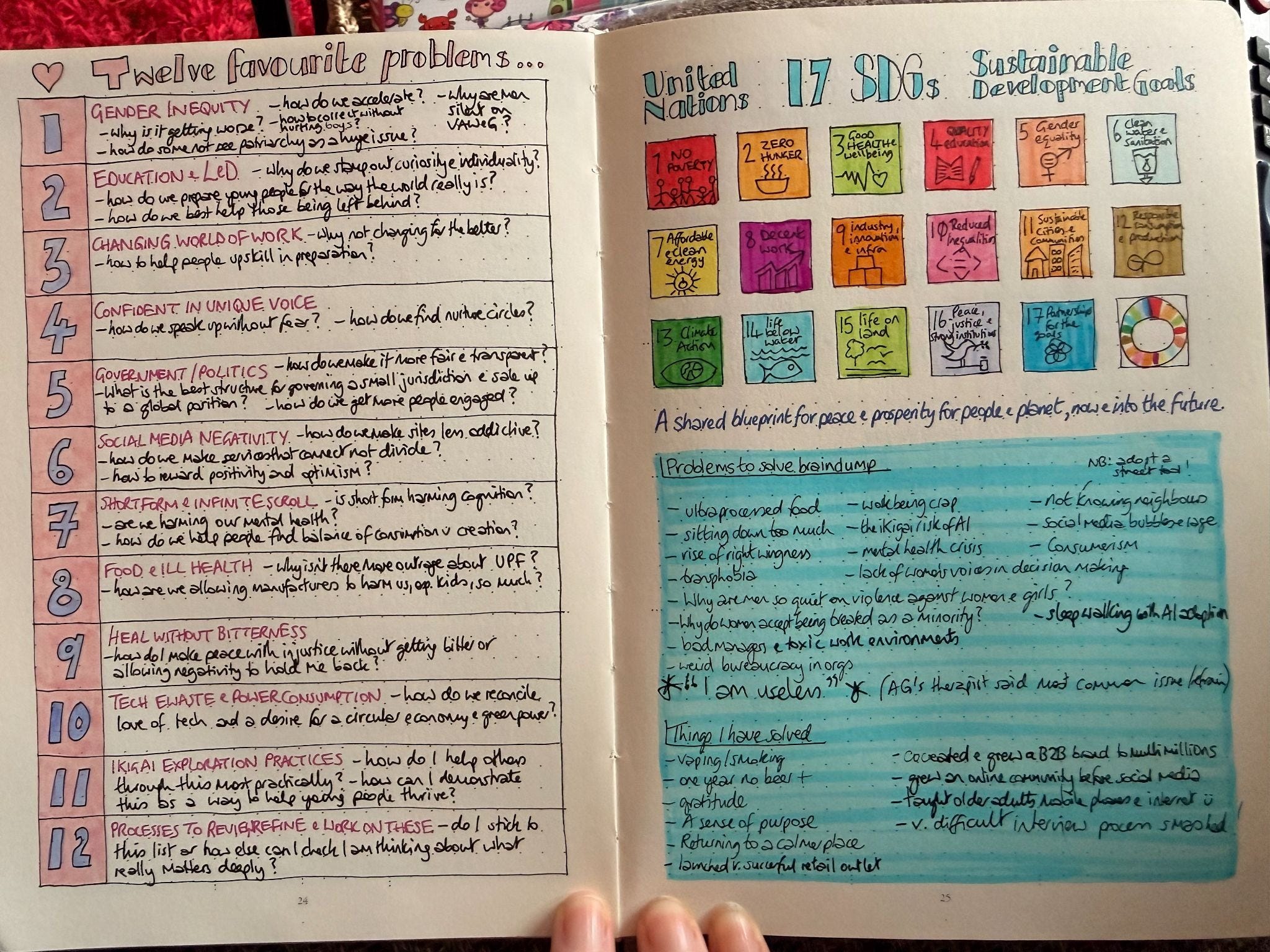
A fifteen-minute sprint to list 12 problems you care about, no overthinking, a mix of scales; personal, local, global. I pinched this from Feynman, who carried his favourite problems around with him for years. Mine include gender inequity, the future of work in an age of AI, and helping people find their authentic voice.
11 SDG exercise
Run your twelve past the UN’s seventeen Sustainable Development Goals and see which light you up, most of your problems will map onto one or more. Mine land squarely in Goal 4 (education), Goal 5 (gender equality) and Goal 8 (decent work).
12 Talk to one
The experiment again. Don’t theorise about a problem from behind your desk, pick the specific people you’d like to help and actually talk to one of them. A problem you genuinely care about survives contact with a real human, it’s the fastest, kindest reality check there is.
Phase 3: bringing it together and the question that matters most
Now you’ve got all the ingredients, two steps before you cook.
Face your constraints
Journal honestly about the real parameters, time, money, location, skills gaps, family realities. Mine, right now: I can’t relocate while my stepchildren are at school, I need to cover the mortgage, and I’m fifty so some paths simply aren’t on the table. These aren’t limitations to grieve, they’re the edges of the board, and constraints are where creativity often happens.
Synthesise with AI
Photograph your journal page reflections of these steps and hand them to Claude or ChatGPT, asking it to find the patterns across your joys, labels, values, strengths, problems and constraints, and to suggest concrete pathways… with a note on how close to ikigai each might feel. AI is genuinely brilliant at spotting threads you’re too close to see.
But and this is an important point of this evolution, mind how you take that AI step. This is the moment the ikigai-risk shows up in miniature. It would be so easy to end a purpose-hunt by typing “so what’s my purpose then?” and taking dictation from the machine, and that is precisely the erosion I keep banging on about. So don’t. Prompt yourself first (this is the whole spirit of Purpose Prompting) you’ve done the hard, human work of getting clearer, and the machine’s only job is to help you see, not to decide for you. It surfaces the patterns, you make the meaning.
Which is why the process doesn’t really end with AI, you decide. Read back what the machine reflects to you, and then you choose which pathway makes you feel a tingle and commit to the single smallest experiment you can run this week. Because all of my ikigai-risk thinking really comes down to one question, and it belongs right here at the finish line ask what’s worth keeping human before you automate anything. Finding your own reason for being is very near the top of that list.
The point of all this
This process is messy, iterative and never quite finished, I’ve done versions of it for years, and each pass reveals a new layer. The goal was never a perfect life plan wrapped beautifully with a bow, it’s purpose literacy… knowing, in your body, when you’re drifting towards what matters and when you’re drifting away.
You don’t need to be “ready” or have everything sorted. You need curiosity, a willingness to be honest with yourself, and the discipline to keep the meaningful part of all of this processing yours. Start with the joy audit today. Ten minutes. Notice what comes up, and don’t you dare judge yourself for any of it *grin*
Your ikigai isn’t waiting in some perfect future version of your life. It’s already in reach, possibly even threaded through your actual real life, in the patterns and problems and small joys that keep calling you. Time to answer.
In one word, what makes work feel worth doing, for you? Please share in the comments below beautiful souls.
Sarah, seeking ikigai xxx
PS — Bullet Journal Prompt > This time the whole essay is twelve exercises each of which is really a journal prompt, and the doing happens on the page, in your own hand. I’m an unapologetic bullet-journal nerd, so I’m always happy to share more of my own spreads as we go.. and if you’d like every prompt laid out to walk through with room to fill it in, there’s a companion work worth doing workbook to go with this essay.
PPS — When you reach the “synthesise with AI” step, here’s a prompt to run with. Attach as many of your twelve exercise pages as you’ve done, even a few is a start; just tell it what’s still missing. And notice what the prompt does and doesn’t ask for: patterns and possibilities, never a verdict. You did the human work, the machine just helps you explore possibilities.
“I’m working out my hatarakigai, work worth doing, using the framework: what I love, what I’m good at, what I can be paid for and what the world needs. Attached are photos of my journalling on this: my joys, labels and values; my strengths; the problems I care about; what I could be paid for; and my real constraints. (If you’ve only done some please note which elements are still missing.)
Please don’t tell me what my purpose is, instead:
1. Read across all of it and reflect back the strongest patterns and threads you see, the connections between my loves, strengths, problems and values that I might be too close to notice.
2. Suggest 6 concrete pathways that combine these into meaningful work; a mix of career moves, ways to reshape my current role and entrepreneurial or side-project ideas.
3. For each, give an honest read on how close to ikigai it might feel for me, and what would need to be true, skills, money, time, to make it realistic within my constraints.
4. Point out anything that seems to light me up more than I’ve realised, and any tension worth sitting with.
Keep me in the driving seat: offer patterns and possibilities, not a verdict. I’ll decide what resonates and choose one small experiment to try first.
PPPS — Today’s soundtrack is “These Are Days” by 10,000 Maniacs. I chose it because it conveys such a lovely feeling, one I want everyone to have as often as possible... it’s about noticing that the luminous, meaningful days are the ones you’re living right now, not the ones you’re rushing towards. Your reason for being isn’t waiting in some tidier future life, it’s threaded through this one, today.
“Reflection tells you what you believe is true about yourself, a small experiment tells you what actually is.”
That line stayed with me. I’m a great admirer of notebooks, but they do occasionally become a very comfortable waiting room.
I also really liked your distinction around AI: patterns and possibilities, never a verdict. That feels like the right boundary. The machine can hold up the mirror, but it shouldn’t get to name the person standing there.
For me, work feels worth doing when it creates a small but visible shift in someone else’s day.