


🌸 ikigai 生き甲斐 is a reason for being, your purpose in life – from the Japanese iki 生き meaning life and gai 甲斐 meaning worth 🌸
I don’t think I consciously chose my 12 favourite problems. They chose me.
If you’ve ever found yourself sitting bolt upright at 4am thinking about the same question you were also overthinking a year ago... you know exactly what I mean. Some problems just won’t leave you alone. They tap you on the shoulder in the shower. They shape the things you read, the conversations you lean into, the rabbit holes you fall down when you were supposed to be researching something else entirely.
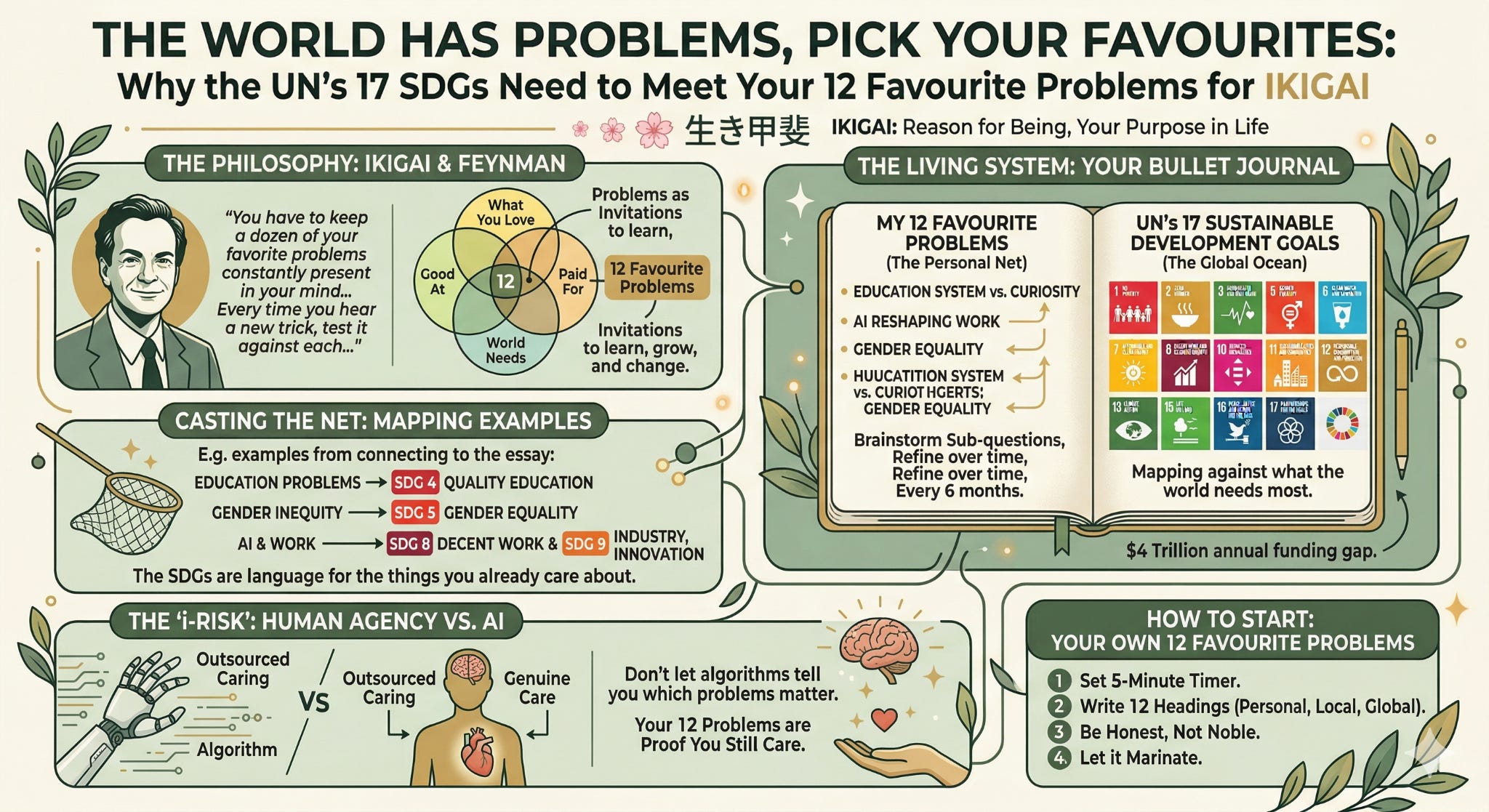
Richard Feynman understood this. The Nobel winning physicist kept a running list of twelve favourite problems... his most important unsolved questions, always simmering away in the background. “Every time you hear or read a new trick or a new result, test it against each of your twelve problems to see whether it helps” Feynman didn’t avoid problems or race to solve them. He collected them, carried them around like companions. Notice the word favourite. Not twelve urgent problems, not twelve important ones. Favourite. The ones you’re drawn to, not the ones you feel obligated by. That distinction matters hugely.
His weren’t all physics, either. How can I keep track of time in my head? How can I sustain a two-handed polyrhythm on drums? How can I write a sentence in perfect handwritten Chinese? He was curious about everything.
We can flinch at the word “problem” because we’ve been taught it means something’s broken… but your favourite problems don’t have to be, or aren’t *just* broken things. They’re invitations. To learn, to grow, to change your mind, to really properly see things you’ve been looking straight through. The problems that won’t leave you alone? They’re a curriculum, not an enemy.
We’re often taught how to function outwardly, to be ‘logical, responsible, practical’, but we aren’t always guided on how to look inwardly at what truly moves us.
I first came across this idea in 2023 on Write of Passage, a brilliant learning community of writers exploring how to make a difference with their words. One of the exercises was to write your own twelve favourite problems. I scribbled down seven in the five minutes we were given, later fleshed out to twelve and published as a rough essay (my 4th substack post ever), and moved on.
I had no idea at that point that those twelve problems would go on to write many of the next one hundred and twenty five essays for me.
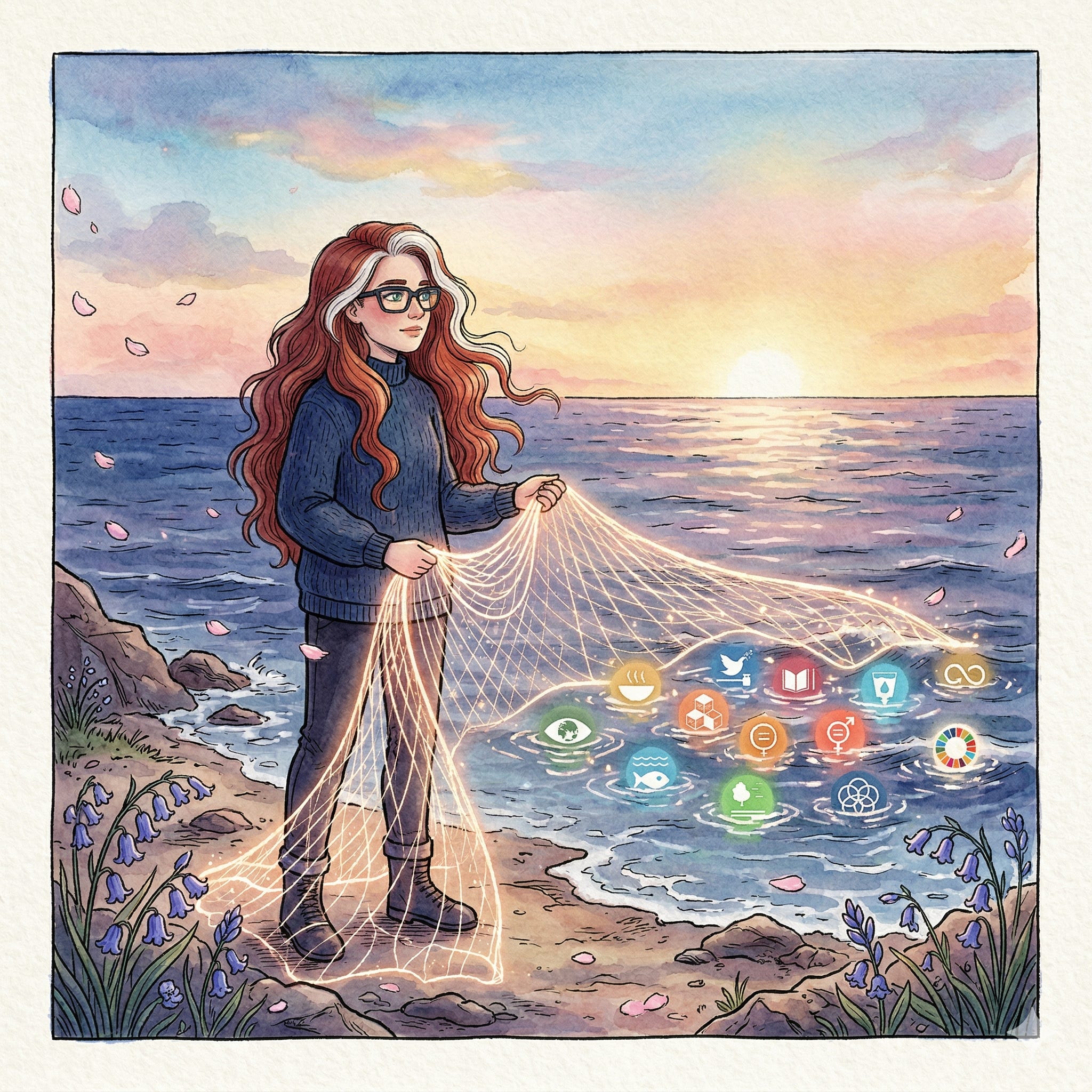
The problems behind the essays
My original list included questions like; why does our education system stamp out curiosity and individuality? What happens to the structure of work as AI reshapes everything? How do we accelerate gender equality without unintended consequences? Why isn’t there more outrage about ultra-processed food harming us and our kids? How do I make peace with injustice without getting bitter? Oh and, of course, how do I help others find their own sense of ikigai in a way that lands?
Most of those questions became essays. Several became very many essays. My question about education fed into “Rethinking AI Literacy“. The work question resurfaced in “Money Talks, We Don’t“ when I explored hatarakigai and why we can’t talk about the money circle. Social media negativity showed up in “AI’s Awkward Teenage Phase“. Gender inequity drove “Your Awkward Voice Matters“, which started as a brainstorm, became a workshop discussion that completely challenged my original thesis, and ultimately became an essay about why men’s silence on violence against women is itself a form of harm.
Gender inequity is one of the problems that has deepened for me over time. Amy Watson’s work with HASSL is one inspirational example of what happens when a global scale favourite problem becomes a life’s work, trying to tackle root causes through education, systemic change and community action.
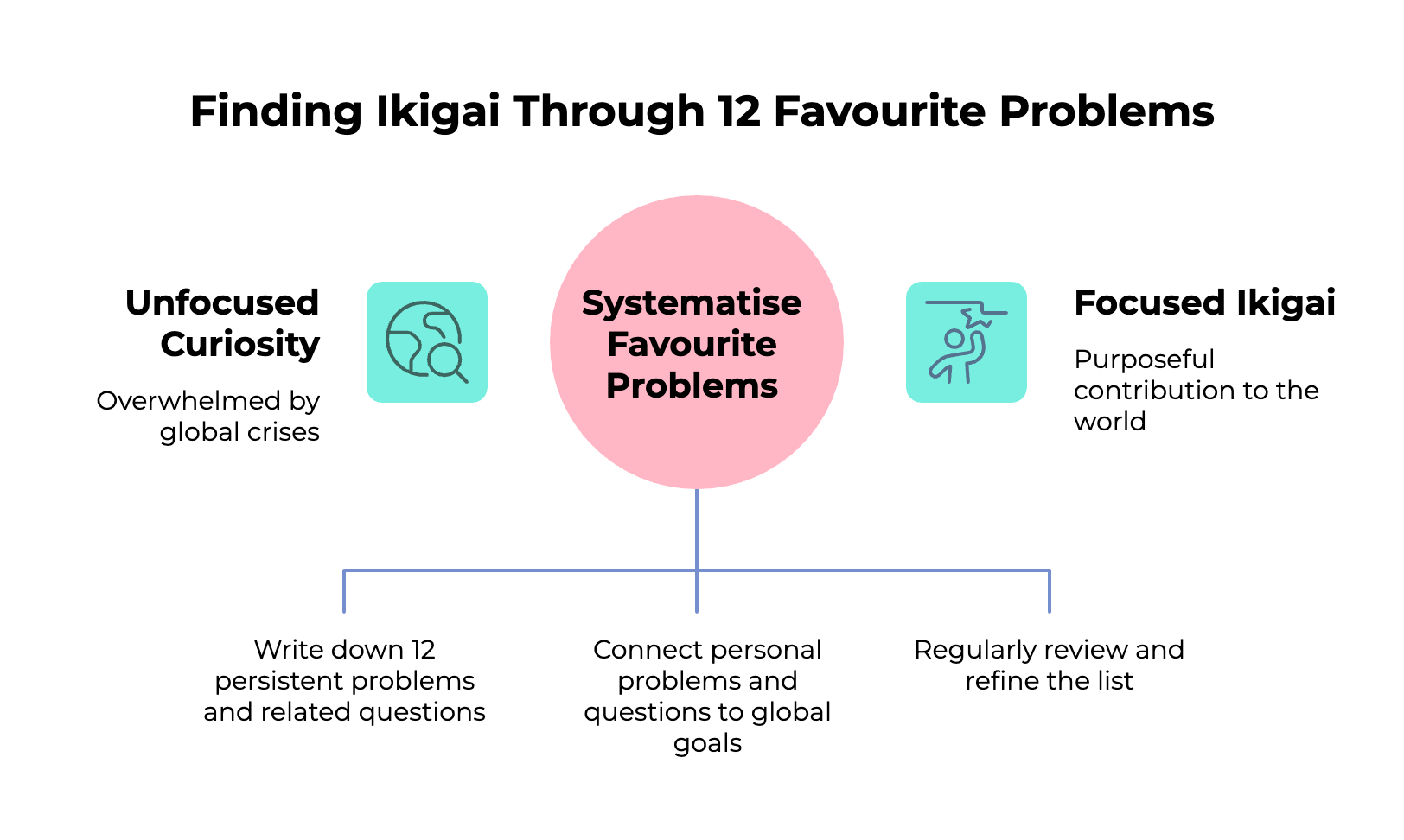
A system to stay with your 12 favourite problems
So I wanted to share this, as I don’t see people talk much about systems for all of this stuff. The list becomes a fabulous thing, a fuel for your ikigai, if you don’t treat it as a one-off exercise. It’s a living system for me.
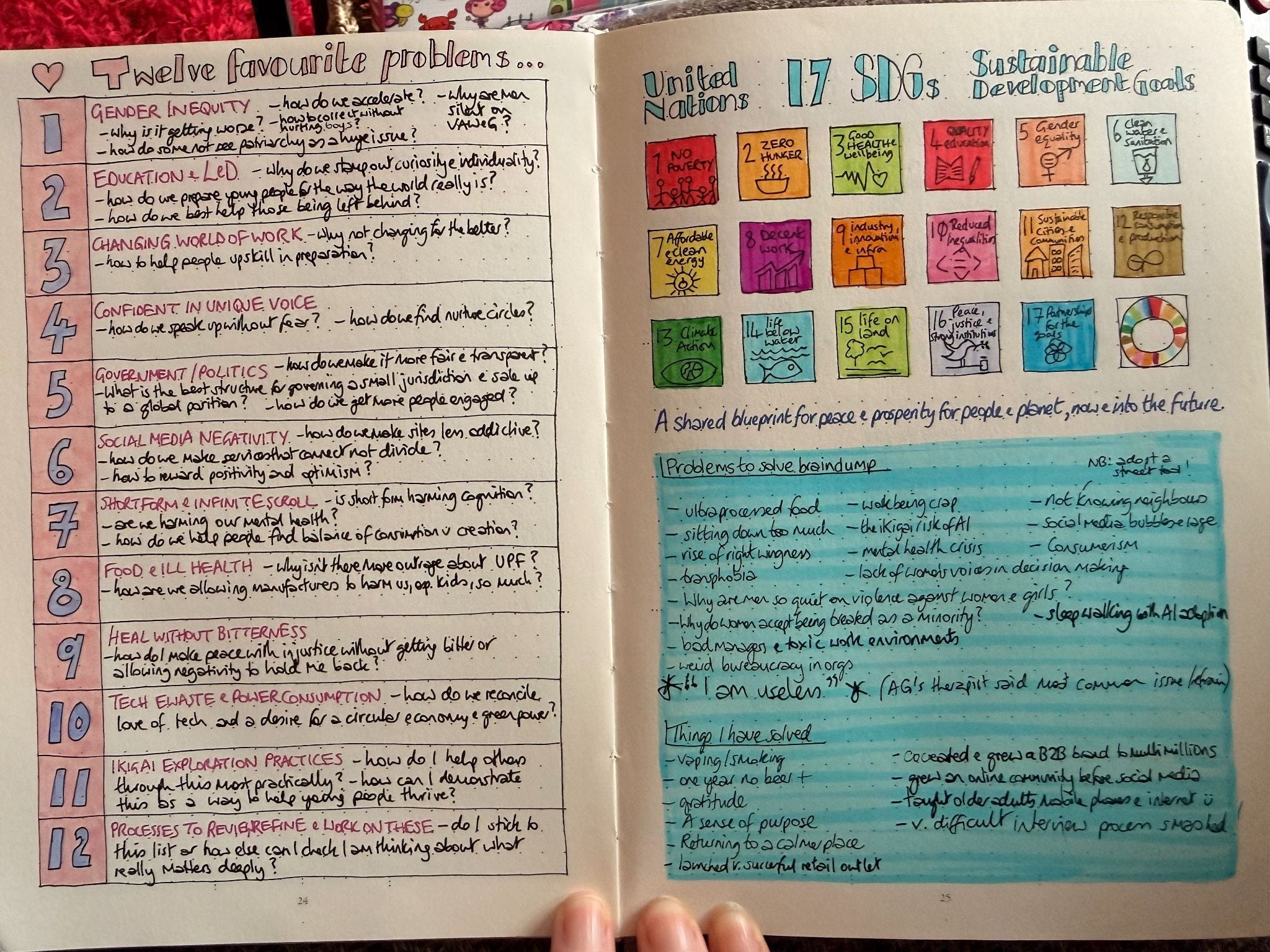
I’ve recreated the same bullet journal spread in each of my last three journals now, every six months. On the left page, I write my twelve topics or headings. Then I leave it. Let it marinate. Days or weeks later, I come back and brainstorm the sub-questions... the new angles, the sharper framings, the things that have shifted since last time.
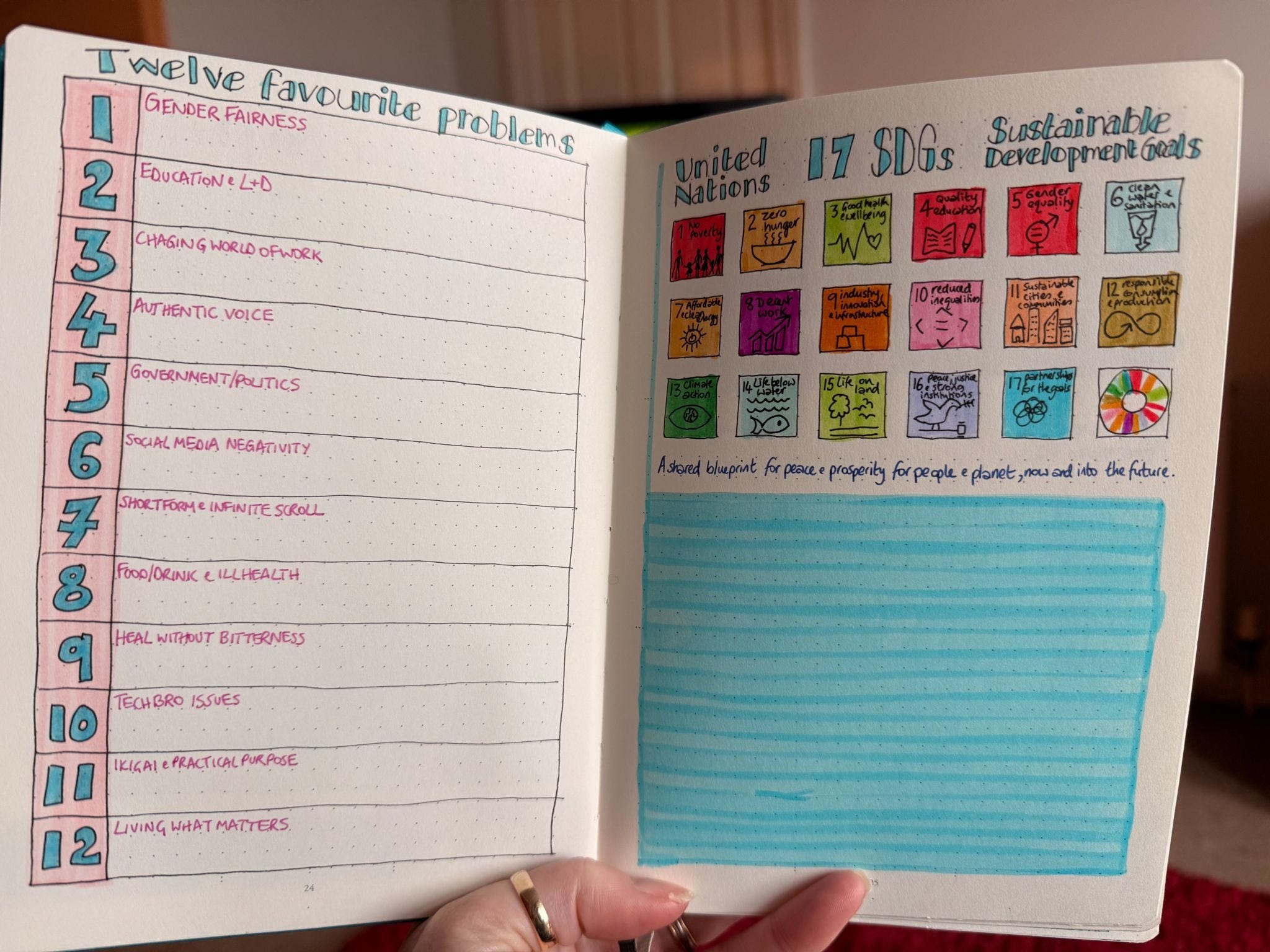
Some problems merge. Some split. Some I rephrase entirely because I’ve learned something that changes how I see them. My question about social media negativity eventually separated into two; one about addictiveness and connection, another about how to reward positivity and optimism. That felt important, the refinement was its own kind of clarity.
On the opposite page, I keep a reminder of the United Nations’ Sustainable Development Goals (SDGs)... all seventeen of them. If you haven’t come across the SDGs before, they’re essentially the world’s shared to-do list; seventeen goals agreed by 193 countries in 2015, covering everything from ending poverty and hunger to climate action, gender equality, quality education, decent work and peace. A blueprint for a fairer, kinder, healthier planet.
Having them right there, opposite my twelve problems, does something powerful. It frames my personal questions within the context of what the world really needs the most. The world’s problems can feel too big to hold, hard to feel a personal ‘spark’ for a bullet point on a PDF in Geneva… but when you map your own curiosities against them, the apathy of scale turns into the energy of choice. It also reminds me that there is a $4 trillion annual gap in funding for these global goals, aside from being the right things to do there is also a massive opportunity for anyone brave enough to pick up a ‘favourite problem’ and run with it.
And below that, I generate more lists: a braindump of all the problems I see around me that burn the most... the ikigai risk of AI, mental health crisis, sleepwalking into AI automation, toxic work environments, consumerism... and alongside that, a list of things I’ve personally already solved or contributed to. Live a life of gratitude. Quit alcohol. Built a business to multi-millions. Taught older adults to use mobile phones and the internet. Found my way back to positivity after burnout. That list matters because it’s evidence. Evidence that you’ve already been solving problems that matter... it builds the confidence to go bigger.
Starting from what matters most and trying to fix it, rather than creating something nobody needs? That’s not just ikigai thinking, it’s good product management thinking too.
If you want to try this yourself, the PS below has the full journal process and the PPS has an AI prompt that might help you surface problems you didn’t know you were already carrying. But the short version? Get a rough book or blank piece of paper, write “My 12 favourite problems” at the top, set a timer for 5 minutes and just write what comes to your mind first. Start with the headings if easier. Just twelve things you can’t stop thinking about, try to balance some on a personal scale, some a local scale and some a global scale. Don’t try too hard or think too long, this isn’t about who can be the most noble. The world won’t be helped by you listing the most impressive problems you can think of. It needs your most honest ones, the ones you won’t get bored thinking about or working on.
The net and the ocean
Think of the SDGs as the ocean. Vast, deep, overwhelming in the best possible way. Now think of your twelve favourite problems as your net. You don’t need to catch the whole ocean. You need to know where to cast.
When I look at my twelve now, I can see the SDGs running through them, threads I didn’t consciously choose or prioritise. Gender inequity? SDG 5 is all about it. Work and AI reshaping society? SDG 8, Decent Work, tangled with SDG 9, Industry and Innovation and more than a sprinkle of SDG 4, Quality Education.
My problems picked these for me. The SDGs are there to give language and structure to the things you already care about.
I didn’t start with ‘SDG 5’ I started with anger and fear about why women’s voices were being ignored so often. The SDG gave my care a home, connected a personal ‘favourite problem’ to a global nervous system. Turning one of my ‘4am bolt-upright’ thoughts into a conversation with 193 countries.
This matters for the bigger picture. If you’ve been following the hatarakigai thread, you know there are four aspects to ‘work worth doing’; what you love, what you’re good at, what the world needs and what you can be paid for. Your twelve favourite problems are the most powerful way I’ve found to fill in that third circle... “what the world needs”... with something real and personal rather than vague and overwhelming… and once that circle has your name on it, it starts talking to the others. What you’re good at gets sharper because you’re practising on problems you care about. What you love becomes clearer because you’re following genuine curiosity, not obligation. Even the money circle starts making more sense when you know what specific value you’re bringing. The twelve favourite problems don’t just feed hatarakigai. They feed your whole ikigai.
Why this matters now (the i-risk bit)
We are living in a moment where AI could help us solve problems as fast as we can articulate them. It can summarise the SDGs in seconds. It can generate action plans for any of the seventeen goals before you’ve finished your tea. That efficiency is genuinely wonderful... right up until it isn’t.
Because the risk, the i-risk, is that we outsource not just the solving but the caring. That we let algorithms tell us which problems matter instead of feeling it for ourselves. That the sheer volume of global crises, amplified by our feeds, curated by algorithms, paralyses the very impulse to contribute. We scroll past seventeen emergencies before breakfast. AI summarises them neatly for us and somehow that efficiency makes us feel less connected to the reality of the problems, not more.
AI has no skin in the game. If we outsource caring to an algorithm, we risk losing our own sense of agency in the process. In a world of infinite automated solutions, your 12 favourite problems are proof that you still care. Proof that your attention belongs somewhere real. If we let AI tell us what matters, we risk losing our own place in the story.
Your twelve favourite problems show you care about something *specific*. They’re a compass and a filter. They’re the thing that makes your contribution to the world irreplaceable... whether or not you’re the best person to solve the problems, you’re the person who can’t stop thinking about your unique combination from your own wonderfully weird perspective.
I wrote my twelve favourite problems in a notebook two and a half years ago, thinking it was just an exercise. Those twelve questions have guided over a hundred essays, shaped my life and answered the very question I started this whole series asking ‘how do I find my ikigai?’
It was never one answer, it was always in the magic of twelve questions that kept choosing me.
I’m curious... what are yours? Even if you share one or a few, what problems are top of mind for you?
Sarah, seeking ikigai xxx
PS: Bullet journal ideas for this week’s essay
The first time (the brainstorm)
Set a timer for five minutes. Write “My 12 Favourite Problems” at the top of a blank page. Write whatever comes... don’t filter, don’t try to sound noble. You might get seven. You might get fifteen. Try to let some be personal (how do I speak up more fearlessly?), some local (what would make my community healthier?) and some global (why are we sleepwalking into this?). Come back a few days later and see which ones are still buzzing. Trim, merge, or rephrase until you’ve got your twelve. Then underneath each, brainstorm the sub-questions... the why, the how, the what if, the who else is working on this?
Every new journal (I do this every six months)
Recreate the spread fresh. Write your twelve headings ideally from memory first, before looking at the old version. What you remember without prompting tells you something. Then compare. Some will have sharpened. Some will have merged. Some might feel done, or replaced by something you didn’t see coming. On the opposite page, print or sketch the 17 SDGs as a reminder of the bigger picture. Below, brainstorm two lists: “problems that burn right now” and “things I’ve already solved or contributed to” That second list matters more than you think.
Ongoing reflection prompts (whenever you journal)
Which of my twelve have I been most drawn to lately... and which am I avoiding?
Has a new problem been tapping me on the shoulder that isn’t on my list yet?
Have any of my problems merged, split, or evolved since I last looked?
What have I actually done about any of these, even accidentally, even small?
Am I being honest with my list... or trying to impress?
If I could only keep three, which three would I fight for?
PPS: AI prompt to try, I recommend Claude *grin*
“I’m going to share [some things I’ve written/bookmarked/been thinking about recently OR my current list of 12 favourite problems]. Please:
1. Identify the recurring themes, tensions and questions I seem drawn to, and frame them as 12 open ended favourite problems in the style of Richard Feynman.
2. For each one, suggest two or three sub-questions that might sharpen or deepen the problem... the kind of questions that would make me sit up and say ‘oh, I hadn’t thought about it that way.’
3. Map each problem to whichever of the UN’s 17 Sustainable Development Goals it most closely connects to, and explain why.
4. Looking at the full list, which three seem to carry the most energy? Where do you see me leaning in hardest?
5. Is there a problem you think I’m circling around but haven’t actually named yet?
6. If I’ve shared a previous version of my list, compare them. What’s shifted? What have I outgrown? What’s emerging?”
PPPS: Song choice
“The Logical Song” by Supertramp. Roger Hodgson wrote it from a problem question that never left him “The Logical Song was born from my questions about what really matters in life. Throughout childhood we are taught all these ways to be and yet we are rarely told anything about our true self. We are taught how to function outwardly, but not guided to who we are inwardly.” If that isn’t the ultimate favourite problem disguised as a pop song, I don’t know what is. We’re taught to be logical, responsible, practical, but nobody teaches us how to ask the questions that actually matter. This essay is about reclaiming those questions.