

🌸 ikigai 生き甲斐 is a reason for being, your purpose in life... from the Japanese iki 生き meaning life and gai 甲斐 meaning worth 🌸
I sign every essay “Sarah, seeking ikigai xxx” and I’ve been wondering if I should stop.
I worry that “seeking” sounds like I haven’t found anything worthwhile. Does it read as flaky, a woman in her fifties who can’t quite get to the point? Sarah, after all this time, when are you going to find it?
I’ve been musing on whether I’ll always be seeking? Should I be? Is this an admission or a stance? The answer came to me already familiar, because the phrase spoke to me for a good reason but I hadn’t consciously appreciated or articulated why.
The seeking is the point.
Not the warm up act for a future state where I announce I’ve cracked it. The seeking itself is the answer. The disposition is the destination.
The Japanese concept that has anchored my essays for nearly three years. Iki meaning life, gai meaning worth or value. Life-worth, a thing that makes getting up in the morning feel worthwhile… and seeking ikigai, properly understood, has no destination you can fail to reach. It’s a way of moving through the world that keeps a question alive. Almost the opposite of a polished mission statement on the office wall. The opposite of the moment you stop asking because you’ve decided you’ve found it.
The people I most want to talk to are still asking questions, I worry about what happens to us when we stop.
So this essay, the third in our little mini series on the components of meaning, is about purpose. I know it might feel like a contradiction, but I don’t have a purpose, well not in the way most purpose discourse means it *grin*.

Goal, mission, purpose
Let’s define our terms, because purpose is one of those words that gets used SO much. People use it interchangeably with goals, mission, calling, vocation, dream, aim, ambition. They are not the same thing, the differences matter for what we’re working through here.
A goal is a destination. You can reach it then it’s done. Hit your subscriber number. Finish the chapter. Run the marathon. Goals live in a closed system. They have a finish line, which is what makes them useful and also what makes them limited. You can have a goal and still not know what your life is for.
A mission is a campaign, with a beginning, a middle and an end. Take the product to market. Get this team home safely. Missions are usually bigger than goals because they’re other-directed and need more hands, but they finish. Companies refresh their missions because the market moves or leadership changes. The danger comes when we treat mission as forever instead of for-now. The words get framed and posted on the office wall, and in the process they drift from soul to slogan, from direction to performance.
Purpose is something else. Purpose is direction. You can travel with no end, watching where you are already pointed and pay attention to what the patterns tell you.
I love how language and cultural framing can add nuance, for example in Japanese. Mokuteki (目的) can mean purpose, aim, objective or intention, but often lives closer to the language of aims and objectives. It’s the sort of word that belongs to a thing you are trying to do. Ikigai (生き甲斐) reaches for something wider. Life-worth. The felt value of being alive. The thing you are living towards, not just a task you are trying to complete.
Two different meanings. English can collapse both into “purpose” and I don’t think that helps us thrive.
Lots of modern purpose discourse (especially on social media) encourages us to declare our purpose. Write it down and make it pithy for your LinkedIn header. Tattoo it on your forearm if you are feeling brave. The assumption it’s something you decide and then announce.
I suggest that purpose is something you recognise. You watch where you keep returning. You notice what you cannot put down… and then, slowly, with humility, you start to articulate what you have been doing all along, shaping it intentionally.
Declared purpose can feel like a loud performance. Recognised purpose is perhaps more of a truthful way of being.
The seeker is doing the recognising, and still consulting the compass.
The pattern that picks you
Last week we talked about coherence as foundational. The whole self walking through every door roughly the same shape and size. A laser focused you. I left you with a line about how a scattered self cannot point anywhere.
Coherence is who you really are. Purpose is where that whole self is pointed.
If coherence is the laser, purpose is the direction the light is travelling.
We’ve been taught to think about purpose as something we choose. We sit with a journal, we do a workshop, we read a book about finding our why, and we try to select a purpose the way we might select a paint colour. Then we wonder why nothing seems to stick.
Try a different starting point. Look at what you are already doing.
Be honest about it too, perhaps not the things you wish you were doing or had planned to do. The things you keep finding yourself doing, even when you said you’d stop. Especially the things nobody is paying you for.
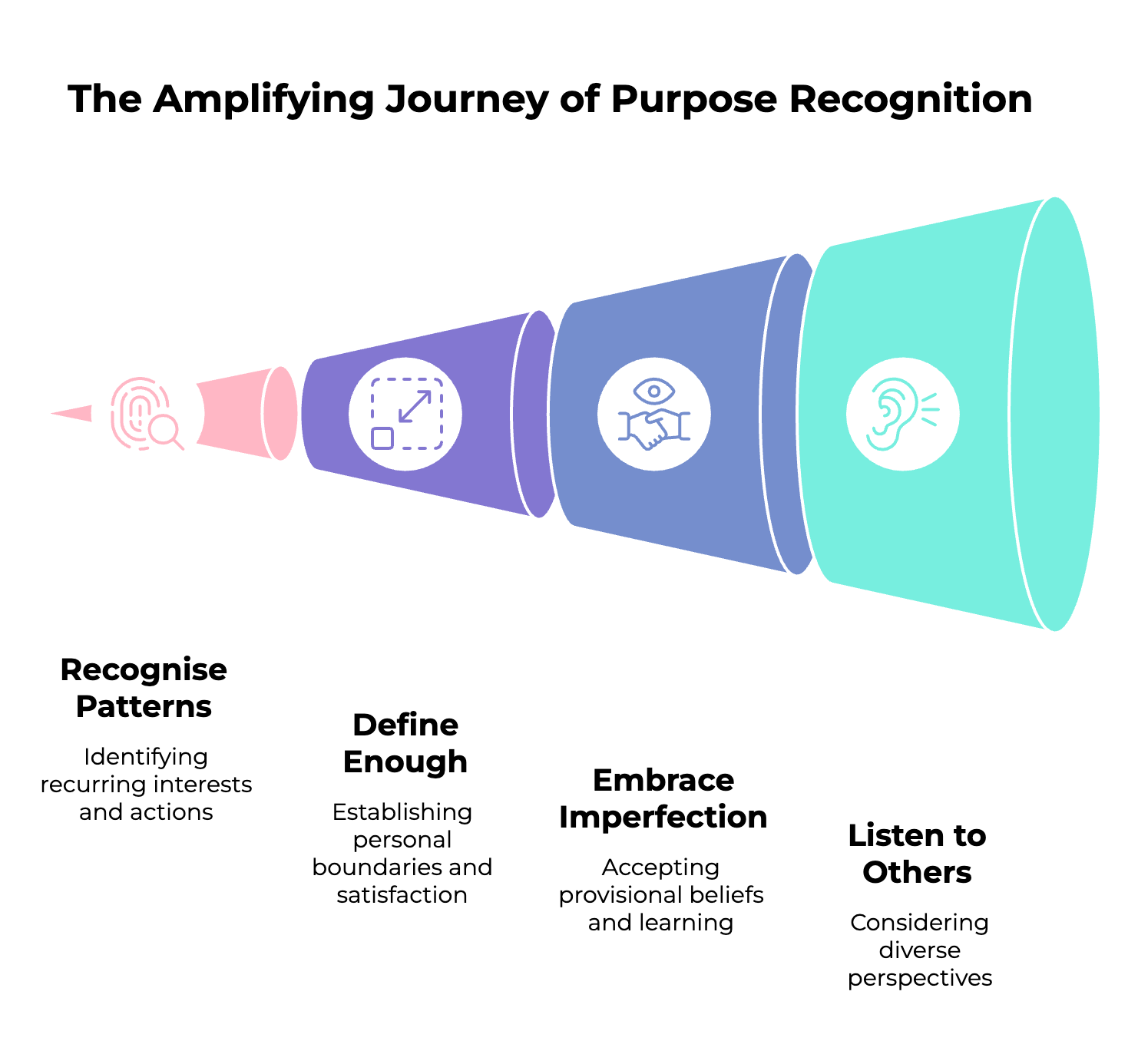
You don’t choose your purpose. You notice the pattern of what you cannot put down or ignore.
In essay 130 I wrote about Richard Feynman’s twelve favourite problems, the small set of questions a person carries through life and tests every new piece of information against. The favourite problems are the ones that picked you. They appear in the corner of your eye and refuse to leave, following you into rooms where they have no business being.
That is purpose in its truest form. The problems that won’t let you go.
Purpose is inherently beyond me. Whatever your problems are, even when personal they also point outward. Toward people you could help or something you want to build. Toward a corner of the world you want to leave shinier than it was.
Self-improvement is so important. It is often the work that gives us enough steadiness to turn outward, and wanting to feel happier and more alive is not selfish in the small grasping sense of the word. Many people argue purpose has to start there to be authentic and sustainable, and I think they’re largely right. You cannot pour from an empty cup… but if the project begins and ends with making myself shinier, we are not in purpose territory yet. Self-improvement is a foundation, not itself the destination… having a sense of community care, the beyond me is the bit that elevates it.
The enough line
So purpose is direction. You watch where you are already pointing. You notice what you cannot put down. Lovely. Now to a question you don’t hear often enough in modern life.
What is enough?
When I wrote what purpose felt like to me, in plain language, it came out as twenty three words.
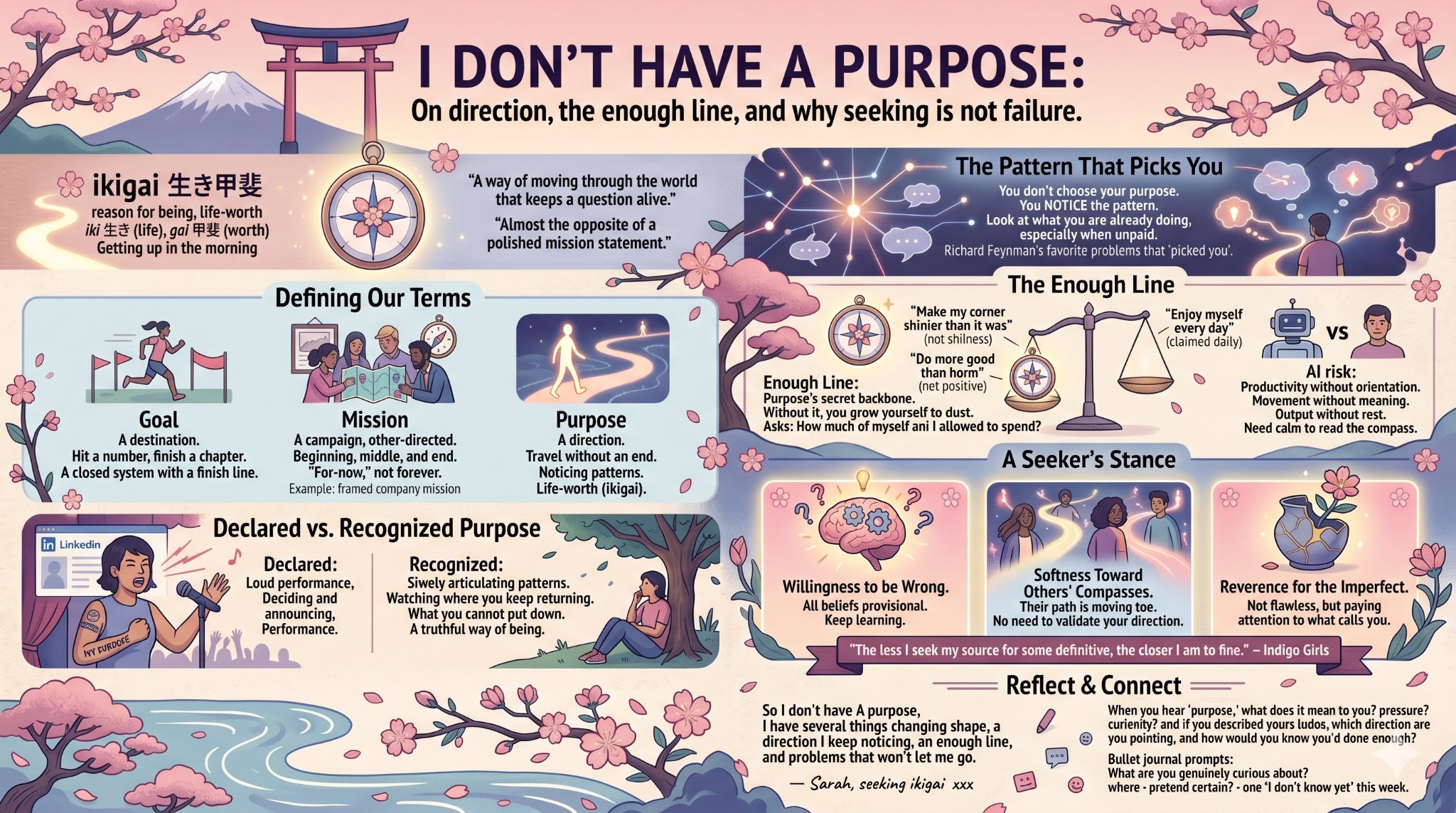
Make my corner of the world shinier than it was. Do more good than harm. Enjoy myself every day as much as possible.
Read it again. The shape of an enough line is in there if you look for it. Shinier than it was tells me when the corner is shiny enough. Not the shiniest or shinier than yours. Just shinier than the version that existed before I started trying. More good than harm tells me when the ledger has tipped. Not perfect, just net positive. And enjoy myself every day as much as possible refuses to defer joy. It’s claimed daily, not earned later.
Three check-ins with none about scale or more.
Enough.
The enough line is purpose’s secret backbone. Without it you can be pointing in exactly the right direction and still grind yourself into dust because you’ve never asked the question how much would be enough today. Purpose does not only ask, what am I here to do? It also asks, how much of myself am I allowed to spend doing it?
This is where AI can get dangerous. AI doesn’t tire. It has no muscles to ache, no eyes to strain, no Sunday afternoon when the body says we are done now. So when we adopt AI as a thinking partner we can absorb its tirelessness without noticing. We start using its clock instead of ours. Another iteration while the kettle boils. The thing is bottomless and we forget that we are not.
This is the ikigai risk of AI at the level of purpose. Productivity without orientation. Movement without meaning. Output without rest. You’re producing, the metrics look great, but somewhere along the way you stopped being able to tell the difference between doing more of the work that matters and simply doing more.
If you never reach enough, you stop being able to tell which way you’re pointing. The compass needle spins because there is no still moment, no calm in which to read it.
The enough line is what gives the seeking its rhythm. Purpose without enough is panic in pretty packaging.
In praise of seeking
Which brings me back to the thing I have been worrying about for weeks, whether seeking sounds too flaky.
I don’t think it does, but I’m really keen to hear your thoughts!
I see a seeker as someone who knows which way she’s heading because she checks her compass periodically. She has an enough line and remains curious as she knows she doesn’t have all the answers. She listens to other perspectives for hers is still being shaped, asking better questions and genuinely wanting to learn with others.
The opposite of the seeker is the certain. The certain person has stopped asking and the problem begins when their perspectives and framework become a fortress. When the brand voice gets louder than the inner human voices. When the tidy sentence has to be defended long after it has stopped feeling true.
I’m not as interested in being certain as I am in being honest or helpful (is what I am trying to articulate kind, necessary or true?).
So if seeking is a stance rather than an admission, what does that look like in practice? Three things, I think.
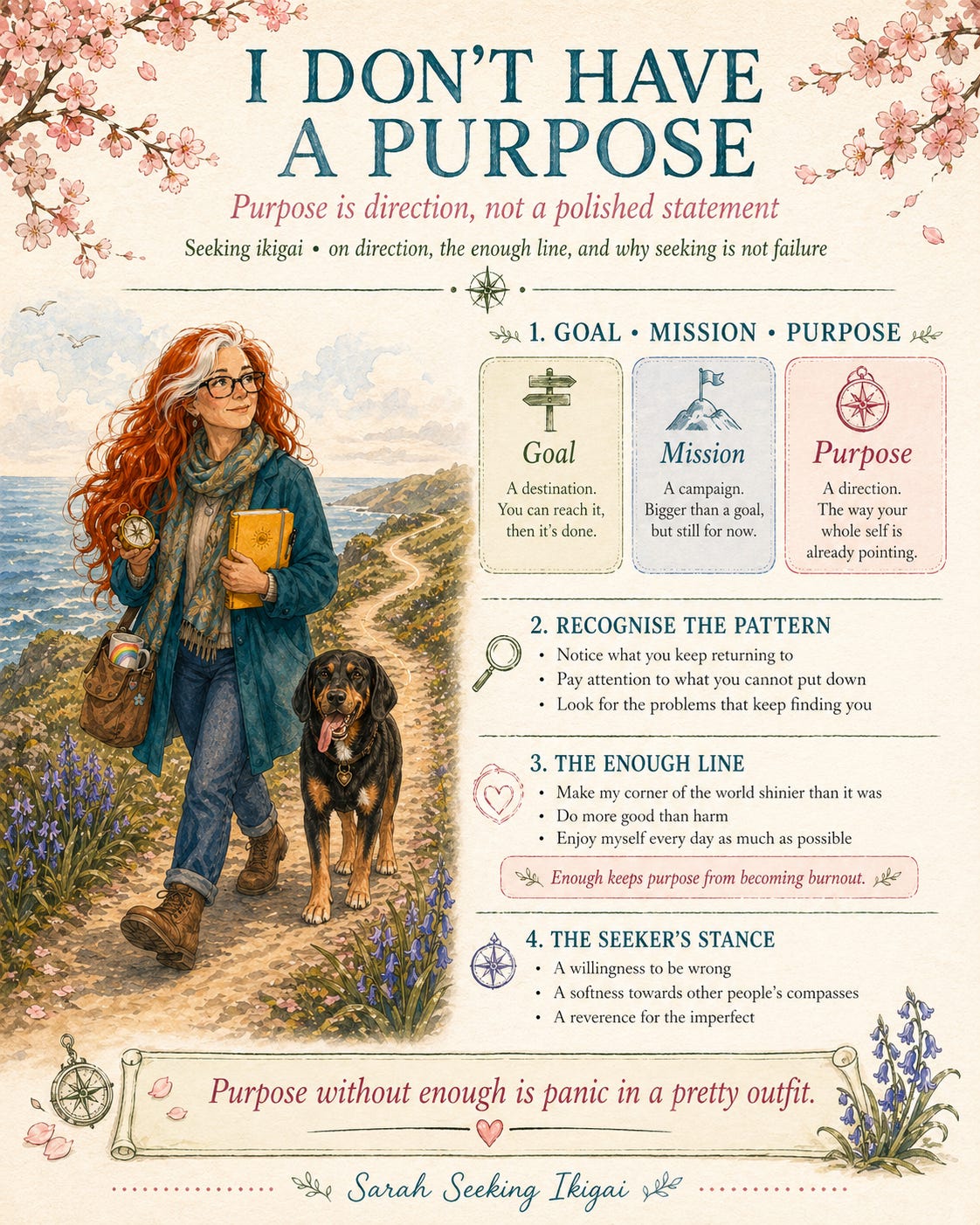
🌸 A willingness to be wrong, because if you’re seeking you haven’t arrived, which means everything you currently believe is provisional. That is the only condition under which you can keep learning.
🌸 A softness toward other people’s compasses, because if yours is still moving, you can imagine theirs is too. The seeker doesn’t need everyone else to validate her direction, she is too busy walking her own path.
🌸 And a reverence for the imperfect, because the seeker knows you don’t get to ikigai by polishing yourself into something flawless, but by paying attention to what calls to you.
There’s an Indigo Girls line I love “The less I seek my source for some definitive, the closer I am to fine.”
Closer to fine is the rhythm of life being lived. Still being shaped and noticed, keeping you moving in roughly the right direction with kindness and curiosity and a willingness to be wrong about most of it.
So when I say I don’t have A purpose, I don’t have one punchy sentence I could hand you. I have several things that keep changing shape, a direction I keep noticing, an enough line that keeps me honest and a small handful of problems that won’t let me go. It’s what purpose looks like when you stop trying to make it sit still.
Next week, the third component of meaning, significance. The bit that asks does this count? It turns purpose from direction into something with weight. We’ve talked about who you are. We’ve talked about where you’re pointing. Now comes the question of what your work is worth, and to whom.
For this week, sit with the seeking.
So I’d love to know… when you hear the word purpose, what does it mean to you? Pressure, curiosity, a vision board you started in 2019 and never finished? And if you had to describe yours in plain language today, which direction would you say you’re pointing, and how would you know when you’d done enough today? Tell me in the comments, the seeking is always richer when we do it out loud together.
Sarah, seeking ikigai xxx
PS - Bullet journal prompts for you to try
A small audit for the seeker in you. What are you still genuinely curious about? Where have you been pretending to be more certain than you are? What’s one thing you’d dare to say I don’t know yet about, out loud, this week?
PPS AI prompt to test in your favourite AI helper with thinking mode turned on
I’m exploring purpose as something I unearth rather than performatively declare. Help me notice the patterns, I’d like to reflect on where my life is roughly pointing, the ethical compass I want to use and what enough looks like on an ordinary day, so I don’t grind myself into dust chasing more. Ask me five questions, one at a time, to help explore (we might start with things like what I’ve been doing lately that nobody asked me to do, or what keeps quietly calling me back, or what enough might look like on an ordinary day). After I answer, reflect back the themes you hear without tidying them into something slogan worthy. I want to see the raw and honest shape, not a polished sentence.
PPPS - Today’s soundtrack is “Closer to Fine” by Indigo Girls
This essay is about not needing one final, polished, purpose statement. The line “the less I seek my source for some definitive, the closer I am to fine” feels like a seeker’s manifesto. By loosening our grip on certainty, paying attention to the patterns and trusting the direction we learn that purpose is what the seeking teaches us to recognise in lots of aspects of our journeying.
I was brought here by the Chief Absurdist Officer post. For a moment, I felt like I had so much to say - and then silence. What stayed with me was this: active, in-action loving kindness feels like a core principle. Integrity, to me, is the compass. The imposter feeling when praised - that’s something I still don’t know how to integrate.
BTW there is an issue when want to comment, system suddenly ask to sign in to Substack.