

🌸 ikigai 生き甲斐 is a reason for being, your purpose in life... from the Japanese iki 生き meaning life and gai 甲斐 meaning worth 🌸
I spent my Bank Holiday Monday mooching and journalling.
Daydreaming, listening to podcasts, making notes about what I was learning and thinking, doodling and flicking back to other spreads I was still working through.
Elizabeth Day’s fabulous How to Fail interview with Andy Burnham hugely resonated, I got emotional several times and was left feeling SUCH a sense of hope I haven’t had from a politician talking in ages! Hearing him reflect on Hillsborough and the choice he faced of toeing the party line or standing with the people he grew up with, made me jump straight back to my values spread and I sat for a while trying to pin down exactly why I admired it so much. Thinking about specific words to describe what I was seeing, was it courage? vulnerability?
Then a word arrived for me that I didn’t already have written on my values page, INTEGRITY.
Which set me off with several research strands to assess its fit for my thinking.

Down the dictionary rabbit hole
Integrity comes from the Latin integritas, derived from integer, meaning whole, intact, untouched. The same word many of us learned in maths, a whole number, one that isn’t split into fractions. So integrity doesn’t really mean honesty, but moreso WHOLENESS, of being undivided (something I also wrote about when defining coherence). Honesty comes downstream of that, you tell the truth because lying would split you into two versions of you and that just isn’t something you can cope with.
So yeah, armed with shiny etymology, I did what I always do with words that matter to me, I wrote it in fineliner on a Leuchtturm1917 page.
If you’ve been here a while you’ll know this isn’t my first values rodeo. I wrote a practical guide to finding your values in the early days, then went deeper with the Schwartz Values Wheel when I decoded my talent DNA. This is at least my fourth values spread across as many journals, and I really need you to hear that the repetition is not boring… the repetition IS the exercise and where you get the benefits over time. The first time, you mostly write down words you aspire to be, even if you struggle to embody all of them all of the time. The second time, you notice which words survived the year, and which new ones emerged and which you perhaps no longer care so much about… by the third and fourth, patterns emerge but also sometimes something floats up that feels like a really important lesson.
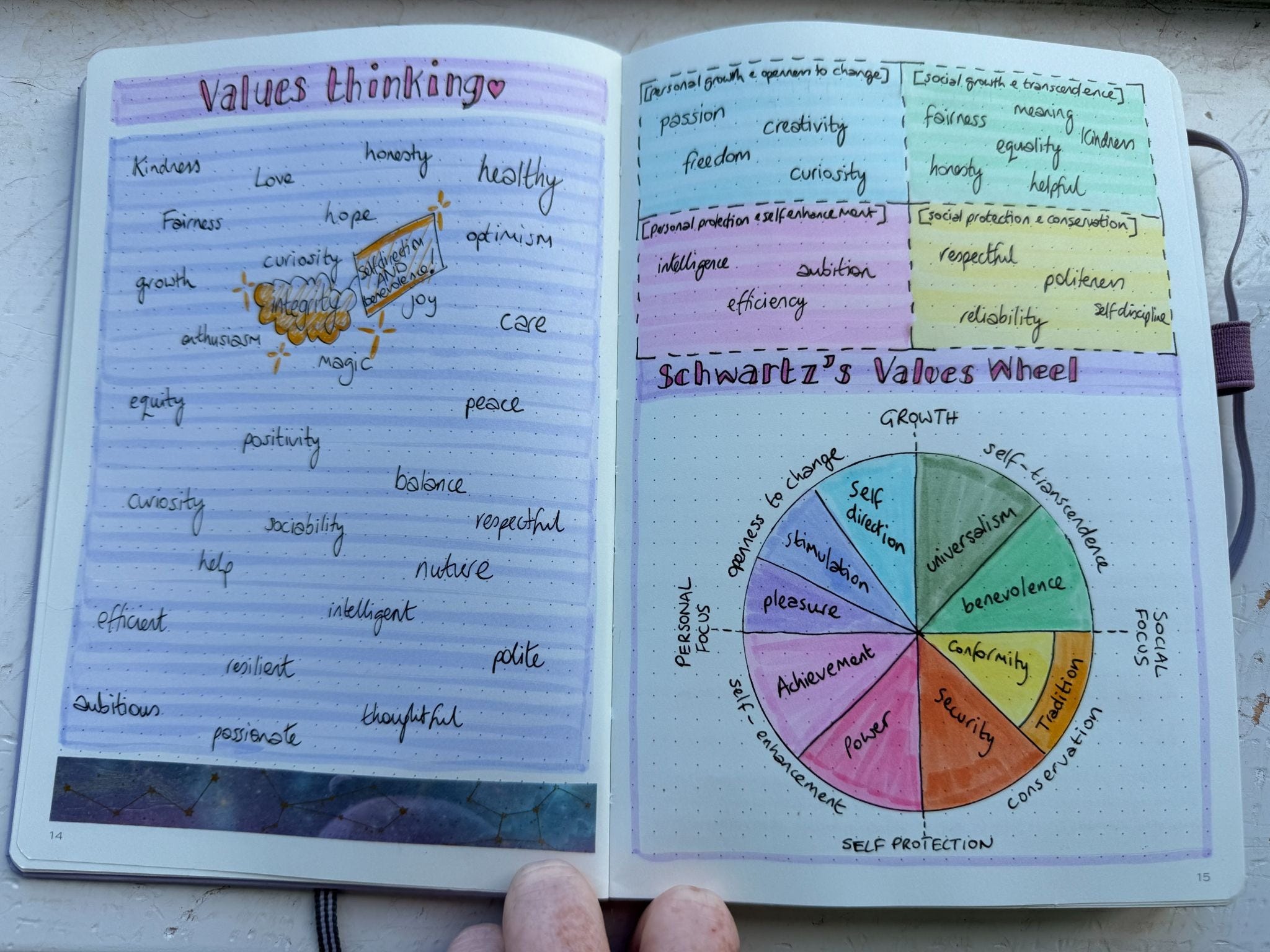
This time, sparkly highlights and all (spread below), it was integrity… but when I tried to plot it on the wheel, I realised that it didn’t neatly map to just one place which I hadn’t noticed happening before.
Quick refresher for newer readers… the ten labels on Schwartz’s wheel are for FAMILIES of values, ten broad motivations arranged in a circle where neighbours are natural allies and opposites pull against each other. Each segment can align to everyday value words; honesty and loyalty live in benevolence, creativity and freedom live in self direction, politeness and self discipline live in conformity. The exercise I do in my journal spread is to brainstorm the words that matter first, then working out which family each one belongs to.
I struggled with integrity. Depending on what you mean by it, it could land in self direction (being true to yourself, acting on your own principles) or in benevolence (being someone others can rely on, keeping your word), with perhaps even a little nudge into the conservation side too when you are thinking about remaining whole. I realised that I was definitely being BOTH/AND coded with my thinking, my most important value word refusing to pick a side.
Of course it won’t sit in one segment. A word that means WHOLENESS cannot live in just a slice of you. So if it isn’t any one place, perhaps I’ve stumbled on something more like a rim... a thing that holds all the pieces together in one circle.
Your values are not always friends
The wheel is a map of tensions. The families are arranged so that pursuing something on one side can make its opposite harder to honour in the same decision. Openness to change pulls against conservation. Looking after yourself pulls against looking after everyone. Your values are not a cosy team all rowing in the same direction. Sometimes they fight.
I love AI, I work with it, I write about it, I believe in what it can do for people... AND I worry about the ethics of it, deeply.
I care about our planet with my whole heart... AND I live day to day inside a world where almost nobody in charge seems to be treating our changing climate as an emergency.
I want inequality halted and reversed... AND I operate inside systems that habitually, structurally perpetuate it.
I genuinely believe rest is productive and that wellbeing is the foundation everything else stands on... AND I still catch myself measuring a day by how much I produced.
None of those tensions make me a hypocrite. They make me a person holding more than one value at once. The wheel’s gift is showing you that the pull you feel is the geometry of caring about more than one thing, rather than a character flaw.
You don’t find out what you most value by listing lovely words in January and July. You find out in the moment two of them fight. The spread is a rehearsal, a low stakes way of asking yourself in advance, when it isn’t clear cut which way do I turn? That, I think, is what I was really admiring in that interview. Hillsborough put two different motivations of one values word in direct conflict.. loyalty to the government he served or loyalty to the people he came from.
Which opens a question I’ve circled in my journals for years, can values motivations even be classified as GOOD or bad?
My answer is mostly no when I’m being my best self. Judgement comes from your own frame, your own map of the world, not from some absolute scoreboard in the sky. One person’s healthy ambition is another’s greed, one person’s loyalty is another’s tribalism. The wheel itself is neutral about all this... every label on it is a legitimate human motivation, even the ones I personally find hardest to relate to.
If you add an assumption though the picture sharpens. If your north star is to minimise causing any harm in this world, then some hierarchies become obvious. Mine currently reads; responsibility over blame, honesty over image, resilience over comfort, curiosity over certainty, growth over pleasure. Not because blame, image, comfort, certainty and pleasure are villains, they’re all on the wheel for a reason, and comfort and pleasure will absolutely be seeing me later on this evening *grin*... but because when a pair is in conflict, I’ve already decided which way I will turn.
Then there are harder rankings, ones where good people part ways. There are those who would judge someone for standing firm against a local law, legal contract or a company edict in the name of human rights, or dignity, or wellness, or preserving our planet. Rules are rules, they’d say, and I do understand where they’re coming from... order and security sit on the wheel too, they keep a lot of our world turning… I just can’t be that person myself. Which is exactly why I so admire the people who stand against the norms when the norms are causing harm, and why that interview struck me the way it did.
Makoto, or staying whole
There’s a Japanese concept that captures where all this lands for me too, makoto 誠, usually translated as honesty or sincerity, one of the traditional bushido virtues. The character places the element for WORD beside the element for COMPLETION... Nitobe, in his classic Bushido The Soul of Japan, translated the pairing as Word and Perfect, using perfect in its old sense of completed, brought to wholeness. I think the traditional reading is beautiful and fitting; what you say, made complete in what you do. Your word, made whole. I love that it’s a doing word, a practice of closing the distance between thoughts and action, over and over, wholeness as a verb.
Which brings me to something I’ve believed for a long time… that bringing our whole selves to work is healthier for us and that we need to destigmatise it. I made the case in the language of wellbeing and creativity but now realise it was also an integrity argument in the oldest sense of the word. Every time we split ourselves into a work self and a real self, a public face and a private conviction, we disrupt our wholeness. Wholeness is not the same as total disclosure. Nobody owes a workplace access to every private, tender or potentially unsafe part of themselves. Sometimes integrity means setting a boundary. The question is whether adapting to the room protects your wholeness or separates you from it. Some small variance is just life, many of us flex and adapt and read the room, social skill rather than fraud. It only becomes corrosive when the gap grows so wide you can’t find your way back across it.
I believe that your values are the best way to become whole.
If you’re wondering what any of this has to do with AI, my other favourite subject... I asked recently in More Capable, Less Free? whether AI is increasing our agency or just our output, and what would still need to belong to me, even if I relied on AI every day, for that reliance to feel like an extension of my agency. I think this spread is a piece of my answer. AI can help me spot patterns and challenge the stories I tell myself. What it cannot do is want things on my behalf or carry the moral weight of the choice. The noticing can be collaborative, the authorship cannot be delegated. My values are what make me the author of my life rather than merely efficient at someone else’s defaults. Doing this work in this way is my agency maintenance.
Knowing your values is how you pick your battles. It is also how you forgive yourself for the ones you don’t fight.
Not every day is a battle though, most days are just living... school runs, spreadsheets, being patient with people who test you, doing your best inside imperfect systems while you work out how to nudge them (and ourselves) a little closer to better than not. Integrity doesn’t ask you to be infinite, it asks you to be whole, grace must live here too.
Seeing your values and daring to live them whole, is a way of aiming higher. More of us need to do that, when it is safe to do so… and more of us need to make it safer for each other too.
What’s your ___ over ___? I’d love to hear one value pairing where you’ve already decided which way you turn”... where do you hold two values that pull against each other, and have you forgiven yourself for it yet?
Sarah, seeking ikigai xxx
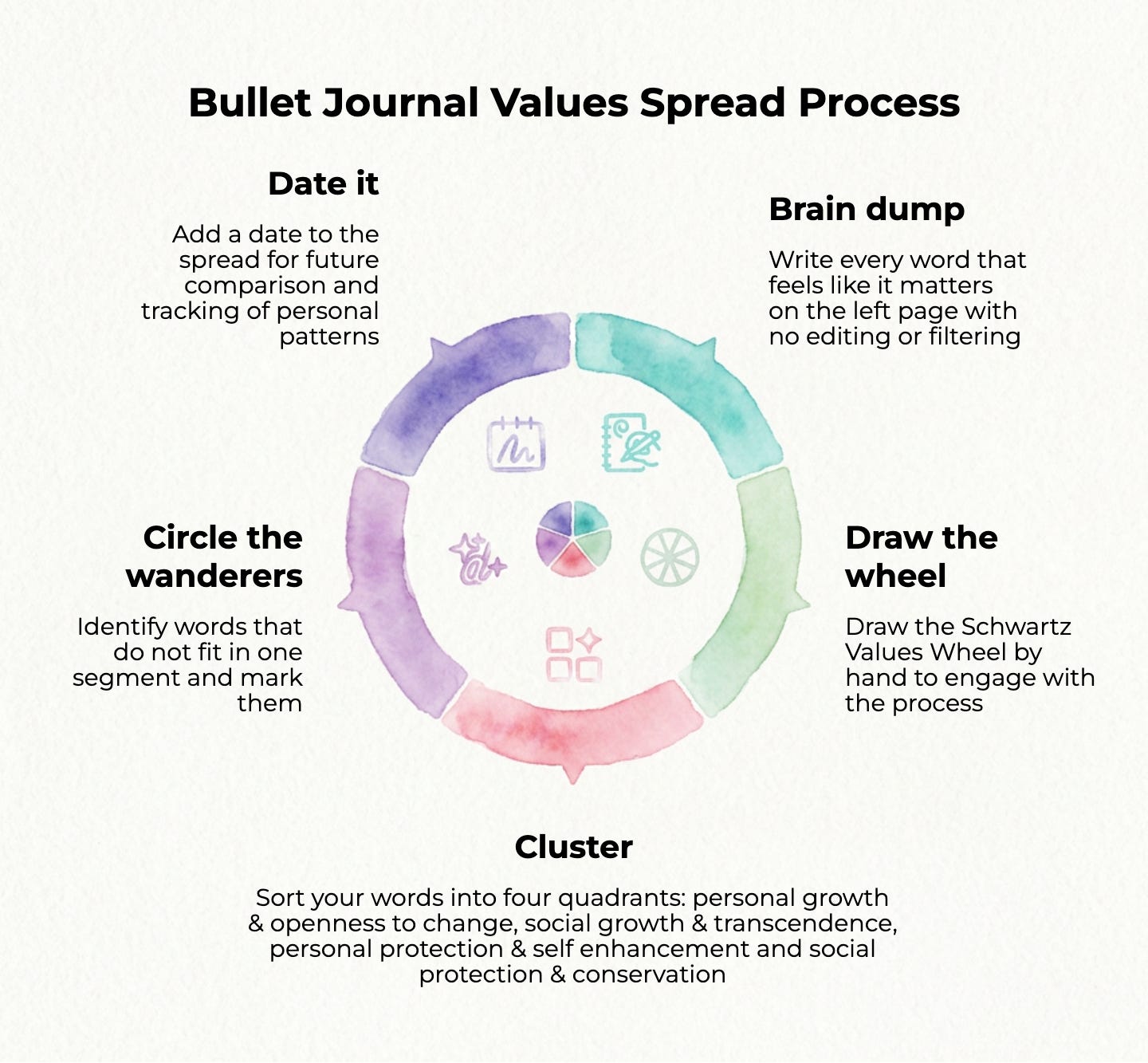
PS Bullet Journal Spread - Fancy running the spread yourself, even if (especially if) you’ve done it before? Here’s my process, fifteen minutes and two pages;
Brain dump, left page. Every word that feels like it matters, no editing, no filtering, repeats allowed.
Draw the wheel. Yes, by hand, wonky is fine. Something happens in the drawing that doesn’t happen in the reading.
Cluster. Four boxes: personal growth and openness to change, social growth and transcendence, personal protection and self enhancement, social protection and conservation. Sort your words in. Notice which boxes fill fastest.
Circle the wanderers. Any word that won’t sit in one segment gets a sparkly cloud. These are usually your most important ones, the values with more than one motivation underneath... your rim material.
Date it. Future you, doing this in a new journal, will thank present you for the comparison. The comparison is where the unlocks live.
PPS - AI prompt to try - photograph your finished spread, upload it, and try this;
“Here is my values brain dump and my attempt to map it onto the Schwartz Values Wheel categories. First, tell me which of my words map cleanly to one segment and which ones wander across several. Then, for the wanderer you suspect might matter most to me, ask me one question at a time to help me work out which motivations are underneath it FOR ME, naming a real tension in my life where my values pull in different directions, and rehearse with me which way I want to turn when it isn’t clear cut. Finally, help me write one sentence about how I want to show up when that value gets tested. Be warm but don’t flatter me, and don’t let me off with hypothetical answers.”
The wanderers are where the good conversations happen, with the AI and with yourself.
PPPS - Today’s soundtrack is The Whole of the Moon by The Waterboys, which has featured here before but it’s my second favourite song of all time… a song about someone who aimed that bit higher, who saw further and wider than everyone around them... It gives me the same big epic feeling every single time I hear it, that we can all choose to not settle for the slice, of the sky, of the wheel, of ourselves, when the whole is out there.