


🌸 ikigai 生き甲斐 is a reason for being, your purpose in life - from the Japanese iki 生き meaning life and gai 甲斐 meaning worth 🌸
I’ve long carried a nagging feeling my screen time is probably higher than ideal… but having faaaar too many other things to worry about, I rarely check the stats *grin*.
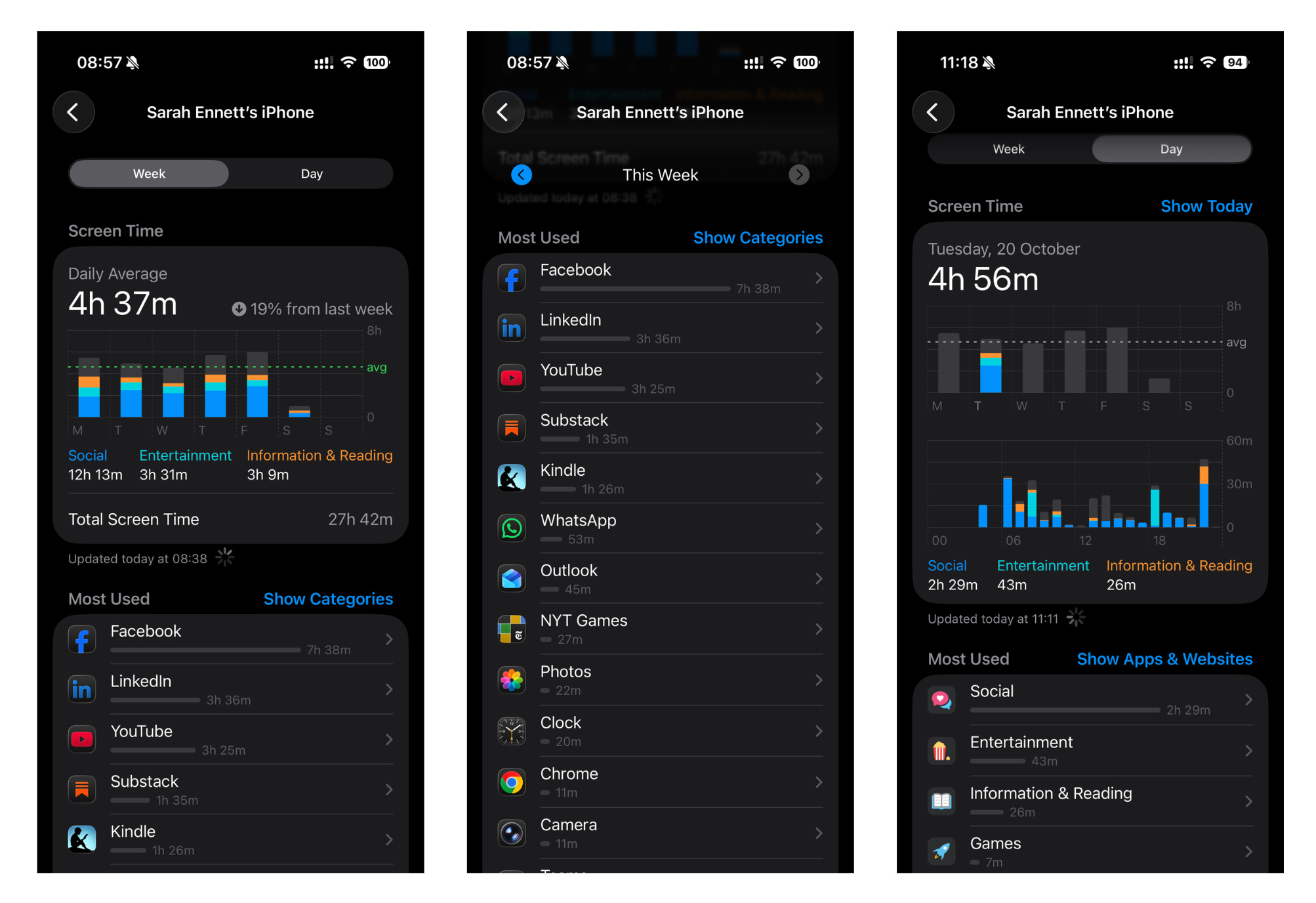
This week I looked while researching and writing this essay. It says four hours and thirty seven minutes a day. Down from last week, with Facebook at the top of the list on seven hours and thirty eight minutes so far this week, then LinkedIn, then YouTube.
I felt a flush of shame.
Then realistion dawned I hadn’t considered how many of those hours made me happier, closer to people I love or better informed about stuff. I went straight to guilt.
I do find that a bit weird considering my geeky heart gets SO much from being online. I created and grew one of the Island’s very first internet communities. I found friendships in chat rooms and online games long before most people had an email address. I learn SO much every day from the people I follow and I write to you from here every week. So where does that nagging feeling come from? Why do I think my number is too high?
If you’ve been reading awhile, you’ll know that underneath all the essays about purpose and AI and bullet journals runs my concern for humanity. I care whether our days hold enough joy, connection and meaning to be worth getting up for, and I care whether the tools we build make that easier or harder. So I was happy to see that Gallup’s annual report on the state of the world’s emotional health has a new section on social media!
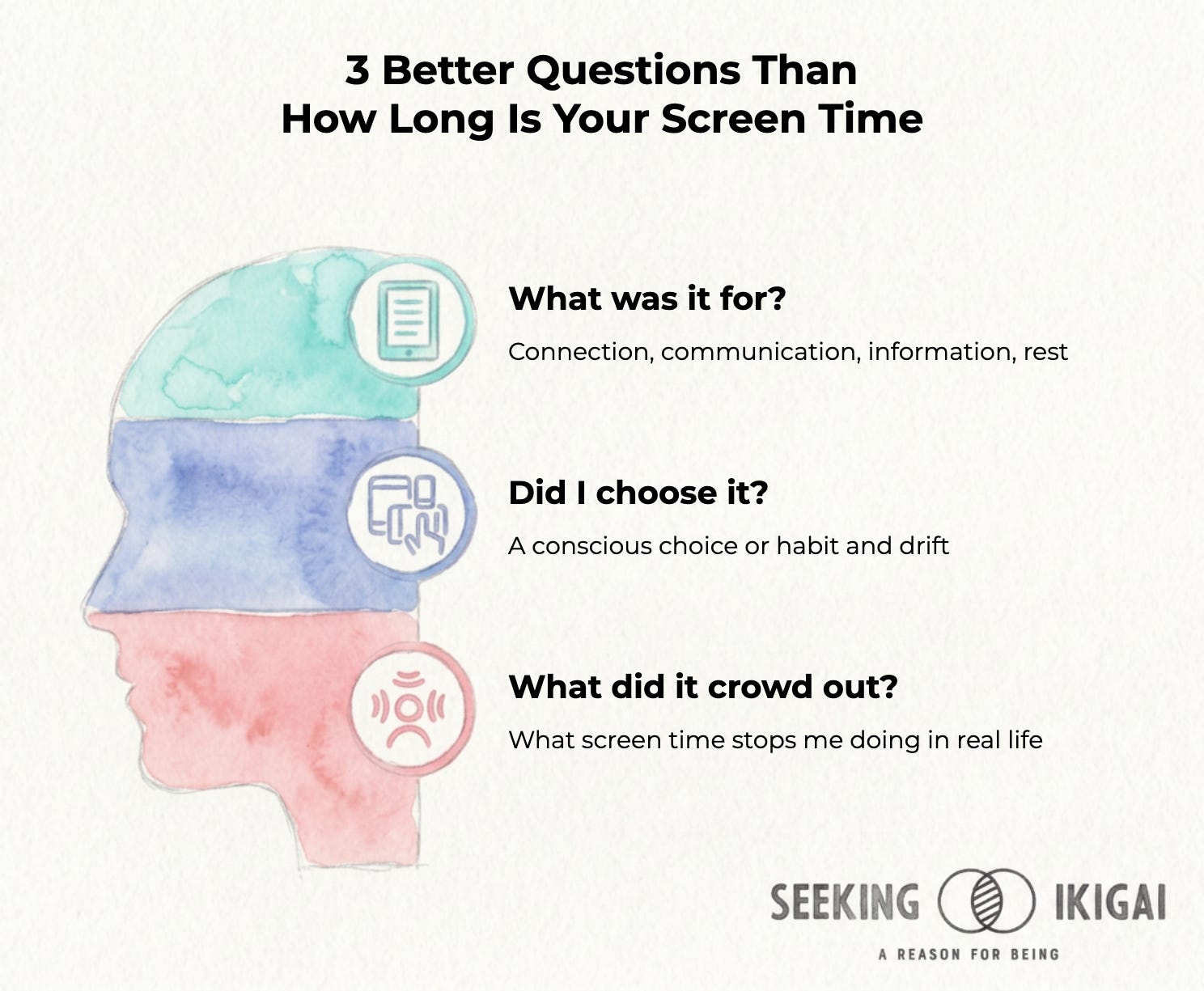
I suspect that the clock is the least interesting thing about our time online. Better questions sit underneath the metric. What was it for? Did we choose it? What did it crowd out? … and shame is very good at stopping us asking them. AI is already becoming the next big place our hours go, so I’d like us to get these questions right now... and I’d love for you to try them with me.
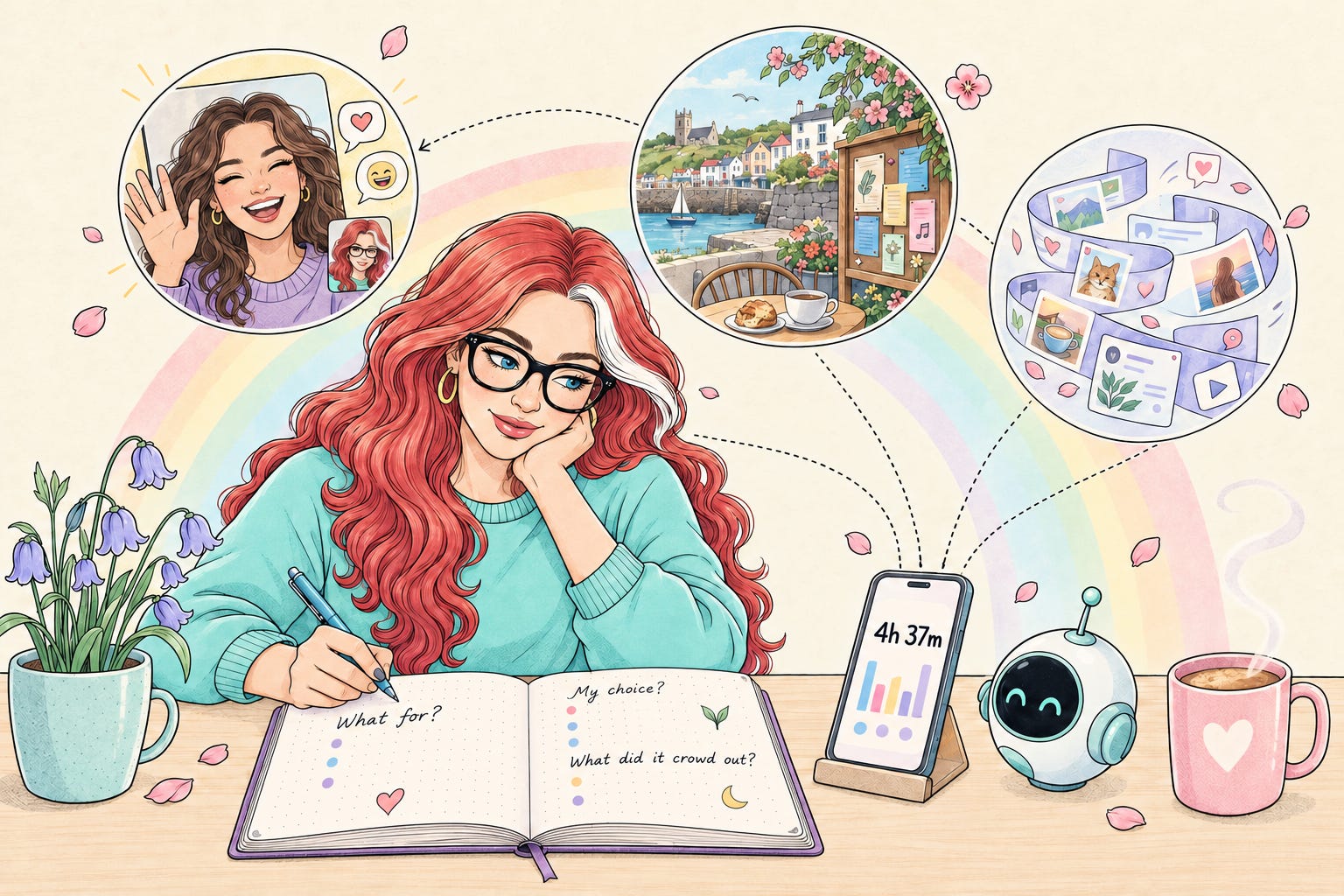
The state of the world’s emotional health
This year Gallup’s State of the World’s Emotional Health report asked two new questions. Did you use any kind of social media in the past seven days? And if so, roughly how long do you spend on it each day? They then lined the answers up against questions about how people feel day to day, enjoyment and worry, laughter and sadness, being treated with respect and how they rate their lives on a scale from zero to ten. It’s a rich report that builds on twenty years of emotion data and I’d encourage you to read the whole thing.
Once Gallup accounted for age, health, income and the rest, social media users were slightly more likely than non users to say they’d learned something interesting the day before, enjoyed themselves, laughed and been treated with respect. My geeky heart felt a little vindicated.
Time tells a more tangled story. The people who fared best overall sat in the middle, on social media for half an hour to two hours a day. Heavier users, on two hours or more, reported a little more anger, loneliness, sadness, stress and worry. Lighter users, a group that includes people who don’t use it at all, reported a little less enjoyment and laughter and rated their lives a touch lower.
That phrase “a little” is doing a lot of work. The adjusted differences come to a couple of percentage points. In the UK, heavy use showed no statistically significant association with emotional wellbeing once those other factors were in the picture.
Gallup is admirably candid about its own limits. This was an observational study, it can’t tell us whether social media changes how people feel, whether their feelings shape their use, or both. They measured whether people use social media and for how long… not which platforms people used, what they did there, what they came across or whether the habit felt compulsive. Their report points to a WHO review that found the effects depend on who is using it and what they come across, as well as when, why and how much they use it. The WHY is clearly super important.
In my defence
I wanted to know how other people feel about their stats, so I went where people confess things to strangers... Reddit posts asking people to share their screen time with replies ranging from minutes to very many hours.
What struck me most was how many people reported a number with a defence. YouTube playing while I cook. Music at work. Podcasts to fall asleep to. Feeding a baby at three in the morning. Recovering from surgery. Illness. The clock counts all of it the same, and people rush to explain.
The vocabulary was moral too... embarrassing, ashamed, horrified, addicted, please don’t judge me. One person said their number was strictly between them, Apple and God. Another said they still hadn’t developed the square eyes their mother always warned them about, and I suspect plenty of Gen X readers heard that warning growing up. One poster converted four hours a day into years of life, the kind of maths that makes your stomach drop… though some of that overlaps with other stuff, say time on the toilet *grin*.
I wonder how much of my own nagging feeling comes from exactly there. Decades of square eyes warnings, headlines about brain rot, apps promising to rescue us from our screen time… and very little of it from looking at what I actually do.
The wisest voices in those threads kept moving towards the same place. It depends what you use it for. Split the hours you chose from the hours you drifted into. Ask where relaxing ends and reaching for the easiest thing begins. They looked past the number and that’s where the three better questions live.
1. What was it for?
For me, Facebook does three jobs. It’s how I check in on friends and family, how I communicate with many people and how I keep up with local news and events. On a small Island it does a lot of the work the parish noticeboard used to do. Some of those seven hours and thirty eight minutes were connection, some were communication, some were information and some, if I’m being honest, *were* me drifting and I should possibly have stopped the scroll earlier.
If you’re new here, this is where ikigai comes in (a Japanese word often translated as a reason for being). The version I’ve come to love is having LOTS of reasons to get up in the morning... a call with someone you love, a job well done, a good book, a bit of local news about a new café that’s opening. Any of those can arrive through a screen. Hours on a phone can feed that sense of a life worth living or starve it, and a clock counts both the same.
In The Lighthouse Keeper’s Dashboard I wrote about the four columns every dashboard hides, activity, output, outcome and impact. Screen time is the purest first column number there is.
I want to be careful here, because “what for” can easily turn into yet another productivity test, one more way to grade ourselves. In Humans Do Not Recharge I argued that we all deserve time that is for nothing at all. So “for nothing” counts as an answer. A few rounds of the morning puzzles, a video you’ll forget by lunchtime, ten minutes of staring at beautiful art... if you chose it and it felt like rest, happy days.
2. Did I choose it?
This is the question I think matters most. There’s a world of difference between picking up my phone to message a friend and picking it up because of habit. A conscious choice turns an hour into something I spent. Drift can turn it into time I hadn’t meant to give.
The places where social media reaches the most people include Lebanon, Ukraine and the West Bank and East Jerusalem, alongside Kyrgyzstan, Kazakhstan, Estonia and Northern Cyprus... places living with war, conflict, division or a nervous border. Denmark, Singapore and Bahrain are on that list too, so it’s no neat rule, and Gallup draws no such link itself. Those figures count whether people used social media in the past week, with nothing about how long. Still, it got me thinking. Where the news can be a matter of life and death, checking in frequently makes sense. It might be how you know your family is safe.
Here on the Isle of Man I care a great deal about what’s happening, from the election to what’s on in the coming weeks, yet very little of it changes from one hour to the next. I think perhaps my ‘facebook news check’ vigilance is set for a storm we’re not having. Gallup’s heavier users were a little more likely to report stress, worry and anger, which is a fair description of how I feel after a long scroll through local news and comments threads... a bit het up. So I’d like to turn my sensitivity dial down a notch. Caring about politics and societal change matters, checking on it so frequently is a choice I can make differently.
3. What did it crowd out?
The third question is the one a stopwatch can never answer, and it’s a kind of gap analysis. What, if anything, is my screen time stopping me from doing in real life? And what is it stopping me from doing properly, because the phone is in my hand while real humans are right there in front of me?
One story from those threads has stayed with me. A mum who had forgotten her phone, sat by a theme park ride exit with her baby while the rest of her family went on and watched the people coming off for ages. She found herself wanting to chat to the woman beside her about the soaked and delighted riders, and she realised she hadn’t felt that urge to talk to a stranger in a long time. The urge comes back if the phone is out of reach.
Sometimes the answer to this question is nothing at all. A queue, a waiting room, a bus stop... the phone fills a gap that was empty anyway, and that’s fine (though I’d argue so called boredom can be a gorgeous way for your imagination to flourish). Other times the answer stings a little. The conversation you half heard. The walk where you saw more of the screen than the sea. The bedtime story read with one eye on a notification. Gallup’s survey can’t see any of that, and neither can the stats… only we can, if we’re willing to look without flinching.
The questions coming for AI
I think we’re about to make the same mistake again, on a bigger scale. AI is becoming the next place our hours go, and the questions are already lining up. How many hours a day do you use it? How many chat threads do you start a day? How much time did it save you? Employers are counting logins. Vendors are counting tokens. Imagine if, in a few years, Gallup adds AI questions to its survey... I’d love it to be a better one than how long.
So in the spirit of giving rather than grumbling, here are the questions I’d hand them, built on the same three.
What for... yesterday, what did you ask AI to help you with, and did you come away feeling more capable, more like yourself or neither?
Whose choice... who decided you would use it, you or someone else?
What’s missing... did you let it do anything you’d have liked to do yourself, and did it bring you closer to anyone or leave you more on your own?
None of those can be answered with a stopwatch. All of them get closer to understanding the ikigai risk of AI, the chance that our tools make our days more efficient while wearing away the reasons we have for living them.
Have a look at your own screen time this week and if you also want to explore this with more nuance, choose the question/s that speak most to you and share in the comments;
What’s your daily average?
Which app sits at the top of your list, and what do you mostly go there for?
What was your very first feeling when you saw the number?
How much of it did you choose, and how much did you drift into?
Is there anything your phone gets in the way of?
If you sit with it a moment longer, does that time leave you happier, closer to your people or better informed... or none of those?
I’ll gather what turns up and share patterns, I’m curious what we’re all actually doing in there.
I’m keeping my own log this week too, Facebook first, and I’ll put my findings alongside yours. I’m also going to try a small experiment. For the next few weeks I’ll aim to spend less of my Facebook time on local news, keep the parts that connect me to people and see whether I feel a little less het up. I’d like it to be a choice I make from curiosity, with the shame left at the door.
Those twenty seven hours and forty two minutes were a slice of my week. Only I can say what they were for, whether I chose them and who I was with while I spent them.
So what would change if your phone gave you a different report card on a Sunday... one that captured what your weekly screen time was actually for?
Sarah, seeking ikigai xxx
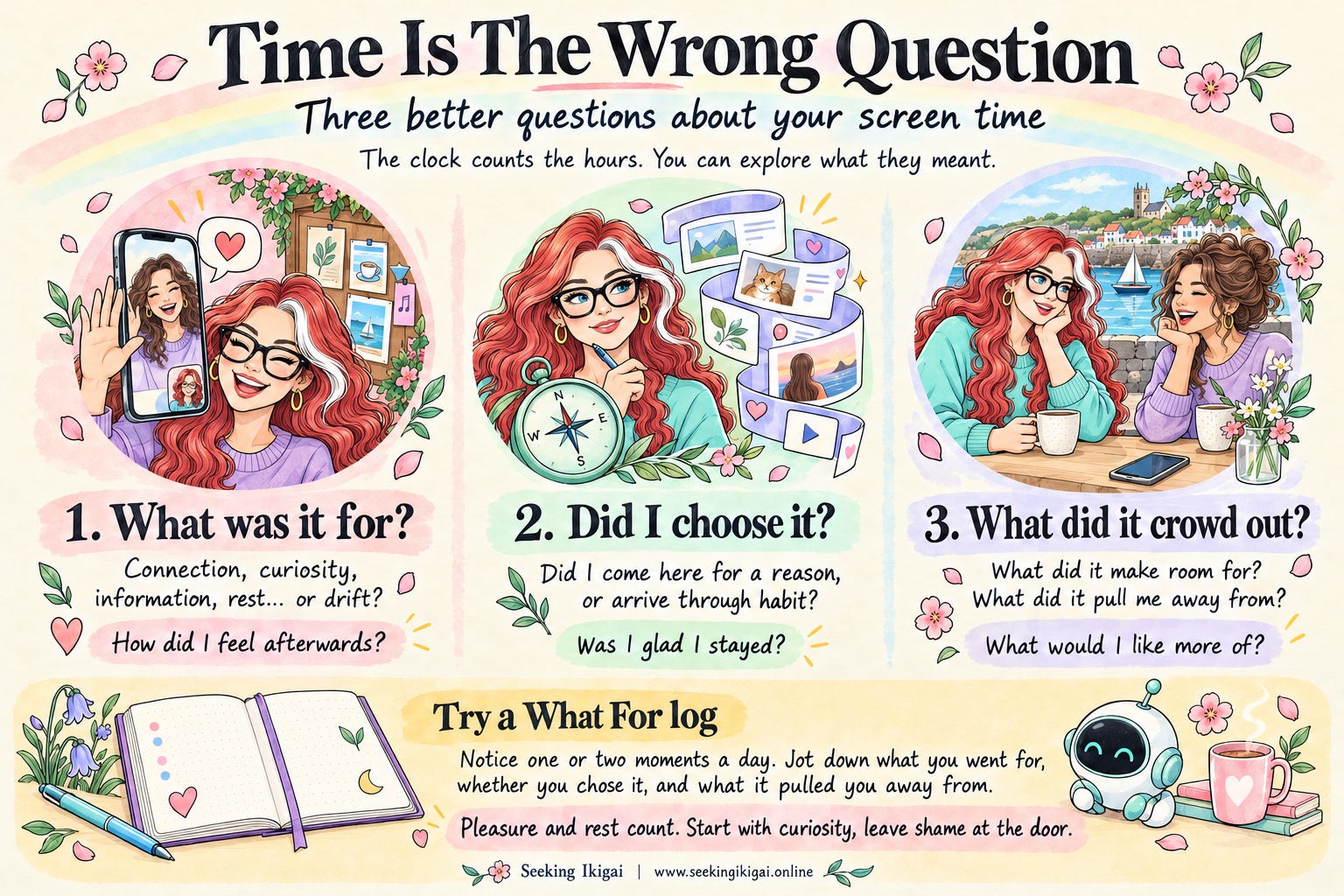
PS For the bullet journallers, a What For log. Create a double page spread with three columns. Each time you put down your phone for a week try to remember to jot down what you went on it for, whether you chose it or drifted into it and what (if anything) it pulled you away from. Timings aren’t important… at the end, sort your notes (rainbow pastel highlighters perhaps hehe) into connection, communication, information, rest and drift, and see if the balance of the categories surprises you.
PPS An AI prompt to try “Here are notes on why I picked up my phone this week, whether I chose it and what it pulled me away from. Help me notice which uses might help me feel more like myself and where my phone might be getting in the way of thriving or connection. Then give me some creative ideas to help me be more intentional with my phone use that suit what you know about what matters most to me.”
PPPS This week’s soundtrack is Time by Pink Floyd… a song about years slipping by… it makes me want to really notice what my hours are spent on more often.