

🌸 ikigai 生き甲斐 is a reason for being, your purpose in life, from the Japanese iki 生き meaning life and gai 甲斐 meaning worth 🌸
Imagine somebody made you an offer.
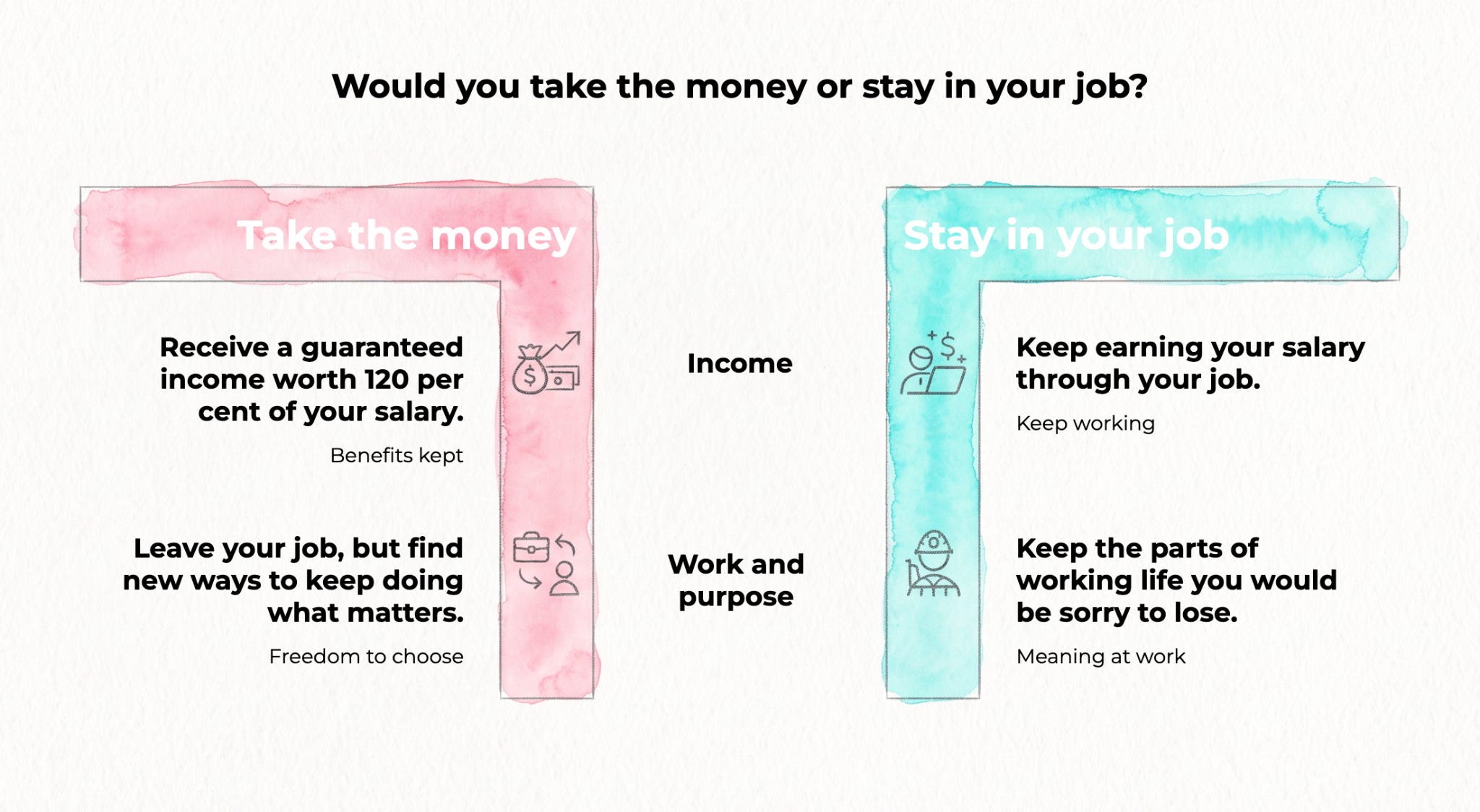
Leave your job. Keep your benefits and receive a guaranteed income worth 120 per cent of your salary.
Would you take it?
This summer, researchers put that hypothetical offer to thousands of people. About one in five working respondents said no.
I’ve been turning that answer over in my mind as there are days I’d take the money in a heartbeat… but there are many things in my working life I’d be very sorry to lose too!
That tension sits right at the heart of why I care about the ikigai risk of AI. The survey asks what a job gives us once we no longer need it for income. AI raises a related question whenever it changes the work we do... what else changes with it? I care about the chance to use our abilities and feel that we’re contributing. I’d like us to notice what happens to that as we decide which parts of our work to hand over. What’s at risk is the feeling that what you do each day is yours and that it matters. I think a settled sense of meaning and purpose is one of the strongest psychological buffers we have, and I’d rather we didn’t trade it away by accident.
So I’d like to ask you the same question, and then a better one.
Would you take the money? … and what would you carry on doing?
That second answer is your carry on regardless list. I think it’s a useful thing to have beside you when deciding where AI belongs in your work and life and where it doesn’t.

The offer
The research is by Julian Jacobs of Oxford and Google DeepMind, in a paper published at the end of October with a title I wish I’d thought of first, What is Work For? More in Common surveyed 8,234 working age adults in the UK, the US, Denmark and India. The income question covered 7,106 working respondents. Offers began at 60 per cent of their salary and rose in steps to 120 per cent, with benefits preserved. At that final offer, about one in five still said they would stay.
These were hypothetical choices and can’t tell us what people would actually do, or directly measure what AI might take away but they give us a reason to ask what people value beyond their pay… and reason to be curious about everyone who answered. Somebody who would happily leave their job might have something just as meaningful waiting outside it.
People have been asking versions of the lottery question for decades. If you suddenly had enough money, would you keep working? In a Gallup poll in 2013, around two thirds of American workers said they would carry on after a ten million dollar lottery win. GIven how much people moan about work, it always surprises me to see that most of those who would continue wanted to keep their existing job.
What interests me is the distinction between wanting to keep a particular job and wanting to keep doing something worthwhile. You might love helping people but be exhausted by the organisation you help them through. You might keep making things, just without the commute or the targets. You might leave paid employment and find more than enough to care about elsewhere.
So taking the money wouldn’t settle the question of what work means to you. It just might give you the freedom to answer it differently.
Four things we get from work
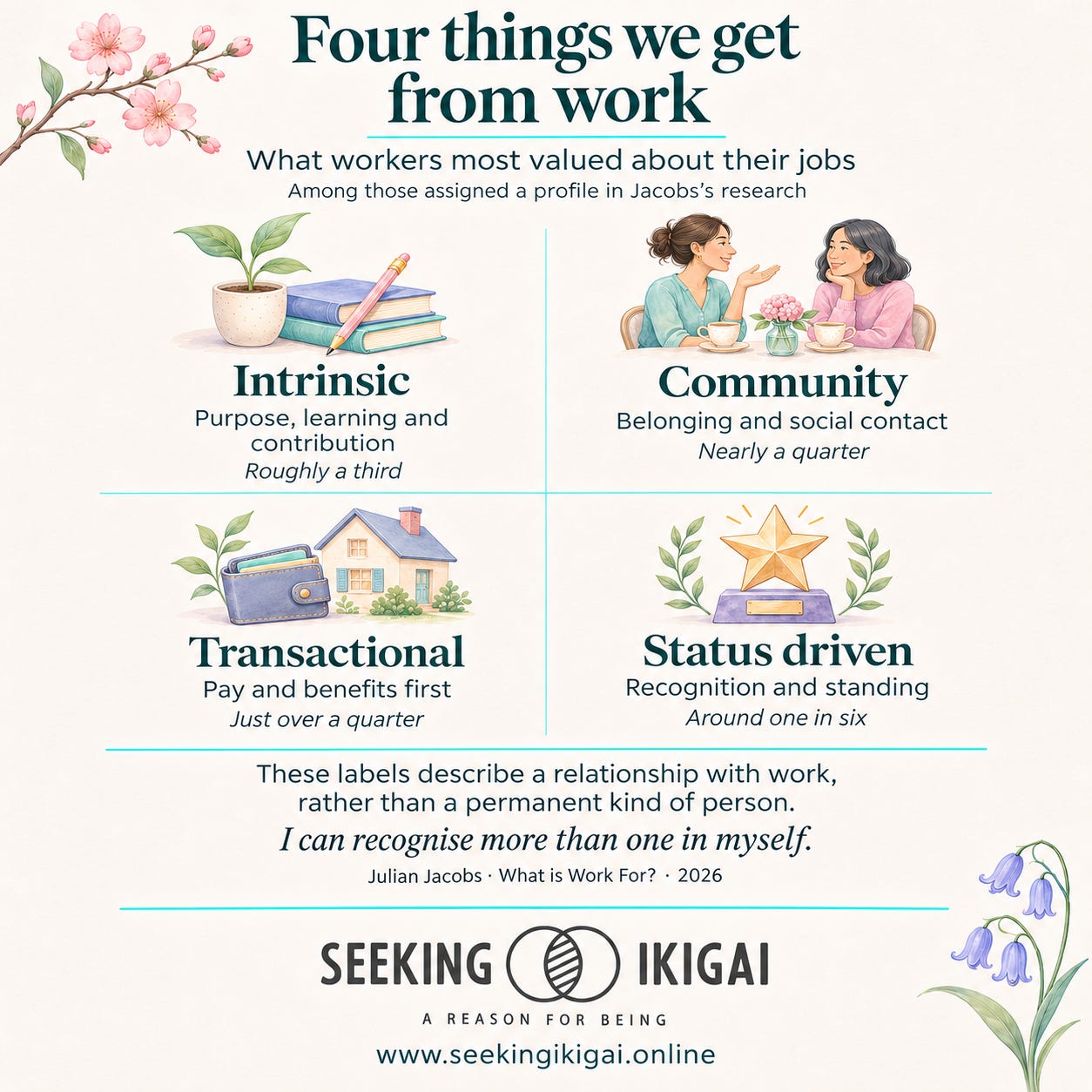
Jacobs also grouped workers by what they most valued about their jobs. Among those assigned a profile, roughly a third were intrinsic, valuing purpose, learning and contribution. Nearly a quarter were community, prioritising belonging and social contact. Just over a quarter were transactional, putting pay and benefits first. Around one in six were status driven, valuing recognition and standing. Those labels describe a relationship with work, rather than a permanent kind of person. I can recognise more than one in myself.
Those who most valued purpose, learning and contribution were more likely to refuse even the highest offer. But most of them still accepted it. You can value what your work gives you and still imagine a better arrangement.
The research team’s accompanying essay describes different expectations of a life with a guaranteed income. Transactional workers were especially likely to choose leisure or travel. Many intrinsic and community oriented workers envisaged volunteering or caring for someone. Status driven workers often imagined another job or starting a business.
Reading this has inspired in me more ways to ask what societal AI change might affect in us.
Would I miss practising a skill? Would I miss the people I practise it with? Is the satisfaction in making something useful, or in having my contribution recognised? Different answers call for different choices. Automating a report could be a relief. Automating the conversations that drive the evidence for the report could cost you something you wanted to keep. Being paid matters hugely of course, in our world we need to pay for shelter and sustenance! Someone who works mainly for the money doesn’t owe an apology.
That is why I find the question of universal basic income interesting and often incomplete. Money could remove a huge source of insecurity and open up possibilities. It wouldn’t though preserve a valued workplace relationship or the experience of using a hard won skill. We’d still need to think about where those things could be found.
My answer
I’m sure this is true for anyone who works in an office, but there are parts of my job I would hand to a machine tomorrow and never think of again. The reporting that you know for a fact no one properly reads… the fifth version of a document that was good enough the first time around… yeah, lots of admin and process wrapped around the stuff we’re actually trying to get done.
But then I think about a conversation with somebody who has an idea for a business and hasn’t yet dared say it out loud or didn’t know there were schemes to help them get started. The moment you watch them realise it might actually be possible. I think about my absolute joy at being a line manager and striving to coach and support my team. I think about the people who turned up to learn about AI because they were curious and a bit scared and wanted to understand their feelings as much as be taught anything. Of course I think about writing to you every Saturday, this and other things that I do for no money at all... whatever happened to my job, I’d want a place for stuff like this in my life.
Being in the second half of my career probably shapes my answer. I’ve had years to discover what I’m good at, what I enjoy and where I can make a difference. I have experiences to draw on when I ask myself what I’d carry on doing anyway. I wonder how that offer would feel at the beginning of a career, while you’re still finding those things out. Financial security could open up wonderful possibilities. But we’d also need to make sure there were opportunities to learn alongside other people, take on responsibility and experience having something valuable to contribute. That might mean deliberately creating the mentoring and supported practice that a good workplace can provide.
So would I take 120 per cent of my salary to stop? I think I probably would... and I’d be excited about what it could make possible. More adventures, more opportunities to help, more time to write and follow my curiosity, more to give to those who need it. Some of what I’d miss comes through my job and some I’ve made for myself, so I’d need to find new ways to keep it up. And I’d want to give some thought to the ordinary days too. Once the novelty had worn off, what would get me up in the morning, and what would give the week its shape?
The carry on regardless list
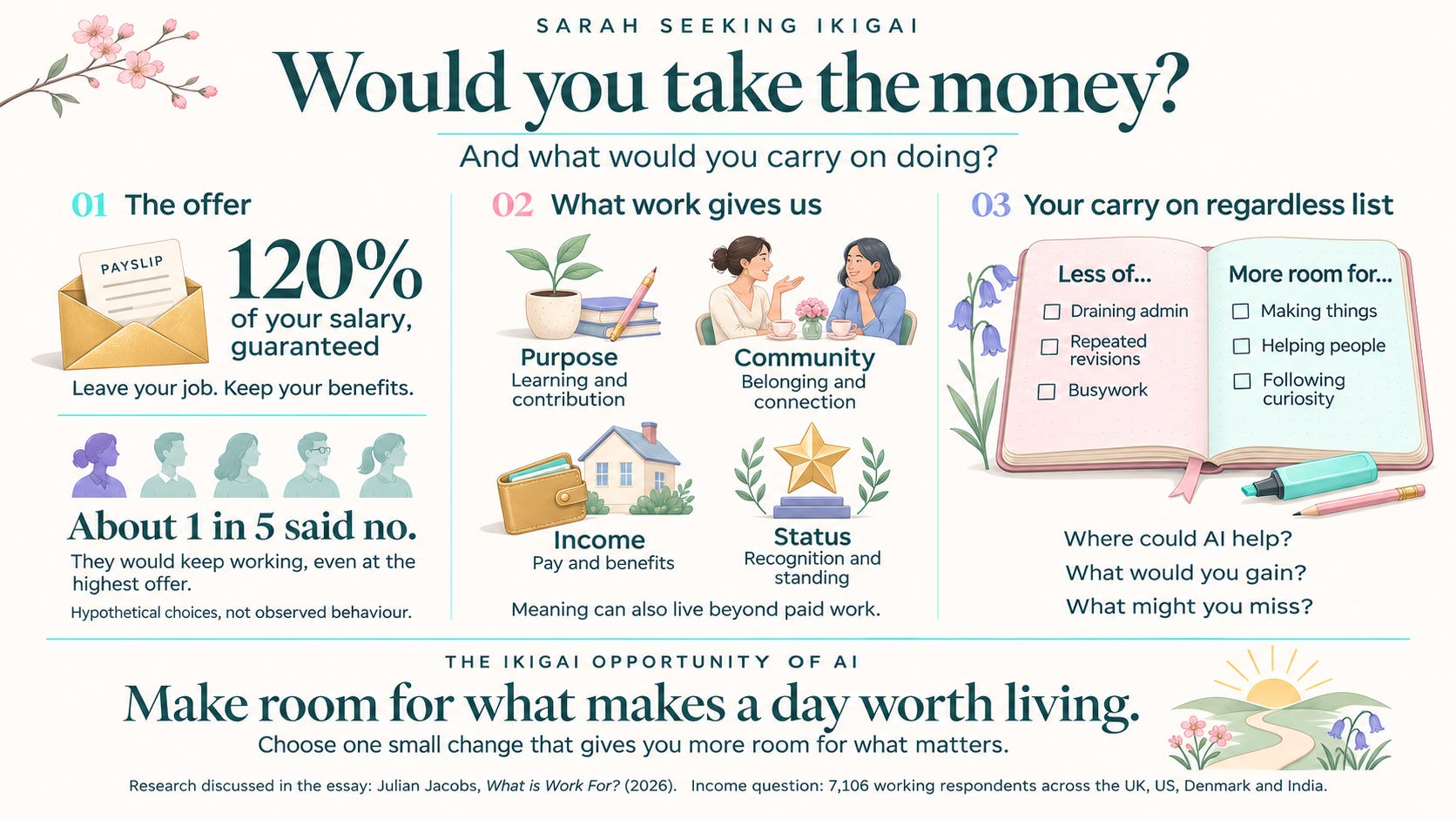
A Japanese word that helps me think about this is yarigai (やり甲斐), the sense that something is worth doing, that the effort is worthwhile… it sits alongside hatarakigai, the sense of worth we find in our work. I think of the carry on regardless list as one way to explore that feeling on paper. Take a double page journal spread and on the left, write the things in your work life you’d happily stop if the money kept arriving… and on the right, write what you’d want to keep doing or finally have time to do properly if other stuff went.
Then take a highlighter and look at where AI already helps and for each one ask what that help changes. Do you get more time for the bit you value? Are you still practising what you want to be good at? Is there something you now miss doing? An AI tool might make it possible to get past a blank page, or it might handle preparation so you can spend longer with someone who needs you. If AI helps you clear something what could that make room for on the right?
That’s where I see the ikigai opportunity of AI... the room it could make for what makes a day worth living, if we decide what goes there before more of the same work does. Getting help with the work that drains us could give us that room but we need to give it thought. For that opportunity to become real at work, people need a say in how AI is introduced and how any time saved is used.
If you lead a team, I think there’s something useful here for your next conversation about AI. Alongside asking which tasks people would happily automate, ask which parts of their work they want to keep doing, and why. People need to be able to answer honestly. That means knowing their answer won’t become a test of loyalty, a request to work for free or a reason to call them resistant to change.
If I were putting a purpose proofing clause into an AI charter, it would ask leaders to involve people in decisions about automating the work they find meaningful, including what they would lose and what they could gain. In Choose Your Own Ikigai Adventure, I suggested treating AI as a scout, something that runs ahead and shows you possible paths while you keep the choosing. It can gather information, offer possibilities and check your working. You get to decide where its help leaves you more able to do the thing you are here for.
Would you?
I’d love you to think about this too, maybe 120% is too easy, would you do it for 80%? Vote below and let’s have our own small conversation, rather than a scientific comparison with Jacobs’s results.
Whatever your answer, there’s a second question I’d love you to think about.
Imagine your income was secure and you could choose how to spend a typical day. What would you want that day to include? You might still choose the work you already do. You might want time to make something, help someone or return to an interest you’ve put aside. You might need a proper rest before you could even begin to answer.
The carry on regardless list can help us notice what we want our days to contain, so we can think about whether AI is giving us more room for those things or gradually taking them out of our hands.
I’d love to hear one thing from your list in the comments. Something you already do, or something you’d finally have time to begin.
The thing I’d carry on regardless is ___.
Sarah, seeking ikigai xxx
PS For the bullet journallers, the carry on regardless spread. Left page, what you’d happily stop or do less of. Right page, what you’d keep, return to or begin. Beside anything AI already helps with, note what you gain and anything you miss. Then choose one small change that would give you more room for something on the right.
PPS An AI prompt to try. “Here is my carry on regardless spread, the parts of my work and life I want to keep, return to or begin. Here is how I currently use AI with each one. Help me examine what that support makes possible and what I might lose through it. Ask for any missing context rather than assuming you know my habits. Suggest ways you could help while leaving me involved in the parts I value. Then ask me one question about the list that I probably haven’t thought about.”
PPPS This week’s soundtrack is Good As Gold (Stupid As Mud) by The Beautiful South… I’ve had “carry on regardless” running through my head all morning. I’m borrowing that refrain for the things we’d keep choosing, whatever happened to our jobs. There’s plenty I’d happily take off my to do list, but I’d love more room for the things that make me glad to be here like singing along to awesome tunes *grin*