

🌸 ikigai 生き甲斐 is a reason for being, your purpose in life, from the Japanese iki 生き meaning life and gai 甲斐 meaning worth 🌸
I always cheated at Choose Your Own Adventure books.
If you’re Gen X you’ll know exactly what I mean. You’d reach the bottom of a page and be offered a fork in the road... if you decide to enter the cave, turn to page 34, if you decide to follow the river, turn to page 52. And instead of choosing like a brave adventurer, I’d wedge a finger in the current page, sneak a peek at page 34 and, if there was a dragon waiting, scuttle back and follow the river instead.
Some days I had three fingers wedged in at once. A whole hand of hedged bets.
Did you do that too? I think lots of us did after the first heady read through and reaching an untimely end. I think I’m still doing it... only these days the finger in the page is a little circular arrow under every AI answer. Claude calls it retry, ChatGPT calls it try again and I call it the reroll, because that’s what it feels like... rolling the dice again until you get the number you wanted.

Turn to page one
The first book in Bantam’s Choose Your Own Adventure series, Edward Packard’s The Cave of Time, came out in 1979. The magic of those books was that your choices mattered. Some endings were glorious. Some were properly grim, and you’d be eaten, or lost in time forever, or stuck in a cave with no way home. Which is why the finger in the page was such a cheat. It let me feel the thrill of choosing without paying the cost of choosing… and if I’m truthful, it spoiled the books a little.
AI gives us a finger in every page. Draft the email five ways. Generate twelve versions of your LinkedIn headline. Ask for another option, and another, and another... Nothing ever has to be final, because there’s always one more version a click away. It’s wonderful. I use it every day. Sometimes another version helps me see what I mean. Sometimes it saves me from having to decide whether I mean it enough to do anything about it. I wonder what it does to us when nothing ever has to be the one. This essay is a case in point. I could ask AI to generate ideas for a more scroll stop worthy title, a tighter wordcount, a different thesis... and spend all my writing time choosing between versions. Eventually I have to pick a direction and write the words I can stand behind and hit publish. Preferably before I lose my weekly publishing streak *grin*
Twenty four jams
You may know the jam study. In the mid nineties, psychologists Sheena Iyengar and Mark Lepper set up a tasting stall in an upmarket supermarket in California. Every hour the display switched between 24 jams and just 6. The big display drew more people in... but only around 3% of them bought a jar. At the small display, around 30% did.
That study became the founding story of the paradox of choice, Barry Schwartz’s name for the way more options can leave us more anxious, less decisive and less satisfied with whatever we eventually pick. Later researchers have complicated the picture. One large review found that across lots of studies the effect averages out to roughly nothing, but that choice overload bites hardest when the options are complex, when we’re unsure what we want and when the decision feels like it really matters.
Which sounds familiar when the thing we’re choosing is who to become.
When I was growing up there were only four TV channels. The careers adviser had a slim menu of possible selves. I’ve written before about how I ended up with an accidental career, shaped by narrow GCSE choices and very little guidance. That narrowness has real costs and oh how I wish we helped people see more possibilities earlier.
Now the menu feels endless. You can be anything, live anywhere, work any way you like and reinvent yourself on a wet Wednesday... at least on paper, even when our actual circumstances are anything but… that freedom is a gift that people before us fought hard for.
Expanding the menu is only part of the work. We also need to learn how to choose from it. In Escape from Freedom, published in 1941, Erich Fromm explored how the weight of freedom can make us seek relief by surrendering it. He argued that people go looking for ways to put it down, handing their choices to an authority, a crowd or a system that will decide for them.
Imagine the appeal of something clever, friendly, endlessly patient and available at 2am. Recommendation engines already choose much of what we watch, read and buy. In The NeverEnding Becoming, I wrote about AI moving from capturing our attention to shaping our desires. Now I’m wondering about the everyday temptation to let it decide what we want.
Faced with endless options, I can keep asking for more. Or I can ask the machine to pick.
I recognise both temptations. Neither gets me much closer to making a choice I can call my own.
Regret is the receipt
In 1843 Søren Kierkegaard wrote, “Marry, and you will regret it; do not marry, you will also regret it.” I think he wrote it with a twinkle in his eye, but there’s something true tucked inside the joke. Every real choice closes a door. Something is always lost.
Regret is an inescapable part of being human. It’s the receipt we’re handed for having chosen at all. The research backs this up in an interesting way. Thomas Gilovich and Victoria Medvec found that we tend to regret actions more in the short term... but over the long run, it’s the things we didn’t do that haunt us. The roads we never took. The finger we never quite pulled out of the page.
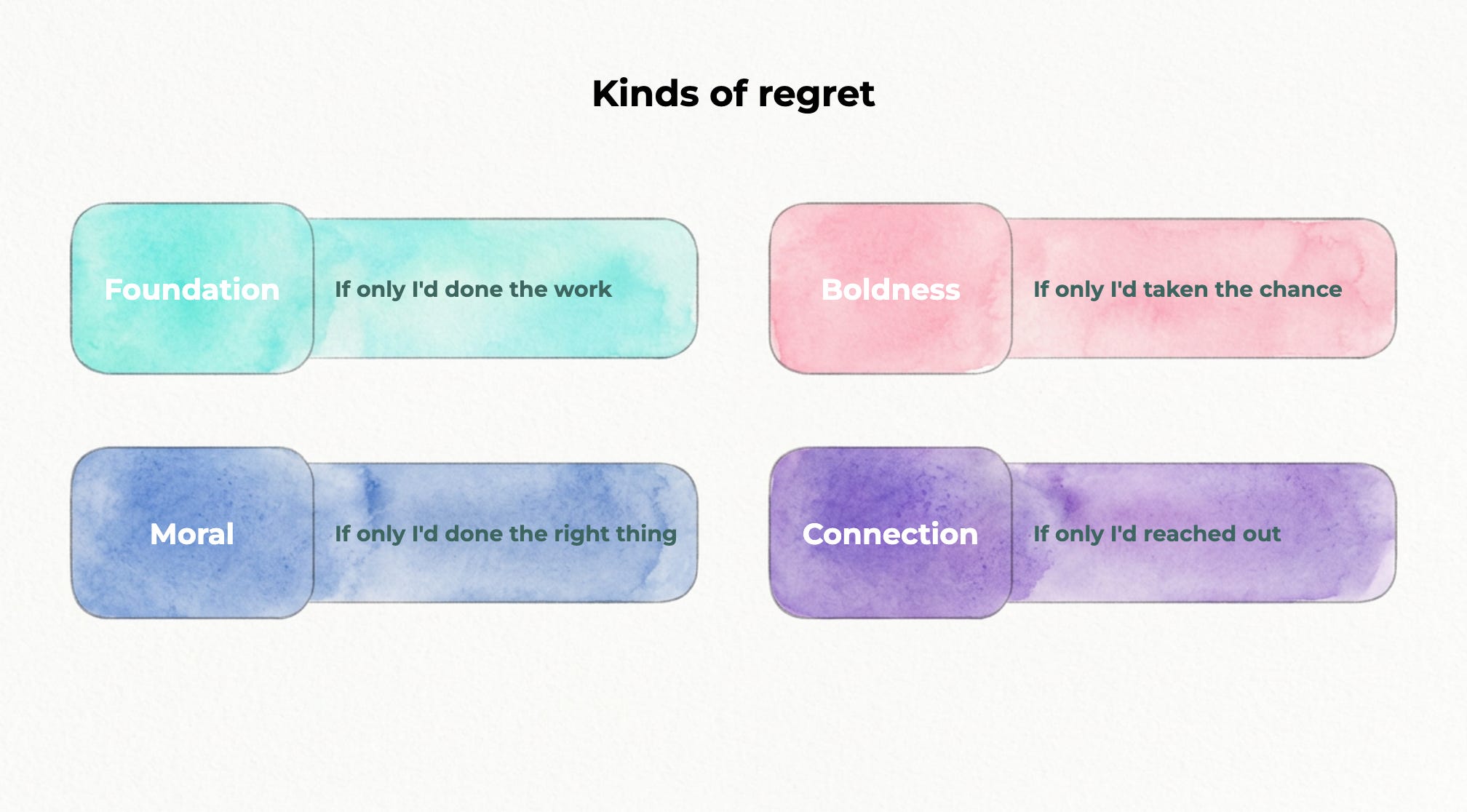
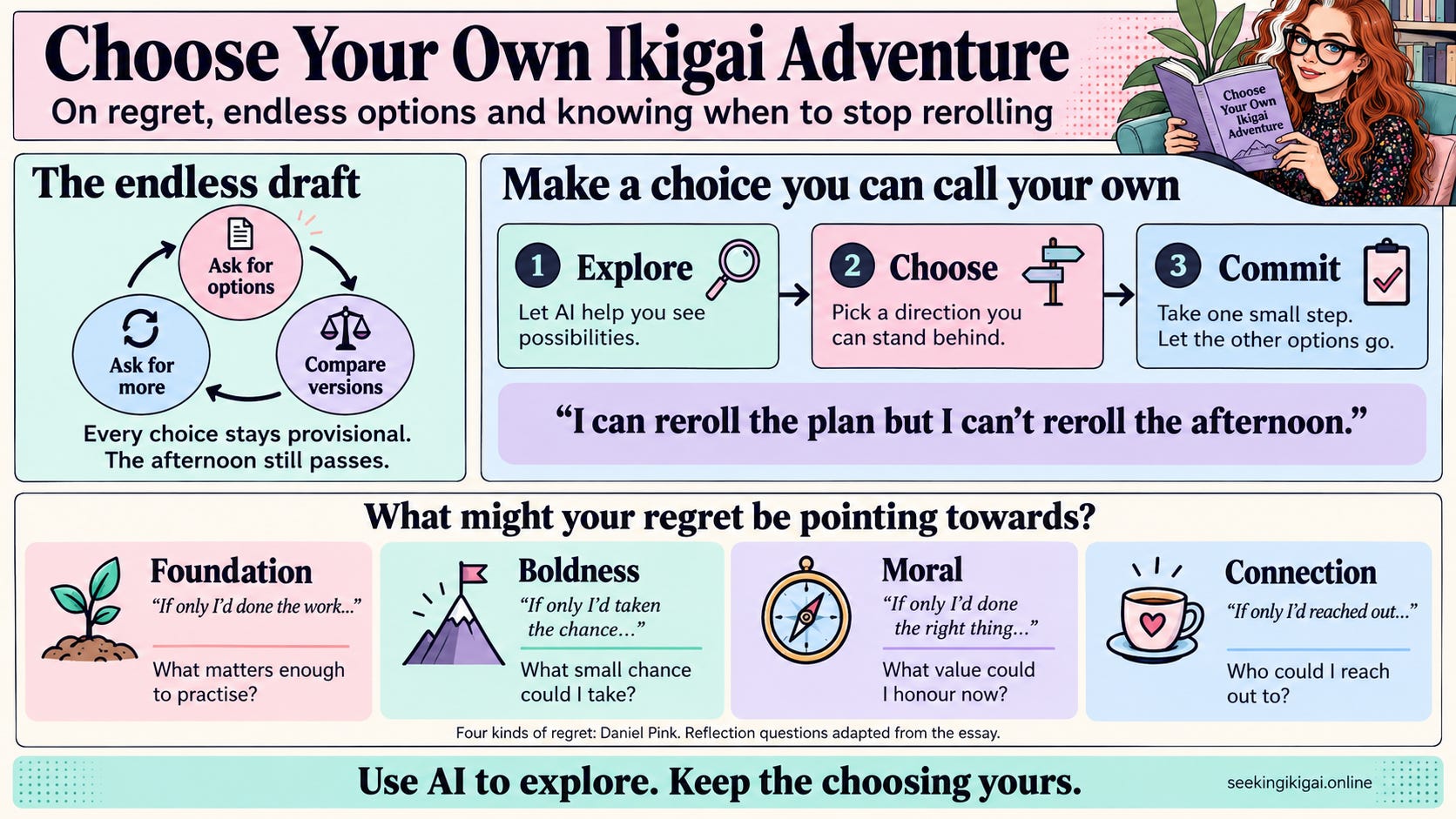
Daniel Pink’s World Regret Survey gathered regrets from thousands of people in many countries, and found they cluster into four kinds of regret. Foundation (if only I’d done the work). Boldness (if only I’d taken the chance). Moral (if only I’d done the right thing). And connection (if only I’d reached out). Pink’s lovely insight is that each regret is a photographic negative of something we value. Hold it up to the light and you can see the shape of what matters to you.
Which makes “no regrets” a strange thing to aspire to, doesn’t it? A life with no regrets would be a life where nothing mattered enough to lose. Perhaps ‘no regrets’ asks the wrong thing of us. I’d rather learn from mine than pretend there was nothing worth regretting.
I’ve just turned fifty one. I have a decent collection of them by now. Some I’ve made peace with, some I’m still sitting with and a few I’d rather not write down just yet… but every one of them points at something I love even if you have to squint to see that.
The ikigai risk of the endless draft
Some of our ikigai grows in the choices that cost us something. We become who we are through commitment... to a person, a place, a craft, a cause, a way of spending our ordinary days. Every yes is built from a hundred small noes. It can grow through the things I keep choosing, even when choosing them means letting something else go.
When AI offers us infinite drafts, every choice can stay provisional. We don’t have to commit to the sentence, the plan, the direction. We can keep it all in beta, and a self kept permanently in beta never quite gets to become anyone. The finger in the page saves us from the dragons, and it also stops us ever reaching an ending we can call our own. The day still passes while we compare possibilities. I can reroll the plan but I can’t reroll the afternoon I spent asking for another one. At some point, keeping every path open starts to cost me the chance to walk any of them.
This is part of what I mean by purpose proofing AI in reaction to my concerns about the ikigai risk of AI. The risk lives less in the dramatic headlines and more in the habit of never having to choose. I’m not about to throw away the reroll button. AI can be a brilliant scout, running ahead to peer down paths we’d never have imagined, which is a big part of what Purpose Prompting is for. But the scout can’t walk the path for us. The choosing, the closing of doors and the living with the loss... that bit stays ours and I think it’s where meaning can get made.
The map nobody can draw
In 2018 the finger in the page moved to the telly. Charlie Brooker’s Black Mirror Bandersnatch landed on Netflix, a film you steered with your remote, set in 1984 and all about a young programmer turning a Choose Your Own Adventure style book into a video game.
My first playthrough was exciting, I made my choices, reached an ending that I remember enjoying. But the geek in me couldn’t leave it there. What was behind the other doors? Should I draw flowcharts of every branch and share them across the interwebs? That would have worked in 2018, because Bandersnatch was finite. Someone had written every path, so someone could find every path.
Now imagine the next version. A story generated by AI as you watch, tailored to you, your choices and your mood, never quite the same twice. There’d be no flowchart to draw. You could never see every ending, because most of them wouldn’t exist until somebody chose them.
And oh gosh... that’s real life, isn’t it?
There has never been a map of every path. Not for your career, your relationships, the town you didn’t move to or the person you might have become. We just used to be able to pretend there might be one, somewhere, if only we looked hard enough.
So maybe the practice is learning to finish a first playthrough and feel ok about choosing a path where we don’t know the ending. To let the unwatched branches stay unwatched, without carrying regret for paths we were never going to see anyway or treating them as evidence that we choose badly.
Akirameru, or seeing clearly
There’s a Japanese word I discovered this week. Akirameru (諦める) usually translated as to give up, which sounds like failure but its roots run back to an older word meaning to make clear… and the character 諦 is the one used in Japanese Buddhism for truth, as in the Four Noble Truths.
So akirameru is, at heart, to see a situation clearly enough to let it go. That changes how closing a door feels to me. When I let go of the life where I did the other thing, I’m seeing my actual life a little more clearly. The cave I didn’t enter becomes part of the map of who I chose to be.
I suspect a life you feel content living is built from exactly this. Doors closed on purpose, and made peace with.
I don’t remember a huge amount about the books I cheated at with fingers in lots of pages. The ones I remember better are when I committed. Where I chose the cave, got eaten by something dreadful on page 87, laughed and flipped straight back to the beginning to start a brand new adventure, a little wiser.
So I’m wondering this week... which pages do you have fingers wedged in? What might happen if you pulled one out and let the story carry on? Which branches are you still trying to map? And is there a door, closed long ago, that you might finally akirameru... see clearly and let go?
Turn the page. I’ll see you on the other side.
Sarah, seeking ikigai xxx
PS Bullet journal spread to try. Turn to Page... Draw your own Choose Your Own Adventure flowchart across a double page spread. In the top left corner, draw a box labelled “Page 1, you are here” with today’s date, and write this question inside it... When I replay the past, which “if only...” am I hearing most loudly?
If only I’d done the work... turn to Foundation.
If only I’d taken the chance... turn to Boldness.
If only I’d done the right thing... turn to Moral.
If only I’d reached out... turn to Connection.
From that box, draw four branching paths to boxes, one for each of Pink’s regrets, and give each a colour if you like.
Follow whichever branches answer your question; there may be more than one. In each box you land in, write the regret as if it were an ending from the old books, finishing with THE END. You never sent the letter. THE END. Then write a new beginning idea underneath... A year from now, I’d love to look back and see that I... Pick the branch that tugs at you most, ink it in bold and write one small step you’ll take this week.
If you’d rather just journal and reflect;
Which “if only...” still follows me around?
What do I wish I could turn back the page on?
PPS Choose Your Own AI Prompt Adventure. Two prompts this week, and you get to pick. If you’re in the mood for some fun, turn to Prompt A. If you’d rather sit with something a little deeper, turn to Prompt B. Fingers out of the page, please.
Prompt A, for fun. Paste this into your favourite assistant and bring a dilemma, big or small.
Write me a Choose Your Own Adventure page in the style of an 80s gamebook, starring me, about this real dilemma: [describe it in a sentence]. Make it gloriously over the top... caves, dragons, suspicious wizards, the lot. End the page with two choices and page numbers, then wait for me to pick. Keep going until I reach an ending, glorious or grim, and finish with THE END.
No rerolls allowed. Afterwards, notice which choice you made without thinking. That might be the one you already knew.
Prompt B, for reflection. Pick one of the regrets from your spread and paste this into your favourite assistant.
I’d like to reflect gently on a regret. Here it is: [describe it]. Daniel Pink says every regret is a photographic negative of something we value. Ask me one question at a time, no more than five, to help me see what this regret shows about what matters to me. Please don’t reassure me or try to fix it. When we’re done, tell me in two or three sentences what value you heard, and ask me what one choice this week would honour it.
Then close the chat and reflect on the value.
PPPS This week’s soundtrack is Regret by New Order. It’s 1993 full of promise and Bernard Sumner sings it like a man shrugging at the very idea of looking back.