


🌸 ikigai 生き甲斐 is a reason for being, your purpose in life, from the Japanese iki 生き meaning life and gai 甲斐 meaning worth 🌸
There are two notebooks on my desk this morning.
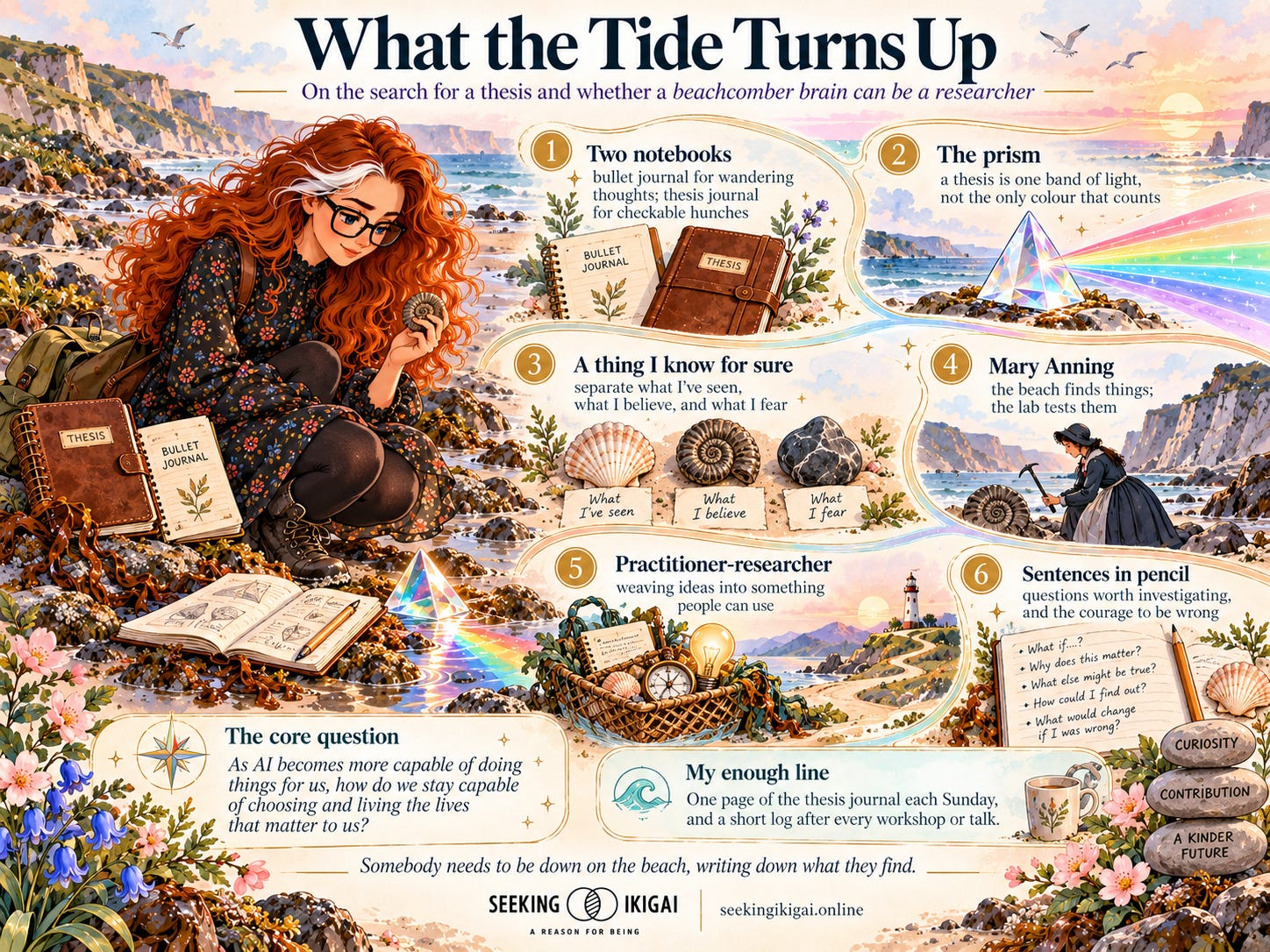
My lilac bullet journal of course, ever present and opened every day for lots of my thinking. The other my Leuchtturm1917 Thesis Journal with a step by step methodology for turning a question into something you can defend. I open it rarely, and when I do it’s with an intake of breath.
In March I wrote that I’d started it tentatively, like stepping into cold sea water one toe at a time. I’d love to tell you I’ve since waded in up to my shoulders. The tide has been in and out many hundreds of times since then yet I’m still stood at the water’s edge with my jeans rolled up.
I want to work through why I keep picking the thing up and putting it down again, and whether a woman with a busy life, a wandering brain and little formal academic exposure should be putting herself through this at all.
The dictionary says a thesis is the main idea, opinion, or theory of a person, group, piece of writing or speech.
If you’ve ever wondered what I mean when I say I’m in search of a thesis, here’s the shortest answer I’ve found. I want my hunches to be checkable and to feel confident the methods I use to help people are doing more good than harm.

What I thought in March
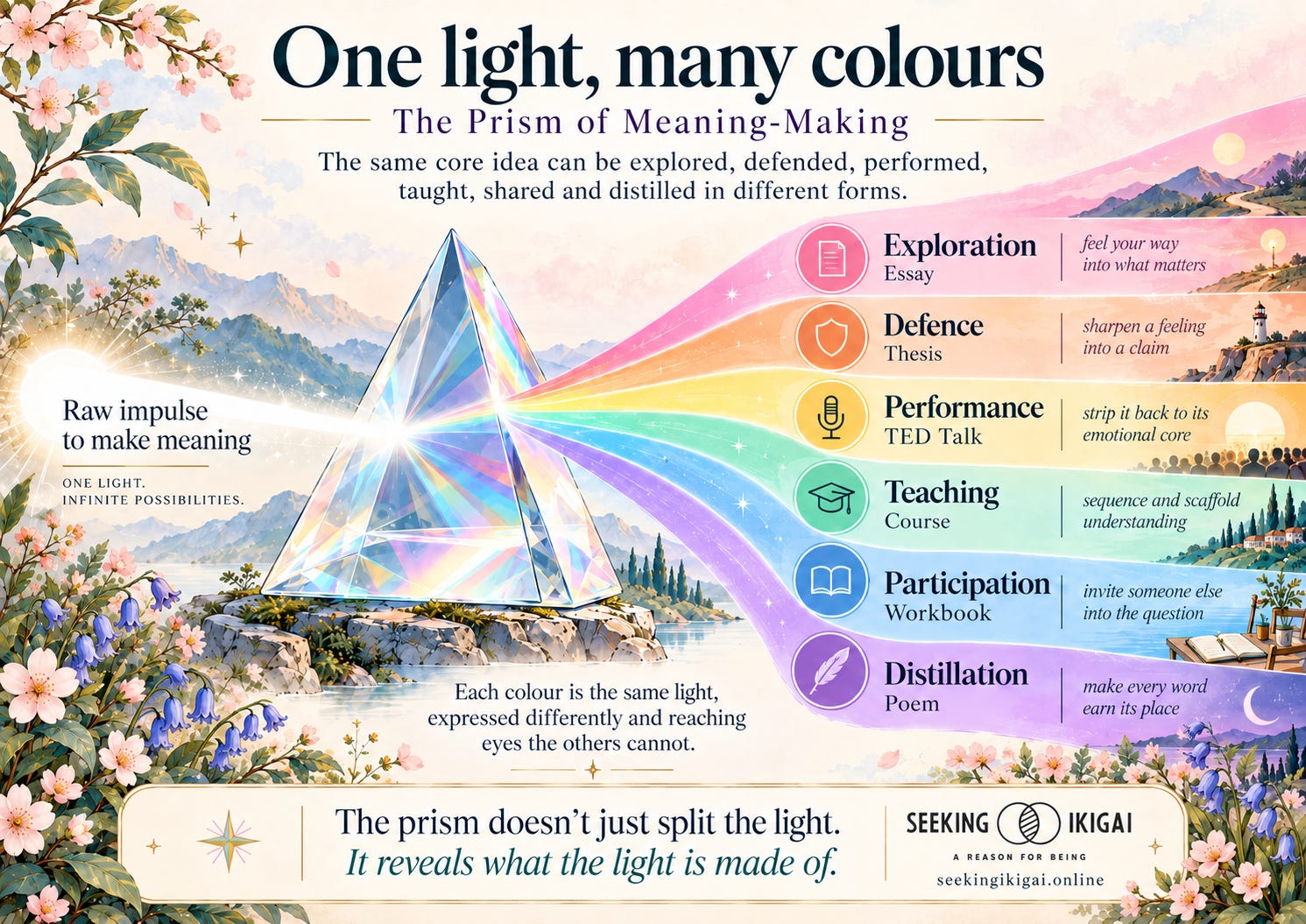
In Essayer, What Do I Know? I said “an essay explores, a thesis defends”. I wrote about the tenderness of rigour, the idea that the most caring thing I can offer you is something sturdier than my own enthusiasm… and I came up with an image I still adore. White light, that raw urge to make meaning, hits a prism and splits into colours. An essay. A talk. A course. A workbook. A poem. A thesis. The same light, each colour reaching eyes the others can’t.
Rereading it this week, I noticed two things.
The first is how many new colours have appeared since March. Workshops. Bite size lessons. Talks and panels. Frameworks tested in rooms full of real people. An AI charter I’m building with my own team at work.
The second is where I’d gone wrong with thesis thinking… why turn it into the colour that has to be mastered before any of the others matter. The prism says something kinder, that thesis is only one band of light. Its the broader prismatic thinking that shows what the light is made of and ultimately whether we can trust the rainbow as a whole.
A thing I know for sure
Last week I read about AI being used to decode Second World War Enigma messages that had defeated researchers for years. The playbook was simple, give the AI a goal, let it research and build its own tools, feed it one thing you’re sure of as a clue, then check the answer against known facts.
So I tried it on my own archive. I wanted to map how my thinking about the ikigai risk of AI had grown across more than 150 essays and what thesis ideas are becoming clearer. For my one sure thing, I gave it this;
People around me are already struggling, and I believe a lack of purpose literacy is part of why. AI is arriving so fast and so chaotically that I fear it could harm human flourishing, or concentrate it in ways that make inequality worse.
It built me a timeline and a conceptual map.
Reading my sure thing back, I noticed that the sentence is three things. Something I’ve seen, people around me struggling. Something I believe, that missing purpose literacy is part of the reason. And something I fear, that AI could make it worse and unevenly so. The first I can stand behind but the other two are hunches, built from years of watching and listening. Rigour is the work of telling them apart.
That’s what makes it a thesis in waiting I guess, a feeling, broken into claims I could be wrong about.
The map showed me something else too, that I’ve described the ikigai risk of AI in many slightly different ways. It began, in January 2025, as a worry about work worth doing. By this spring it had grown into a worry about ikigai itself, the felt sense of a life worth living. My wandering had a spine but I hadn’t been drawing it out as my thinking evolves.
So here today’s draft definition stitched together from my own words;
The ikigai risk of AI is the possibility that, in making our lives easier and more productive, we unintentionally erode some of the agency, growth, contribution and meaning that make those lives feel worth living.
But the more I turn it over, the more I see different faces of the same question. There’s the paradox of progress, where making life easier might not make it better. There’s human agency, and what we surrender when we hand over our thinking, creating and choosing. There’s equity, and the possibility that AI expands freedom for some while narrowing it for others… and underneath it all is the philosophical question of what makes us human, and whether choosing, trying, learning and contributing matter as much as the things we produce.
Different ways of looking at one worry, and a growing collection of questions I don’t yet know the answers to… but here’s how I think we might respond, Purpose Proofing as a deliberate practice of protecting what matters, with Purpose Prompting as a daily habit... prompt yourself first, prompt the AI with intention, then return to your own judgement.
A girl on the beach at Lyme
Mary Anning was born in Lyme Regis in 1799, into a poor family. She had almost no schooling, teaching herself from the beach, borrowed papers and patient hours studying the creatures she found. She was about twelve when she and her brother Joseph uncovered an ichthyosaur skeleton. Later came the first complete plesiosaur. She hunted after winter storms, when the cliffs slumped and gave up what they’d been hiding.
Gentlemen geologists bought her finds, wrote them up in learned papers and often left her name out. She couldn’t go to university or join the Geological Society of London, which didn’t admit women. Yet the experts kept coming to her little shop, seeking the knowledge of a woman who had taught herself by doing. In 2022 Lyme Regis gave her a statue, after a campaign started by a schoolgirl.
The word amateur comes, through French, from the Latin for lover. We’ve let it slide into meaning not quite good enough but Mary was an amateur in the oldest sense, a devotee, someone whose love for a subject became close to obsession. Is that what makes a good researcher? If so I feel like I qualify and am thinking about her this week for two more reasons.
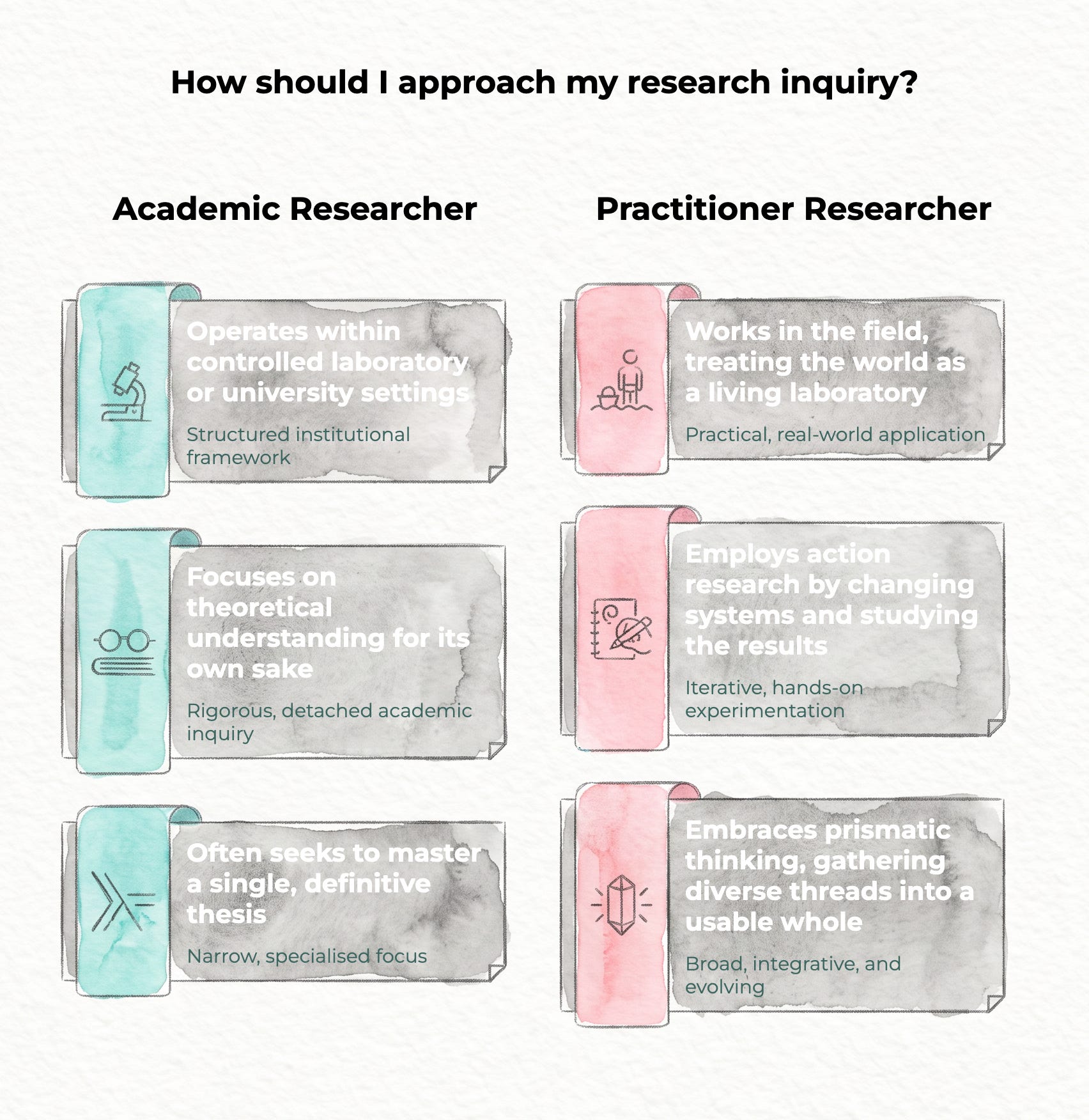
The first is that practitioners have always fed science. The people on the beach find things the people in the lab would never stumble across. A practitioner’s ideas, workshops and hunches only survive if they’re written down clearly enough for someone else to pick up.
The second is that my brain works far more like her beach than a laboratory. I wander. I pick things up, noticing what the last storm has turned over. For a long time I’ve worried that this is the wrong kind of brain for a thesis.
Now I’m seeing that research needs both and that there may be more accessible pathways for me to either become one or add to the body of knowledge in this sphere.
Tankyū, the searching that goes all the way down
The Japanese word I’ve fallen for this week when researching this essay is Tankyū (探究) which means inquiry, the patient search for understanding. The first character carries the sense of searching or feeling your way, the second of investigating something right to its end. Add the character for heart and mind and you get tankyūshin (探究心), an inquiring spirit... a curious heart.
I named my publication after a verb, seeking. I’ve written before that the seeking itself became a reason for being. Tankyū adds seeking with direction and keeps going until it reaches the bottom of the question.
A beachcomber with a question walks a shore noticing everything, she also knows what she’s looking for.
That, I think, is what a thesis is for, giving my wandering a focus.
Pasteur’s corner, and a small Island
In 1997 the political scientist Donald Stokes drew a grid of the different kinds of research. In one corner he put Niels Bohr, who wanted to understand the atom for its own sake. In another he put Thomas Edison, who wanted things that worked and wasn’t fussed about why. In the corner where both wishes meet he put Louis Pasteur, who wanted to understand microbes because wine was spoiling and people were dying.
I live in Pasteur’s corner, minus a lab coat. I want to understand what AI is doing to our sense of purpose and I want that understanding to help someone practically speaking.
I doubt I’ve stumbled on something nobody else has noticed. Researchers already study autonomy, cognitive offloading, deskilling and meaningful work. What I might offer is the weaving... gathering threads into something an ordinary person can pick up and use and asking one plain question of it. When does AI help us flourish, when might it chip away at that and how can we tell the difference?
There’s a long tradition for people like me. In the 1940s the psychologist Kurt Lewin championed action research, the idea you can learn about a system by changing it and studying what happens. Teachers, nurses and community workers have been doing it ever since… and I currently work in Government, on an Island small enough that the distance between an idea and the people it touches is short. I’ve written before about small islands as living laboratories. You can’t hide from the people your decisions affect here, and you can see quickly whether something helps. Practising change alongside the people who need it most. Feeding evidence into policy. Gathering people to think differently about systems that should serve both people and planet, economically and environmentally and above all in ways that leave us healthy and thriving. Those feel like more colours of the same light, and maybe the brightest ones.
So, can a practitioner feed the research ecosystem? I think she can, if she leaves a trail clear enough to follow. Writing claims down before testing, in words I could be wrong about. Borrowing measures researchers already trust, like the nine question ikigai scale developed and tested at Mejiro University in Japan, used before and after interventions. Keeping a method log of what I tried, with whom, what I expected and what happened, flops included. Sharing it all openly, ideally alongside an academic friend who’d love a practitioner’s beach to walk on.
Every one of those habits fits in a notebook *grin*
If someone new asks what I am passionate about around here, I’ve found a description I quite like. An independent practitioner researcher, exploring AI, human agency and flourishing. It names a direction more than a title, which feels about right for now.
Sentences in pencil
Underneath everything sits one question.
As AI becomes more capable of doing things for us, how do we stay capable of choosing and living the lives that matter to us?
And beneath that are the questions I’m starting to scribble in pencil. Questions I want to be able to investigate, and perhaps one day answer with something sturdier than my own enthusiasm.
Does knowing what gives our lives meaning help us navigate change, including the changes AI brings?
When AI makes us more productive, what happens to our sense of agency, contribution and purpose? Does it matter whether we chose to hand something over, or had the choice made for us?
Could Purpose Proofing help us keep hold of what matters and might we actually measure the difference?
Who gets to flourish? If AI expands freedom and opportunity for some, whose choices might become narrower? I’m particularly interested in what this means for women, and for people who already have less control over their working lives.
That last question probably deserves a page of its own, Mary Anning would understand why.
There are different lenses through which I might look for answers. Agency... who decides? Meaning... what matters here? Capability... what do we keep? Flourishing... what makes a life good? And always, the question of whose lives we are talking about.
I’m going looking for evidence that I’m wrong, too. AI can widen lives. It can open doors for someone with a disability, someone short on time or confidence, someone who never had the chance to make things before. Perhaps what matters most is how, why, when and by whom it’s used. Whatever I build needs room for the gains, the losses and the reality of our muddled lives. I want to find out how well my ideas explain real life, including the places where they don’t.
These questions will change, that’s the point of pencil.
Is it worth the stress?
I have a rule for handing things to AI, before I let go of a task, I ask what I would miss if I stopped doing it myself. So I thought through this when refining my thesis, Claude could draft me a thesis statement in seconds but I’d miss part of what I love which is the thinking and refining.
So yeah I’ve been thinking it through with two AI helpers, like two mirrors held at different angles. Claude helped map my archive, while ChatGPT helped me imagine what a research practice might look like for me without a PHD, can I build something here in researching the ikigai risk of AI that also helps me live my own ikigai? Both helped and as ever the next steps are mine to make.
Back in April I also wrote about needing an enough line, so that purpose doesn’t slide into endless productivity. A thesis could easily become one more way to never feel enough. So my enough line for now is one page of the thesis journal each Sunday and a short log after every workshop or talk.
The prism takes care of the rest. The thesis becomes another way of honouring the same impulse to make meaning, and one more small reason to get up in the morning.
As for whether my brain suits it... I’m starting to think a thesis can be shaped to fit a brain like mine walking the shore after every storm. And AI acceleration is one almighty storm. The cliffs are slipping all over the place right now. Things are being uncovered every week that nobody has had time to understand.
Somebody needs to be down on the beach, writing down what they find.
So I’m going to open the thesis journal this afternoon… dip a toe in first probably, but definitely in.
What about you? Is there something you feel sure of, but haven’t yet tried to prove? What might happen if you wrote it down in pencil and started looking for the evidence?
Sarah, seeking ikigai xxx
PS Bullet journal spread to try. The Tide Line. Draw a wavy line across the middle of a double page spread, like the mark the sea leaves on the sand. Above it, write your hunches... the things you believe about your life or work but can’t yet show anyone. Below it, write your finds... the conversations, notes, feedback and moments that back them up. Along the line itself, write what would change your mind. Then pick the hunch with the most finds beneath it and write it as one sentence, in pencil, at the bottom of the page.
PPS AI prompt to try, with extended thinking on;
“Here is something I feel sure of about my life, my work or the world. [Describe it.] First, help me separate it into what I have seen, what I believe and what I fear. Ask me one question at a time about each part. Then help me turn the strongest part into a working thesis, one sentence I could be wrong about. Tell me what evidence would support it, what evidence would change my mind and one small experiment I could run in the next month to start finding out. Finish by telling me how I could check the result against something I already know is true.”
Then take whatever it gives you back to your notebook, and decide for yourself what you feel about the exchange..
PPPS This week’s soundtrack is I Still Haven’t Found What I’m Looking For by U2, a song by someone certain of what they believe and still out searching... which is how this thesis sensing can feel to me at times,