


🌸 ikigai 生き甲斐 is a reason for being, your purpose in life... from the Japanese iki 生き meaning life and gai 甲斐 meaning worth 🌸
People keep asking me “where do I start?”
So here’s my answer.
I wrote this guide because I kept getting the same message in my inbox. I love what you’re doing, where should I begin? The quick answer is #085 Why Should I Care About Ikigai. The longer answer is everything else below.
132* essays is a lot to take in.
I’ve picked sixteen essays that do the structural work for everything else in the archive and organised them into five tracks. Read them in the order below within each track. Skip tracks if a later one catches your eye more than an earlier one.
If you’re short on time, #085 alone does a lot of the work as I consciously wrote it to update my summary thinking. It’s the foundational essay if you don’t want to have to start from the very beginning and watch my messy evolution in real time hehe, and the one I’m most likely to hand to anyone asking what this publication is about.
* As at 19th April 2026, I will periodically update this *grin*

Track 1: The Entry Triptych
If you read nothing else, read these three. They are the why, the what, and the how, in that order.
#085 Why Should I Care About Ikigai?
“A slightly sweary guide to making Thursdays feel magical.”
The foundational essay. If you only read one piece from this guide, read this one.
In around 1,700 words I name the thesis (the ikigai risk of AI, defined in the essay itself as “the danger of AI disconnecting us from purpose rather than helping us find it”), I make the case for hatarakigai (work worth doing) as distinct from ikigai, and I explain why a Japanese philosophy, a bullet journal and an AI tool belong in the same practice.
“There’s magic hiding in your ordinary Thursday, I promise” If a line like that makes you want to keep reading, you’re in the right place.

#086 What Actually Is Ikigai?
This is where I layout my understanding... a felt sense, a quiet knowing, iki (life) plus gai (worth)... and it’s why your ikigai cannot be automated.

#087 How To Find Your Ikigai
The practical piece. Two phases, ten exercises, a bullet journal and an AI as thinking partners. Phase one grounds you in the five pillars, phase two shifts you toward the Venn diagram as a hatarakigai design tool. If you want purpose literacy, this is the one to work through with a pen in hand.

Track 2: The Five Pillars
If Track 1 lands and you want the full architecture, this is where I walk through Ken Mogi’s five pillars of ikigai, one essay each. They were published as a series in spring 2024.
#027 The Power of Starting Small (Pillar 1)
Starting Small is such an important lesson, it’s not a compromise but a learning stance. Atomic habits, 1% improvements... all aimed at helping you break down what matters into something you are more likely to be able to do.

#028 Let Go To Grow (Pillar 2)
Why releasing the illusory self is the pre-condition of self-acceptance. Via thinking about karaoke, while singing loudly in my car early on a Sunday morning. Windows up or windows down, depending on your nerve!

#029 Seeing Earth From Space Changes Everything (Pillar 3)
The Overview Effect and the Gaia installation, enlisted to argue that harmony and sustainability are active practices, not the absence of conflict. About decisions scaled across generations, not just this weekend.

#030 Craft A Contented Life Under A Vanilla Sky (Pillar 4)
Tom Cruise’s “the little things... there’s nothing bigger” pressed up against Mogi’s fourth pillar. Gratitude as a muscle you train, not a sentiment you feel.

#031 Douze Points For The Doctor (Pillar 5)
Doctor Who and Eurovision share one night, one couch, and one argument: fandom and present-moment attention are not separate things. Being In The Here And Now, via shared passion.

Track 3: The Hatarakigai Turn
This is where I work through why I am still so drawn to the purpose venn diagram most people wrongly think of as ikigai.
#024 Hatarakigai = Work Worth Doing
The arithmetic of a typical weekday: 8 hours sleep, 10 hours for work and commute, about 6 hours for everything else a human needs to be whole. Making the case why hatarakigai is actually a good thing to strive towards for ikigai.

#033 Venn-ture Towards Ikigai
A detective story. Who actually drew the now-famous ikigai Venn diagram? (Answer: Mark Winn, 2014. Not a Japanese philosopher.)

#062 Everyone Gets The Venn Diagram Wrong!
The definitive reckoning. The four-circle diagram is brilliant... for hatarakigai, but it is NOT ikigai… it is also mathematically impossible the way most people draw it!

#128 Money Talks, We Don’t
The current edge of the thread. Three money traps (Guilt, Survival, Hustle) and the question almost nobody’s asking: what if the fourth circle of hatarakigai didn’t have to look like exactly like how we do capitalism today?

Track 4: The Bullet Journal
The personal operating system that holds all of this together. I’ve kept one since July 2017. It’s the bridge between the philosophy and the practice, and the tool the AI essays in Track 5 sit on top of.
#034 Bullet Journal And Take Control Of Your Life
Talking about what Bullet Journal is, why I picked it up in 2017 and never put it down.

#064 Achievement Unlocked: Life Manual Found
The essay where the bullet journal clicks as something more than a to-do list. A life manual. A compass. A way of seeing the same things differently once you’ve slowed down enough to write them down. This is the essay where I explain how it was bullet journal that really unlocked ikigai and hatarakigai for me.

#075 One Journal To Rule Them All
If you’ve ever had a work diary, a planner, a notebook, a journal, and a separate to-do app... this is the case for collapsing them into one bullet journal.

Track 5: The AI Practices
The working theory of how to stay human while using AI.
#125 What Is Purpose Prompting?
The signature practice, named at last. A daily loop I’d been running unofficially for years before I had a word for it. Prompt yourself first, prompt AI with intention, return to yourself. If you take one tangible thing from this archive into your working week, take this.

#126 What Is Purpose Proofing AI?
The philosophy underneath Purpose Prompting. Fireproof what’s flammable. Soundproof what’s loud. Purpose-proof what gives your life meaning. This essay elevates the daily practice into a way of living alongside AI.

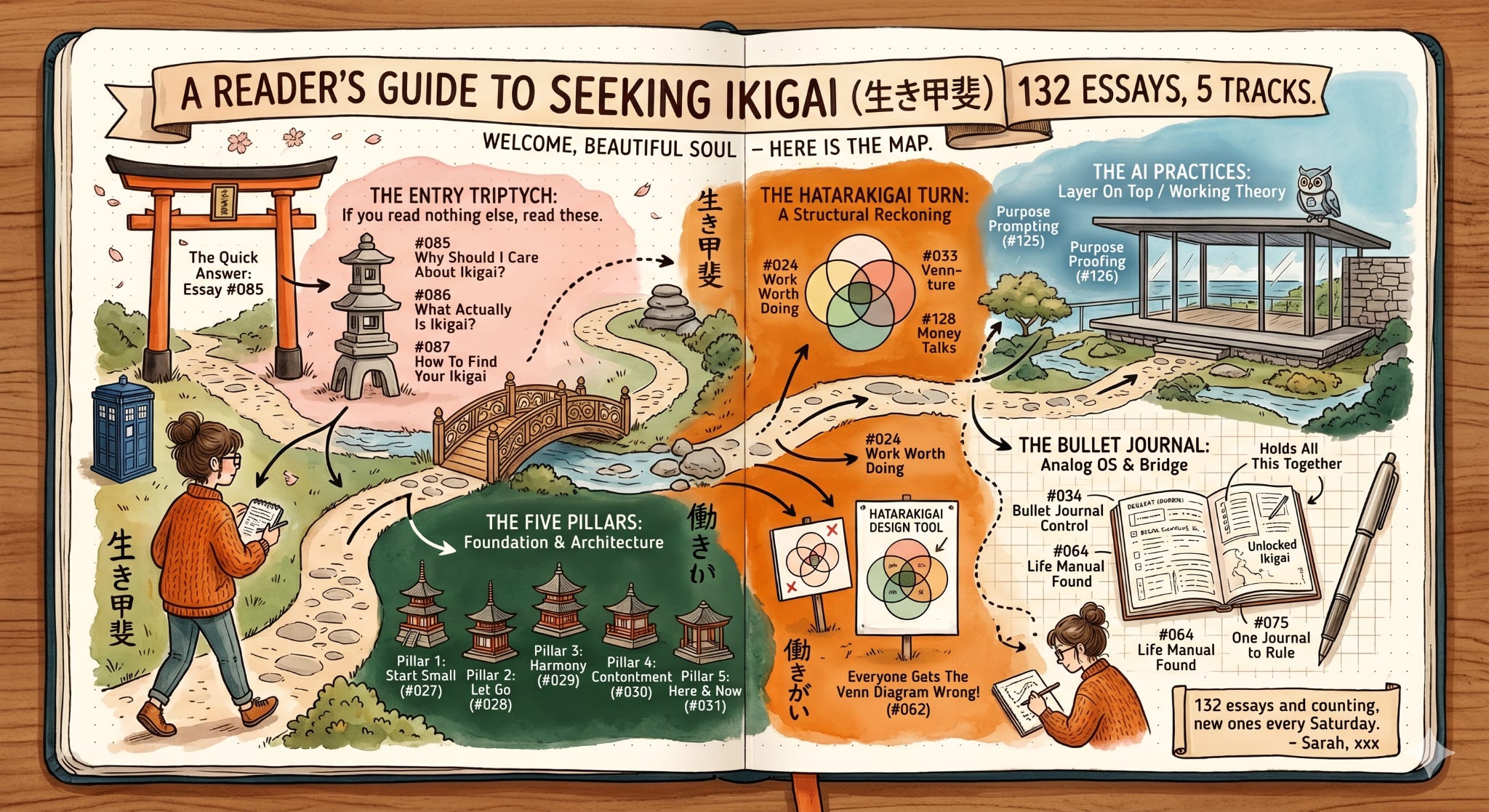
How the tracks fit together
Tracks 1 and 2 are the foundation. Track 3 is the structural reckoning. Track 4 is the personal operating system. Track 5 is the working theory building on top of all of them. Read in whatever order calls to you.
If you’ve read an essay that changed something for you and it isn’t on this list, tell me. If one of these essays from the list didn’t make sense to you, tell me about that too! My exploration, my writing and this guide gets better the more honest feedback I am given.
If the tracks land, the full archive is waiting. 132 essays and still counting, new ones arrive every Saturday.
Subscribe and the next one will find you.
Tell me, what brings you to this corner of the internet today, and what are you seeking? What’s one essay or book or song that changed something for you, that you’d hand me if we were swapping reader’s guides?
Sarah, seeking ikigai xxx
PS - Bullet journal spread to try. Open to a fresh double-page spread and make your own reader’s guide. Not of this publication... of you. Five tracks of your life so far. Three to five essays (conversations, books, memories, moments) per track. The ones that did the structural work. The ones you’d hand to someone who wanted to understand you. It’s the most revealing bullet journal exercise I know.
PPS - Share this guide with your AI of choice and ask it this: “Based on what you already know about me, which of Sarah’s five tracks and/or individual essays should I start with, and why?” Then read whichever track it picks first. Then journal about whether it got you right. Purpose Prompting in action, with this Guide as the reflective surface.
PPPS - Our soundtrack is “Hallelujah” the Jeff Buckley version (though I nearly went KD Lang). I wanted something epic to convey how it feels to have written 132 essays, something that expresses love for the beauty and complexity of life, but also a song that isn’t perfect or finished either. I believe that Leonard Cohen wrote hundreds of versions. “I’ve heard there was a secret chord” is such a poignant message for someone who has started looking for their ikigai… you’ve heard it exists, you’re not sure yet what it sounds like, but you’re moving toward it anyway. I’m here still singing about the same word from 132 (and counting) different verses…. Hallelujah ikigai